India Smart Manufacturing Systems Market Size & Growth Rate
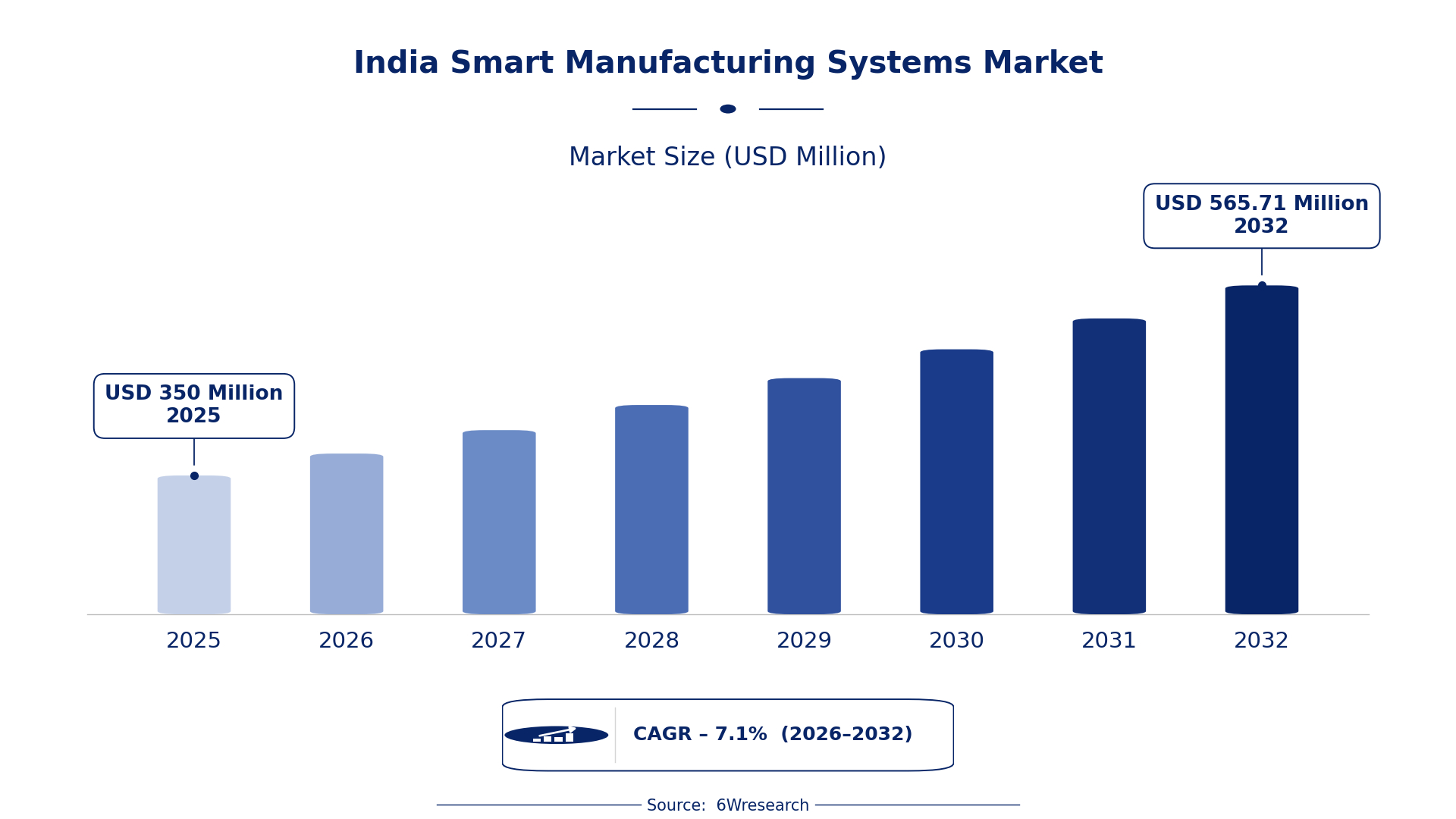
According to 6Wresearch internal database and industry insights, the India Smart Manufacturing Systems Market was valued at USD 350.0 million in 2025 and is projected to reach USD 565.71 million by 2032, growing at a CAGR of approximately 7.1% during 2026–2032.
India Smart Manufacturing Systems Market Highlights
| Report Metric | Details |
| Report Name | India Smart Manufacturing Systems Market |
| Market Size 2025 | USD 350.0 million |
| Market Size 2032 | USD 565.71 million |
| Absolute Growth 2025–2032 | USD 215.71 million |
| CAGR 2026–2032 | 7.1% |
| Peak Annual Growth | 8.8% in 2029 |
| Forecast Period | 2026–2032 |
| Historical Data | 2022–2025 |
| Base Year | 2025 |
| Leading System Type, 2025 | Smart Assembly Systems (54% share) |
| Leading Smart Feature, 2025 | Quality Feedback Loops (52% share) |
| Leading Automation Layer, 2025 | PLC + AI Layer (47% share) |
| Leading End User, 2025 | Electronics Manufacturers (49% share) |
| Fastest-Growing System Type | Integrated Robotic Cells (9.0% CAGR) |
| Fastest-Growing Smart Feature | Multi-Robot Coordination (8.9% CAGR) |
| Fastest-Growing Automation Layer | Industrial IoT (9.1% CAGR) |
| Growing Sector | Electronics Manufacturers |
| Key End Users | Electronics Manufacturers, Oil & Gas Refineries, Aerospace Components, Industrial SMEs |
India Smart Manufacturing Systems Market Year-wise Growth Rate and Key Drivers (2022–2032)
This graph illustrates the annual growth rates of the market from 2022 to 2032, highlighting a steady upward trajectory and projected market expansion over the forecast period.
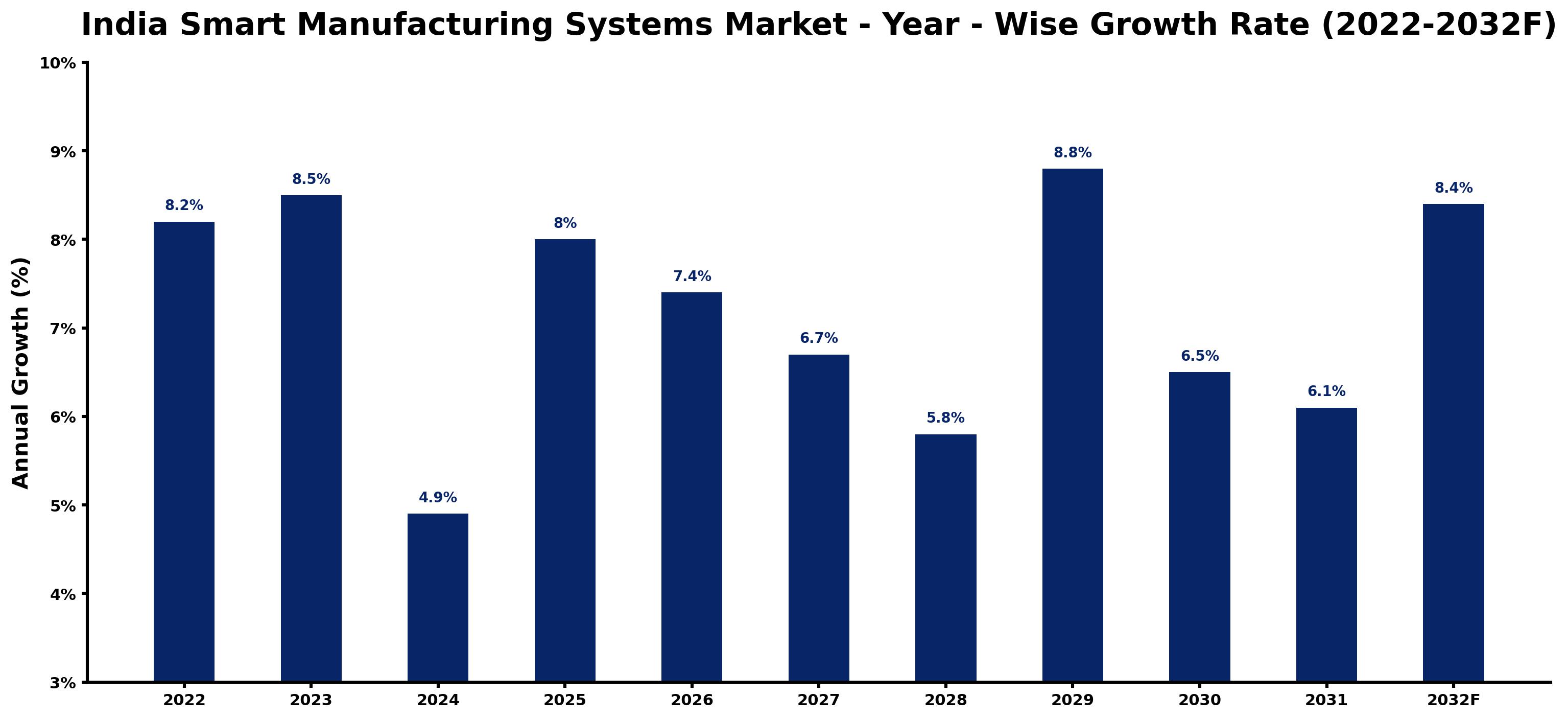
The table below sets out the estimated growth rate for each year and the main factor behind it.
| Year | Estimated Annual Growth (%) | Market Rationale |
| 2022 | 8.2 | The market experienced solid growth due to increased domestic production in electronics. |
| 2023 | 8.5 | Demand surged as manufacturers adopted advanced technologies to improve efficiency. |
| 2024 | 4.9 | Growth slowed as some sectors faced temporary production challenges. |
| 2025 | 8.0 | The market rebounded with renewed investments in smart manufacturing solutions. |
| 2026 | 7.4 | Adoption rates decreased slightly as companies adjusted to new technologies. |
| 2027 | 6.7 | Growth continued but at a slower pace as market maturity set in. |
| 2028 | 5.8 | The market experienced a further slowdown as competition intensified. |
| 2029 | 8.8 | A surge in demand occurred as manufacturers sought to modernise operations. |
| 2030 | 6.5 | Growth slowed again as companies focused on consolidating gains. |
| 2031 | 6.1 | The market continued to grow, albeit at a reduced rate due to the Make in India initiative. |
| 2032 | 8.4 | Demand increased as manufacturers aimed for higher efficiency and productivity. |
Note: Market size estimations and growth projections presented in this report are based on 6Wresearch's proprietary forecasting methodology, utilizing the latest available industry data, government publications, and primary research inputs.
India Smart Manufacturing Systems Market Synopsis
The India Smart Manufacturing Systems Market encompasses advanced technologies that integrate automation and data exchange in manufacturing processes. These systems utilise IoT, AI, and robotics to optimise production lines and improve quality control. The market is expanding as domestic production and exports in the electronics and automotive sectors drive demand. Initiatives like the Production Linked Incentive Scheme and the Make in India initiative are further boosting market growth.
Market Dynamics Impact Analysis (2026–2032)
| Factor | Type | Impact | Primary Segment Affected |
| Increased domestic production in electronics and automotive sectors | Driver | High | Smart Assembly Systems |
| Government incentives promoting advanced manufacturing technologies | Driver | High | SCADA-Driven Systems |
| Growing demand for automation in manufacturing processes | Opportunity | High | Integrated Robotic Cells |
| Rising investments in Industry 4.0 technologies | Opportunity | High | Cloud-Connected Systems |
| High initial investment costs for smart manufacturing systems | Restraint | High | Smart Assembly Systems |
| Limited skilled workforce in advanced manufacturing technologies | Restraint | Medium | SCADA-Driven Systems |
| The Smart Manufacturing Systems market in India faces challenges in technology integration | Challenge | High | Integrated Robotic Cells |
| Competition from low-cost manufacturing countries poses a threat | Challenge | Medium | Cloud-Connected Systems |
Evaluation of Drivers in India Smart Manufacturing Systems Market (2026–2032)
Below mentioned are some major drivers and their influence on market dynamics.
| Drivers | Primary Segment Affected | Why It Matters (Evidence) |
| Rising domestic production in electronics | Smart Assembly Systems | This trend increases demand for efficient assembly processes, with the electronics sector projected to grow by 10% in 2025. |
| Government incentives for advanced manufacturing | SCADA-Driven Systems | The Production Linked Incentive Scheme encourages manufacturers to adopt smart technologies, boosting demand for real-time monitoring systems. |
| Increased focus on automation | Integrated Robotic Cells | The automotive sector's rapid adoption of automation drives demand for robotic solutions in manufacturing. |
| Growing interest in Industry 4.0 | Cloud-Connected Systems | As manufacturers seek to improve connectivity, cloud solutions are increasingly sought after for data sharing. |
| Investment in workforce training | Quality Feedback Loops | The Electronics Sector Skill Council of India's training initiatives improve capabilities in smart manufacturing technologies. |
In 2021, the Production Linked Incentive Scheme allocated INR 10,000 crores to boost manufacturing, leading to higher investments in smart technologies. The automotive sector is rapidly adopting integrated robotic cells, which improves productivity on assembly lines. By 2032, the market will reach USD 565.71 million, reflecting strong growth in demand for smart manufacturing solutions.
Evaluation of Restraints in India Smart Manufacturing Systems Market
The key brakes on demand, and where they bite hardest, are shown below.
| Market Restraint | Primary Segment Affected | Why It Matters (Evidence) |
| High initial investment costs for implementing smart systems | Smart Assembly Systems | These costs deter small and medium enterprises from adopting advanced technologies, limiting market growth. |
| Limited availability of skilled workforce | SCADA-Driven Systems | A shortage of trained professionals hampers the effective implementation of smart manufacturing technologies. |
| Integration challenges with existing systems | Integrated Robotic Cells | Difficulties in integrating new technologies with legacy systems slow down adoption rates. |
| Competition from low-cost manufacturing countries | Cloud-Connected Systems | Countries with lower production costs pose a threat to India's smart manufacturing initiatives. |
| Regulatory hurdles in technology adoption | Quality Feedback Loops | Complex compliance requirements can delay the implementation of smart manufacturing solutions. |
India Smart Manufacturing Systems Market Challenges
Buyers in the India Smart Manufacturing Systems market face rising costs due to fluctuating raw material prices, which can inflate production expenses by up to 15%. Many manufacturers encounter challenges with technology integration, as outdated systems hinder efficiency improvements and reduce their competitiveness. Supply chain disruptions, exacerbated by global events, lead to longer lead times for critical components, forcing manufacturers to extend production schedules by weeks. A shortage of skilled personnel in smart manufacturing technologies limits operational effectiveness, with a reported gap of 30% in qualified workers, which restricts growth potential for producers in this sector.
Trends in the India Smart Manufacturing Systems Market
The trends below show where the India Smart Manufacturing Systems Market is heading.
- Shift towards Automation in Manufacturing: The automotive sector in India has increasingly embraced automation technologies since 2021, concentrating on integrated robotic cells to boost production efficiency. This shift is anticipated to drive sector growth by enhancing operational capabilities.
- Rise of Cloud-Connected Systems: The trend towards cloud-connected systems in manufacturing has gained traction in India since 2022, driven by the need for real-time data access. This transition is expected to improve operational efficiency across various sectors.
- Increased Focus on Workforce Training: Since 2020, the Electronics Sector Skill Council of India has prioritised training in smart manufacturing technologies, resulting in a more skilled workforce. This initiative is crucial for meeting the growing demand for advanced manufacturing solutions.
- Adoption of Industry 4.0 Standards: The implementation of Industry 4.0 standards has accelerated in India since 2021, particularly within electronics manufacturing. This shift is poised to drive the adoption of smart manufacturing systems, with substantial investments being made.
Investment Opportunities in the India Smart Manufacturing Systems Market
Some of the investment opportunities in the India Smart Manufacturing Systems Market are mentioned below.
- Investment in Smart Assembly Systems: The automotive sector in India is increasingly adopting smart assembly systems, with a projected market size of USD 350 million by 2025. Forming local partnerships can assist suppliers in entering this expanding market.
- Expansion of SCADA-Driven Systems: With the rise of automation, there is a notable opportunity for SCADA-driven systems in manufacturing. The electronics manufacturing sector represents a key buyer group, offering a promising entry point for suppliers.
- Growth in Integrated Robotic Cells: The demand for integrated robotic cells is increasing, particularly in the automotive sector. Suppliers can penetrate this market by establishing joint ventures with local manufacturers to enhance production capabilities.
- Cloud-Connected Systems for Enhanced Data Sharing: The need for cloud-connected systems is growing as manufacturers pursue improved data sharing capabilities. Targeting electronics manufacturers can present a solid opportunity for investment in this area.
Government Initiatives in the India Smart Manufacturing Systems Market
The National Policy on Electronics 2019 aims to boost domestic production and attract investments in smart manufacturing technologies, implemented by the Ministry of Electronics and Information Technology. This policy encourages local production and innovation, impacting the adoption of smart manufacturing systems. The Production Linked Incentive Scheme, launched in 2021 by the Ministry of Heavy Industries, incentivises manufacturers to increase production and adopt advanced technologies. This initiative is vital for driving growth in the smart manufacturing sector. Additionally, the National Mission on Advanced Manufacturing, established in 2021, focuses on promoting research and development in smart manufacturing systems with a budget of INR 10,000 crores.
The Ministry of Electronics and Information Technology oversees the implementation of the National Policy on Electronics, approving projects that align with its objectives. The Electronics Sector Skill Council of India plays a key role in training professionals in smart manufacturing technologies, improving workforce capabilities. The government has allocated substantial funding for skill development initiatives, ensuring that the workforce is equipped to meet the demands of advanced manufacturing. Furthermore, the Ministry of Heavy Industries supports the Production Linked Incentive Scheme, which funds projects aimed at increasing production capacity and adopting smart technologies.
Future Insight of the India Smart Manufacturing Systems Market
The India Smart Manufacturing Systems market will undergo a notable transformation by 2032, driven by the National Policy on Electronics aiming to establish India as a global hub for electronics manufacturing. Training initiatives from the Electronics Sector Skill Council will help bridge the skills gap, resulting in a more competent workforce. The growth of the Industrial IoT market will facilitate the integration of advanced technologies, improving operational efficiency. Government support, including substantial funding for advanced manufacturing initiatives, will stimulate innovation and strengthen the manufacturing sector.
Market Segmentation Analysis
Each segment group is reviewed below, with the leader by share and the fastest grower by CAGR.
By System Type – Smart Assembly Systems Dominated, Integrated Robotic Cells Expected to Grow Fastest
According to Dhaval Chaurasia, Assistant Manager at 6Wresearch, Smart Assembly Systems held a 54% share of the India Smart Manufacturing Systems Market by system type in 2025. Smart Assembly Systems hold the largest market share due to their critical role in optimising assembly processes, particularly within the automotive industry. Their extensive deployment in manufacturing facilities across India illustrates the increasing demand for efficient production lines. The quickest growth will come from Integrated Robotic Cells, forecast to expand at a CAGR of 9.0% between 2026 and 2032. Integrated Robotic Cells are rapidly gaining traction as manufacturers pursue automation solutions, particularly in assembly lines. This growth is propelled by the need for enhanced productivity and precision in manufacturing operations, which will further solidify the dominance of Smart Assembly Systems. Suppliers should focus on advancing Integrated Robotic Cells to address the rising demand for automation in manufacturing.
By Smart Feature – Quality Feedback Loops Dominated, Multi-Robot Coordination Expected to Grow Fastest
The largest smart feature category in 2025 was Quality Feedback Loops, with a 52% share of total revenue. Quality Feedback Loops capture a significant market share as they are essential for ensuring high standards of quality assurance in manufacturing processes. Their widespread application across various sectors guarantees consistent product quality and customer satisfaction, making them indispensable for manufacturers. Multi-Robot Coordination is projected to grow fastest, at a CAGR of 8.9% during 2026–2032. Multi-Robot Coordination is experiencing swift growth as manufacturers seek to optimise complex tasks through improved collaboration among robots, particularly in high-volume production settings. This trend highlights the increasing complexity of manufacturing operations that require coordinated efforts. Buyers should invest in Multi-Robot Coordination technologies to maintain competitiveness in an advancing manufacturing environment.
By Automation Layer – PLC + AI Layer Dominated, Industrial IoT Expected to Grow Fastest
In 2025, PLC + AI Layer led the automation layer split with a 47% share. This integration is vital for real-time decision-making and operational efficiency across various manufacturing sectors. Industrial IoT is set to record the highest CAGR in this split, 9.1% over 2026–2032. Industrial IoT is witnessing significant growth as manufacturers embrace connected devices to gather data and improve operational insights. This trend signals a broader transition towards smart manufacturing practices across industries, reinforcing the importance of the PLC + AI Layer. Suppliers must prioritise developing Industrial IoT solutions to meet the increasing demand for interconnected manufacturing systems.
By End User – Electronics Manufacturers Dominated and Is Expected to Record the Fastest Growth
Electronics Manufacturers took a 49% share of end user in 2025, more than any other category. Electronics Manufacturers dominate the market share as they are major users of smart manufacturing systems, driven by the need for efficiency and quality in production. The robust growth of this sector in India further cements their leading position in the market. Its lead should widen, with a projected CAGR of 9.8% during 2026–2032, the highest in this split. Electronics Manufacturers are also the fastest-growing end users, as they increasingly adopt smart technologies to boost competitiveness and streamline operations. This dual role as both leader and fastest signifies a strong commitment to modernising manufacturing processes. Suppliers should tailor their offerings to meet the specific needs of Electronics Manufacturers, ensuring they remain at the forefront of smart manufacturing advancements.
Key Attractiveness of the Report
- 10 Years of Market Numbers
- Historical Data Starting from 2022 to 2025
- Base Year 2025
- Forecast Data until 2032
- Key Performance Indicators Impacting the Market
- Major Upcoming Developments and Projects
Key Highlights of the Report:
- India Smart Manufacturing Systems Market Outlook
- Market Size of India Smart Manufacturing Systems Market, 2025
- Forecast of India Smart Manufacturing Systems Market, 2032
- Historical Data and Forecast of India Smart Manufacturing Systems Revenues & Volume for the Period 2022 - 2032F
- India Smart Manufacturing Systems Market Trend Evolution
- India Smart Manufacturing Systems Market Drivers and Challenges
- India Smart Manufacturing Systems Price Trends
- India Smart Manufacturing Systems Porter's Five Forces
- India Smart Manufacturing Systems Industry Life Cycle
- Historical Data and Forecast of India Smart Manufacturing Systems Market Revenues & Volume By System Type for the Period 2022 - 2032F
- Historical Data and Forecast of India Smart Manufacturing Systems Market Revenues & Volume By Smart Assembly Systems for the Period 2022 - 2032F
- Historical Data and Forecast of India Smart Manufacturing Systems Market Revenues & Volume By SCADA-Driven Systems for the Period 2022 - 2032F
- Historical Data and Forecast of India Smart Manufacturing Systems Market Revenues & Volume By Integrated Robotic Cells for the Period 2022 - 2032F
- Historical Data and Forecast of India Smart Manufacturing Systems Market Revenues & Volume By Cloud-Connected Systems for the Period 2022 - 2032F
- Historical Data and Forecast of India Smart Manufacturing Systems Market Revenues & Volume By Smart Feature for the Period 2022 - 2032F
- Historical Data and Forecast of India Smart Manufacturing Systems Market Revenues & Volume By Quality Feedback Loops for the Period 2022 - 2032F
- Historical Data and Forecast of India Smart Manufacturing Systems Market Revenues & Volume By Remote Control for the Period 2022 - 2032F
- Historical Data and Forecast of India Smart Manufacturing Systems Market Revenues & Volume By Multi-Robot Coordination for the Period 2022 - 2032F
- Historical Data and Forecast of India Smart Manufacturing Systems Market Revenues & Volume By Performance Monitoring for the Period 2022 - 2032F
- Historical Data and Forecast of India Smart Manufacturing Systems Market Revenues & Volume By Automation Layer for the Period 2022 - 2032F
- Historical Data and Forecast of India Smart Manufacturing Systems Market Revenues & Volume By PLC + AI Layer for the Period 2022 - 2032F
- Historical Data and Forecast of India Smart Manufacturing Systems Market Revenues & Volume By Industrial IoT for the Period 2022 - 2032F
- Historical Data and Forecast of India Smart Manufacturing Systems Market Revenues & Volume By Vision + Control AI for the Period 2022 - 2032F
- Historical Data and Forecast of India Smart Manufacturing Systems Market Revenues & Volume By Edge to Cloud for the Period 2022 - 2032F
- Historical Data and Forecast of India Smart Manufacturing Systems Market Revenues & Volume By End User for the Period 2022 - 2032F
- Historical Data and Forecast of India Smart Manufacturing Systems Market Revenues & Volume By Electronics Manufacturers for the Period 2022 - 2032F
- Historical Data and Forecast of India Smart Manufacturing Systems Market Revenues & Volume By Oil & Gas Refineries for the Period 2022 - 2032F
- Historical Data and Forecast of India Smart Manufacturing Systems Market Revenues & Volume By Aerospace Components for the Period 2022 - 2032F
- Historical Data and Forecast of India Smart Manufacturing Systems Market Revenues & Volume By Industrial SMEs for the Period 2022 - 2032F
- India Smart Manufacturing Systems Import Export Trade Statistics
- Market Opportunity Assessment By System Type
- Market Opportunity Assessment By Smart Feature
- Market Opportunity Assessment By Automation Layer
- Market Opportunity Assessment By End User
- India Smart Manufacturing Systems Top Companies Market Share
- India Smart Manufacturing Systems Competitive Benchmarking By Technical and Operational Parameters
- India Smart Manufacturing Systems Company Profiles
- India Smart Manufacturing Systems Key Strategic Recommendations
Market Covered
The report offers an extensive study of the following market segments.
By System Type
- Smart Assembly Systems
- SCADA-Driven Systems
- Integrated Robotic Cells
- Cloud-Connected Systems
By Smart Feature
- Quality Feedback Loops
- Remote Control
- Multi-Robot Coordination
- Performance Monitoring
By Automation Layer
- PLC + AI Layer
- Industrial IoT
- Vision + Control AI
- Edge to Cloud
By End User
- Electronics Manufacturers
- Oil & Gas Refineries
- Aerospace Components
- Industrial SMEs































