India Smart Retail Technology Market Size & Growth Rate
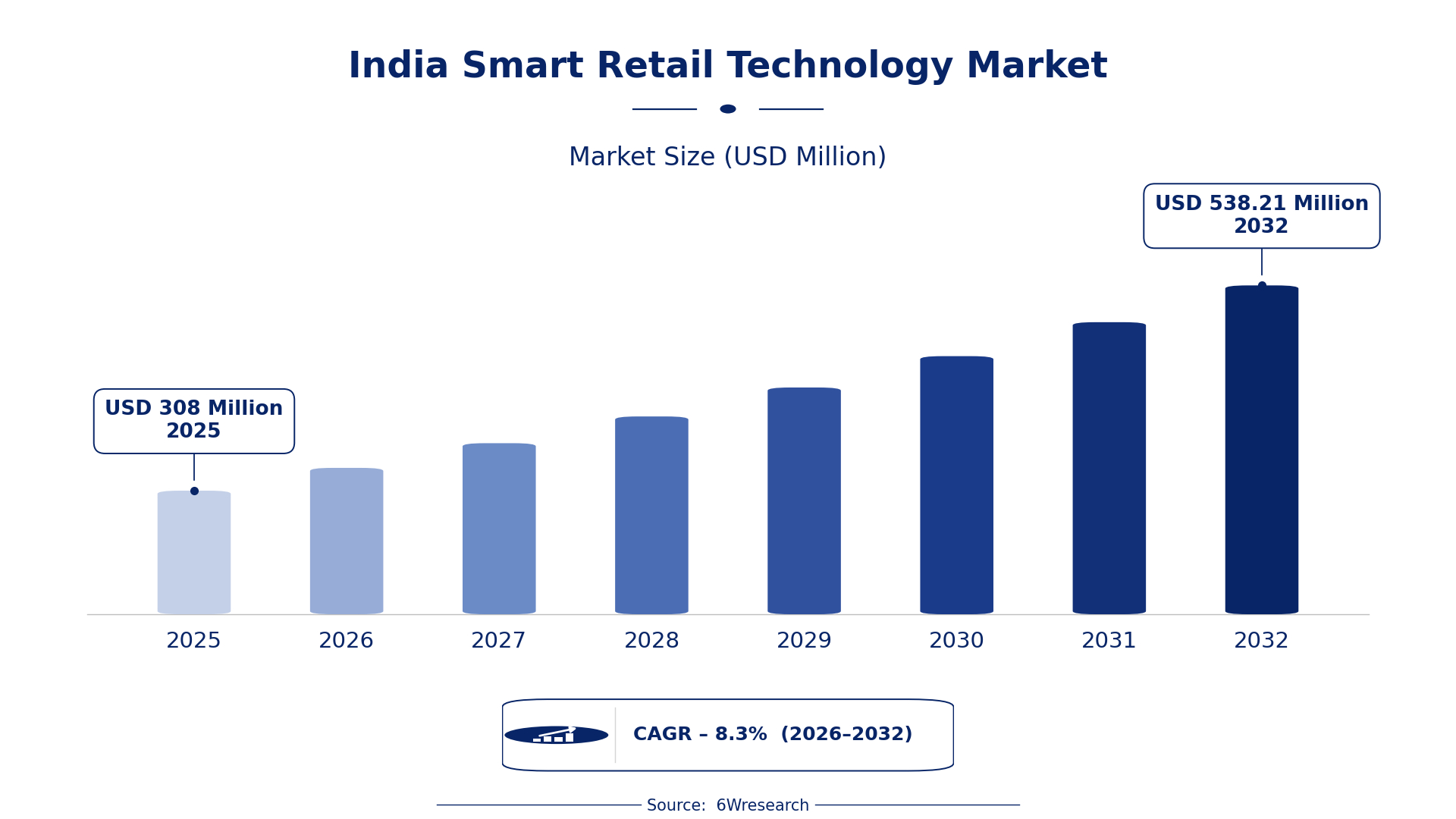
According to 6Wresearch internal database and industry insights, the India Smart Retail Technology Market was valued at USD 308.0 million in 2025 and is projected to reach USD 538.21 million by 2032, growing at a CAGR of approximately 8.3% during 2026–2032.
India Smart Retail Technology Market Highlights
| Report Metric | Details |
| Report Name | India Smart Retail Technology Market |
| Market Size 2025 | USD 308.0 million |
| Market Size 2032 | USD 538.21 million |
| Absolute Growth 2025–2032 | USD 230.21 million |
| CAGR 2026–2032 | 8.3% |
| Peak Annual Growth | 10.2% in 2026 |
| Forecast Period | 2026–2032 |
| Historical Data | 2022–2025 |
| Base Year | 2025 |
| Leading Technology Type, 2025 | Smart POS Systems (40% share) |
| Leading Smart Feature, 2025 | Contactless Payments (46% share) |
| Leading Hardware Interface, 2025 | NFC + QR Code Readers (41% share) |
| Leading End User, 2025 | Quick Service Stores (51% share) |
| Fastest-Growing Technology Type | AI Recommendation Tools (11.0% CAGR) |
| Fastest-Growing Smart Feature | Personalized Offers (10.5% CAGR) |
| Fastest-Growing Hardware Interface | RFID + AI Analytics (10.1% CAGR) |
| Fastest-Growing End User | Online Retailers (9.4% CAGR) |
| Growing Sector | Online Retailers |
| Key End Users | Quick Service Stores, Online Retailers, Airports/Malls, Retail Warehouses |
India Smart Retail Technology Market Year-wise Growth Rate and Key Drivers (2022–2032)
This graph illustrates the annual growth rates of the market from 2022 to 2032, highlighting a steady upward trajectory and projected market expansion over the forecast period.
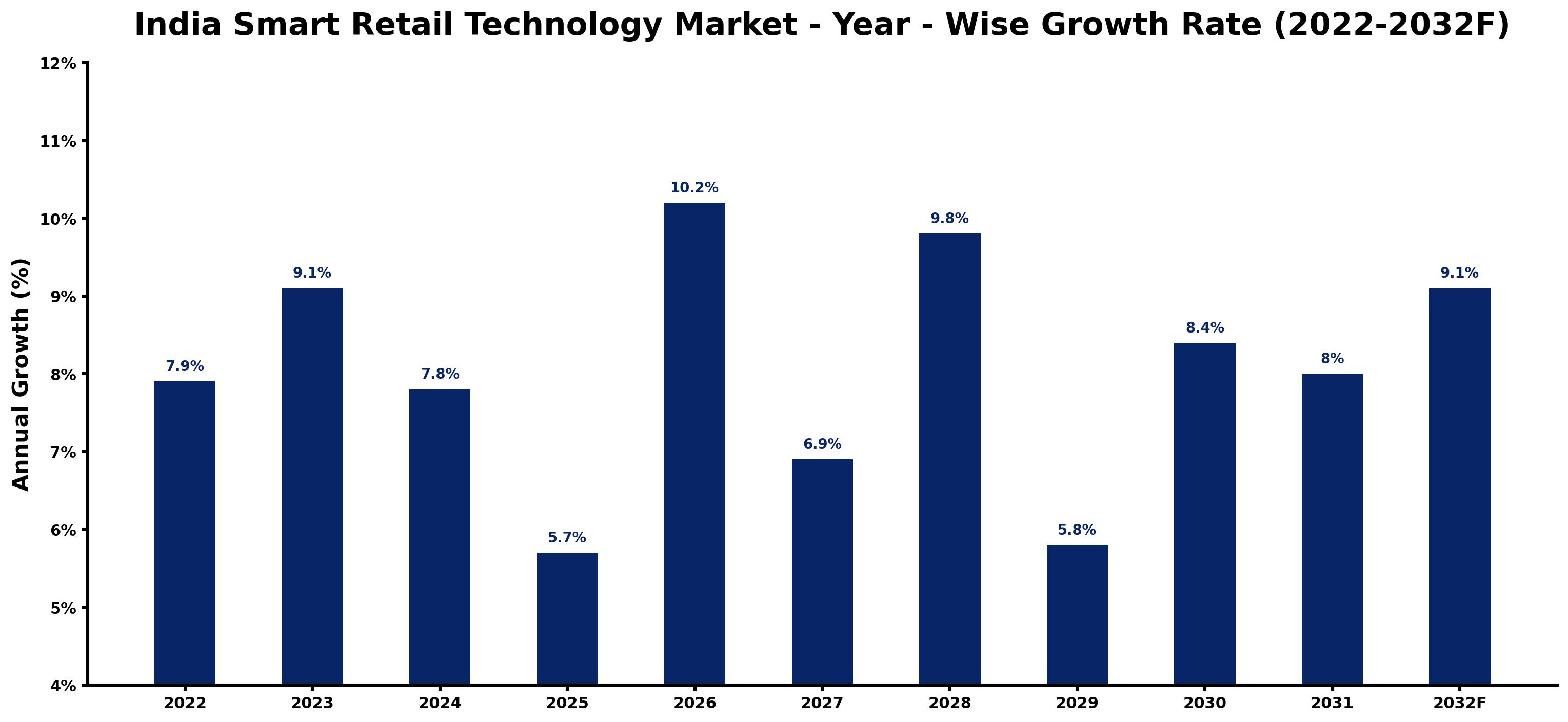
Year by year, the estimates below pair each growth rate with the development that shaped it.
| Year | Estimated Annual Growth (%) | Market Rationale |
| 2022 | 7.9 | Digital transactions surged, reflecting changing consumer preferences in urban retail environments. |
| 2023 | 9.1 | The adoption of smart technologies accelerated, driven by urbanisation and increased digital payment options. |
| 2024 | 7.8 | Growth slowed due to the National Retail Policy's initial implementation phase and limited market access for smaller retailers. |
| 2025 | 5.7 | Demand continued to slow as market saturation began to affect new technology adoption rates. |
| 2026 | 10.2 | Investment in smart retail technology surged as urban areas embraced digital solutions for operational efficiency. |
| 2027 | 6.9 | A slowdown occurred as the market adjusted to previous rapid growth and technology integration. |
| 2028 | 9.8 | The market rebounded with renewed interest in AI-driven tools and customer engagement strategies. |
| 2029 | 5.8 | Growth slowed again as businesses focused on optimising existing technology investments. |
| 2030 | 8.4 | Demand increased as retailers sought to improve operational efficiency through advanced analytics and smart solutions. |
| 2031 | 8.0 | The market experienced a slight slowdown as competition intensified among technology providers. |
| 2032 | 9.1 | Growth accelerated again as urban areas pushed for smarter retail solutions to meet consumer expectations. |
Note: Market size estimations and growth projections presented in this report are based on 6Wresearch's proprietary forecasting methodology, utilizing the latest available industry data, government publications, and primary research inputs.
India Smart Retail Technology Market Synopsis
Smart Retail Technology in India encompasses advanced solutions such as Smart POS, AI-driven tools, and RFID technology, all aimed at refining retail operations. These technologies streamline inventory management and elevate customer experience. The India Smart Retail Technology Market is growing due to the increasing shift towards digital transactions, with over 60% of retail transactions in urban areas now conducted digitally. Demand is particularly strong from Quick Service Stores and urban retailers, who are adopting these technologies to optimise sales processes and boost operational efficiency.
Market Dynamics Impact Analysis (2026–2032)
| Factor | Type | Impact | Primary Segment Affected |
| Rising adoption of digital payment solutions is increasing the demand for contactless transactions. | Driver | High | Contactless Payments |
| The growing need for efficient inventory management is driving the adoption of Smart RFID technology. | Driver | High | Smart RFID Readers |
| Investment in smart retail technology is expected to exceed $5 billion by 2025, creating opportunities for suppliers. | Opportunity | High | Smart POS Systems |
| The Smart Cities Mission promotes technology adoption in urban retail environments, opening new avenues for growth. | Opportunity | Medium | AI Recommendation Tools |
| Implementation of smart retail technologies is hampered by high initial investment costs for retailers. | Restraint | High | Smart POS Systems |
| Limited awareness of smart retail solutions among smaller retailers restricts market growth. | Restraint | Medium | AI Recommendation Tools |
| Supply chain disruptions can delay the rollout of smart retail technologies, affecting retailers' operations. | Challenge | High | Smart RFID Readers |
| Regulatory hurdles in technology adoption can slow down the implementation process for retailers. | Challenge | Medium | Contactless Payments |
Evaluation of Drivers in India Smart Retail Technology Market (2026–2032)
The main growth drivers and the segments they affect most are set out below.
| Drivers | Primary Segment Affected | Why It Matters (Evidence) |
| Increased digital transactions drive demand for Smart POS systems, with a 40% rise in adoption over two years. | Smart POS Systems | This growth reflects the shift towards cashless payments in urban retail environments. |
| The need for personalised shopping experiences drives the adoption of AI Recommendation Tools, used by 30% of online retailers. | AI Recommendation Tools | These tools improve customer engagement and boost sales through tailored suggestions. |
| The rise in contactless payment preferences leads to higher demand for NFC + QR Code Readers, which accounted for 41% of hardware interfaces. | NFC + QR Code Readers | This technology facilitates quick and safe transactions, appealing to modern consumers. |
| The increasing focus on inventory management efficiency boosts the use of Smart RFID Readers, implemented in 15% of retail outlets. | Smart RFID Readers | These systems help prevent theft and streamline stock management processes. |
| The growing trend of urbanisation supports the expansion of smart retail technologies in Quick Service Stores, which have adopted smart tech at over 80%. | Quick Service Stores | These stores utilise technology to improve customer service and operational efficiency. |
The Smart Retail Technology market in India is expanding due to a surge in digital transactions, a growing need for efficient inventory management, and the embrace of AI-driven tools. With over 60% of retail transactions in urban areas now digital, retailers are compelled to invest in Smart POS systems. The uptake of Smart RFID technology has reached 15% in metropolitan retail outlets, enhancing inventory control and reducing theft. Urbanisation is prompting Quick Service Stores to adopt smart technologies, with more than 80% utilising these solutions to improve operational efficiency. The demand for AI Recommendation Tools is also increasing, as they are now employed by 30% of online retailers, boosting customer engagement through personalised suggestions.
Evaluation of Restraints in India Smart Retail Technology Market
The main factors holding the market back are set out below.
| Market Restraint | Primary Segment Affected | Why It Matters (Evidence) |
| High initial investment costs hinder the widespread adoption of Smart POS systems, limiting access for smaller retailers. | Smart POS Systems | Many smaller retailers struggle to afford the upfront costs associated with implementing advanced technologies. |
| Limited awareness among smaller retailers restricts the adoption of AI Recommendation Tools, affecting overall market growth. | AI Recommendation Tools | Without proper knowledge of benefits, many retailers are hesitant to invest in these technologies. |
| Supply chain disruptions can delay the deployment of Smart RFID Readers, impacting inventory management for retailers. | Smart RFID Readers | Manufacturers face challenges in sourcing components, which can slow down technology rollout. |
| Regulatory hurdles can complicate the implementation of Contactless Payments, delaying adoption among retailers. | Contactless Payments | Compliance with various standards can create barriers for retailers looking to adopt new payment methods. |
| Market saturation in urban areas may slow growth for Smart Retail Technologies as competition intensifies. | NFC + QR Code Readers | As more retailers adopt similar technologies, differentiation becomes challenging. |
India Smart Retail Technology Market Challenges
The implementation of Smart Retail Technology in India faces regulatory hurdles, as the Bureau of Indian Standards has established guidelines that can delay technology approvals by up to six months, hindering suppliers' ability to meet market demands. Buyers confront high initial costs for upgrading systems, with many retail outlets needing investments exceeding $100,000, making competition challenging for smaller businesses. A skills gap persists, with only 30% of retail staff trained in advanced technologies, leading to inefficiencies that affect customer service. Technology adoption is uneven, with just 15% of retail outlets using Smart RFID, limiting effective inventory management across the sector.
Trends in the India Smart Retail Technology Market
The trends below show where the India Smart Retail Technology Market is heading.
- Shift Towards Digital Payment Solutions: Quick Service Stores are increasingly adopting digital payment systems, with contactless payments accounting for 25% of total transactions in 2022. This trend reflects consumer preferences for convenience and safety.
- Growth of AI in Retail: Urban retailers are integrating AI Recommendation Tools to improve customer experience, with a 30% adoption rate among online retailers in India. This shift is transforming how retailers engage with consumers.
- Rise of Smart Vending Machines: Smart vending machines are gaining traction in urban areas, with a 20% increase in installations. These machines are becoming popular for their convenience and advanced features.
- Expansion of Smart RFID Technology: The implementation of Smart RFID technology is growing, with 15% of retail outlets in metropolitan areas adopting these systems. This trend is essential for improving inventory management and loss prevention.
Investment Opportunities in the India Smart Retail Technology Market
Several openings in the India Smart Retail Technology Market merit attention from investors.
- Timing for Smart Retail Investment: With an anticipated investment exceeding $5 billion by 2025, the Smart Retail Technology market offers promising opportunities. Quick Service Stores are prime candidates for investment, as they increasingly adopt smart technologies to boost efficiency.
- Supply of Smart POS Systems: The demand for Smart POS systems is escalating, with a 40% rise in adoption. Retailers in urban areas are seeking reliable suppliers to fulfil their needs for advanced transaction solutions.
- Gap in AI Recommendation Tools: The 30% adoption rate of AI Recommendation Tools highlights a substantial gap in the market. Retailers aiming to enhance customer engagement are prime candidates for advanced solutions.
- Urban Retail Facilities: Urban retail facilities are rapidly embracing smart technologies, with over 80% of Quick Service Stores utilising these solutions. Suppliers can penetrate this market through partnerships with local retailers.
Government Initiatives in the India Smart Retail Technology Market
The National Retail Policy, launched by the Ministry of Commerce in 2021, aims to streamline regulations and promote growth in the retail sector. This policy is designed to boost the sector's contribution to GDP by 2025, encouraging investment in smart technologies. The Digital India initiative, led by the Ministry of Electronics and Information Technology since 2020, promotes the adoption of smart solutions in retail. The Smart Cities Mission, initiated by the Ministry of Housing and Urban Affairs in 2020, supports the integration of technology in urban retail environments. The Bureau of Indian Standards introduced guidelines for smart retail technologies in 2021, ensuring quality and safety standards.
The Digital India initiative provides resources and support for implementing smart technologies in retail. The Ministry of Electronics and Information Technology oversees this initiative, facilitating the adoption of advanced solutions. The Smart Cities Mission encourages urban retailers to embrace smart technologies, improving operational efficiency. The Ministry of Commerce's 'Atmanirbhar Bharat' initiative supports local manufacturing of smart retail technologies, creating a sustainable supply chain. These measures aim to establish a more efficient and competitive retail environment.
Future Insight of the India Smart Retail Technology Market
Several forward-looking factors should support the Smart Retail Technology market in India over the coming years. The National Retail Policy aims to increase the sector's GDP contribution by 2025, driving investment in advanced solutions. Investment in smart retail technology is projected to exceed $5 billion by 2025, reflecting strong market confidence. The Smart Cities Mission will promote technology integration in urban retail, while the Digital India initiative will encourage wider adoption of advanced solutions. These developments will create new opportunities for buyers and suppliers, improving operational efficiency and customer engagement.
Market Segmentation Analysis
The analysis below covers each segmentation, its leading category in 2025 and its fastest-growing category through 2032.
By Technology Type – Smart POS Systems Dominated, AI Recommendation Tools Expected to Grow Fastest
According to Dhaval Chaurasia, Assistant Manager at 6Wresearch, with a 40% revenue share in 2025, Smart POS Systems was the largest technology type category. Smart POS systems dominate the market due to their essential role in facilitating digital transactions and tracking sales in retail settings. With over 60% of retail transactions in urban areas now digital, these systems are vital for the modern retail landscape. AI Recommendation Tools are projected to grow fastest, at a CAGR of 11.0% during 2026–2032. AI Recommendation Tools are rapidly gaining traction as they enhance customer experience by providing personalised shopping suggestions. Their adoption by 30% of online retailers signifies a strong trend towards tailored engagement strategies, likely expanding their market share further. This trend indicates that suppliers must focus on developing advanced solutions to cater to the increasing demand from retailers.
By Smart Feature – Contactless Payments Dominated, Personalized Offers Expected to Grow Fastest
The largest smart feature category in 2025 was Contactless Payments, with a 46% share of total revenue. Contactless payments dominate the market as they are increasingly preferred by consumers for their convenience and safety. With 25% of total transactions in 2022 being contactless, this method is becoming a standard in retail transactions. The quickest growth will come from Personalized Offers, forecast to expand at a CAGR of 10.5% between 2026 and 2032. Personalised offers are rapidly gaining traction as retailers strive to improve customer engagement and retention strategies. This approach is essential for standing out in a competitive retail environment, driving further adoption of such features. Suppliers need to invest in technologies that enable personalised marketing to capture the attention of discerning consumers.
By Hardware Interface – NFC + QR Code Readers Dominated, RFID + AI Analytics Expected to Grow Fastest
NFC + QR Code Readers took a 41% share of hardware interface in 2025, more than any other category. NFC and QR code readers capture the largest share as they are fundamental for enabling contactless transactions and promotional activities in retail environments. Their widespread application supports the growing shift towards digital payment solutions, making them essential for retailers. Over 2026–2032, RFID + AI Analytics is expected to post the fastest growth, at a CAGR of 10.1%. RFID combined with AI analytics is quickly gaining traction for its critical role in data-driven decision-making regarding inventory management. This integration is vital for retailers aiming to optimise their operations and improve efficiency. Suppliers should prioritise enhancing RFID and AI capabilities to address the rising demand for smart inventory solutions.
By End User – Quick Service Stores Dominated, Online Retailers Expected to Grow Fastest
In 2025, Quick Service Stores led the end user split with a 51% share. Quick Service Stores lead the market as they are the primary adopters of smart retail technologies, utilising them to boost operational efficiency. Their extensive use reflects the necessity for speed and convenience in service delivery, solidifying their position in the market. Online Retailers are set to record the highest CAGR in this split, 9.4% over 2026–2032. Online retailers are swiftly embracing smart technologies to improve user experience and streamline their operations. This trend underscores the increasing importance of digital engagement in the retail sector, suggesting a continued rise in their market share. Suppliers should tailor their offerings to meet the specific needs of online retailers as they enhance their technological infrastructure.
Key Attractiveness of the Report
- 10 Years of Market Numbers
- Historical Data Starting from 2022 to 2025
- Base Year 2025
- Forecast Data until 2032
- Key Performance Indicators Impacting the Market
- Major Upcoming Developments and Projects
Key Highlights of the Report:
- India Smart Retail Technology Market Outlook
- Market Size of India Smart Retail Technology Market, 2025
- Forecast of India Smart Retail Technology Market, 2032
- Historical Data and Forecast of India Smart Retail Technology Revenues & Volume for the Period 2022 - 2032F
- India Smart Retail Technology Market Trend Evolution
- India Smart Retail Technology Market Drivers and Challenges
- India Smart Retail Technology Price Trends
- India Smart Retail Technology Porter's Five Forces
- India Smart Retail Technology Industry Life Cycle
- Historical Data and Forecast of India Smart Retail Technology Market Revenues & Volume By Technology Type for the Period 2022 - 2032F
- Historical Data and Forecast of India Smart Retail Technology Market Revenues & Volume By Smart POS Systems for the Period 2022 - 2032F
- Historical Data and Forecast of India Smart Retail Technology Market Revenues & Volume By AI Recommendation Tools for the Period 2022 - 2032F
- Historical Data and Forecast of India Smart Retail Technology Market Revenues & Volume By Automated Vending for the Period 2022 - 2032F
- Historical Data and Forecast of India Smart Retail Technology Market Revenues & Volume By Smart RFID Readers for the Period 2022 - 2032F
- Historical Data and Forecast of India Smart Retail Technology Market Revenues & Volume By Smart Feature for the Period 2022 - 2032F
- Historical Data and Forecast of India Smart Retail Technology Market Revenues & Volume By Contactless Payments for the Period 2022 - 2032F
- Historical Data and Forecast of India Smart Retail Technology Market Revenues & Volume By Personalized Offers for the Period 2022 - 2032F
- Historical Data and Forecast of India Smart Retail Technology Market Revenues & Volume By Remote Stock Refill Alerts for the Period 2022 - 2032F
- Historical Data and Forecast of India Smart Retail Technology Market Revenues & Volume By Theft Prevention for the Period 2022 - 2032F
- Historical Data and Forecast of India Smart Retail Technology Market Revenues & Volume By Hardware Interface for the Period 2022 - 2032F
- Historical Data and Forecast of India Smart Retail Technology Market Revenues & Volume By NFC + QR Code Readers for the Period 2022 - 2032F
- Historical Data and Forecast of India Smart Retail Technology Market Revenues & Volume By CRM Integration for the Period 2022 - 2032F
- Historical Data and Forecast of India Smart Retail Technology Market Revenues & Volume By Sensor-Driven for the Period 2022 - 2032F
- Historical Data and Forecast of India Smart Retail Technology Market Revenues & Volume By RFID + AI Analytics for the Period 2022 - 2032F
- Historical Data and Forecast of India Smart Retail Technology Market Revenues & Volume By End User for the Period 2022 - 2032F
- Historical Data and Forecast of India Smart Retail Technology Market Revenues & Volume By Quick Service Stores for the Period 2022 - 2032F
- Historical Data and Forecast of India Smart Retail Technology Market Revenues & Volume By Online Retailers for the Period 2022 - 2032F
- Historical Data and Forecast of India Smart Retail Technology Market Revenues & Volume By Airports/Malls for the Period 2022 - 2032F
- Historical Data and Forecast of India Smart Retail Technology Market Revenues & Volume By Retail Warehouses for the Period 2022 - 2032F
- India Smart Retail Technology Import Export Trade Statistics
- Market Opportunity Assessment By Technology Type
- Market Opportunity Assessment By Smart Feature
- Market Opportunity Assessment By Hardware Interface
- Market Opportunity Assessment By End User
- India Smart Retail Technology Top Companies Market Share
- India Smart Retail Technology Competitive Benchmarking By Technical and Operational Parameters
- India Smart Retail Technology Company Profiles
- India Smart Retail Technology Key Strategic Recommendations
Market Covered
The report offers an extensive study of the following market segments.
By Technology Type
- Smart POS Systems
- AI Recommendation Tools
- Automated Vending
- Smart RFID Readers
By Smart Feature
- Contactless Payments
- Personalized Offers
- Remote Stock Refill Alerts
- Theft Prevention
By Hardware Interface
- NFC + QR Code Readers
- CRM Integration
- Sensor-Driven
- RFID + AI Analytics
By End User
- Quick Service Stores
- Online Retailers
- Airports/Malls
- Retail Warehouses































