India Smart Speaker Market Size, Share & Growth Rate
The India Smart Speaker Market was estimated at USD 947 Million in 2025 and is projected to reach USD 1502 Million by 2032, growing at a CAGR of 6.8% from 2026 to 2032. This remarkable growth trajectory can be attributed to the increasing penetration of internet-enabled devices and the growing familiarity of consumers with voice-assisted technologies. Urban populations with rising disposable incomes are notably driving the demand for smart speakers, which serve as central hubs for home automation and entertainment.
India Smart Speaker Market Year-wise Growth Rate and Key Drivers
This graph highlights how the India Smart Speaker Market has steadily grown over the years, supported by major growth factors.
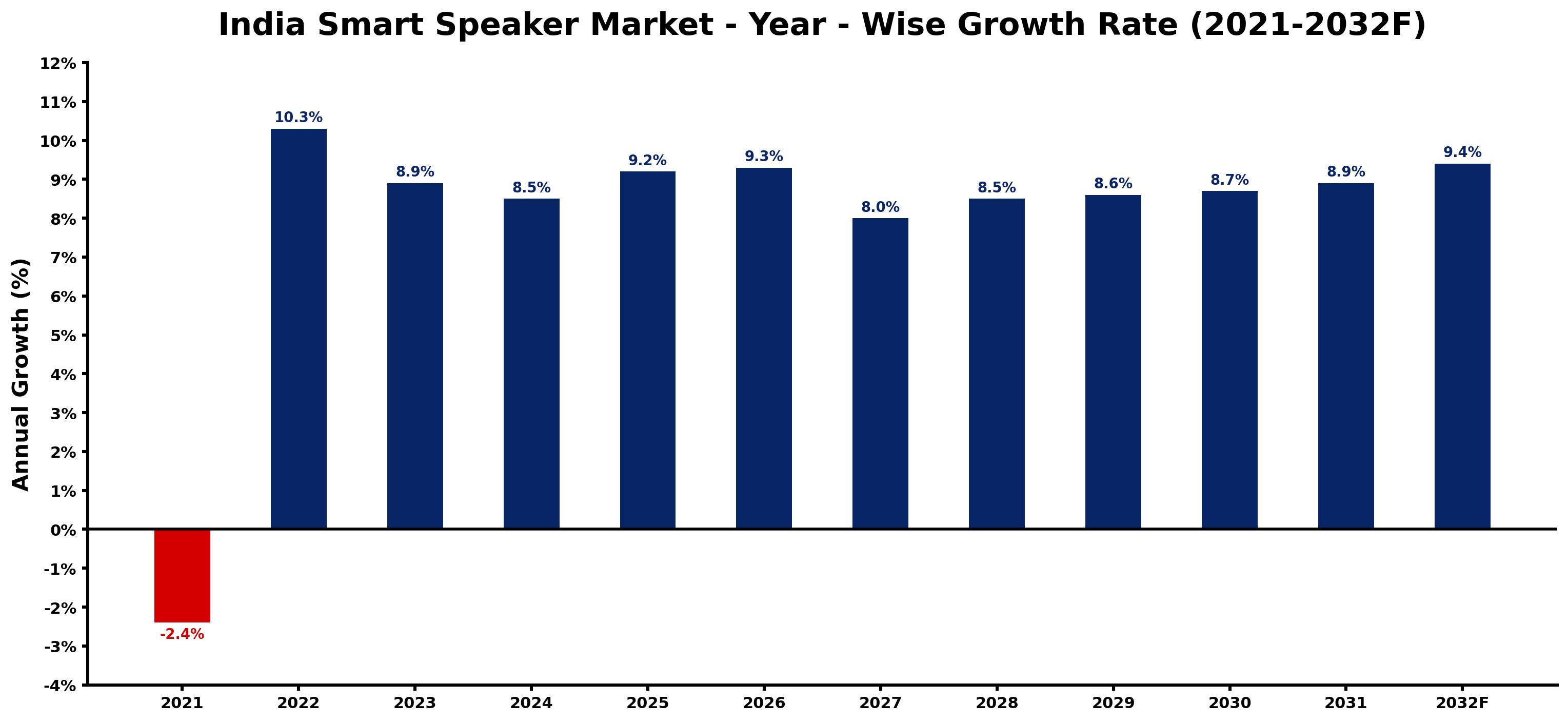
The table below presents the year‑wise growth rates along with the key drivers influencing the market
| Year | Growth Rate | Major Drivers |
| 2021 | -2.4% | Government infrastructure modernization initiatives |
| 2022 | 10.3% | Growing urbanization and commercial development |
| 2023 | 8.9% | Expansion of transportation and logistics networks |
| 2024 | 8.5% | Rapid growth in telecom and data center sectors |
| 2025 | 9.2% | Expansion of manufacturing activities |
| 2026 | 9.3% | Rapid growth in telecom and data center sectors |
| 2027 | 8.0% | Increasing industrial automation investments |
| 2028 | 8.5% | Rapid growth in telecom and data center sectors |
| 2029 | 8.6% | Growing renewable energy integration projects |
| 2030 | 8.7% | Rising electricity demand across industries |
| 2031 | 8.9% | Growing urbanization and commercial development |
| 2032 | 9.4% | Increasing smart city development projects |
Note - Market size estimations and growth projections presented in this report are based on 6Wresearch’s advanced forecasting approach, validated with industry datasets as of June 2026.
India Smart Speaker Market Synopsis
The Indian smart speaker market is experiencing a transformative phase, largely fueled by the surge in Internet of Things (IoT) adoption. This shift has facilitated an ever-expanding ecosystem where consumers engage with smart speakers for music, news, and home automation, often initiated by simple voice commands.
Moreover, as major tech players continue to innovate and introduce various AI-based digital assistants, consumers are increasingly drawn to smart speaker offerings that boast seamless integration with a multitude of devices. This trend is significantly reshaping consumer electronics consumption in urban India, making smart speakers a staple in modern households.
India Smart Speaker Market Key Takeaways
- The market is on a rapid growth trajectory, expected to reach USD 1502 Million by 2032.
- Urban consumers are driving the adoption of smart speakers, facilitated by increased disposable incomes.
- Integration with IoT and home automation products is a key demand driver.
- Technological advancements in AI and voice recognition are enhancing user experiences.
- Promotional offers and installation services are boosting market penetration.
Evaluation of Restraints in India Smart Speaker Market
Despite a promising outlook, the India Smart Speaker Market faces several significant restraints. High costs associated with premium audio equipment remain a hurdle for broader consumer adoption, particularly among price-sensitive segments. Additionally, the complexity of integrating various technologies into a unified platform can create technical barriers for both consumers and manufacturers. Furthermore, there is a noticeable lack of awareness regarding the capabilities and benefits of smart speakers in rural areas, potentially stifling market growth. Lastly, security concerns regarding data privacy and the protection against unauthorized access are critical issues that consumers increasingly consider when adopting these devices.
India Smart Speaker Market Trends
The market is witnessing several trends that are shaping demand and technology. One significant trend is the rise of multiroom audio systems, allowing users to control multiple sound sources throughout their homes via voice commands, enhancing the overall music experience. This functionality appeals particularly to tech-savvy customers seeking convenience and seamless integration of their audio systems. Additionally, there is a marked shift towards premium offerings, with manufacturers focusing on superior sound quality and advanced features to attract discerning consumers.
India Smart Speaker Market Opportunities
Opportunities for growth within the India Smart Speaker Market lie in the continued expansion of smart home ecosystems. Companies can capitalize on the rising consumer interest in home automation by developing products that offer easy integration with existing devices. Furthermore, tapping into rural markets, where awareness and accessibility are currently limited, presents a substantial growth avenue. This involves not only enhancing consumer education but also offering affordable solutions that cater to diverse income levels.
Government Initiatives in the India Smart Speaker Market
The Indian government has recognized the importance of technology and innovation in economic development and is implementing policies that support the digital ecosystem. Initiatives aimed at promoting digital literacy and expanding internet access are crucial for facilitating the adoption of smart devices, including smart speakers. Furthermore, public spending on technology infrastructure is expected to create a conducive environment for the growth of IoT solutions across various segments.
Future Insights of the India Smart Speaker Market
Looking ahead to 2026-2032, the India Smart Speaker Market is poised for substantial evolution. As technology continues to advance, smart speakers will likely integrate more deeply with daily consumer life, transforming into central control hubs for all connected devices. Enhanced AI capabilities will improve user interactions, making smart speakers not just tools, but essential companions in homes. With increased awareness and education around smart technologies, along with the expansion of internet access, the market is set to flourish.
India Smart Speaker Market Latest Developments (May 2025 - June 2026)
Recent developments in the India Smart Speaker Market indicate a significant push towards innovative product offerings and enhanced consumer engagement. Companies are focusing on integrating advanced features, such as improved voice recognition and multi-device compatibility. Furthermore, strategic promotional campaigns are being launched to educate consumers about the benefits of smart speakers, fostering higher adoption rates. As competition intensifies, manufacturers are also exploring collaborations to enhance product ecosystems, ultimately benefiting the end user.
India Smart Speaker Market - Key Attractiveness of the Report
- 10 Years of Market Numbers
- Historical Data Starting from 2022 to 2025
- Base Year: 2025
- Forecast Data until 2032
- Key Performance Indicators Impacting the Market
- Major Upcoming Developments and Projects
Key Highlights of the Report:
- India Smart Speaker Market Outlook
- Market Size of India Smart Speaker Market, 2025
- Forecast of India Smart Speaker Market, 2032
- Historical Data and Forecast of India Smart Speaker Revenues & Volume for the Period 2022-2032F
- India Smart Speaker Market Trend Evolution
- India Smart Speaker Market Drivers and Challenges
- India Smart Speaker Price Trends
- India Smart Speaker Porter's Five Forces
- India Smart Speaker Industry Life Cycle
- Historical Data and Forecast of India Smart Speaker Market Revenues & Volume By Debris Size for the Period 2022-2032F
- Historical Data and Forecast of India Smart Speaker Market Revenues & Volume By Between 1 mm and 1 cm for the Period 2022-2032F
- Historical Data and Forecast of India Smart Speaker Market Revenues & Volume By Between 1 cm to 10 cm for the Period 2022-2032F
- Historical Data and Forecast of India Smart Speaker Market Revenues & Volume By More than 10 cm for the Period 2022-2032F
- Historical Data and Forecast of India Smart Speaker Market Revenues & Volume By End-users for the Period 2022-2032F
- Historical Data and Forecast of India Smart Speaker Market Revenues & Volume By Commercial for the Period 2022-2032F
- Historical Data and Forecast of India Smart Speaker Market Revenues & Volume By Defense for the Period 2022-2032F
- India Smart Speaker Import Export Trade Statistics
- Market Opportunity Assessment By Debris Size
- Market Opportunity Assessment By End-users
- India Smart Speaker Top Companies Market Share
- India Smart Speaker Competitive Benchmarking By Technical and Operational Parameters
- India Smart Speaker Company Profiles
- India Smart Speaker Key Strategic Recommendations






































