India Smart Transport Systems Market Size & Growth Rate
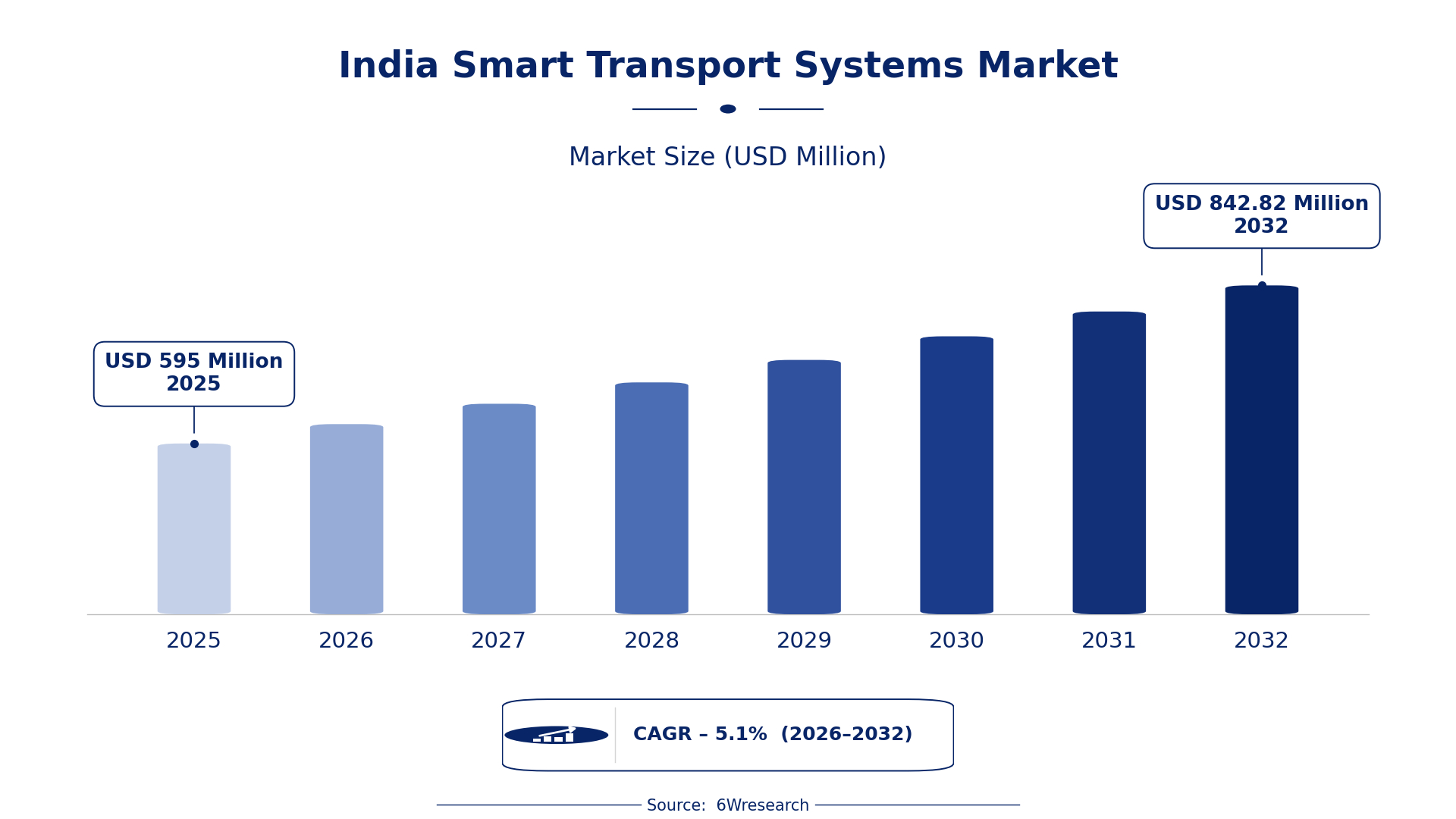
According to 6Wresearch internal database and industry insights, the India Smart Transport Systems Market was valued at USD 595.0 million in 2025 and is projected to reach USD 842.82 million by 2032, growing at a CAGR of approximately 5.1% during 2026–2032.
India Smart Transport Systems Market Highlights
| Report Metric | Details |
| Report Name | India Smart Transport Systems Market |
| Market Size 2025 | USD 595.0 million |
| Market Size 2032 | USD 842.82 million |
| Absolute Growth 2025–2032 | USD 247.82 million |
| CAGR 2026–2032 | 5.1% |
| Peak Annual Growth | 7.0% in 2031 |
| Forecast Period | 2026–2032 |
| Historical Data | 2022–2025 |
| Base Year | 2025 |
| Leading System Type, 2025 | Integrated Mobility Apps (40% share) |
| Leading Smart Feature, 2025 | Real-Time Route Optimization (43% share) |
| Leading Tech Stack, 2025 | Cloud + GPS + AI (46% share) |
| Leading End User, 2025 | Smart City Admin (52% share) |
| Fastest-Growing System Type | Smart Tolling Systems (6.1% CAGR) |
| Fastest-Growing Smart Feature | Fleet Movement Analytics (7.6% CAGR) |
| Fastest-Growing Tech Stack | V2I + 5G (7.3% CAGR) |
| Fastest-Growing End User | Traffic Controllers (6.3% CAGR) |
| Growing Sector | Traffic Controllers |
| Key End Users | Smart City Admin, Traffic Controllers, Highway Authorities, Citizens |
India Smart Transport Systems Market Year-wise Growth Rate and Key Drivers (2022–2032)
This graph illustrates the annual growth rates of the market from 2022 to 2032, highlighting a steady upward trajectory and projected market expansion over the forecast period.
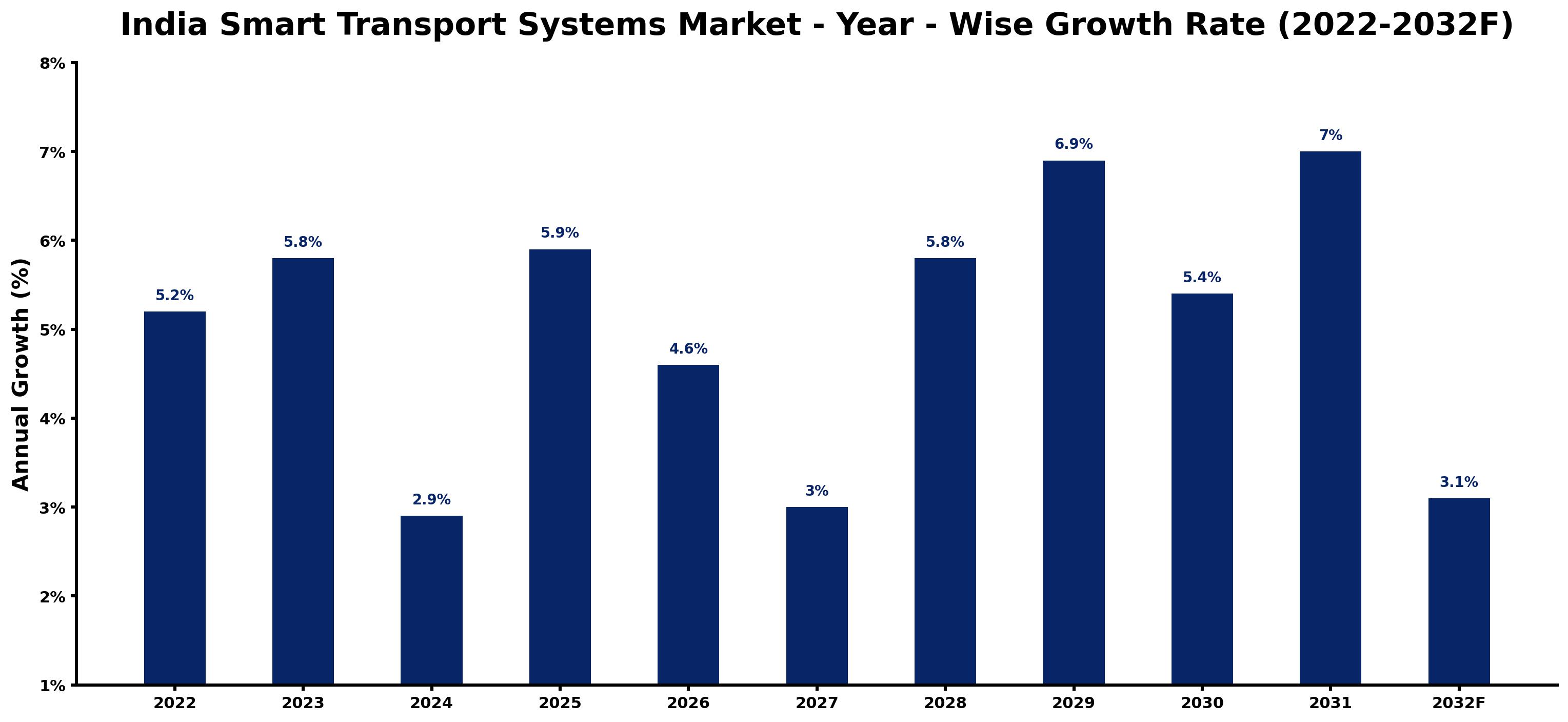
Year by year, the estimates below pair each growth rate with the development that shaped it.
| Year | Estimated Annual Growth (%) | Market Rationale |
| 2022 | 5.2 | Urban population growth necessitated improved transport solutions to manage congestion. |
| 2023 | 5.8 | The Smart Cities Mission accelerated investments in integrated transport systems across major cities. |
| 2024 | 2.9 | Integration challenges slowed the adoption of new technologies in existing infrastructure. |
| 2025 | 5.9 | Increased funding for smart transport initiatives led to significant project implementations. |
| 2026 | 4.6 | The market experienced a slowdown as the focus shifted to system optimization and maintenance. |
| 2027 | 3.0 | Demand continued to grow as urban mobility needs increased amid rising vehicle numbers. |
| 2028 | 5.8 | Technological advancements spurred renewed interest in smart transport solutions for urban areas. |
| 2029 | 6.9 | The introduction of new standards enhanced the reliability of smart transport systems. |
| 2030 | 5.4 | A slowdown occurred as projects matured and required more extensive testing and validation. |
| 2031 | 7.0 | Peak growth was driven by the completion of major smart city projects and infrastructure upgrades. |
| 2032 | 3.1 | Growth slowed as the market stabilizes, focusing on system integration and user adoption. |
Note: Market size estimations and growth projections presented in this report are based on 6Wresearch's proprietary forecasting methodology, utilizing the latest available industry data, government publications, and primary research inputs.
India Smart Transport Systems Market Synopsis
Smart Transport Systems in India encompass technologies designed to improve urban mobility and traffic management. These systems integrate software applications, hardware, and data analytics for real-time traffic monitoring and route optimisation. The India Smart Transport Systems Market is expanding due to urbanisation and substantial investments from both government and private sectors. The Smart Cities Mission aims to develop 100 smart cities by 2023, further increasing demand for integrated transport solutions. With India's urban population reaching 468 million in 2023, the necessity for efficient transport systems has never been more pressing.
Market Dynamics Impact Analysis (2026–2032)
| Factor | Type | Impact | Primary Segment Affected |
| Urban population growth drives demand for efficient transport solutions. | Driver | High | Integrated Mobility Apps |
| Government investments in smart transport initiatives create opportunities for technology providers. | Driver | High | Smart Tolling Systems |
| The need for real-time traffic management systems presents a significant opportunity. | Opportunity | High | Real-Time Route Optimization |
| Growing vehicle population necessitates enhanced traffic management solutions. | Opportunity | High | Vehicle-to-Infrastructure |
| Integration challenges with existing infrastructure can delay project implementations. | Restraint | Medium | Centralized Control Hubs |
| Limited public awareness of smart transport benefits may hinder adoption rates. | Restraint | Medium | Smart Tolling Systems |
| High initial investment costs can deter potential buyers from adopting new systems. | Challenge | High | Integrated Mobility Apps |
| Regulatory hurdles can slow down the approval process for new technologies. | Challenge | High | Vehicle-to-Infrastructure |
Evaluation of Drivers in India Smart Transport Systems Market (2026–2032)
The table below links each growth driver to the segment it affects and the evidence for it.
| Drivers | Primary Segment Affected | Why It Matters (Evidence) |
| Urban population growth necessitates improved transport solutions. | Integrated Mobility Apps | India's urban population reached 468 million in 2023, increasing demand for efficient transport systems. |
| Government funding boosts smart transport initiatives. | Smart Tolling Systems | The government allocated ₹1,000 crore for smart transport initiatives in the 2022 budget. |
| Technological advancements improve system efficiency and user experience. | Real-Time Route Optimization | Integration of advanced analytics improves real-time traffic monitoring capabilities. |
| Smart city projects drive demand for integrated transport solutions. | Centralized Control Hubs | The Smart Cities Mission aims to develop 100 smart cities by 2023, focusing on transport. |
| Rising vehicle numbers increase the need for traffic management. | Vehicle-to-Infrastructure | India's vehicle population is expected to reach 300 million by 2025, driving smart solutions. |
The urban population reached 468 million in 2023, which increases the need for efficient transport systems. The Smart Cities Mission, aiming to develop 100 smart cities by 2023, drives demand for integrated transport solutions. With the vehicle population expected to reach 300 million by 2025, the need for effective traffic management solutions prompts investments in smart technologies.
Evaluation of Restraints in India Smart Transport Systems Market
The following restraints limit how fast demand can grow.
| Market Restraint | Primary Segment Affected | Why It Matters (Evidence) |
| Integration challenges with existing infrastructure can delay project implementations. | Centralized Control Hubs | Many cities struggle to integrate new systems with outdated infrastructure, causing delays. |
| Limited public awareness of smart transport benefits may hinder adoption rates. | Smart Tolling Systems | Without understanding the advantages, citizens may resist adopting new technologies. |
| High initial investment costs can deter potential buyers from adopting new systems. | Integrated Mobility Apps | The upfront costs associated with smart technologies can limit buyer interest. |
| Regulatory hurdles can slow down the approval process for new technologies. | Vehicle-to-Infrastructure | Complex approval processes can delay the implementation of transport solutions. |
| Insufficient technical skills among local personnel may hinder system maintenance. | Real-Time Route Optimization | A lack of trained professionals can affect the long-term sustainability of smart systems. |
India Smart Transport Systems Market Challenges
India's urban population reached 468 million in 2023, highlighting a critical shortage of skilled professionals in smart transport systems. This skills gap delays project implementation for suppliers, resulting in potential revenue losses estimated at ₹500 crore annually. Rapid technological advancements in smart transport solutions outpace local development, leading to reliance on imported technologies that can inflate costs for buyers by as much as 30%. Additionally, the lack of standardisation in smart transport technologies complicates integration efforts, causing project delays that can extend timelines by six months for municipalities aiming to improve urban mobility.
Trends in the India Smart Transport Systems Market
The trends below show where the India Smart Transport Systems Market is heading.
- Shift from Traditional to Smart Traffic Management: In 2021, the National Intelligent Transport System (ITS) Policy was launched, promoting smart technologies. This shift is visible as cities adopt real-time traffic management systems, improving urban mobility.
- Increase in Integrated Mobility Apps Usage: Since 2023, the demand for integrated mobility apps has surged, driven by urbanisation. With India's urban population at 468 million, these apps facilitate real-time travel information.
- Adoption of Smart Tolling Systems: The introduction of smart tolling systems has streamlined toll collection processes since 2022. With an allocation of ₹1,000 crore for smart transport initiatives, efficiency has improved.
- Growth of Vehicle-to-Infrastructure Communication: The integration of V2I technology has gained traction since 2023, improving traffic management. This technology facilitates better communication between vehicles and road infrastructure.
Investment Opportunities in the India Smart Transport Systems Market
Investors looking at the India Smart Transport Systems Market should consider the following areas.
- Investment in Smart City Projects: With the Smart Cities Mission aiming to develop 100 smart cities by 2023, there is an opportunity for investment in integrated transport solutions. Local governments are seeking partnerships to improve urban mobility.
- Supply of Real-Time Traffic Management Systems: The need for real-time traffic management systems is rising, especially in major urban areas. Cities like Delhi-NCR are implementing pilot projects, creating demand for advanced technologies.
- Development of Integrated Mobility Apps: As urbanisation continues, there is a growing need for integrated mobility apps that provide real-time information. Smart city administrations are looking for solutions to improve user experience.
- Expansion of Smart Tolling Systems: The increasing vehicle population presents an opportunity for smart tolling systems. Highway authorities are investing in automation to improve efficiency and reduce congestion.
Government Initiatives in the India Smart Transport Systems Market
The 'National Intelligent Transport System (ITS) Policy' launched in 2021 by the Ministry of Road Transport and Highways improves traffic management through technology. This policy builds on the 'National Urban Transport Policy' revised in 2020, which prioritises smart transport systems. By integrating technology into traffic management, the policy aims to improve urban mobility and reduce congestion, thus benefiting both producers and users of smart transport solutions.
In 2022, the government allocated ₹1,000 crore for smart transport initiatives under the 'Atmanirbhar Bharat' initiative, administered by the Ministry of Housing and Urban Affairs. This funding supports the development of integrated transport solutions in urban areas. Additionally, the Smart Cities Mission, which aims to develop 100 smart cities by 2023, focuses on improving urban mobility through technology, ensuring that local governments receive the necessary resources for implementation.
Future Insight of the India Smart Transport Systems Market
The smart transport systems market in India is expected to evolve significantly by 2032, driven by the Smart Cities Mission, which targets the development of 50 urban areas with integrated transport solutions. Real-time traffic management systems will be implemented in 10 major cities, improving urban mobility and efficiency. By 2025, India's vehicle population is projected to reach 300 million, intensifying the demand for smart transport solutions. The updated National Urban Transport Policy prioritises these systems, ensuring sustained government support for technological advancements.
Market Segmentation Analysis
The analysis below covers each segmentation, its leading category in 2025 and its fastest-growing category through 2032.
By System Type – Integrated Mobility Apps Dominated, Smart Tolling Systems Expected to Grow Fastest
According to Dhaval Chaurasia, Assistant Manager at 6Wresearch, Integrated Mobility Apps accounted for a 40% market share by system type in 2025. Integrated Mobility Apps hold the largest share in the India Smart Transport Systems Market due to their widespread adoption among urban commuters. They provide essential real-time information that significantly improves travel experiences in densely populated regions such as Delhi-NCR. Smart Tolling Systems are projected to grow fastest, at a CAGR of 6.1% during 2026–2032. Smart Tolling Systems are experiencing rapid growth as urban areas increasingly seek to automate toll collection processes. With the vehicle population expected to reach 300 million by 2025, the demand for efficient tolling solutions will continue to rise. Suppliers should focus on developing advanced tolling technologies to meet the growing demand from urban transport authorities.
By Smart Feature – Real-Time Route Optimization Dominated, Fleet Movement Analytics Expected to Grow Fastest
Real-Time Route Optimization held a 43% share of the India Smart Transport Systems Market by smart feature in 2025. Real-Time Route Optimization captures the largest share as it directly addresses the need for efficient travel in India's congested urban areas. This feature is crucial for commuters navigating heavy traffic, particularly in cities like Mumbai and Bangalore. Fleet Movement Analytics is set to record the highest CAGR in this split, 7.6% over 2026–2032. Fleet Movement Analytics is witnessing swift growth as logistics companies aim to enhance their operations amidst rising vehicle numbers. The increasing complexity of urban logistics makes this analytics essential for effective fleet management. Buyers in the logistics sector must invest in analytics solutions to improve operational efficiency and reduce costs.
By Tech Stack – Cloud + GPS + AI Dominated, V2I + 5G Expected to Grow Fastest
In 2025, Cloud + GPS + AI led the tech stack split with a 46% share. The Cloud + GPS + AI tech stack leads the market due to its ability to provide advanced data processing and real-time tracking. This combination is vital for smart transport systems, especially in urban areas where traffic conditions fluctuate frequently. The quickest growth will come from V2I + 5G, forecast to expand at a CAGR of 7.3% between 2026 and 2032. V2I + 5G technology is set to grow quickly as it enhances communication between vehicles and infrastructure, which is essential for effective traffic management. As cities invest in smart infrastructure, this tech stack will become increasingly important for seamless transport operations. Suppliers should prioritise the development of V2I solutions to align with the rising demand for smart transport technologies.
By End User – Smart City Admin Dominated, Traffic Controllers Expected to Grow Fastest
With a 52% revenue share in 2025, Smart City Admin was the largest end user category. Smart City Admins dominate the market share as they are responsible for implementing smart transport systems that enhance urban mobility. Their pivotal role is evident in cities like Ahmedabad, where integrated transport solutions are being prioritised. Over 2026–2032, Traffic Controllers are expected to post the fastest growth, at a CAGR of 6.3%. Traffic Controllers are witnessing the fastest growth as they require advanced systems for effective traffic management and incident response. The increasing complexity of urban traffic patterns necessitates enhanced tools for these professionals. Investing in tailored solutions for traffic controllers can lead to improved traffic flow and reduced congestion in urban areas.
Key Attractiveness of the Report
- 10 Years of Market Numbers
- Historical Data Starting from 2022 to 2025
- Base Year 2025
- Forecast Data until 2032
- Key Performance Indicators Impacting the Market
- Major Upcoming Developments and Projects
Key Highlights of the Report:
- India Smart Transport Systems Market Outlook
- Market Size of India Smart Transport Systems Market, 2025
- Forecast of India Smart Transport Systems Market, 2032
- Historical Data and Forecast of India Smart Transport Systems Revenues & Volume for the Period 2022 - 2032F
- India Smart Transport Systems Market Trend Evolution
- India Smart Transport Systems Market Drivers and Challenges
- India Smart Transport Systems Price Trends
- India Smart Transport Systems Porter's Five Forces
- India Smart Transport Systems Industry Life Cycle
- Historical Data and Forecast of India Smart Transport Systems Market Revenues & Volume By System Type for the Period 2022 - 2032F
- Historical Data and Forecast of India Smart Transport Systems Market Revenues & Volume By Integrated Mobility Apps for the Period 2022 - 2032F
- Historical Data and Forecast of India Smart Transport Systems Market Revenues & Volume By Vehicle-to-Infrastructure for the Period 2022 - 2032F
- Historical Data and Forecast of India Smart Transport Systems Market Revenues & Volume By Centralized Control Hubs for the Period 2022 - 2032F
- Historical Data and Forecast of India Smart Transport Systems Market Revenues & Volume By Smart Tolling Systems for the Period 2022 - 2032F
- Historical Data and Forecast of India Smart Transport Systems Market Revenues & Volume By Smart Feature for the Period 2022 - 2032F
- Historical Data and Forecast of India Smart Transport Systems Market Revenues & Volume By Real-Time Route Optimization for the Period 2022 - 2032F
- Historical Data and Forecast of India Smart Transport Systems Market Revenues & Volume By Signal & Hazard Response for the Period 2022 - 2032F
- Historical Data and Forecast of India Smart Transport Systems Market Revenues & Volume By Fleet Movement Analytics for the Period 2022 - 2032F
- Historical Data and Forecast of India Smart Transport Systems Market Revenues & Volume By License Plate Recognition for the Period 2022 - 2032F
- Historical Data and Forecast of India Smart Transport Systems Market Revenues & Volume By Tech Stack for the Period 2022 - 2032F
- Historical Data and Forecast of India Smart Transport Systems Market Revenues & Volume By Cloud + GPS + AI for the Period 2022 - 2032F
- Historical Data and Forecast of India Smart Transport Systems Market Revenues & Volume By V2I + 5G for the Period 2022 - 2032F
- Historical Data and Forecast of India Smart Transport Systems Market Revenues & Volume By IoT + Dashboard for the Period 2022 - 2032F
- Historical Data and Forecast of India Smart Transport Systems Market Revenues & Volume By Camera + AI for the Period 2022 - 2032F
- Historical Data and Forecast of India Smart Transport Systems Market Revenues & Volume By End User for the Period 2022 - 2032F
- Historical Data and Forecast of India Smart Transport Systems Market Revenues & Volume By Citizens for the Period 2022 - 2032F
- Historical Data and Forecast of India Smart Transport Systems Market Revenues & Volume By Traffic Controllers for the Period 2022 - 2032F
- Historical Data and Forecast of India Smart Transport Systems Market Revenues & Volume By Smart City Admin for the Period 2022 - 2032F
- Historical Data and Forecast of India Smart Transport Systems Market Revenues & Volume By Highway Authorities for the Period 2022 - 2032F
- India Smart Transport Systems Import Export Trade Statistics
- Market Opportunity Assessment By System Type
- Market Opportunity Assessment By Smart Feature
- Market Opportunity Assessment By Tech Stack
- Market Opportunity Assessment By End User
- India Smart Transport Systems Top Companies Market Share
- India Smart Transport Systems Competitive Benchmarking By Technical and Operational Parameters
- India Smart Transport Systems Company Profiles
- India Smart Transport Systems Key Strategic Recommendations
Market Covered
This report examines the market across the segments below.
By System Type
- Integrated Mobility Apps
- Vehicle-to-Infrastructure
- Centralized Control Hubs
- Smart Tolling Systems
By Smart Feature
- Real-Time Route Optimization
- Signal & Hazard Response
- Fleet Movement Analytics
- License Plate Recognition
By Tech Stack
- Cloud + GPS + AI
- V2I + 5G
- IoT + Dashboard
- Camera + AI
By End User
- Citizens
- Traffic Controllers
- Smart City Admin
- Highway Authorities































