India Smart Vision Systems Market Size & Growth Rate
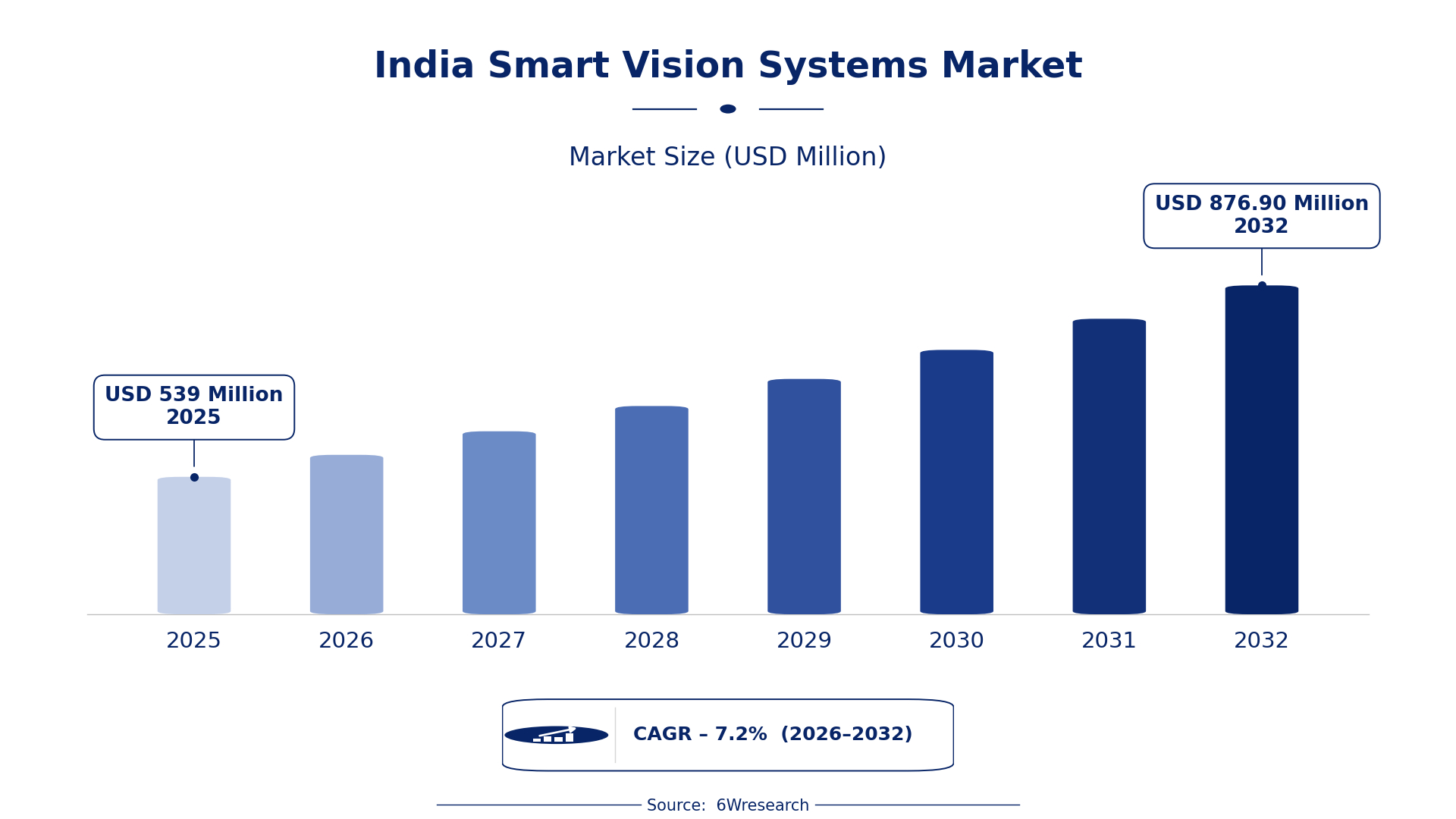
According to 6Wresearch internal database and industry insights, the India Smart Vision Systems Market was valued at USD 539.0 million in 2025 and is projected to reach USD 876.90 million by 2032, growing at a CAGR of approximately 7.2% during 2026–2032.
India Smart Vision Systems Market Highlights
| Report Metric | Details |
| Report Name | India Smart Vision Systems Market |
| Market Size 2025 | USD 539.0 million |
| Market Size 2032 | USD 876.90 million |
| Absolute Growth 2025–2032 | USD 337.90 million |
| CAGR 2026–2032 | 7.2% |
| Peak Annual Growth | 9.7% in 2028 |
| Forecast Period | 2026–2032 |
| Historical Data | 2022–2025 |
| Base Year | 2025 |
| Leading Vision Type, 2025 | Machine Vision (47% share) |
| Leading Smart Feature, 2025 | Object Detection + Sorting (46% share) |
| Leading Application Area, 2025 | Robotics + Packaging (42% share) |
| Leading End User, 2025 | Factories (41% share) |
| Fastest-Growing Vision Type | Medical Imaging Vision (8.7% CAGR) |
| Fastest-Growing Smart Feature | Diagnostic Assistance (9.2% CAGR) |
| Fastest-Growing Application Area | MRI/CT AI Sync (9.4% CAGR) |
| Fastest-Growing End User | Hospitals (8.2% CAGR) |
| Growing Sector | MRI/CT AI Sync |
| Key End Users | Robotics + Packaging, MRI/CT AI Sync, ADAS, Video Analytics |
India Smart Vision Systems Market Year-wise Growth Rate and Key Drivers (2022–2032)
This graph illustrates the annual growth rates of the market from 2022 to 2032, highlighting a steady upward trajectory and projected market expansion over the forecast period.
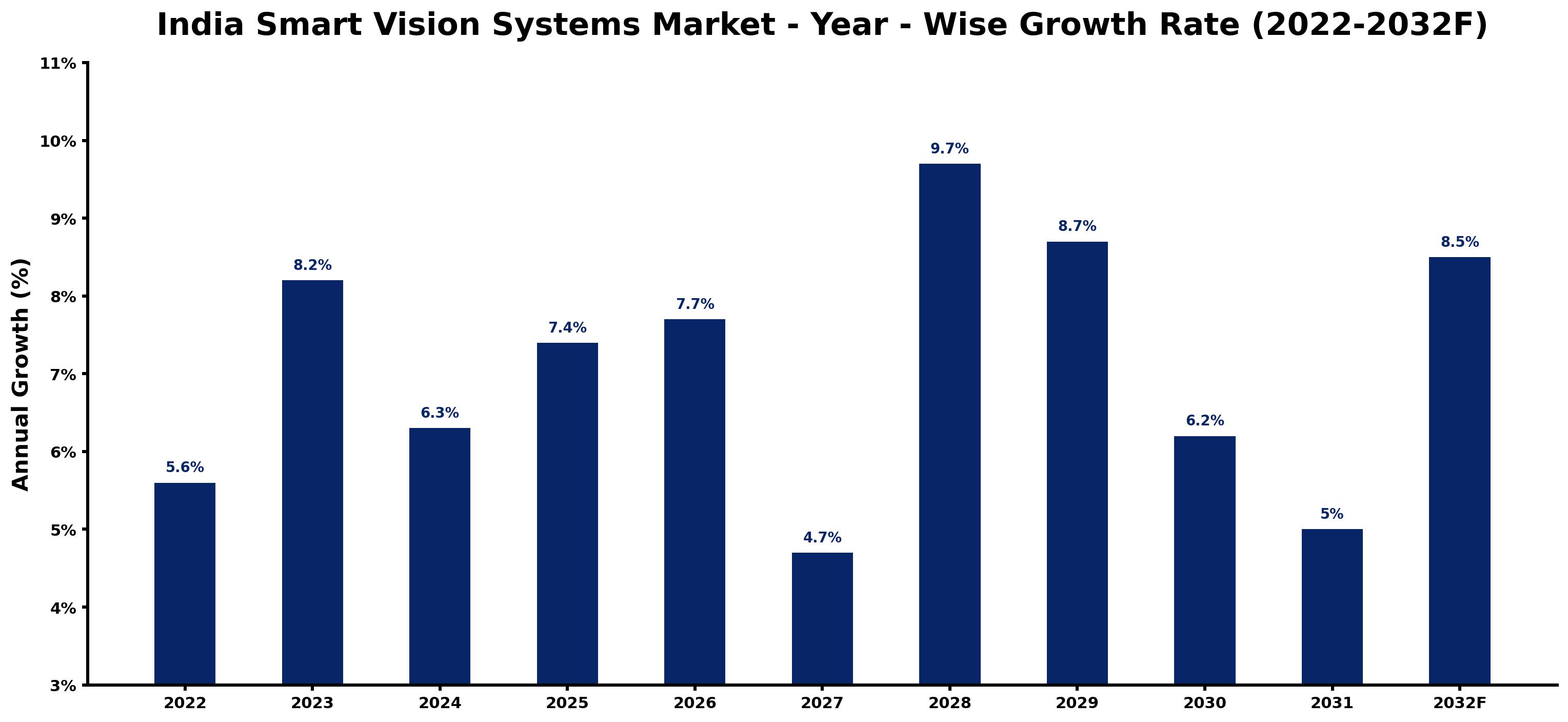
Each row of the following table gives one year's estimated growth and the event or demand shift that explains it.
| Year | Estimated Annual Growth (%) | Market Rationale |
| 2022 | 5.6 | The market experienced steady growth, driven by ongoing investments in smart technologies, particularly in the manufacturing sector. |
| 2023 | 8.2 | Demand surged due to the Digital India programme, which is enhancing smart city infrastructure across the country. |
| 2024 | 6.3 | Growth slowed as the market adjusted to evolving technology needs in the automotive sector. |
| 2025 | 7.4 | A boost in automotive sector investments spurred demand for vision systems in vehicles, particularly for safety features. |
| 2026 | 7.7 | Technological advancements in AI integration are expected to support a rise in smart vision applications in various industries. |
| 2027 | 4.7 | Growth is projected to slow as manufacturers face challenges in scaling production capabilities amid rising costs. |
| 2028 | 9.7 | A peak in demand is anticipated due to the automotive sector's growth, which is expected to reach $300 billion by 2026. |
| 2029 | 8.7 | Demand growth is expected to slow as market saturation begins to impact new project initiations in smart cities. |
| 2030 | 6.2 | The market will continue to grow, driven by the healthcare sector's increasing reliance on advanced imaging technologies. |
| 2031 | 5.0 | A slowdown is expected as manufacturers adjust to changing regulatory requirements in the smart vision sector. |
| 2032 | 8.5 | Demand is projected to rise as hospitals adopt more advanced diagnostic imaging technologies, driven by the National Health Mission. |
Note: Market size estimations and growth projections presented in this report are based on 6Wresearch's proprietary forecasting methodology, utilizing the latest available industry data, government publications, and primary research inputs.
India Smart Vision Systems Market Synopsis
Smart Vision Systems in India encompass technologies that enable machines to interpret visual data through advanced imaging and AI algorithms. These systems are crucial for industrial automation, medical diagnostics, automotive safety, and security surveillance. The India Smart Vision Systems Market is poised for robust growth, driven by the Digital India programme and the National Health Mission, which enhance urban infrastructure and healthcare delivery, respectively. The automotive sector's expansion further stimulates demand for these technologies, creating opportunities for suppliers and manufacturers.
Market Dynamics Impact Analysis (2026–2032)
| Factor | Type | Impact | Primary Segment Affected |
| Growing investments in smart city projects drive demand for advanced imaging technologies. | Driver | High | Smart Cities |
| Increasing adoption of AI in healthcare enhances the need for advanced diagnostic imaging. | Driver | High | Medical Imaging Vision |
| The automotive sector's expansion presents opportunities for advanced safety features. | Opportunity | High | Automotive Vision AI |
| The rise of smart factories creates demand for automation technologies. | Opportunity | High | Machine Vision |
| High costs of implementing smart vision systems can deter small manufacturers. | Restraint | Medium | Machine Vision |
| Limited awareness of smart vision benefits among traditional industries hampers growth. | Restraint | Medium | Factories |
| Supply chain disruptions affect timely delivery of components for smart vision systems. | Challenge | High | Surveillance Vision |
| Regulatory compliance can delay the introduction of new technologies in the market. | Challenge | Medium | Medical Imaging Vision |
Evaluation of Drivers in India Smart Vision Systems Market (2026–2032)
The table below links each growth driver to the segment it affects and the evidence for it.
| Drivers | Primary Segment Affected | Why It Matters (Evidence) |
| Increased urbanisation leads to greater demand for smart city infrastructure. | Smart Cities | The Digital India programme aims to develop 100 smart cities, increasing the need for smart vision systems to improve urban management. |
| Growing healthcare investments drive the need for advanced diagnostic technologies. | Medical Imaging Vision | The National Health Mission's focus on improving healthcare delivery increases demand for imaging systems in hospitals. |
| Rising automotive production boosts the need for safety-enhancing vision systems. | Automotive Vision AI | The automotive sector is expected to grow significantly, increasing the demand for vision systems that improve vehicle safety features. |
| Manufacturers are increasingly automating processes to improve efficiency. | Machine Vision | The manufacturing sector's growth is driving demand for automation technologies, particularly in quality control and production efficiency. |
| Integration of AI technologies improves operational capabilities across sectors. | Robotics + Packaging | The National AI Strategy promotes AI integration, increasing the need for smart vision applications in automation processes. |
Market growth for Smart Vision Systems in India is underpinned by rising investments in healthcare, expanding urbanisation, and increasing automotive production. The National Health Mission's focus on advanced diagnostic technologies is driving demand for imaging systems in hospitals, with over 1,500 hospitals adopting these technologies as of 2023. These factors are contributing to a strong demand for smart vision systems across various sectors.
Evaluation of Restraints in India Smart Vision Systems Market
The following restraints limit how fast demand can grow.
| Market Restraint | Primary Segment Affected | Why It Matters (Evidence) |
| High implementation costs deter small manufacturers from adopting smart vision systems. | Machine Vision | The initial investment required for advanced systems can be prohibitive for smaller players, limiting their market participation. |
| Limited awareness of smart vision benefits restricts market penetration in traditional sectors. | Factories | Many traditional manufacturing sectors remain unaware of the efficiency gains that smart vision systems can provide, hindering adoption. |
| Supply chain disruptions can delay the availability of critical components for smart vision systems. | Surveillance Vision | Global supply chain issues have led to shortages of essential hardware and software components, affecting project timelines. |
| Regulatory complexities can slow down the introduction of new technologies in healthcare. | Medical Imaging Vision | Compliance with ISO 13485 standards can delay product launches in the medical imaging sector, impacting market growth. |
| Competition from alternative technologies can limit market share for smart vision systems. | Automotive Vision AI | Emerging technologies may offer similar functionalities at lower costs, affecting adoption rates among manufacturers. |
India Smart Vision Systems Market Challenges
Buyers and suppliers in the India Smart Vision Systems market face a skills shortage, as the rapid pace of technological advancement outstrips the availability of trained professionals, resulting in project delays that can extend up to six months for manufacturers. High costs associated with advanced imaging technologies create barriers to entry, with initial investments often exceeding ₹50 lakhs, making it challenging for smaller firms to compete effectively. Supply chain disruptions are common, as reliance on imported components can delay project timelines by three months, adversely impacting production schedules in the automotive sector. Outdated technology in some facilities restricts the integration of AI algorithms, leading to reduced efficiency and increased operational costs for producers.
Trends in the India Smart Vision Systems Market
Several trends are reshaping the India Smart Vision Systems Market; the most important are set out below.
- Shift from Traditional to Smart Vision Technologies: Since 2020, the automotive sector has increasingly adopted Smart Vision Systems for improved safety features, with investments exceeding ₹10,000 crores to advance vehicle technology. This shift is prompting manufacturers to invest in advanced vision technologies.
- Transition from Manual to Automated Processes: In recent years, factories have begun adopting automation technologies, with Machine Vision systems accounting for a significant share of this transition. By 2025, the manufacturing sector is projected to reach $1 trillion, driving further automation.
- Emergence of AI in Healthcare Diagnostics: The integration of AI in medical imaging has accelerated since 2020, with the National Health Mission promoting advanced diagnostic technologies. As of 2023, over 1,500 hospitals are equipped with these advanced imaging systems.
- Prioritisation of Smart City Initiatives: The Smart Cities Mission, launched in 2015, has led to increased investments in smart vision technologies. By 2023, substantial funding has been allocated to improve urban infrastructure and enhance city management.
Investment Opportunities in the India Smart Vision Systems Market
Some of the investment opportunities in the India Smart Vision Systems Market are mentioned below.
- Investment in Smart City Infrastructure: The Smart Cities Mission presents an opportunity for suppliers to provide smart vision systems, with ₹10,000 crores allocated for technology integration. Collaborating with local governments can facilitate market entry.
- Healthcare Facility Upgrades: Hospitals are increasingly adopting advanced diagnostic imaging technologies, driven by the National Health Mission's focus on healthcare improvements. Suppliers can enter this market by partnering with healthcare providers for technology deployment.
- Automation in Manufacturing: With the manufacturing sector projected to reach $1 trillion by 2025, there is a significant opportunity for investment in Machine Vision systems. Collaborating with factories can enhance automation capabilities.
- AI Integration in Robotics: The integration of AI in robotics applications is growing, with a focus on improving operational efficiency. Suppliers can target robotics manufacturers to provide smart vision solutions.
Government Initiatives in the India Smart Vision Systems Market
The Digital India Programme, initiated by the Ministry of Electronics and Information Technology in 2020, aims to improve digital infrastructure, including smart vision technologies. This initiative builds upon previous efforts to modernise India's technological framework, ensuring that smart vision systems are integrated into various sectors, including healthcare and urban management. The programme has allocated substantial resources to support the development of smart technologies, promoting innovation and adoption across industries, with a budget of ₹10,000 crores for AI and smart technologies as of 2023.
As of 2023, the National Health Mission continues to focus on improving healthcare delivery through advanced diagnostic technologies, including Medical Imaging Vision systems. The Ministry of Health and Family Welfare oversees this initiative, funding projects that enhance healthcare infrastructure. The Smart Cities Mission also promotes the use of smart vision systems in urban development, with the Ministry of Housing and Urban Affairs facilitating investments to improve city management and infrastructure, ensuring that urban areas are equipped with advanced technologies.
Future Insight of the India Smart Vision Systems Market
The India Smart Vision Systems market will undergo substantial changes by 2032, driven by the Digital India programme and the National AI Strategy, which will enhance technology integration across sectors. The automotive sector's expected growth to $300 billion by 2026 will fuel demand for advanced imaging solutions. The establishment of ISO 13485 standards for medical devices will encourage compliance and innovation in healthcare technologies. Additionally, the Electronics Policy 2020 will strengthen domestic manufacturing, reinforcing supply chains for smart vision applications.
Market Segmentation Analysis
The analysis below covers each segmentation, its leading category in 2025 and its fastest-growing category through 2032.
By Vision Type – Machine Vision Dominated, Medical Imaging Vision Expected to Grow Fastest
According to Dhaval Chaurasia, Assistant Manager at 6Wresearch, Machine Vision accounted for a 47% market share by vision type in 2025. Machine Vision holds the largest share in the India Smart Vision Systems Market as it is extensively utilised for quality control in manufacturing processes. The anticipated growth of India's manufacturing sector to $1 trillion by 2025 further emphasises the increasing reliance on these systems. The quickest growth will come from Medical Imaging Vision, forecast to expand at a CAGR of 8.7% between 2026 and 2032. Medical Imaging Vision is experiencing rapid growth, primarily due to the National Health Mission's focus on improving healthcare delivery and the rising demand for advanced diagnostic technologies. The presence of over 1,500 hospitals equipped with sophisticated imaging technologies in 2023 illustrates this upward trend. This trend presents a significant opportunity for suppliers to broaden their product offerings in the healthcare sector.
By Smart Feature – Object Detection + Sorting Dominated, Diagnostic Assistance Expected to Grow Fastest
Object Detection + Sorting held a 46% share of the India Smart Vision Systems Market by smart feature in 2025. Object Detection + Sorting leads the market as it is widely implemented in automated sorting systems in factories, crucial for improving operational efficiency. The ongoing automation trend in manufacturing processes reinforces its market dominance. Diagnostic Assistance is projected to grow fastest, at a CAGR of 9.2% during 2026–2032. Diagnostic Assistance is the fastest-growing feature, playing a vital role in ensuring accurate diagnoses through imaging technologies, which aligns with the increasing demands of the healthcare sector. The emphasis on advanced diagnostic tools under the National Health Mission propels this growth. Suppliers should focus on developing advanced diagnostic features to cater to the surging demand in healthcare.
By Application Area – Robotics + Packaging Dominated, MRI/CT AI Sync Expected to Grow Fastest
The largest application area category in 2025 was Robotics + Packaging, with a 42% share of total revenue. Robotics + Packaging is the leading application area due to its essential role in automating packaging processes, which are critical for enhancing production line efficiency. The anticipated growth in the manufacturing sector supports the sustained demand for these applications. Over 2026–2032, MRI/CT AI Sync is expected to post the fastest growth, at a CAGR of 9.4%. MRI/CT AI Sync is the fastest-growing application area, significantly improving imaging capabilities in medical facilities and addressing the rising need for advanced diagnostic imaging. The integration of AI technologies in healthcare is a key factor driving this growth. This trend highlights the necessity for suppliers to prioritise AI integration in their medical imaging solutions.
By End User – Factories Dominated, Hospitals Expected to Grow Fastest
Factories took a 41% share of end user in 2025, more than any other category. Factories dominate the end-user segment, primarily utilising smart vision systems for automation in production processes. The anticipated growth in India's manufacturing sector further cements their leading position in the market. Hospitals are set to record the highest CAGR in this split, 8.2% over 2026–2032. Hospitals are the fastest-growing end-user group, driven by the rising demand for medical imaging and diagnostics as healthcare facilities upgrade their technologies. The emphasis on advanced diagnostic tools underlines the importance of this segment. This growth presents an opportunity for suppliers to tailor their offerings specifically for the healthcare sector.
Key Attractiveness of the Report
- 10 Years of Market Numbers
- Historical Data Starting from 2022 to 2025
- Base Year 2025
- Forecast Data until 2032
- Key Performance Indicators Impacting the Market
- Major Upcoming Developments and Projects
Key Highlights of the Report:
- India Smart Vision Systems Market Outlook
- Market Size of India Smart Vision Systems Market, 2025
- Forecast of India Smart Vision Systems Market, 2032
- Historical Data and Forecast of India Smart Vision Systems Revenues & Volume for the Period 2022 - 2032F
- India Smart Vision Systems Market Trend Evolution
- India Smart Vision Systems Market Drivers and Challenges
- India Smart Vision Systems Price Trends
- India Smart Vision Systems Porter's Five Forces
- India Smart Vision Systems Industry Life Cycle
- Historical Data and Forecast of India Smart Vision Systems Market Revenues & Volume By Vision Type for the Period 2022 - 2032F
- Historical Data and Forecast of India Smart Vision Systems Market Revenues & Volume By Machine Vision for the Period 2022 - 2032F
- Historical Data and Forecast of India Smart Vision Systems Market Revenues & Volume By Medical Imaging Vision for the Period 2022 - 2032F
- Historical Data and Forecast of India Smart Vision Systems Market Revenues & Volume By Automotive Vision AI for the Period 2022 - 2032F
- Historical Data and Forecast of India Smart Vision Systems Market Revenues & Volume By Surveillance Vision for the Period 2022 - 2032F
- Historical Data and Forecast of India Smart Vision Systems Market Revenues & Volume By Smart Feature for the Period 2022 - 2032F
- Historical Data and Forecast of India Smart Vision Systems Market Revenues & Volume By Object Detection + Sorting for the Period 2022 - 2032F
- Historical Data and Forecast of India Smart Vision Systems Market Revenues & Volume By Diagnostic Assistance for the Period 2022 - 2032F
- Historical Data and Forecast of India Smart Vision Systems Market Revenues & Volume By Lane, Traffic Sign Detection for the Period 2022 - 2032F
- Historical Data and Forecast of India Smart Vision Systems Market Revenues & Volume By Movement Heatmaps for the Period 2022 - 2032F
- Historical Data and Forecast of India Smart Vision Systems Market Revenues & Volume By Application Area for the Period 2022 - 2032F
- Historical Data and Forecast of India Smart Vision Systems Market Revenues & Volume By Robotics + Packaging for the Period 2022 - 2032F
- Historical Data and Forecast of India Smart Vision Systems Market Revenues & Volume By MRI/CT AI Sync for the Period 2022 - 2032F
- Historical Data and Forecast of India Smart Vision Systems Market Revenues & Volume By ADAS for the Period 2022 - 2032F
- Historical Data and Forecast of India Smart Vision Systems Market Revenues & Volume By Video Analytics for the Period 2022 - 2032F
- Historical Data and Forecast of India Smart Vision Systems Market Revenues & Volume By End User for the Period 2022 - 2032F
- Historical Data and Forecast of India Smart Vision Systems Market Revenues & Volume By Factories for the Period 2022 - 2032F
- Historical Data and Forecast of India Smart Vision Systems Market Revenues & Volume By Hospitals for the Period 2022 - 2032F
- Historical Data and Forecast of India Smart Vision Systems Market Revenues & Volume By EV Makers for the Period 2022 - 2032F
- Historical Data and Forecast of India Smart Vision Systems Market Revenues & Volume By Smart Cities for the Period 2022 - 2032F
- India Smart Vision Systems Import Export Trade Statistics
- Market Opportunity Assessment By Vision Type
- Market Opportunity Assessment By Smart Feature
- Market Opportunity Assessment By Application Area
- Market Opportunity Assessment By End User
- India Smart Vision Systems Top Companies Market Share
- India Smart Vision Systems Competitive Benchmarking By Technical and Operational Parameters
- India Smart Vision Systems Company Profiles
- India Smart Vision Systems Key Strategic Recommendations
Market Covered
Segments analysed in this report are listed below.
By Vision Type
- Machine Vision
- Medical Imaging Vision
- Automotive Vision AI
- Surveillance Vision
By Smart Feature
- Object Detection + Sorting
- Diagnostic Assistance
- Lane
- Traffic Sign Detection
- Movement Heatmaps
By Application Area
- Robotics + Packaging
- MRI/CT AI Sync
- ADAS
- Video Analytics
By End User
- Factories
- Hospitals
- EV Makers
- Smart Cities































