India Smart Warehousing Technologies Market Size & Growth Rate
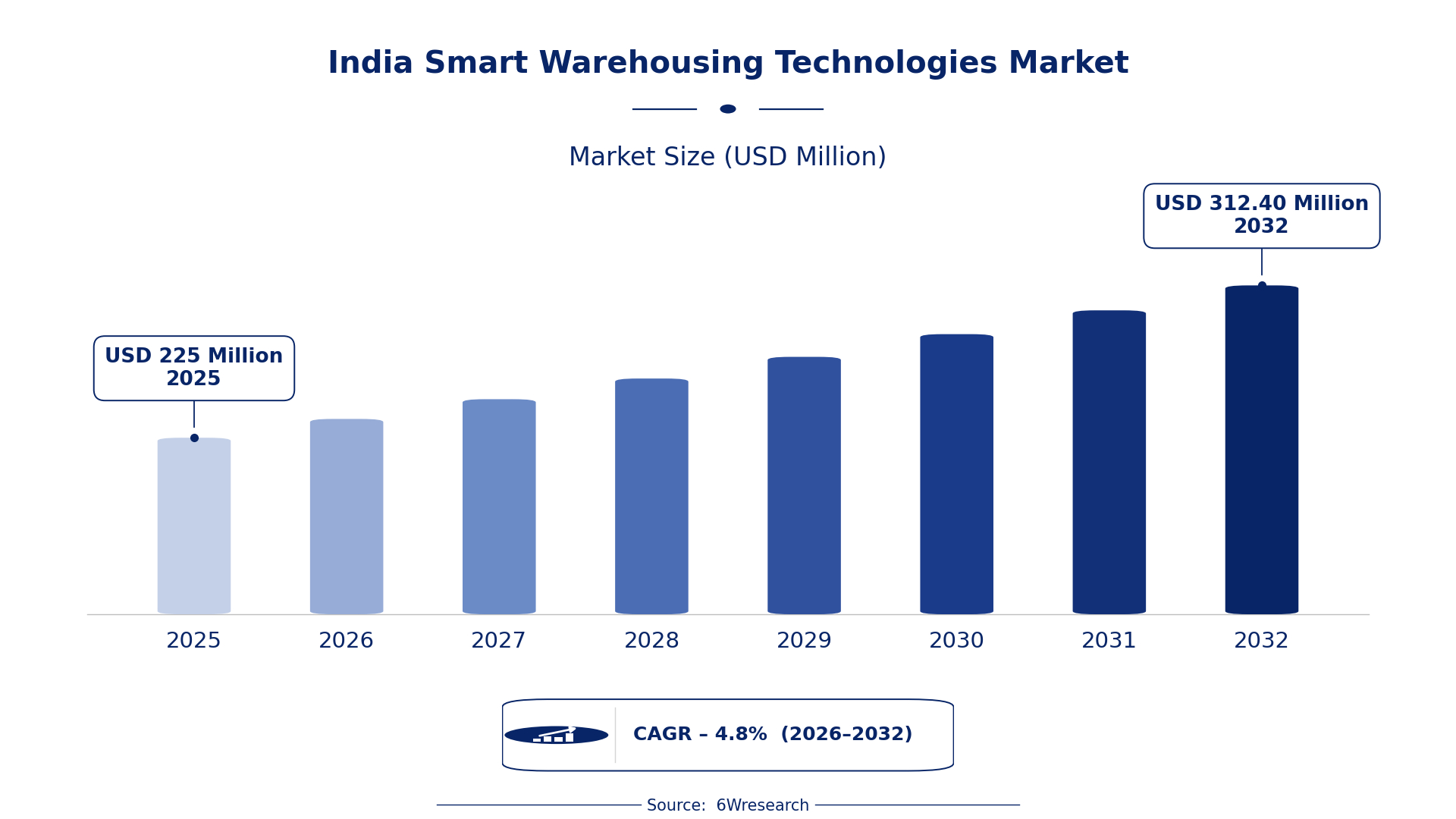
According to 6Wresearch internal database and industry insights, the India Smart Warehousing Technologies Market was valued at USD 225.0 million in 2025 and is projected to reach USD 312.40 million by 2032, growing at a CAGR of approximately 4.8% during 2026–2032.
India Smart Warehousing Technologies Market Highlights
| Report Metric | Details |
| Report Name | India Smart Warehousing Technologies Market |
| Market Size 2025 | USD 225.0 million |
| Market Size 2032 | USD 312.40 million |
| Absolute Growth 2025–2032 | USD 87.40 million |
| CAGR 2026–2032 | 4.8% |
| Peak Annual Growth | 7.1% in 2029 |
| Forecast Period | 2026–2032 |
| Historical Data | 2022–2025 |
| Base Year | 2025 |
| Leading Technology Type, 2025 | Integrated WMS Systems (40% share) |
| Leading Smart Feature, 2025 | Inventory + Order Sync (42% share) |
| Leading Automation Layer, 2025 | Cloud-Based Intelligence (44% share) |
| Leading End User, 2025 | E-commerce Giants (37% share) |
| Fastest-Growing Technology Type | Robotics & Drones (6.2% CAGR) |
| Fastest-Growing Smart Feature | Forecasting + Route Planning (7.4% CAGR) |
| Fastest-Growing End User | 3PL Companies (7.3% CAGR) |
| Growing Sector | 3PL Companies |
| Key End Users | E-commerce Giants, 3PL Companies, Online Retailers, Smart Infrastructure |
India Smart Warehousing Technologies Market Year-wise Growth Rate and Key Drivers (2022–2032)
This graph illustrates the annual growth rates of the market from 2022 to 2032, highlighting a steady upward trajectory and projected market expansion over the forecast period.
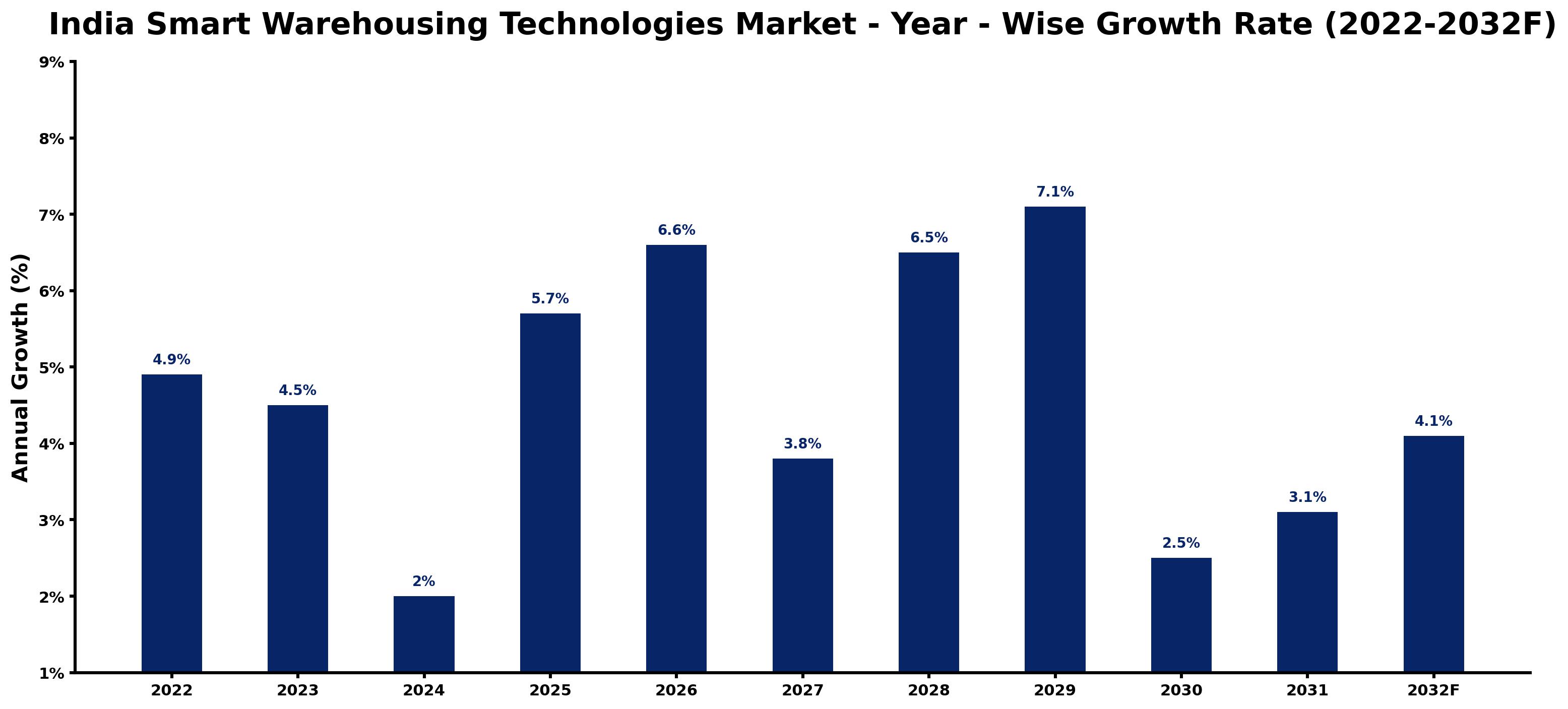
The following table presents the estimated annual growth rate for each year together with the principal factor influencing market performance.
| Year | Estimated Annual Growth (%) | Market Rationale |
| 2022 | 4.9 | The market experienced steady growth, driven by the ongoing digital transformation in logistics. |
| 2023 | 4.5 | Adoption of smart warehousing technologies slowed as e-commerce companies adjusted to evolving operational demands. |
| 2024 | 2.0 | Demand growth continued to decelerate amid challenges in integrating advanced technologies and supply chain management. |
| 2025 | 5.7 | A surge in e-commerce activity boosted growth as companies invested in advanced warehousing solutions to meet rising consumer expectations. |
| 2026 | 6.6 | Increased investments in automation technologies are expected to lead to a rebound in market growth, particularly among logistics providers. |
| 2027 | 3.8 | Growth is projected to slow again as companies face challenges in scaling operations and integrating new technologies effectively. |
| 2028 | 6.5 | A resurgence in demand is anticipated as logistics companies expand their capabilities and infrastructure to meet market needs. |
| 2029 | 7.1 | The market is expected to peak with heightened investments in smart warehousing technologies to improve operational efficiency and reduce costs. |
| 2030 | 2.5 | Growth will moderate as companies focus on optimising existing operations rather than pursuing aggressive expansion strategies. |
| 2031 | 3.1 | A slight recovery in growth is projected as firms begin to adopt more advanced solutions to enhance productivity and efficiency. |
| 2032 | 4.1 | The market is anticipated to stabilise with steady investments in technology and infrastructure, supported by government initiatives. |
Note: Market size estimations and growth projections presented in this report are based on 6Wresearch's proprietary forecasting methodology, utilizing the latest available industry data, government publications, and primary research inputs.
India Smart Warehousing Technologies Market Synopsis
Smart Warehousing Technologies in India include advanced logistics solutions that combine AI, robotics, and IoT to enhance inventory management and order fulfillment. These technologies streamline supply chain operations and accelerate delivery. The India Smart Warehousing Technologies Market is expanding, driven by the booming logistics and e-commerce sectors, with more than 60% of e-commerce companies adopting these solutions. Government initiatives like the National Logistics Policy and Gati Shakti are further propelling this growth by improving infrastructure and operational efficiency.
Market Dynamics Impact Analysis (2026–2032)
| Factor | Type | Impact | Primary Segment Affected |
| Increasing adoption of AI Logistics Algorithms for optimising warehouse operations | Driver | High | AI Logistics Algorithms |
| Rising demand from E-commerce Giants for efficient order fulfillment | Driver | High | E-commerce Giants |
| Growing investment in automation technologies among online retailers | Opportunity | High | Online Retailers |
| Expansion of 3PL Companies seeking advanced warehousing solutions | Opportunity | High | 3PL Companies |
| Challenges in integrating new technologies within existing systems | Restraint | Medium | Integrated WMS Systems |
| High initial investment costs for implementing smart warehousing technologies | Restraint | Medium | Robotics & Drones |
| The Smart Warehousing Technologies market faces regulatory hurdles impacting adoption | Challenge | High | AI Logistics Algorithms |
| Competition among logistics providers intensifying pressure on pricing and service quality | Challenge | Medium | E-commerce Giants |
Evaluation of Drivers in India Smart Warehousing Technologies Market (2026–2032)
Key forces behind demand, with the segment each one moves most, are listed below.
| Drivers | Primary Segment Affected | Why It Matters (Evidence) |
| Increasing adoption of AI Logistics Algorithms | AI Logistics Algorithms | These algorithms optimise warehouse operations and inventory management, with over 60% of e-commerce companies in India implementing them. |
| Growing demand for Integrated WMS Systems | Integrated WMS Systems | These systems are critical for managing over 200 million square feet of warehouse space, enhancing operational efficiency for logistics providers. |
| Rising investment in Robotics & Drones | Robotics & Drones | These technologies are essential for automated picking and inventory checks, driving demand as logistics companies seek efficiency. |
| Expansion of 3PL Companies | 3PL Companies | With over 1,500 operational 3PL companies, the demand for smart warehousing technologies is increasing to improve logistics efficiency. |
| Enhancements in Cloud-Based Intelligence | Cloud-Based Intelligence | This technology provides scalable solutions for data management and analytics, crucial for modern warehousing operations. |
Market growth for Smart Warehousing Technologies in India is underpinned by increasing adoption of AI-driven inventory management systems, with over 60% of e-commerce companies implementing these solutions. The logistics sector is also experiencing a surge in demand for Robotics, essential for automated picking and inventory checks. Companies are investing heavily in these technologies to improve order fulfillment efficiency, while 3PL providers are expanding their capabilities to meet growing logistics demands. The need for Integrated WMS Systems is rising as they manage operations across over 200 million square feet of warehouse space, enhancing overall operational efficiency.
Evaluation of Restraints in India Smart Warehousing Technologies Market
The main factors holding the market back are set out below.
| Market Restraint | Primary Segment Affected | Why It Matters (Evidence) |
| Integration challenges with existing systems delaying implementation | Integrated WMS Systems | Many companies struggle to seamlessly integrate new technologies, impacting operational efficiency and causing delays. |
| High costs associated with implementing advanced technologies | Robotics & Drones | Initial investment costs can be prohibitive, limiting adoption among smaller players and startups. |
| Regulatory hurdles affecting the deployment of smart technologies | AI Logistics Algorithms | Compliance with standards set by the Bureau of Indian Standards can slow down implementation and increase costs. |
| Intense competition among logistics providers impacting pricing strategies | E-commerce Giants | Increased competition leads to pressure on margins, affecting investment in technology and service quality. |
| Limited awareness of benefits among traditional warehousing operators | 3PL Companies | Many operators are hesitant to invest in new technologies due to a lack of understanding of their advantages. |
India Smart Warehousing Technologies Market Challenges
The India Smart Warehousing Technologies market faces a skills shortage, as many workers lack the necessary training in advanced logistics solutions. This gap exists because educational institutions have not updated their curricula to meet industry demands, which delays the adoption of smart technologies for logistics companies. Buyers encounter rising costs, as the lack of skilled personnel can inflate operational expenses by 20%. Regulatory hurdles also impede progress; compliance with the Bureau of Indian Standards can take several months, causing delays in technology implementation for suppliers. Competition is intense, with over 1,500 operational 3PL companies vying for market share, which drives prices down and tightens margins for producers.
Trends in the India Smart Warehousing Technologies Market
Buyers and suppliers in the India Smart Warehousing Technologies Market are adjusting to the following trends.
- Shift from Traditional to Smart Warehousing: India is experiencing a shift from traditional warehousing methods to smart solutions, driven by the need for efficiency. Over 70% of online retailers are investing in automation technologies by 2025, indicating a transformation in the sector.
- Transition to AI-Driven Inventory Management: The logistics sector is increasingly adopting AI-driven inventory management systems to optimise operations. Major Indian cities like Mumbai and Delhi are seeing a rise in such technologies, improving accuracy and efficiency in supply chains.
- Emergence of Robotics in Warehousing: Robotics and drones are becoming integral to warehouse operations, streamlining processes like picking and inventory checks. The adoption of these technologies is projected to grow at a CAGR of 6.2% from 2026 to 2032.
- Focus on Integrated WMS Systems: There is a growing emphasis on Integrated WMS Systems to manage complex warehouse operations. These systems are essential for managing logistics across India's extensive warehousing space, which exceeds 200 million square feet.
Investment Opportunities in the India Smart Warehousing Technologies Market
Some of the investment opportunities in the India Smart Warehousing Technologies Market are mentioned below.
- Current Demand for Automation Solutions: With over 70% of online retailers investing in automation technologies, there is a chance to supply advanced solutions. Partnering with logistics providers can facilitate entry into this expanding market.
- Expansion of 3PL Companies: The increasing number of operational 3PL companies in India presents an opportunity to provide smart warehousing technologies. Targeting regions with high logistics activity can enhance market penetration.
- Investment in AI Logistics Algorithms: The demand for AI Logistics Algorithms is on the rise as companies seek to optimise operations. Investing in software development can address the needs of logistics firms looking to improve efficiency.
- Growth in E-commerce Sector: The booming e-commerce sector offers a prime opportunity for smart warehousing technologies. Collaborating with e-commerce companies can drive significant sales and market presence.
Government Initiatives in the India Smart Warehousing Technologies Market
The National Logistics Policy, launched by the Ministry of Commerce in 2022, aims to reduce logistics costs to 8% of GDP by 2030. This policy streamlines operations and encourages the adoption of smart warehousing technologies among logistics providers. Additionally, the Gati Shakti initiative, introduced in 2021, focuses on improving multimodal connectivity, which is essential for efficient logistics operations across India. These measures create a supportive environment for the growth of smart warehousing solutions.
The Digital India programme, launched by the Ministry of Electronics and Information Technology in 2020, promotes technology adoption in logistics. This initiative aims to improve digital infrastructure and support the integration of advanced technologies in warehousing. Furthermore, the National Master Plan for Logistics, implemented by the Ministry of Road Transport and Highways, is designed to enhance infrastructure and reduce bottlenecks in logistics operations. Together, these initiatives provide funding and support for the development of smart warehousing technologies.
Future Insight of the India Smart Warehousing Technologies Market
Several forward-looking factors should support the India Smart Warehousing Technologies market in the coming years. The government's 'Gati Shakti' initiative will improve logistics infrastructure, leading to more efficient operations for suppliers. By 2025, over 70% of e-commerce companies are expected to invest in automation technologies, driving demand for smart warehousing solutions. The National Logistics Policy will streamline operations, benefiting buyers through reduced costs and improved service delivery. With integrated WMS systems managing over 200 million square feet of warehouse space, stakeholders can anticipate increased opportunities for innovation and efficiency.
Market Segmentation Analysis
Each segment group is reviewed below, with the leader by share and the fastest grower by CAGR.
By Technology Type – Integrated WMS Systems Dominated, Robotics & Drones Expected to Grow Fastest
According to Dhaval Chaurasia, Assistant Manager at 6Wresearch, in 2025, Integrated WMS Systems led the technology type split with a 40% share. Integrated WMS systems dominate the market share in India because they are essential for managing warehouse operations and ensuring smooth inventory flow. Their critical role is highlighted by the fact that over 1,500 operational 3PL companies are utilising these systems effectively. Robotics & Drones are set to record the highest CAGR in this split, 6.2% over 2026–2032. Robotics and drones are rapidly gaining traction as they are increasingly adopted for automated picking and inventory checks in warehouses. This growth is fuelled by the pressing need for improved efficiency and accuracy in logistics operations across the country. Suppliers should prioritise the development of advanced robotics solutions to align with the rising demand from logistics providers.
By Smart Feature – Inventory + Order Sync Dominated, Forecasting + Route Planning Expected to Grow Fastest
Inventory + Order Sync took a 42% share of smart feature in 2025, more than any other category. Inventory and order sync features dominate the market due to their crucial role in maintaining real-time inventory levels and ensuring efficient order processing. This is especially relevant for the substantial number of e-commerce companies adopting smart warehousing solutions in India. The quickest growth will come from Forecasting + Route Planning, forecast to expand at a CAGR of 7.4% between 2026 and 2032. Forecasting and route planning are experiencing rapid growth as they are vital for improving delivery efficiency and optimising inventory management. The increasing investments in automation technologies across various sectors are propelling this segment's expansion. Suppliers should focus on enhancing features that improve forecasting and route planning to meet the growing demand.
By Automation Layer – Cloud-Based Intelligence Dominated and Is Expected to Record the Fastest Growth
With a 44% revenue share in 2025, Cloud-Based Intelligence was the largest automation layer category. Cloud-based intelligence leads the market due to its ability to provide scalable solutions for data management and analytics. This technology is essential for optimising operations across the logistics sector in India. Its lead should widen, with a projected CAGR of 5.9% during 2026–2032, the highest in this split. Cloud-based intelligence is also the fastest-growing automation layer, as its scalability aligns with the increasing complexity of logistics operations. The demand for advanced data analytics will continue to drive this segment's growth. Suppliers must prioritise cloud-based solutions to cater to the increasing need for data-driven decision-making in warehousing.
By End User – E-commerce Giants Dominated, 3PL Companies Expected to Grow Fastest
E-commerce Giants held a 37% share of the India Smart Warehousing Technologies Market by end user in 2025. E-commerce giants command the largest market share as they depend on smart warehousing technologies for effective order fulfillment and inventory management. Their significant presence in the logistics sector drives substantial demand for these advanced solutions. Over 2026–2032, 3PL Companies are expected to post the fastest growth, at a CAGR of 7.3%. 3PL companies represent the fastest-growing end user segment, utilising smart warehousing technologies to enhance logistics efficiency. The rise in operational 3PL providers in India is a critical factor contributing to this growth. Suppliers must tailor their solutions to meet the specific needs of 3PL companies to capitalise on this expanding market.
Key Attractiveness of the Report
- 10 Years of Market Numbers
- Historical Data Starting from 2022 to 2025
- Base Year 2025
- Forecast Data until 2032
- Key Performance Indicators Impacting the Market
- Major Upcoming Developments and Projects
Key Highlights of the Report:
- India Smart Warehousing Technologies Market Outlook
- Market Size of India Smart Warehousing Technologies Market, 2025
- Forecast of India Smart Warehousing Technologies Market, 2032
- Historical Data and Forecast of India Smart Warehousing Technologies Revenues & Volume for the Period 2022 - 2032F
- India Smart Warehousing Technologies Market Trend Evolution
- India Smart Warehousing Technologies Market Drivers and Challenges
- India Smart Warehousing Technologies Price Trends
- India Smart Warehousing Technologies Porter's Five Forces
- India Smart Warehousing Technologies Industry Life Cycle
- Historical Data and Forecast of India Smart Warehousing Technologies Market Revenues & Volume By Technology Type for the Period 2022 - 2032F
- Historical Data and Forecast of India Smart Warehousing Technologies Market Revenues & Volume By AI Logistics Algorithms for the Period 2022 - 2032F
- Historical Data and Forecast of India Smart Warehousing Technologies Market Revenues & Volume By Robotics & Drones for the Period 2022 - 2032F
- Historical Data and Forecast of India Smart Warehousing Technologies Market Revenues & Volume By Integrated WMS Systems for the Period 2022 - 2032F
- Historical Data and Forecast of India Smart Warehousing Technologies Market Revenues & Volume By Edge Computing Nodes for the Period 2022 - 2032F
- Historical Data and Forecast of India Smart Warehousing Technologies Market Revenues & Volume By Smart Feature for the Period 2022 - 2032F
- Historical Data and Forecast of India Smart Warehousing Technologies Market Revenues & Volume By Forecasting + Route Planning for the Period 2022 - 2032F
- Historical Data and Forecast of India Smart Warehousing Technologies Market Revenues & Volume By Auto Scanning & Delivery for the Period 2022 - 2032F
- Historical Data and Forecast of India Smart Warehousing Technologies Market Revenues & Volume By Inventory + Order Sync for the Period 2022 - 2032F
- Historical Data and Forecast of India Smart Warehousing Technologies Market Revenues & Volume By Real-Time Local Analysis for the Period 2022 - 2032F
- Historical Data and Forecast of India Smart Warehousing Technologies Market Revenues & Volume By Automation Layer for the Period 2022 - 2032F
- Historical Data and Forecast of India Smart Warehousing Technologies Market Revenues & Volume By Cloud-Based Intelligence for the Period 2022 - 2032F
- Historical Data and Forecast of India Smart Warehousing Technologies Market Revenues & Volume By Vision + Mapping Sensors for the Period 2022 - 2032F
- Historical Data and Forecast of India Smart Warehousing Technologies Market Revenues & Volume By ERP + API Integration for the Period 2022 - 2032F
- Historical Data and Forecast of India Smart Warehousing Technologies Market Revenues & Volume By IoT Gateway for the Period 2022 - 2032F
- Historical Data and Forecast of India Smart Warehousing Technologies Market Revenues & Volume By End User for the Period 2022 - 2032F
- Historical Data and Forecast of India Smart Warehousing Technologies Market Revenues & Volume By 3PL Companies for the Period 2022 - 2032F
- Historical Data and Forecast of India Smart Warehousing Technologies Market Revenues & Volume By E-commerce Giants for the Period 2022 - 2032F
- Historical Data and Forecast of India Smart Warehousing Technologies Market Revenues & Volume By Online Retailers for the Period 2022 - 2032F
- Historical Data and Forecast of India Smart Warehousing Technologies Market Revenues & Volume By Smart Infrastructure for the Period 2022 - 2032F
- India Smart Warehousing Technologies Import Export Trade Statistics
- Market Opportunity Assessment By Technology Type
- Market Opportunity Assessment By Smart Feature
- Market Opportunity Assessment By Automation Layer
- Market Opportunity Assessment By End User
- India Smart Warehousing Technologies Top Companies Market Share
- India Smart Warehousing Technologies Competitive Benchmarking By Technical and Operational Parameters
- India Smart Warehousing Technologies Company Profiles
- India Smart Warehousing Technologies Key Strategic Recommendations
Market Covered
Segments analysed in this report are listed below.
By Technology Type
- AI Logistics Algorithms
- Robotics & Drones
- Integrated WMS Systems
- Edge Computing Nodes
By Smart Feature
- Forecasting + Route Planning
- Auto Scanning & Delivery
- Inventory + Order Sync
- Real-Time Local Analysis
By Automation Layer
- Cloud-Based Intelligence
- Vision + Mapping Sensors
- ERP + API Integration
- IoT Gateway
By End User
- 3PL Companies
- E-commerce Giants
- Online Retailers
- Smart Infrastructure































