India Soft Structured Carriers Market Size & Growth Rate
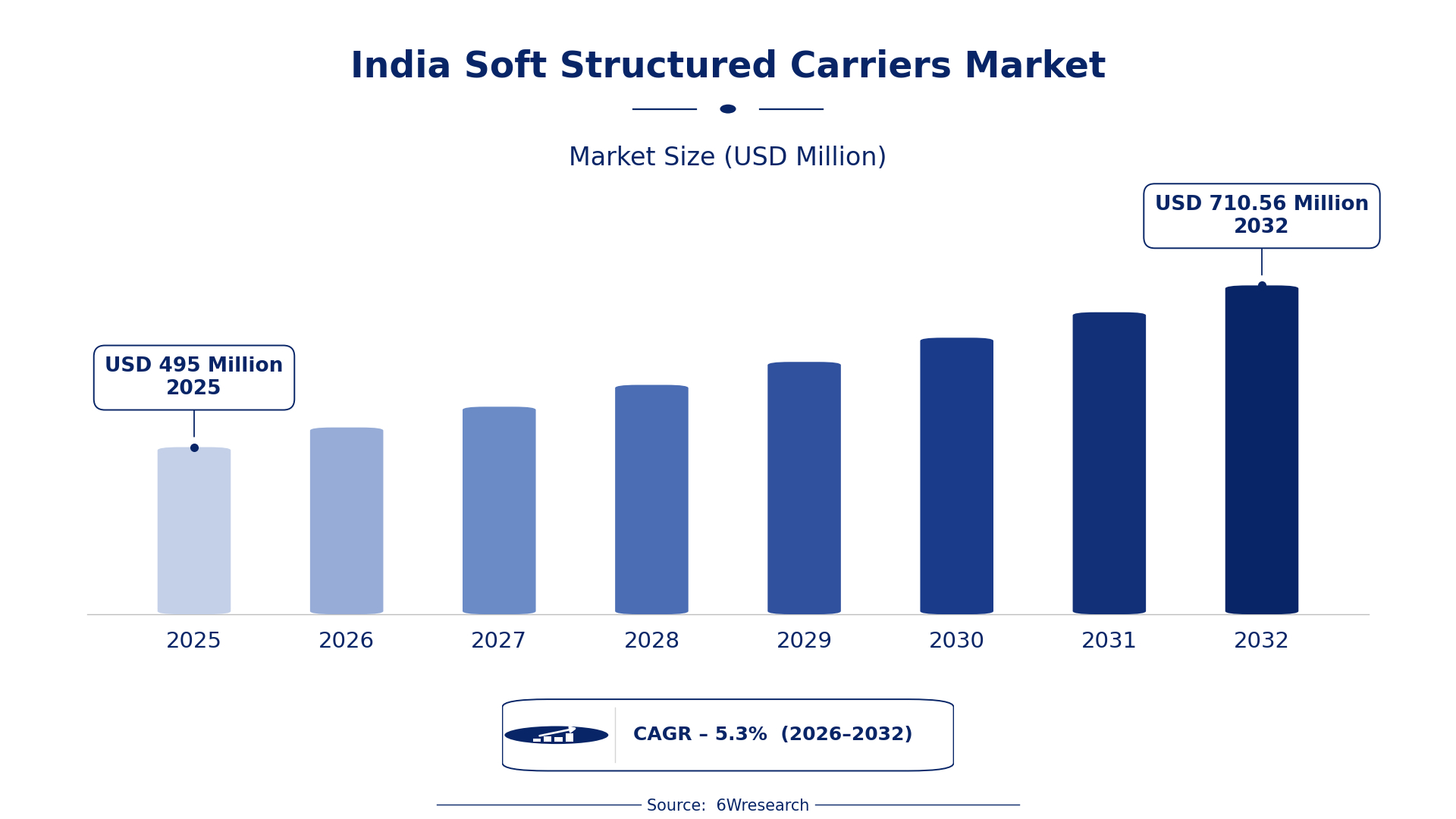
According to 6Wresearch internal database and industry insights, the India Soft Structured Carriers Market was valued at USD 495.0 million in 2025 and is projected to reach USD 710.56 million by 2032, growing at a CAGR of approximately 5.3% during 2026–2032.
India Soft Structured Carriers Market Highlights
| Report Metric | Details |
| Report Name | India Soft Structured Carriers Market |
| Market Size 2025 | USD 495.0 million |
| Market Size 2032 | USD 710.56 million |
| Absolute Growth 2025–2032 | USD 215.56 million |
| CAGR 2026–2032 | 5.3% |
| Peak Annual Growth | 7.7% in 2027 |
| Forecast Period | 2026–2032 |
| Historical Data | 2022–2025 |
| Base Year | 2025 |
| Leading Carrier Type, 2025 | Convertible Carrier (41% share) |
| Leading Weight Capacity, 2025 | Up to 20 kg (35% share) |
| Leading Material Type, 2025 | Cotton/Polyester Blend (44% share) |
| Leading End User, 2025 | New Parents (38% share) |
| Fastest-Growing Carrier Type | Ergonomic Carrier (7.4% CAGR) |
| Fastest-Growing Weight Capacity | Up to 15 kg (6.5% CAGR) |
| Fastest-Growing Material Type | Breathable Mesh (7.6% CAGR) |
| Fastest-Growing End User | Travel Families (7.1% CAGR) |
| Growing Sector | Baby Care Products |
| Key End Users | New Parents, Urban Families, Travel Families |
India Soft Structured Carriers Market Year-wise Growth Rate and Key Drivers (2022–2032)
This graph illustrates the annual growth rates of the market from 2022 to 2032, highlighting a steady upward trajectory and projected market expansion over the forecast period.
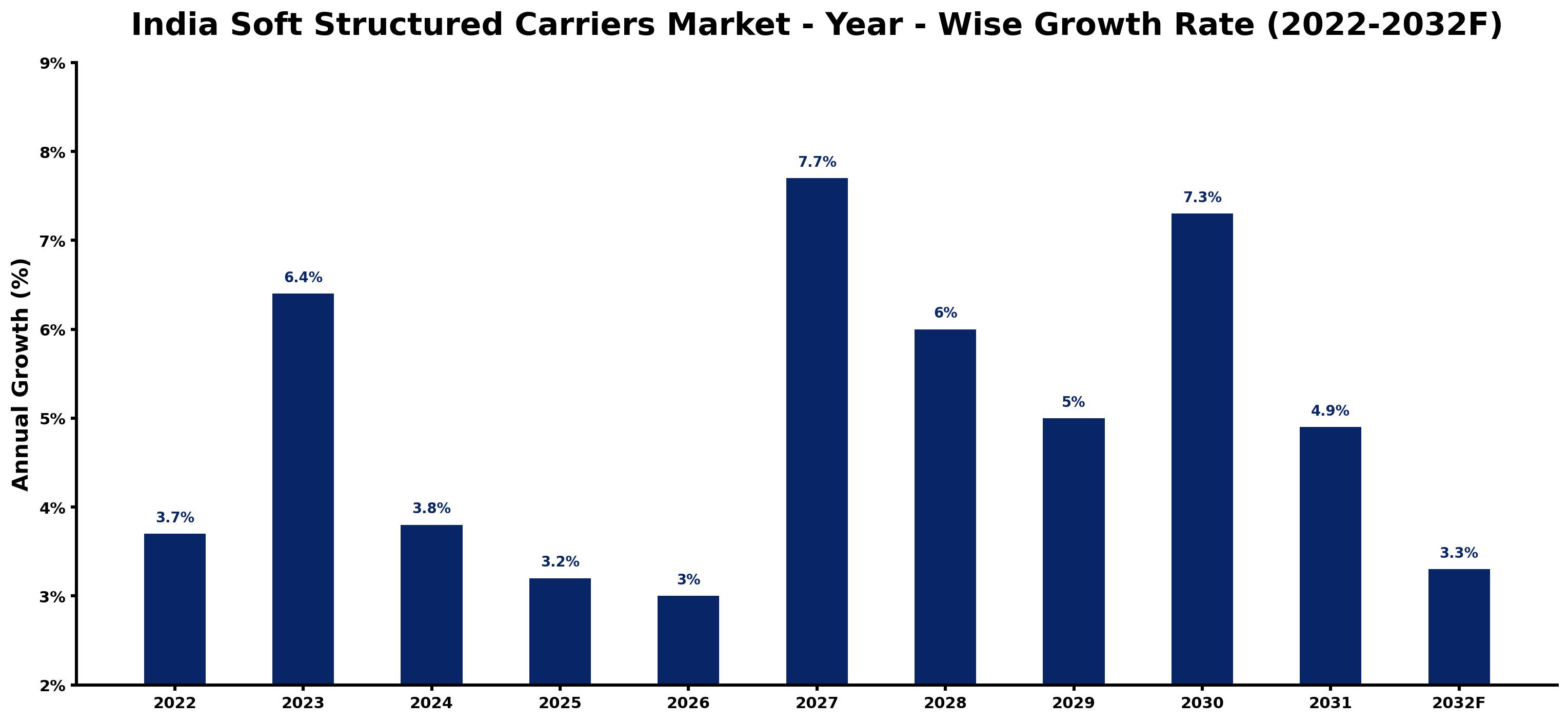
Each row of the following table gives one year's estimated growth and the event or demand shift that explains it.
| Year | Estimated Annual Growth (%) | Market Rationale |
| 2022 | 3.7 | The market showed steady growth, reflecting increasing urbanisation and demand for baby carriers. |
| 2023 | 6.4 | Growth was driven by heightened awareness of child safety and comfort among parents. |
| 2024 | 3.8 | Demand slowed as consumers adjusted to market conditions and explored alternatives. |
| 2025 | 3.2 | The market continued to grow, but at a slower pace due to changing consumer preferences. |
| 2026 | 3.0 | Growth further slowed as the market stabilised, with consumers becoming more discerning. |
| 2027 | 7.7 | The market peaked with a surge in demand for ergonomic carriers among new parents. |
| 2028 | 6.0 | Growth decelerated as competition increased and consumer choices diversified. |
| 2029 | 5.0 | A further slowdown occurred as market saturation began to influence purchasing behaviour. |
| 2030 | 7.3 | Demand rose again, driven by new product innovations and marketing strategies. |
| 2031 | 4.9 | Growth slowed as the market matured and consumer expectations evolved. |
| 2032 | 3.3 | The market continued to grow, albeit at a slower rate, as demand stabilised. |
Note: Market size estimations and growth projections presented in this report are based on 6Wresearch's proprietary forecasting methodology, utilizing the latest available industry data, government publications, and primary research inputs.
India Soft Structured Carriers Market Synopsis
Soft Structured Carriers in India include ergonomic baby carriers crafted for comfort and ease of use, primarily from breathable fabrics like cotton and polyester blends. These carriers enable parents to carry infants and toddlers while keeping their hands free. The India Soft Structured Carriers Market is growing due to rising demand from urban families and new parents, who make up around 40% of the market. Urban areas contribute over 60% of the demand, highlighting a vibrant baby care industry. The average preferred weight capacity of carriers reaches up to 20 kg, further driving purchases.
Market Dynamics Impact Analysis (2026–2032)
| Factor | Type | Impact | Primary Segment Affected |
| Growing urbanisation leads to increased demand for convenient baby carrying solutions. | Driver | High | Ergonomic Carrier |
| The rise in disposable income allows families to invest in quality baby products. | Driver | High | Convertible Carrier |
| The demand for organic and eco-friendly products is increasing among environmentally conscious parents. | Opportunity | Medium | Organic Cotton |
| The growing trend of travel families seeking portable solutions creates market potential. | Opportunity | Medium | Travel Families |
| Competition from other baby carrying solutions may limit market share for soft structured carriers. | Restraint | High | Convertible Carrier |
| Consumer preferences are shifting towards multi-functional carriers, impacting traditional designs. | Restraint | Medium | Hip Seat Carrier |
| Supply chain disruptions can delay product availability and affect sales. | Challenge | High | Convertible Carrier |
| Rising production costs due to material price increases can impact profitability. | Challenge | Medium | Convertible Carrier |
Evaluation of Drivers in India Soft Structured Carriers Market (2026–2032)
The table below links each growth driver to the segment it affects and the evidence for it.
| Drivers | Primary Segment Affected | Why It Matters (Evidence) |
| Increased awareness of child safety and ergonomic design drives demand for soft structured carriers. | Ergonomic Carrier | New parents prioritising comfort constitute approximately 40% of the market. |
| Urbanisation leads to a higher demand for portable baby carriers among city-dwelling families. | Convertible Carrier | Urban areas account for over 60% of the demand for baby carriers. |
| The popularity of eco-friendly products encourages parents to choose organic options. | Organic Cotton | Organic cotton products are certified under the Global Organic Textile Standard, appealing to eco-conscious consumers. |
| Rising disposable incomes enable families to invest in quality baby products. | Convertible Carrier | The average price range for these carriers is between INR 2,000 to INR 5,000, making them accessible to many families. |
| The trend towards travel families seeking convenience boosts sales of portable carriers. | Travel Families | Baby product retailers in urban areas reported a 15% increase in sales of soft structured carriers in 2023. |
Expansion of the Soft Structured Carriers market in India is backed by rising awareness of child safety, urbanisation, and increasing disposable incomes. New parents are prioritising ergonomic designs, while urban areas account for a significant portion of demand. The average price range for these carriers is between INR 2,000 to INR 5,000, making them accessible to many families. The trend towards eco-friendly products is also gaining traction, with organic cotton options attracting health-conscious buyers. Baby product retailers in urban areas reported a 15% increase in sales of soft structured carriers in 2023, indicating strong market growth.
Evaluation of Restraints in India Soft Structured Carriers Market
Below mentioned are some major restraints and their influence on market dynamics.
| Market Restraint | Primary Segment Affected | Why It Matters (Evidence) |
| Intense competition from alternative baby carrying solutions may limit market growth. | Convertible Carrier | The presence of various baby carrier types creates challenges for market penetration. |
| Shifting consumer preferences towards multi-functional carriers can impact traditional designs. | Hip Seat Carrier | Consumers are increasingly looking for versatility in baby carriers. |
| Supply chain disruptions can lead to delays in product availability and affect sales. | Convertible Carrier | Recent global events have caused instability in material sourcing, impacting production timelines. |
| Rising production costs due to material price increases can impact profitability. | Convertible Carrier | Manufacturers face challenges in maintaining margins amid rising costs of raw materials. |
| Limited awareness of safety standards among consumers may hinder market growth. | Convertible Carrier | Not all parents are informed about the National Standards for Baby Products, affecting their purchasing decisions. |
India Soft Structured Carriers Market Challenges
Buyers in the India Soft Structured Carriers market face supply chain disruptions due to reliance on specific material sources, which delays product availability for new parents. Rising costs of cotton and polyester blends, the preferred materials, can inflate retail prices by up to 20%, making carriers less affordable for urban families. Regulatory compliance with the National Standards for Baby Products adds complexity for suppliers, often resulting in additional costs that can increase prices by 10-15%. A shortage of skilled workers in local manufacturing also hampers production efficiency, potentially extending lead times for retailers by several weeks.
Trends in the India Soft Structured Carriers Market
Several trends are reshaping the India Soft Structured Carriers Market; the most important are set out below.
- Shift from Traditional to Ergonomic Carriers: Since 2020, there has been a noticeable shift towards ergonomic carriers that promote child safety and comfort. The growing awareness among new parents about the benefits of these designs has led to a 15% increase in sales in urban areas.
- Rise of Eco-Friendly Materials in Baby Carriers: In 2021, the market saw a rise in demand for eco-friendly materials, particularly organic cotton. The certification under the Global Organic Textile Standard has attracted environmentally conscious parents, contributing to a growing segment of the market.
- Increase in Portable Solutions for Travel Families: The trend of travel families seeking portable baby carriers has gained momentum since 2023. This shift is evidenced by a 15% increase in sales of soft structured carriers among retailers catering to urban families.
- Growing Demand for Multi-Functional Carriers: Since 2021, the market has seen a growing preference for multi-functional carriers that adapt to various carrying styles. This trend is driven by urban parents looking for versatility in their baby carrying solutions.
Investment Opportunities in the India Soft Structured Carriers Market
Investors looking at the India Soft Structured Carriers Market should consider the following areas.
- Gap in Eco-Friendly Carrier Options: With the rising interest in organic products, there is an opportunity to supply eco-friendly carriers. Urban parents are increasingly seeking sustainable options, and the market for organic cotton products is expanding.
- Demand for Portable Solutions: The need for portable baby carriers among travel families is growing, presenting an opportunity to invest in lightweight designs. Retailers in urban areas are well-positioned to cater to this demand, especially as travel resumes.
- Investment in Ergonomic Designs: The market gap for ergonomic carriers is substantial, with new parents prioritising comfort. Investing in ergonomic designs can attract this key buyer group, enhancing market presence.
- Timing for New Product Launches: With the market projected to reach USD 710.56 million by 2032, now is an ideal time to introduce new products. Engaging with urban families through targeted marketing strategies can drive sales.
Government Initiatives in the India Soft Structured Carriers Market
The Bureau of Indian Standards updated the 'IS 15895:2019' for baby carriers in 2021, enhancing safety regulations for manufacturers. This update requires producers to adhere to stricter guidelines regarding materials and safety features, ensuring higher quality products for consumers. Additionally, the 'Make in India' initiative, launched in 2014, continues to support local production of baby products, including soft structured carriers. This initiative aims to boost domestic manufacturing capabilities, encouraging investment in local facilities. As a result, manufacturers are incentivised to improve production processes and expand their offerings, contributing to market growth.
In 2022, the National Health Mission implemented guidelines for safe carrying practices for infants, influencing consumer choices in baby carriers. The Ministry of Women and Child Development oversees this initiative, which promotes awareness about safe carrying techniques among parents. Furthermore, the Ministry of Textiles announced a subsidy scheme in 2021 for manufacturers using organic materials, promoting sustainable practices in the baby product sector. This scheme encourages the adoption of eco-friendly materials, appealing to environmentally conscious consumers and enhancing the market's appeal. These measures collectively aim to improve product safety and sustainability in the India Soft Structured Carriers market.
Future Insight of the India Soft Structured Carriers Market
Several forward-looking factors should support the India Soft Structured Carriers market in the coming years. The 'Make in India' programme is expected to enhance local production capabilities, allowing suppliers to meet rising consumer demand more effectively. Increased awareness of child safety will drive innovation in design and materials, particularly with eco-friendly options gaining traction. By 2032, urban families can anticipate a broader selection of soft structured carriers, as the market continues to evolve and adapt to consumer preferences.
Market Segmentation Analysis
The analysis below covers each segmentation, its leading category in 2025 and its fastest-growing category through 2032.
By Carrier Type – Convertible Carrier Dominated, Ergonomic Carrier Expected to Grow Fastest
According to Summon Dutta, Assistant Manager at 6Wresearch, Convertible Carrier held a 41% share of the India Soft Structured Carriers Market by carrier type in 2025. The Convertible Carrier holds the largest market share as it provides multiple carrying positions, appealing to parents who want a versatile product that adapts to their child's growth. This feature is particularly valued by urban families who appreciate the flexibility in accommodating different carrying preferences. The quickest growth will come from Ergonomic Carrier, forecast to expand at a CAGR of 7.4% between 2026 and 2032. The Ergonomic Carrier is experiencing rapid growth because parents are increasingly aware of the importance of comfort and healthy posture for both themselves and their children. This trend is particularly pronounced in urban areas, where the demand for carriers supporting child safety and comfort is on the rise. Suppliers should prioritise ergonomic designs in their offerings to align with the growing focus on child safety and comfort among parents.
By Weight Capacity – Up to 20 kg Dominated, Up to 15 kg Expected to Grow Fastest
The largest weight capacity category in 2025 was Up to 20 kg, with a 35% share of total revenue. The Up to 20 kg segment holds a leading market share as it effectively accommodates growing toddlers, making it a preferred choice among urban families. This weight capacity aligns with the demands of parents who require durable carriers that can support their children through various stages of growth. Over 2026–2032, Up to 15 kg is expected to post the fastest growth, at a CAGR of 6.5%. The Up to 15 kg segment is witnessing rapid growth because new parents often opt for lighter carriers that are ideal for smaller infants. This trend indicates a strong preference for convenience and mobility, particularly in bustling urban settings where ease of movement is essential. Suppliers should focus on expanding their offerings in the lighter weight category to attract new parents looking for practical and user-friendly solutions.
By Material Type – Cotton/Polyester Blend Dominated, Breathable Mesh Expected to Grow Fastest
In 2025, Cotton/Polyester Blend led the material type split with a 44% share. The Cotton/Polyester Blend holds the largest market share due to its durability and comfort, making it the go-to choice for many parents. This material's popularity is reinforced by its ability to withstand daily use while providing a soft touch for infants. Breathable Mesh is set to record the highest CAGR in this split, 7.6% over 2026–2032. The Breathable Mesh segment is experiencing rapid growth as parents seek carriers that offer better ventilation, especially in warmer climates. This demand is particularly strong in urban areas where comfort during hot weather is a priority for families. Suppliers should invest in developing more breathable options to cater to the increasing preference for comfort and ventilation among consumers.
By End User – New Parents Dominated, Travel Families Expected to Grow Fastest
New Parents accounted for a 38% market share by end user in 2025. New Parents dominate the market share as they are the primary users seeking convenience and comfort for their infants. This group represents a substantial portion of the demand, reflecting the growing trend of hands-free parenting in urban environments. Travel Families are projected to grow fastest, at a CAGR of 7.1% during 2026–2032. Travel Families are driving the fastest growth, as they require portable solutions that facilitate easy transport during trips. This segment's expansion is indicative of a lifestyle shift towards travel and mobility among modern families. Retailers should tailor their marketing strategies to highlight the portability and convenience of carriers for families on the go.
Key Attractiveness of the Report
- 10 Years of Market Numbers
- Historical Data Starting from 2022 to 2025
- Base Year 2025
- Forecast Data until 2032
- Key Performance Indicators Impacting the Market
- Major Upcoming Developments and Projects
Key Highlights of the Report:
- India Soft Structured Carriers Market Outlook
- Market Size of India Soft Structured Carriers Market, 2025
- Forecast of India Soft Structured Carriers Market, 2032
- Historical Data and Forecast of India Soft Structured Carriers Revenues & Volume for the Period 2022 - 2032F
- India Soft Structured Carriers Market Trend Evolution
- India Soft Structured Carriers Market Drivers and Challenges
- India Soft Structured Carriers Price Trends
- India Soft Structured Carriers Porter's Five Forces
- India Soft Structured Carriers Industry Life Cycle
- Historical Data and Forecast of India Soft Structured Carriers Market Revenues & Volume By Carrier Type for the Period 2022 - 2032F
- Historical Data and Forecast of India Soft Structured Carriers Market Revenues & Volume By Front-Facing Carrier for the Period 2022 - 2032F
- Historical Data and Forecast of India Soft Structured Carriers Market Revenues & Volume By Hip Seat Carrier for the Period 2022 - 2032F
- Historical Data and Forecast of India Soft Structured Carriers Market Revenues & Volume By Ergonomic Carrier for the Period 2022 - 2032F
- Historical Data and Forecast of India Soft Structured Carriers Market Revenues & Volume By Convertible Carrier for the Period 2022 - 2032F
- Historical Data and Forecast of India Soft Structured Carriers Market Revenues & Volume By Weight Capacity for the Period 2022 - 2032F
- Historical Data and Forecast of India Soft Structured Carriers Market Revenues & Volume By Up to 15 kg for the Period 2022 - 2032F
- Historical Data and Forecast of India Soft Structured Carriers Market Revenues & Volume By Up to 20 kg for the Period 2022 - 2032F
- Historical Data and Forecast of India Soft Structured Carriers Market Revenues & Volume By Up to 25 kg for the Period 2022 - 2032F
- Historical Data and Forecast of India Soft Structured Carriers Market Revenues & Volume By Multi-Position for the Period 2022 - 2032F
- Historical Data and Forecast of India Soft Structured Carriers Market Revenues & Volume By Material Type for the Period 2022 - 2032F
- Historical Data and Forecast of India Soft Structured Carriers Market Revenues & Volume By Cotton/Polyester Blend for the Period 2022 - 2032F
- Historical Data and Forecast of India Soft Structured Carriers Market Revenues & Volume By Breathable Mesh for the Period 2022 - 2032F
- Historical Data and Forecast of India Soft Structured Carriers Market Revenues & Volume By Organic Cotton for the Period 2022 - 2032F
- Historical Data and Forecast of India Soft Structured Carriers Market Revenues & Volume By Eco-Friendly Fabric for the Period 2022 - 2032F
- Historical Data and Forecast of India Soft Structured Carriers Market Revenues & Volume By End User for the Period 2022 - 2032F
- Historical Data and Forecast of India Soft Structured Carriers Market Revenues & Volume By New Parents for the Period 2022 - 2032F
- Historical Data and Forecast of India Soft Structured Carriers Market Revenues & Volume By Travel Families for the Period 2022 - 2032F
- Historical Data and Forecast of India Soft Structured Carriers Market Revenues & Volume By Urban Parents for the Period 2022 - 2032F
- Historical Data and Forecast of India Soft Structured Carriers Market Revenues & Volume By Baby Product Retailers for the Period 2022 - 2032F
- India Soft Structured Carriers Import Export Trade Statistics
- Market Opportunity Assessment By Carrier Type
- Market Opportunity Assessment By Weight Capacity
- Market Opportunity Assessment By Material Type
- Market Opportunity Assessment By End User
- India Soft Structured Carriers Top Companies Market Share
- India Soft Structured Carriers Competitive Benchmarking By Technical and Operational Parameters
- India Soft Structured Carriers Company Profiles
- India Soft Structured Carriers Key Strategic Recommendations
Market Covered
This report examines the market across the segments below.
By Carrier Type
- Front-Facing Carrier
- Hip Seat Carrier
- Ergonomic Carrier
- Convertible Carrier
By Weight Capacity
- Up to 15 kg
- Up to 20 kg
- Up to 25 kg
- Multi-Position
By Material Type
- Cotton/Polyester Blend
- Breathable Mesh
- Organic Cotton
- Eco-Friendly Fabric
By End User
- New Parents
- Travel Families
- Urban Parents
- Baby Product Retailers































