India Soil Erosion Control Market Size & Growth Rate
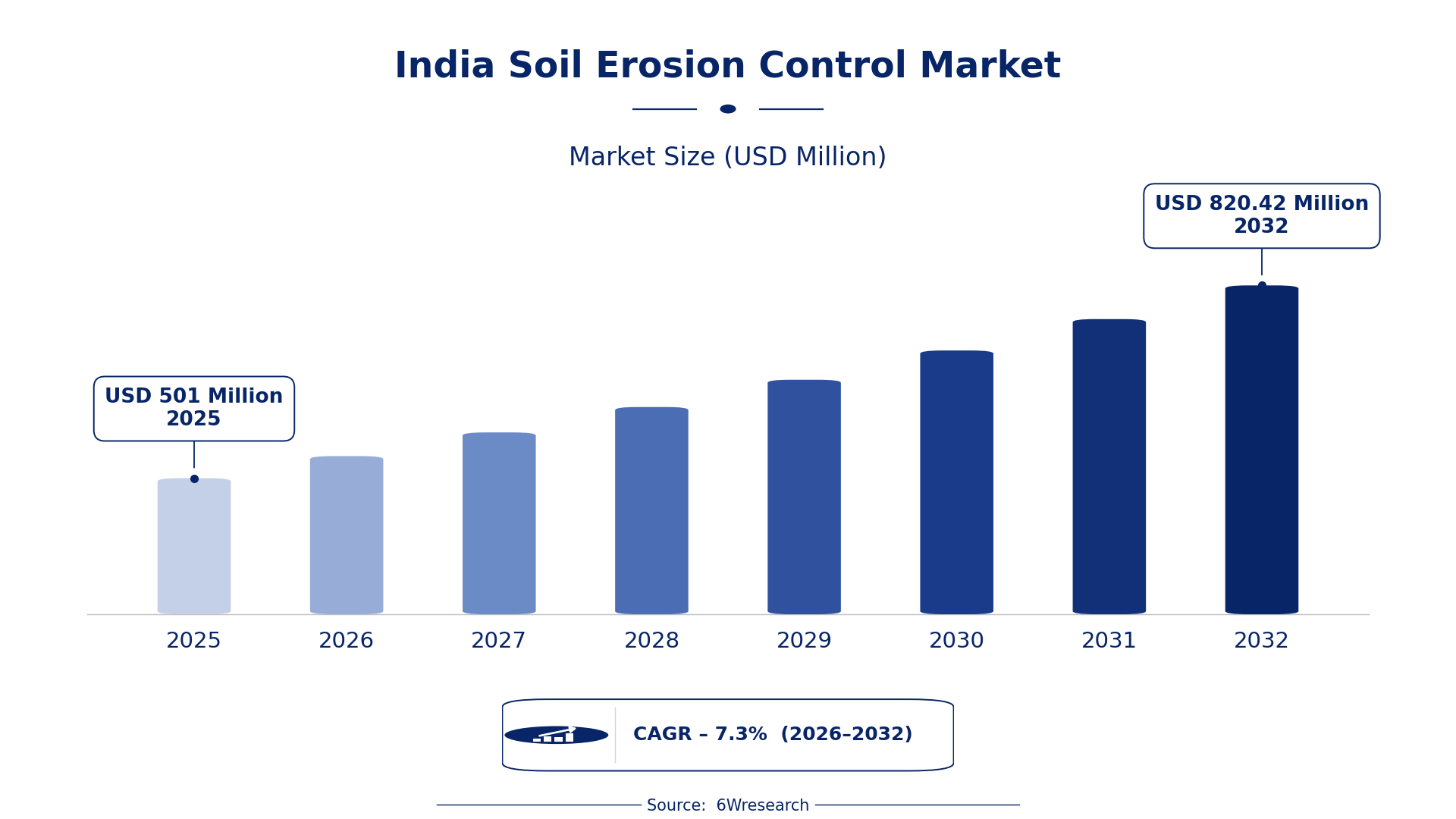
According to 6Wresearch internal database and industry insights, the India Soil Erosion Control Market was valued at USD 501.0 million in 2025 and is projected to reach USD 820.42 million by 2032, growing at a CAGR of approximately 7.3% during 2026–2032.
India Soil Erosion Control Market Highlights
| Report Metric | Details |
| Report Name | India Soil Erosion Control Market |
| Market Size 2025 | USD 501.0 million |
| Market Size 2032 | USD 820.42 million |
| Absolute Growth 2025–2032 | USD 319.42 million |
| CAGR 2026–2032 | 7.3% |
| Peak Annual Growth | 9.2% in 2031 |
| Forecast Period | 2026–2032 |
| Historical Data | 2022–2025 |
| Base Year | 2025 |
| Leading Solution Type, 2025 | Erosion Control Blankets (50% share) |
| Leading Material Used, 2025 | Coir/Straw (54% share) |
| Leading Installation Type, 2025 | Permanent (40% share) |
| Leading End User, 2025 | Road Construction Firms (47% share) |
| Fastest-Growing Solution Type | Geotextiles (10.0% CAGR) |
| Fastest-Growing Material Used | Organic Material (8.8% CAGR) |
| Fastest-Growing Installation Type | Engineered (9.1% CAGR) |
| Fastest-Growing End User | Infrastructure Agencies (9.1% CAGR) |
| Growing Sector | infrastructure |
| Key End Users | Road Construction Firms, Infrastructure Agencies, Plantation Owners, Mining Companies |
India Soil Erosion Control Market Year-wise Growth Rate and Key Drivers (2022–2032)
This graph illustrates the annual growth rates of the market from 2022 to 2032, highlighting a steady upward trajectory and projected market expansion over the forecast period.
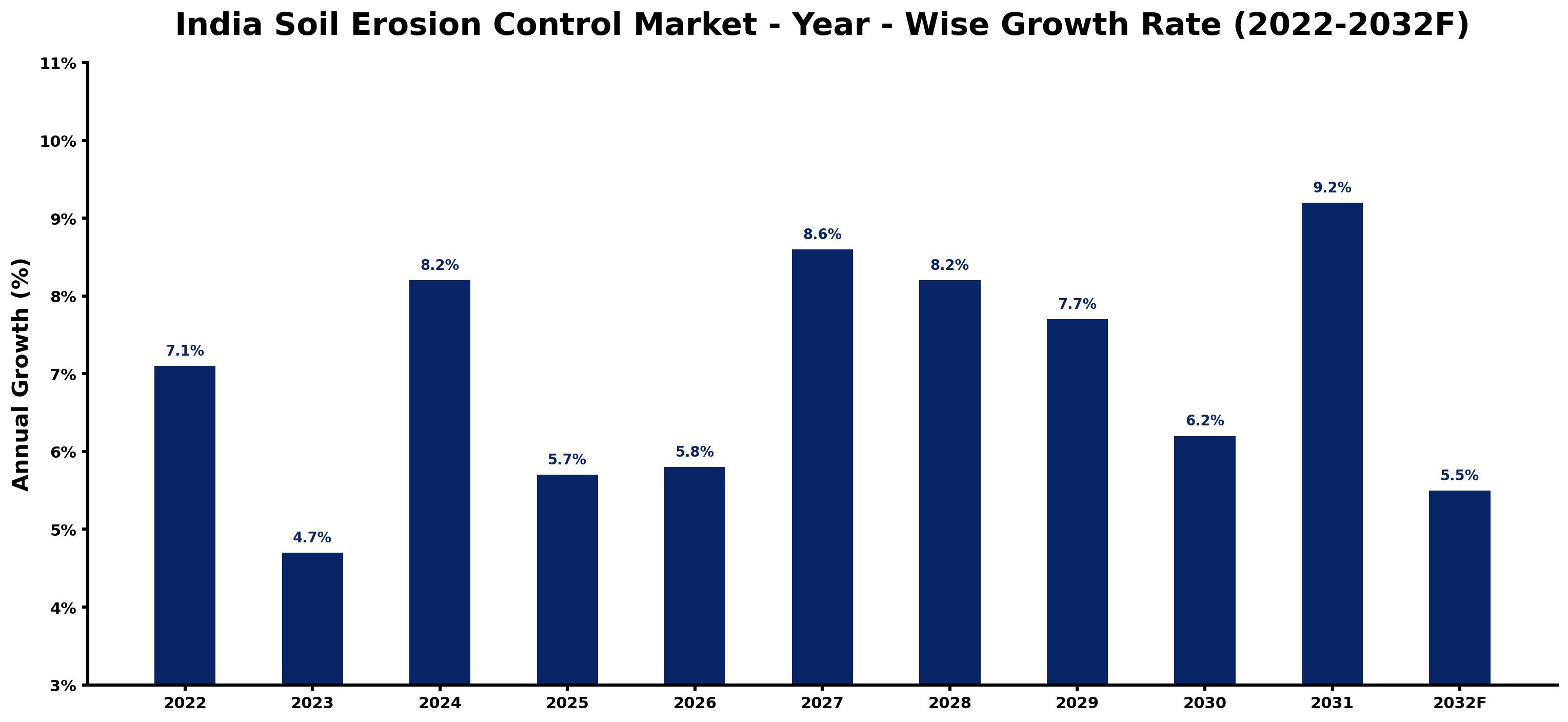
The table below sets out the estimated growth rate for each year and the main factor behind it.
| Year | Estimated Annual Growth (%) | Market Rationale |
| 2022 | 7.1 | The market experienced solid growth due to ongoing infrastructure projects and agricultural demand. |
| 2023 | 4.7 | Growth slowed as some projects faced delays, affecting demand for erosion control solutions. |
| 2024 | 8.2 | Increased awareness of soil health led to a surge in demand for erosion control measures. |
| 2025 | 5.7 | Demand remained strong as construction activities continued, though growth slowed slightly. |
| 2026 | 5.8 | A rise in government initiatives boosted demand for erosion control technologies and materials. |
| 2027 | 8.6 | Investment in infrastructure projects led to a significant increase in demand for erosion control solutions. |
| 2028 | 8.2 | Growth slowed as the market adjusted to previous high levels of demand in construction. |
| 2029 | 7.7 | Demand continued to grow, driven by environmental regulations and sustainable practices. |
| 2030 | 6.2 | A slight slowdown occurred as some sectors faced budget constraints affecting project timelines. |
| 2031 | 9.2 | Demand surged again due to new government initiatives aimed at soil conservation and restoration. |
| 2032 | 5.5 | Growth slowed as the market stabilised, but demand remains strong due to ongoing projects. |
Note: Market size estimations and growth projections presented in this report are based on 6Wresearch's proprietary forecasting methodology, utilizing the latest available industry data, government publications, and primary research inputs.
India Soil Erosion Control Market Synopsis
Soil Erosion Control in India includes techniques and materials designed to prevent soil degradation, such as geotextiles and erosion control blankets. These solutions safeguard landscapes, boost agricultural productivity, and support infrastructure initiatives. The India Soil Erosion Control Market is growing, spurred by domestic projects and environmental regulations. The National Mission for Sustainable Agriculture and the Ministry of Environment's land restoration programme are key drivers of this demand. With a population exceeding 1.3 billion, effective soil management practices are increasingly important.
Market Dynamics Impact Analysis (2026–2032)
| Factor | Type | Impact | Primary Segment Affected |
| Rising government initiatives promoting sustainable agriculture practices | Driver | High | Erosion Control Blankets |
| Growing awareness among construction firms about soil stability | Driver | High | Geotextiles |
| Increasing investment in infrastructure projects across states | Opportunity | High | Road Construction Firms |
| Shift towards organic materials for eco-friendly solutions | Opportunity | Medium | Organic Material |
| Budget constraints affecting project timelines in construction | Restraint | High | Retaining Walls |
| Limited availability of skilled labour for installation | Restraint | Medium | Manual |
| Regulatory compliance costs impacting project budgets | Challenge | High | Infrastructure Agencies |
| Delays in government approvals for new projects | Challenge | Medium | Plantation Owners |
Evaluation of Drivers in India Soil Erosion Control Market (2026–2032)
The main growth drivers and the segments they affect most are set out below.
| Drivers | Primary Segment Affected | Why It Matters (Evidence) |
| Government initiatives like the National Mission for Sustainable Agriculture promote erosion control measures, driving demand. | Erosion Control Blankets | In 2023, the government allocated ₹2,000 crores for soil health initiatives, increasing purchases. |
| Construction firms are increasingly aware of the importance of soil stability in projects, driving demand for geotextiles. | Geotextiles | Geotextiles are utilized in over 60% of new road construction projects to ensure soil stability. |
| Investment in infrastructure projects is rising, leading to increased demand for erosion control solutions. | Road Construction Firms | In 2023, Maharashtra and Karnataka allocated funds for implementing erosion control measures in construction projects. |
| The shift towards organic materials reflects a growing preference for sustainable erosion control practices. | Organic Material | Organic mulching practices have gained popularity among 40% of farmers in southern India, promoting soil conservation. |
| The implementation of environmental regulations mandates erosion control measures in various sectors, boosting demand. | Retaining Walls | The National Green Tribunal has mandated erosion control measures in mining operations to mitigate environmental impact. |
The National Mission for Sustainable Agriculture promotes soil health, resulting in greater demand for erosion control solutions. Investment in infrastructure projects is on the rise, particularly in Maharashtra and Karnataka, further driving demand for effective erosion control solutions. Geotextiles are used in over 60% of new road construction projects, ensuring soil stability.
Evaluation of Restraints in India Soil Erosion Control Market
The following restraints limit how fast demand can grow.
| Market Restraint | Primary Segment Affected | Why It Matters (Evidence) |
| Budget constraints affecting project timelines limit the adoption of erosion control solutions. | Retaining Walls | Many construction firms face budget cuts, delaying the implementation of necessary erosion control measures. |
| Limited availability of skilled labour for installation hampers project execution. | Manual | The shortage of trained personnel affects the timely installation of erosion control solutions, causing project delays. |
| Regulatory compliance costs impact project budgets, reducing demand for erosion control measures. | Infrastructure Agencies | Higher compliance costs can deter investment in essential erosion control technologies, affecting project viability. |
| Delays in government approvals for new projects slow down market growth. | Plantation Owners | Approval delays can postpone the implementation of erosion control measures in agricultural practices, affecting productivity. |
| Market volatility due to fluctuating material costs affects purchasing decisions. | Geotextiles | Rising costs of raw materials can deter construction firms from investing in erosion control solutions, impacting project timelines. |
India Soil Erosion Control Market Challenges
Buyers and suppliers in the India Soil Erosion Control market encounter strict regulatory challenges, as the National Green Tribunal requires erosion control measures in mining operations, complicating compliance for operators. Distributors face supply chain issues due to reliance on geotextiles, which are integral to over 60% of new road construction projects; delays in sourcing these materials can disrupt project timelines for construction firms. Producers are experiencing rising costs, particularly as government funding for retaining walls in flood-prone areas can unexpectedly inflate project budgets. Technological advancements are progressing slowly, as the Central Soil and Water Conservation Research and Training Institute continues to develop effective erosion control technologies, delaying implementation for farmers.
Trends in the India Soil Erosion Control Market
Four trends stand out in the India Soil Erosion Control Market.
- Shift towards Organic Materials: Organic materials for erosion control are gaining traction, with 40% of farmers in southern India adopting organic mulching practices. This trend reflects a growing preference for sustainable solutions that promote soil health and conservation.
- Increase in Government Initiatives: The National Mission for Sustainable Agriculture, launched in 2021, aims to promote soil health and erosion control. This initiative has led to increased funding and support for projects focused on sustainable practices, benefiting local farmers.
- Rise of Geotextiles in Road Construction: Geotextiles are increasingly mandated in road construction projects, with over 60% of new projects incorporating these materials. This shift improves soil stability and reduces erosion in sensitive areas, particularly in hilly regions.
- Growing Demand from Infrastructure Agencies: Infrastructure agencies are prioritising erosion control measures in public works, driven by regulatory mandates. This focus is expected to increase demand for effective solutions across various projects, particularly in urban development.
Investment Opportunities in the India Soil Erosion Control Market
Investors looking at the India Soil Erosion Control Market should consider the following areas.
- Infrastructure Agencies Seeking Sustainable Solutions: Infrastructure agencies are increasingly looking for sustainable erosion control solutions, with a projected budget of ₹2,000 crores for the National Afforestation Programme. Suppliers can enter this market through partnerships with local agencies to provide effective materials.
- Road Construction Firms Needing Effective Materials: Road construction firms require effective erosion control materials, with a growing market for practical solutions. Suppliers can engage through joint ventures with established construction companies to meet this demand.
- Growing Interest in Organic Materials: With 40% of farmers adopting organic mulching practices, there is an opportunity to supply organic erosion control materials. Suppliers can enter by obtaining necessary certifications for organic products to cater to this market segment.
- Demand for Retaining Walls in Flood-Prone Areas: The government allocated funds for constructing retaining walls in flood-prone areas, estimated at ₹2,000 crores. Suppliers can participate by collaborating with local contractors to meet this growing demand.
Government Initiatives in the India Soil Erosion Control Market
In 2023, the Ministry of Road Transport and Highways introduced guidelines for erosion control in road construction, mandating the use of geotextiles in sensitive areas. This measure builds on the Soil Health Card Scheme, updated in 2022, which provides farmers with soil health assessments to promote sustainable practices, including erosion control. Such regulations enhance the quality of erosion control solutions and ensure compliance among producers. The National Afforestation Programme, initiated in 2020, aims to restore degraded land through erosion control measures, with a budget of ₹2,000 crores, further supporting sustainable practices. These frameworks collectively strengthen the foundation for effective soil management in India.
The Central Soil and Water Conservation Research and Training Institute plays a vital role in developing innovative erosion control technologies, focusing on sustainable practices for farmers. The Bureau of Indian Standards approves guidelines for the use of geotextiles in construction projects, ensuring that materials meet quality standards. The Ministry of Environment funds initiatives under the National Mission for Clean Ganga, which includes soil erosion control measures along riverbanks to prevent sedimentation. Such funding is crucial for implementing effective erosion control in various sectors, including agriculture and infrastructure.
Future Insight of the India Soil Erosion Control Market
The India Soil Erosion Control market is expected to evolve significantly by 2032, driven by the National Mission for Sustainable Agriculture promoting soil health initiatives. Increased government funding for restoring 26 million hectares of degraded land will create new opportunities for suppliers and producers. The rise of organic practices among 40% of farmers in southern India will influence market dynamics and product offerings. The Bureau of Indian Standards' guidelines will standardise practices, ensuring improved quality and consistency in erosion control solutions.
Market Segmentation Analysis
The analysis below covers each segmentation, its leading category in 2025 and its fastest-growing category through 2032.
By Solution Type – Erosion Control Blankets Dominated, Geotextiles Expected to Grow Fastest
According to Summon Dutta, Assistant Manager at 6Wresearch, Erosion Control Blankets accounted for a 50% market share by solution type in 2025. Erosion control blankets hold the largest market share due to their widespread application in slope stabilization and vegetation support, especially in highway projects across hilly regions. Their effectiveness in enhancing soil stability makes them a preferred choice among construction firms in India. Over 2026–2032, Geotextiles are expected to post the fastest growth, at a CAGR of 10.0%. Geotextiles are experiencing rapid growth as they are utilised in over 60% of new road construction projects, driven by the increasing demand for improved soil reinforcement and drainage. This trend indicates a shift towards more advanced soil management solutions, further widening their market share. Suppliers should focus on developing geotextile products to capture the growing demand in the Indian soil erosion control market.
By Material Used – Coir/Straw Dominated, Organic Material Expected to Grow Fastest
Coir/Straw took a 54% share of material used in 2025, more than any other category. Coir/straw leads the market due to its eco-friendly nature, making it a preferred choice for users seeking sustainable erosion control solutions. The rising awareness of environmental impact drives its adoption in various projects throughout India. Organic Material is projected to grow fastest, at a CAGR of 8.8% during 2026–2032. Organic materials are rapidly gaining traction as 40% of farmers in southern India adopt them for soil conservation, reflecting a shift towards sustainable practices. This growing preference indicates a significant opportunity for suppliers to innovate in this segment. Buyers are likely to seek more organic options, prompting suppliers to diversify their product offerings in the soil erosion control market.
By Installation Type – Permanent Dominated, Engineered Expected to Grow Fastest
With a 40% revenue share in 2025, Permanent was the largest installation type category. Permanent installations dominate the market as they provide long-lasting solutions essential for infrastructure stability, particularly in flood-prone areas. Their reliability makes them the preferred choice for construction firms managing erosion risks. The quickest growth will come from Engineered, forecast to expand at a CAGR of 9.1% between 2026 and 2032. Engineered solutions are witnessing the fastest growth as they are specifically designed to address complex erosion challenges, reflecting the increasing sophistication of infrastructure projects. This trend suggests that while permanent solutions remain essential, engineered options will gain prominence. Suppliers should invest in engineered solutions to meet the evolving demands of infrastructure agencies in the soil erosion control market.
By End User – Road Construction Firms Dominated, Infrastructure Agencies Expected to Grow Fastest
In 2025, Road Construction Firms led the end user split with a 47% share. Road construction firms represent the largest share of the market, as they are major users of erosion control measures to stabilise construction sites. Their continuous projects highlight the critical need for effective soil management practices in the sector. Infrastructure Agencies are set to record the highest CAGR in this split, 9.1% over 2026–2032. Infrastructure agencies are the fastest-growing end users, responsible for implementing erosion control in public works, particularly in response to government initiatives. This growth indicates a shift towards more structured approaches to soil management in public infrastructure. Suppliers should align their strategies with the needs of infrastructure agencies to capitalise on the expanding opportunities in the soil erosion control market.
Key Attractiveness of the Report
- 10 Years of Market Numbers
- Historical Data Starting from 2022 to 2025
- Base Year 2025
- Forecast Data until 2032
- Key Performance Indicators Impacting the Market
- Major Upcoming Developments and Projects
Key Highlights of the Report:
- India Soil Erosion Control Market Outlook
- Market Size of India Soil Erosion Control Market, 2025
- Forecast of India Soil Erosion Control Market, 2032
- Historical Data and Forecast of India Soil Erosion Control Revenues & Volume for the Period 2022 - 2032F
- India Soil Erosion Control Market Trend Evolution
- India Soil Erosion Control Market Drivers and Challenges
- India Soil Erosion Control Price Trends
- India Soil Erosion Control Porter's Five Forces
- India Soil Erosion Control Industry Life Cycle
- Historical Data and Forecast of India Soil Erosion Control Market Revenues & Volume By Solution Type for the Period 2022 - 2032F
- Historical Data and Forecast of India Soil Erosion Control Market Revenues & Volume By Erosion Control Blankets for the Period 2022 - 2032F
- Historical Data and Forecast of India Soil Erosion Control Market Revenues & Volume By Geotextiles for the Period 2022 - 2032F
- Historical Data and Forecast of India Soil Erosion Control Market Revenues & Volume By Mulching for the Period 2022 - 2032F
- Historical Data and Forecast of India Soil Erosion Control Market Revenues & Volume By Retaining Walls for the Period 2022 - 2032F
- Historical Data and Forecast of India Soil Erosion Control Market Revenues & Volume By Material Used for the Period 2022 - 2032F
- Historical Data and Forecast of India Soil Erosion Control Market Revenues & Volume By Coir/Straw for the Period 2022 - 2032F
- Historical Data and Forecast of India Soil Erosion Control Market Revenues & Volume By Synthetic Fiber for the Period 2022 - 2032F
- Historical Data and Forecast of India Soil Erosion Control Market Revenues & Volume By Organic Material for the Period 2022 - 2032F
- Historical Data and Forecast of India Soil Erosion Control Market Revenues & Volume By Concrete for the Period 2022 - 2032F
- Historical Data and Forecast of India Soil Erosion Control Market Revenues & Volume By Installation Type for the Period 2022 - 2032F
- Historical Data and Forecast of India Soil Erosion Control Market Revenues & Volume By Temporary for the Period 2022 - 2032F
- Historical Data and Forecast of India Soil Erosion Control Market Revenues & Volume By Permanent for the Period 2022 - 2032F
- Historical Data and Forecast of India Soil Erosion Control Market Revenues & Volume By Manual for the Period 2022 - 2032F
- Historical Data and Forecast of India Soil Erosion Control Market Revenues & Volume By Engineered for the Period 2022 - 2032F
- Historical Data and Forecast of India Soil Erosion Control Market Revenues & Volume By End User for the Period 2022 - 2032F
- Historical Data and Forecast of India Soil Erosion Control Market Revenues & Volume By Road Construction Firms for the Period 2022 - 2032F
- Historical Data and Forecast of India Soil Erosion Control Market Revenues & Volume By Infrastructure Agencies for the Period 2022 - 2032F
- Historical Data and Forecast of India Soil Erosion Control Market Revenues & Volume By Plantation Owners for the Period 2022 - 2032F
- Historical Data and Forecast of India Soil Erosion Control Market Revenues & Volume By Mining Companies for the Period 2022 - 2032F
- India Soil Erosion Control Import Export Trade Statistics
- Market Opportunity Assessment By Solution Type
- Market Opportunity Assessment By Material Used
- Market Opportunity Assessment By Installation Type
- Market Opportunity Assessment By End User
- India Soil Erosion Control Top Companies Market Share
- India Soil Erosion Control Competitive Benchmarking By Technical and Operational Parameters
- India Soil Erosion Control Company Profiles
- India Soil Erosion Control Key Strategic Recommendations
Market Covered
The report offers an extensive study of the following market segments.
By Solution Type
- Erosion Control Blankets
- Geotextiles
- Mulching
- Retaining Walls
By Material Used
- Coir/Straw
- Synthetic Fiber
- Organic Material
- Concrete
By Installation Type
- Temporary
- Permanent
- Manual
- Engineered
By End User
- Road Construction Firms
- Infrastructure Agencies
- Plantation Owners
- Mining Companies































