India Sugar Byproducts Market Size & Growth Rate
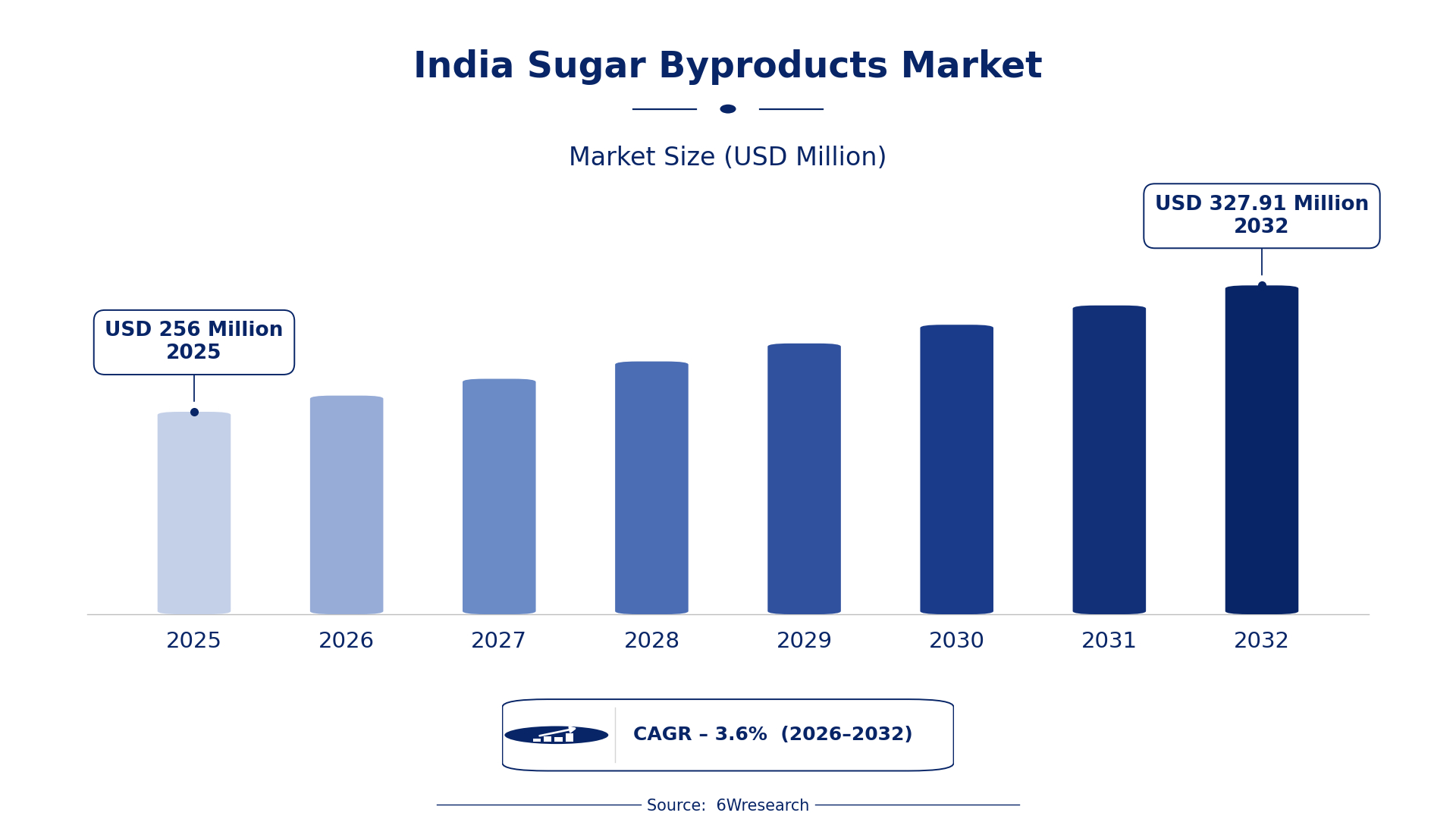
According to 6Wresearch internal database and industry insights, the India Sugar Byproducts Market was valued at USD 256.0 million in 2025 and is projected to reach USD 327.91 million by 2032, growing at a CAGR of approximately 3.6% during 2026–2032.
India Sugar Byproducts Market Highlights
| Report Metric | Details |
| Report Name | India Sugar Byproducts Market |
| Market Size 2025 | USD 256.0 million |
| Market Size 2032 | USD 327.91 million |
| Absolute Growth 2025–2032 | USD 71.91 million |
| CAGR 2026–2032 | 3.6% |
| Peak Annual Growth | 5.8% in 2031 |
| Forecast Period | 2026–2032 |
| Historical Data | 2022–2025 |
| Base Year | 2025 |
| Leading Byproduct Type, 2025 | Molasses (42% share) |
| Leading Processing Method, 2025 | Centrifugal Separation (39% share) |
| Leading Application Area, 2025 | Ethanol Production (43% share) |
| Leading End User, 2025 | Biofuel Companies (51% share) |
| Fastest-Growing Byproduct Type | Bagasse (6.3% CAGR) |
| Fastest-Growing Processing Method | Filtration (4.8% CAGR) |
| Fastest-Growing End User | Biomass Plants (5.1% CAGR) |
| Growing Sector | Biofuel Production |
| Key End Users | Biofuel Companies, Biomass Plants, Cattle Feed Producers, Organic Agri Producers |
India Sugar Byproducts Market Year-wise Growth Rate and Key Drivers (2022–2032)
This graph illustrates the annual growth rates of the market from 2022 to 2032, highlighting a steady upward trajectory and projected market expansion over the forecast period.
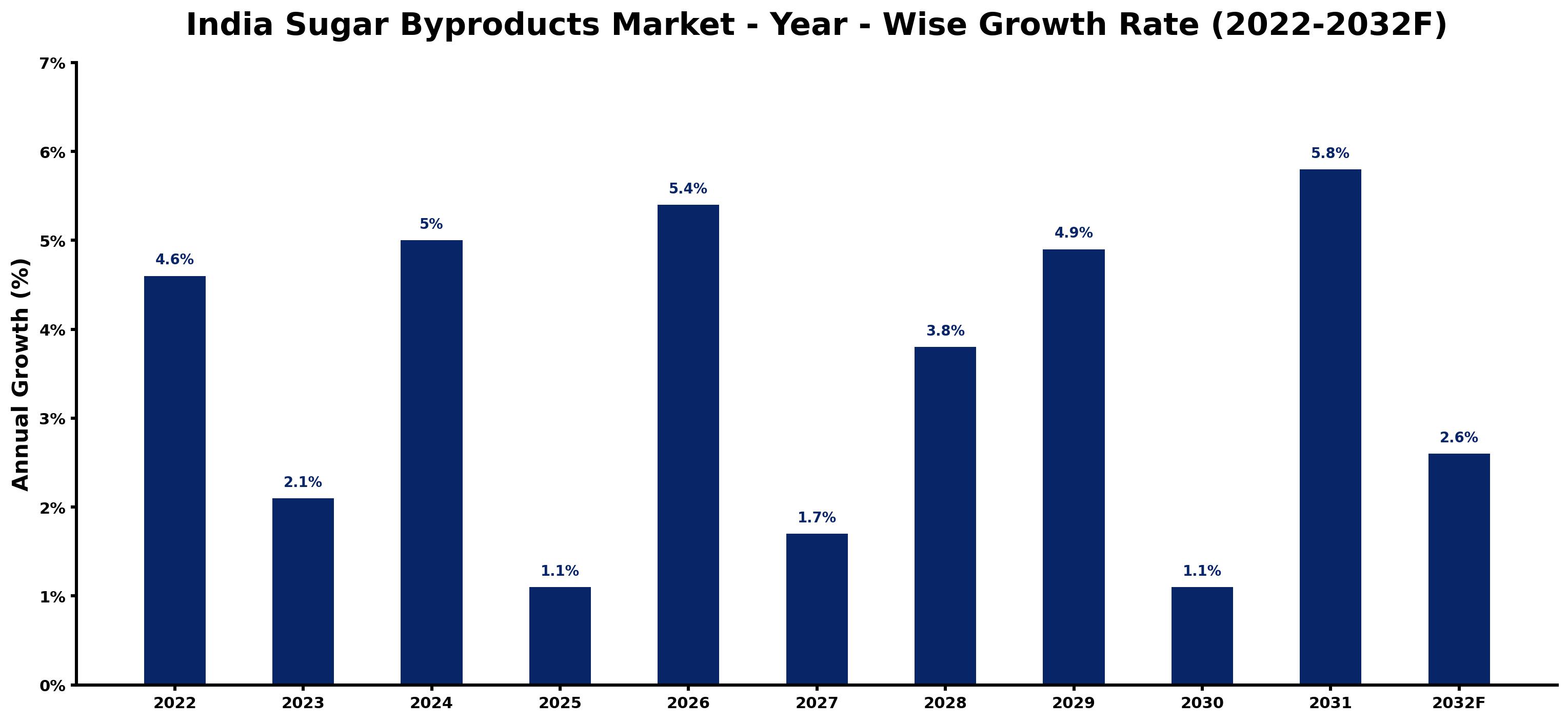
Each row of the following table gives one year's estimated growth and the event or demand shift that explains it.
| Year | Estimated Annual Growth (%) | Market Rationale |
| 2022 | 4.6 | The market showed strong domestic demand for sugar byproducts, particularly in Uttar Pradesh. |
| 2023 | 2.1 | Growth slowed as the market adjusted to fluctuations in sugar production levels. |
| 2024 | 5.0 | Increased ethanol production drove a resurgence in demand for molasses and bagasse. |
| 2025 | 1.1 | A slowdown in growth occurred as biofuel initiatives faced temporary delays. |
| 2026 | 5.4 | Renewed interest in biofuels is expected to spur demand for sugar byproducts, particularly ethanol. |
| 2027 | 1.7 | Growth is projected to slow as the market faces challenges in supply chain logistics. |
| 2028 | 3.8 | An increase in biomass power generation projects is expected to revitalise demand for bagasse. |
| 2029 | 4.9 | Demand will rise as biofuel companies expand their operations and production capacities. |
| 2030 | 1.1 | Growth is projected to slow due to regulatory changes affecting production processes. |
| 2031 | 5.8 | A peak in growth will be driven by the government's Ethanol Blending Programme. |
| 2032 | 2.6 | Growth will moderate as the market stabilises after reaching peak production levels. |
Note: Market size estimations and growth projections presented in this report are based on 6Wresearch's proprietary forecasting methodology, utilizing the latest available industry data, government publications, and primary research inputs.
India Sugar Byproducts Market Synopsis
Sugar Byproducts Market in India includes byproducts from sugarcane processing, such as molasses, bagasse, and press mud. These byproducts play a crucial role in ethanol production, power generation, and animal feed. The India Sugar Byproducts Market is growing due to robust domestic demand, particularly from the biofuel and agricultural sectors. The National Biofuel Policy 2018 aims to increase ethanol blending, further propelling the market. High production levels in states like Uttar Pradesh and Maharashtra support this positive trend.
Market Dynamics Impact Analysis (2026–2032)
| Factor | Type | Impact | Primary Segment Affected |
| Strong domestic demand for ethanol production drives molasses usage. | Driver | High | Molasses |
| Bagasse is increasingly utilised in biomass power generation. | Driver | High | Bagasse |
| Investment in ethanol production facilities presents growth opportunities. | Opportunity | High | Ethanol Production |
| Growing interest in organic fertilizers from press mud creates market potential. | Opportunity | Medium | Press Mud |
| Regulatory challenges affect the quality standards for sugar byproducts. | Restraint | High | Molasses |
| Fluctuations in sugarcane production impact byproduct availability. | Restraint | Medium | Molasses |
| The Sugar Byproducts Market in India faces significant regulatory hurdles. | Challenge | High | Molasses |
| Supply chain disruptions can delay production and distribution. | Challenge | Medium | Molasses |
Evaluation of Drivers in India Sugar Byproducts Market (2026–2032)
The main growth drivers and the segments they affect most are set out below.
| Drivers | Primary Segment Affected | Why It Matters (Evidence) |
| Increased ethanol production from molasses drives demand. | Molasses | India's molasses production is estimated at 4 million tons annually, primarily used for ethanol. |
| Bagasse is used in over 100 biomass power plants. | Bagasse | This creates a consistent demand for bagasse as a renewable energy source. |
| The National Biofuel Policy 2018 promotes ethanol blending. | Ethanol Production | This policy aims for 20% ethanol blending by 2025, increasing demand for sugar byproducts. |
| Growing use of press mud as organic fertilizer supports sustainable agriculture. | Press Mud | Press mud is increasingly used as an organic fertilizer, improving soil health. |
| Expansion of biofuel production units boosts market growth. | Ethanol Production | The Ethanol Blending Programme launched in 2023 encourages production from sugar byproducts. |
Expansion of the Sugar Byproducts market in India is driven by rising ethanol production, strong domestic demand, and investments in renewable energy. Bagasse is now utilised in over 100 biomass power plants, generating renewable energy and ensuring steady demand. The growing interest in organic fertilizers has boosted the use of press mud, further contributing to market growth. These developments are prompting purchases from biofuel companies and agricultural sectors.
Evaluation of Restraints in India Sugar Byproducts Market
The table below lists the restraints and the evidence behind each.
| Market Restraint | Primary Segment Affected | Why It Matters (Evidence) |
| Regulatory challenges complicate the quality standards for sugar byproducts. | Molasses | The Bureau of Indian Standards has established strict quality requirements, affecting producers' compliance. |
| Fluctuations in sugarcane production impact byproduct availability. | Molasses | India produced approximately 30 million tons of sugar in 2022, influencing byproduct supply. |
| Limited awareness among farmers about byproduct applications restricts market growth. | Press Mud | Many organic agri producers lack knowledge of the benefits of using press mud as fertilizer. |
| Infrastructure limitations hinder the transportation of sugar byproducts. | Bagasse | Bagasse's use in biomass power plants is affected by inadequate logistics for supply. |
| Competition from alternative energy sources affects bagasse demand. | Bagasse | The rise of solar and wind energy projects presents challenges for biomass utilisation. |
India Sugar Byproducts Market Challenges
The India Sugar Byproducts Market encounters a challenge with buyers facing difficulties in securing consistent quality from suppliers, as sugar byproducts differ across regions. This inconsistency raises costs for producers who must invest in quality control, ultimately increasing prices for end users by approximately 10%. Regulatory hurdles, such as the Fertilizer Control Order, complicate the use of byproducts as fertilizers, causing delays for farmers seeking to use these materials effectively. Technological constraints in processing facilities limit the efficient conversion of byproducts into value-added products, hindering growth opportunities for suppliers in the market.
Trends in the India Sugar Byproducts Market
Buyers and suppliers in the India Sugar Byproducts Market are adjusting to the following trends.
- Shift towards Ethanol Production: The National Biofuel Policy 2018 has accelerated the transition towards ethanol production from sugar byproducts. With a target of 20% blending by 2025, this policy is expected to drive molasses demand, estimated at 4 million tons annually.
- Increased Use of Organic Fertilizers: Farmers are increasingly adopting press mud as an organic fertilizer, motivated by the National Mission on Sustainable Agriculture. This initiative promotes sustainable practices, enhancing soil health while supporting the organic farming sector.
- Expansion of Biomass Power Generation: Bagasse is being increasingly utilised in biomass power plants, with over 100 facilities operating across India. This trend supports renewable energy objectives while creating a stable demand for bagasse as a biomass resource.
- Growth in Biofuel Companies: Biofuel companies are expanding their operations, encouraged by government incentives and policies. The Ethanol Blending Programme launched in 2023 is anticipated to boost production capacities, increasing overall demand for sugar byproducts.
Investment Opportunities in the India Sugar Byproducts Market
Some of the investment opportunities in the India Sugar Byproducts Market are mentioned below.
- Investment in Ethanol Production Facilities: The Ethanol Blending Programme launched in 2023 presents an opportunity for investment in ethanol production facilities. With a target of 20% blending by 2025, biofuel companies are key players in this sector.
- Expansion of Biomass Power Plants: With over 100 biomass power plants in operation, there is a growing opportunity to supply bagasse for energy generation. Investing in logistics and partnerships with biomass plants can facilitate market entry.
- Utilisation of Press Mud as Organic Fertilizer: The increasing demand for organic fertilizers creates an opportunity to supply press mud to organic agri producers. Collaborating with local farmers can facilitate market penetration and promote sustainability.
- Development of Quality Standards for Byproducts: Establishing quality standards for sugar byproducts can improve market credibility. Engaging with the Bureau of Indian Standards can facilitate compliance and improve market access.
Government Initiatives in the India Sugar Byproducts Market
The Biofuel Policy 2021, introduced by the Ministry of New and Renewable Energy, supports the establishment of biofuel production units and promotes the use of sugar byproducts for renewable energy. This policy complements the National Biofuel Policy 2018, which aims for 20% ethanol blending by 2025, enhancing market potential for sugar byproducts. The National Sugar Policy 2021 seeks to stabilise sugar prices and improve farmers' income through better utilisation of byproducts, creating a more favourable environment for producers.
The Ministry of Agriculture's Pradhan Mantri Kisan Samman Nidhi Yojana offers financial support to farmers cultivating sugarcane. This scheme encourages sugarcane production for byproduct generation, benefiting farmers and boosting the sugar byproducts market. Additionally, the National Mission on Sustainable Agriculture promotes the use of organic fertilizers, including sugar byproducts, to improve soil health, supporting sustainable agricultural practices.
Future Insight of the India Sugar Byproducts Market
Several promising factors should support the India Sugar Byproducts Market in the coming years. The National Policy on Biofuels aims to achieve 20% ethanol blending by 2025, which will increase the demand for sugar byproducts. The Ethanol Blending Programme launched in 2023 will further enhance production capabilities. As biomass power plants increasingly utilise bagasse, renewable energy generation will expand, creating new revenue streams for producers. Improved standards from the Bureau of Indian Standards will elevate product quality, benefiting both buyers and suppliers.
Market Segmentation Analysis
Each segment group is reviewed below, with the leader by share and the fastest grower by CAGR.
By Byproduct Type – Molasses Dominated, Bagasse Expected to Grow Fastest
According to Sumit Sagar, AM at 6Wresearch, the largest byproduct type category in 2025 was Molasses, with a 42% share of total revenue. Molasses holds the largest share due to its critical role in ethanol production, which is essential for India's biofuel objectives. With an estimated annual output of 4 million tons, it is a primary resource for domestic biofuel initiatives. Bagasse is projected to grow fastest, at a CAGR of 6.3% during 2026–2032. Bagasse is witnessing rapid growth as over 100 biomass power plants across India increasingly utilise it for renewable energy generation. This surge is driven by government policies that promote the use of sugar byproducts in energy production. Suppliers should enhance production capabilities to meet the rising demand for molasses and bagasse in the biofuel sector.
By Processing Method – Centrifugal Separation Dominated, Filtration Expected to Grow Fastest
With a 39% revenue share in 2025, Centrifugal Separation was the largest processing method category. Centrifugal Separation commands the largest share as it is crucial for the sugar extraction process, maximising yield from sugarcane. Its widespread use in sugar mills across India solidifies its dominant position in processing methods. The quickest growth will come from Filtration, forecast to expand at a CAGR of 4.8% between 2026 and 2032. Filtration is growing quickly due to its vital role in clarifying sugar solutions, which is essential for maintaining quality in sugar production. As quality standards tighten, the demand for effective filtration techniques will continue to rise. Buyers and suppliers must invest in advanced processing technologies to improve efficiency and comply with quality standards in sugar byproduct production.
By Application Area – Ethanol Production Dominated and Is Expected to Record the Fastest Growth
Ethanol Production accounted for a 43% market share by application area in 2025. Ethanol Production leads the market as the primary application for sugar byproducts, driven by government initiatives to enhance biofuel usage. The target of achieving 20% ethanol blending by 2025 highlights the importance of this application area. Its lead should widen, with a projected CAGR of 4.7% during 2026–2032, the highest in this split. Ethanol Production is also the fastest-growing area due to the government's Ethanol Blending Programme launched in 2023, which aims to boost production from sugar byproducts. This dual role as both leader and fastest indicates a robust growth trajectory. Suppliers should align strategies with government initiatives to capitalise on expanding opportunities in ethanol production.
By End User – Biofuel Companies Dominated, Biomass Plants Expected to Grow Fastest
Biofuel Companies held a 51% share of the India Sugar Byproducts Market by end user in 2025. Biofuel Companies represent the largest share of end users as they are the primary consumers of ethanol derived from sugar byproducts. Their significant role in the biofuel sector ensures consistent demand for molasses and other byproducts. Over 2026–2032, Biomass Plants are expected to post the fastest growth, at a CAGR of 5.1%. Biomass Plants are experiencing the fastest growth as they increasingly utilise bagasse for energy generation, supported by subsidies and policies that promote renewable energy sources. This trend signifies a shift towards sustainable energy solutions within the market. Suppliers need to strengthen partnerships with biomass plants to tap into the growing demand for renewable energy solutions.
Key Attractiveness of the Report
- 10 Years of Market Numbers
- Historical Data Starting from 2022 to 2025
- Base Year 2025
- Forecast Data until 2032
- Key Performance Indicators Impacting the Market
- Major Upcoming Developments and Projects
Key Highlights of the Report:
- India Sugar Byproducts Market Outlook
- Market Size of India Sugar Byproducts Market, 2025
- Forecast of India Sugar Byproducts Market, 2032
- Historical Data and Forecast of India Sugar Byproducts Revenues & Volume for the Period 2022 - 2032F
- India Sugar Byproducts Market Trend Evolution
- India Sugar Byproducts Market Drivers and Challenges
- India Sugar Byproducts Price Trends
- India Sugar Byproducts Porter's Five Forces
- India Sugar Byproducts Industry Life Cycle
- Historical Data and Forecast of India Sugar Byproducts Market Revenues & Volume By Byproduct Type for the Period 2022 - 2032F
- Historical Data and Forecast of India Sugar Byproducts Market Revenues & Volume By Molasses for the Period 2022 - 2032F
- Historical Data and Forecast of India Sugar Byproducts Market Revenues & Volume By Bagasse for the Period 2022 - 2032F
- Historical Data and Forecast of India Sugar Byproducts Market Revenues & Volume By Press Mud for the Period 2022 - 2032F
- Historical Data and Forecast of India Sugar Byproducts Market Revenues & Volume By Filter Cake for the Period 2022 - 2032F
- Historical Data and Forecast of India Sugar Byproducts Market Revenues & Volume By Processing Method for the Period 2022 - 2032F
- Historical Data and Forecast of India Sugar Byproducts Market Revenues & Volume By Centrifugal Separation for the Period 2022 - 2032F
- Historical Data and Forecast of India Sugar Byproducts Market Revenues & Volume By Pulping for the Period 2022 - 2032F
- Historical Data and Forecast of India Sugar Byproducts Market Revenues & Volume By Filtration for the Period 2022 - 2032F
- Historical Data and Forecast of India Sugar Byproducts Market Revenues & Volume By Lime Clarification for the Period 2022 - 2032F
- Historical Data and Forecast of India Sugar Byproducts Market Revenues & Volume By Application Area for the Period 2022 - 2032F
- Historical Data and Forecast of India Sugar Byproducts Market Revenues & Volume By Ethanol Production for the Period 2022 - 2032F
- Historical Data and Forecast of India Sugar Byproducts Market Revenues & Volume By Power Generation for the Period 2022 - 2032F
- Historical Data and Forecast of India Sugar Byproducts Market Revenues & Volume By Fertilizer Manufacturing for the Period 2022 - 2032F
- Historical Data and Forecast of India Sugar Byproducts Market Revenues & Volume By Animal Feed for the Period 2022 - 2032F
- Historical Data and Forecast of India Sugar Byproducts Market Revenues & Volume By End User for the Period 2022 - 2032F
- Historical Data and Forecast of India Sugar Byproducts Market Revenues & Volume By Biofuel Companies for the Period 2022 - 2032F
- Historical Data and Forecast of India Sugar Byproducts Market Revenues & Volume By Biomass Plants for the Period 2022 - 2032F
- Historical Data and Forecast of India Sugar Byproducts Market Revenues & Volume By Organic Agri Producers for the Period 2022 - 2032F
- Historical Data and Forecast of India Sugar Byproducts Market Revenues & Volume By Cattle Feed Producers for the Period 2022 - 2032F
- India Sugar Byproducts Import Export Trade Statistics
- Market Opportunity Assessment By Byproduct Type
- Market Opportunity Assessment By Processing Method
- Market Opportunity Assessment By Application Area
- Market Opportunity Assessment By End User
- India Sugar Byproducts Top Companies Market Share
- India Sugar Byproducts Competitive Benchmarking By Technical and Operational Parameters
- India Sugar Byproducts Company Profiles
- India Sugar Byproducts Key Strategic Recommendations
Market Covered
The report offers an extensive study of the following market segments.
By Byproduct Type
- Molasses
- Bagasse
- Press Mud
- Filter Cake
By Processing Method
- Centrifugal Separation
- Pulping
- Filtration
- Lime Clarification
By Application Area
- Ethanol Production
- Power Generation
- Fertilizer Manufacturing
- Animal Feed
By End User
- Biofuel Companies
- Biomass Plants
- Organic Agri Producers
- Cattle Feed Producers































