India Sugarcane Byproducts Market Size & Growth Rate
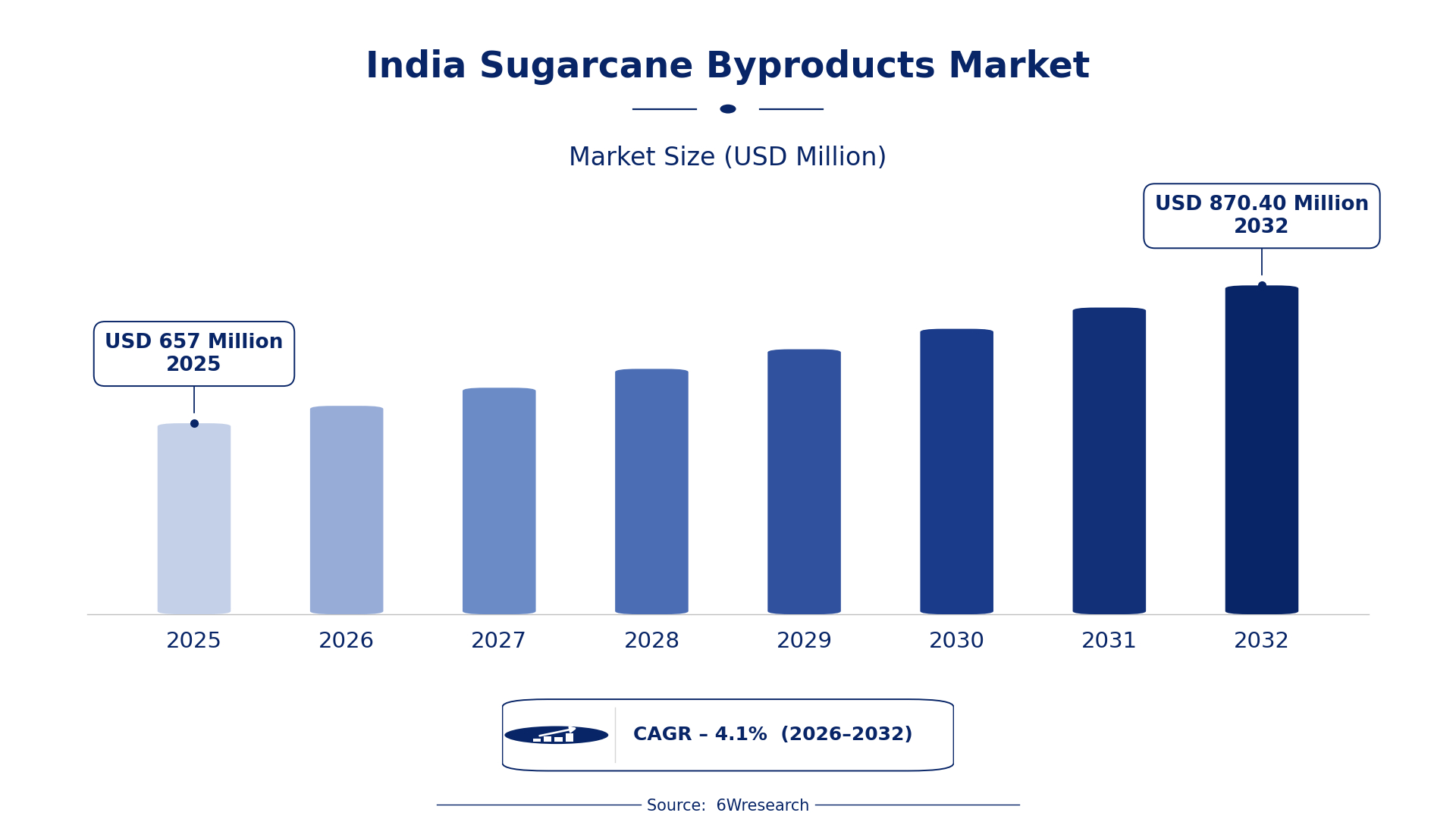
According to 6Wresearch internal database and industry insights, the India Sugarcane Byproducts Market was valued at USD 657.0 million in 2025 and is projected to reach USD 870.40 million by 2032, growing at a CAGR of approximately 4.1% during 2026–2032.
India Sugarcane Byproducts Market Highlights
| Report Metric | Details |
| Report Name | India Sugarcane Byproducts Market |
| Market Size 2025 | USD 657.0 million |
| Market Size 2032 | USD 870.40 million |
| Absolute Growth 2025–2032 | USD 213.40 million |
| CAGR 2026–2032 | 4.1% |
| Peak Annual Growth | 6.1% in 2028 |
| Forecast Period | 2026–2032 |
| Historical Data | 2022–2025 |
| Base Year | 2025 |
| Leading Byproduct Type, 2025 | Bagasse (43% share) |
| Leading Derivative Product, 2025 | Paper Pulp (40% share) |
| Leading Industry Application, 2025 | Packaging Industry (38% share) |
| Leading End User, 2025 | Eco Packaging Firms (35% share) |
| Fastest-Growing Byproduct Type | Molasses (6.2% CAGR) |
| Fastest-Growing Derivative Product | Industrial Alcohol (5.7% CAGR) |
| Fastest-Growing Industry Application | Chemical Industry (6.9% CAGR) |
| Fastest-Growing End User | Solvent Manufacturers (5.9% CAGR) |
| Growing Sector | Chemical Industry |
| Key End Users | Packaging Industry, Chemical Industry, Agriculture, Soil Amendment |
India Sugarcane Byproducts Market Year-wise Growth Rate and Key Drivers (2022–2032)
This graph illustrates the annual growth rates of the market from 2022 to 2032, highlighting a steady upward trajectory and projected market expansion over the forecast period.
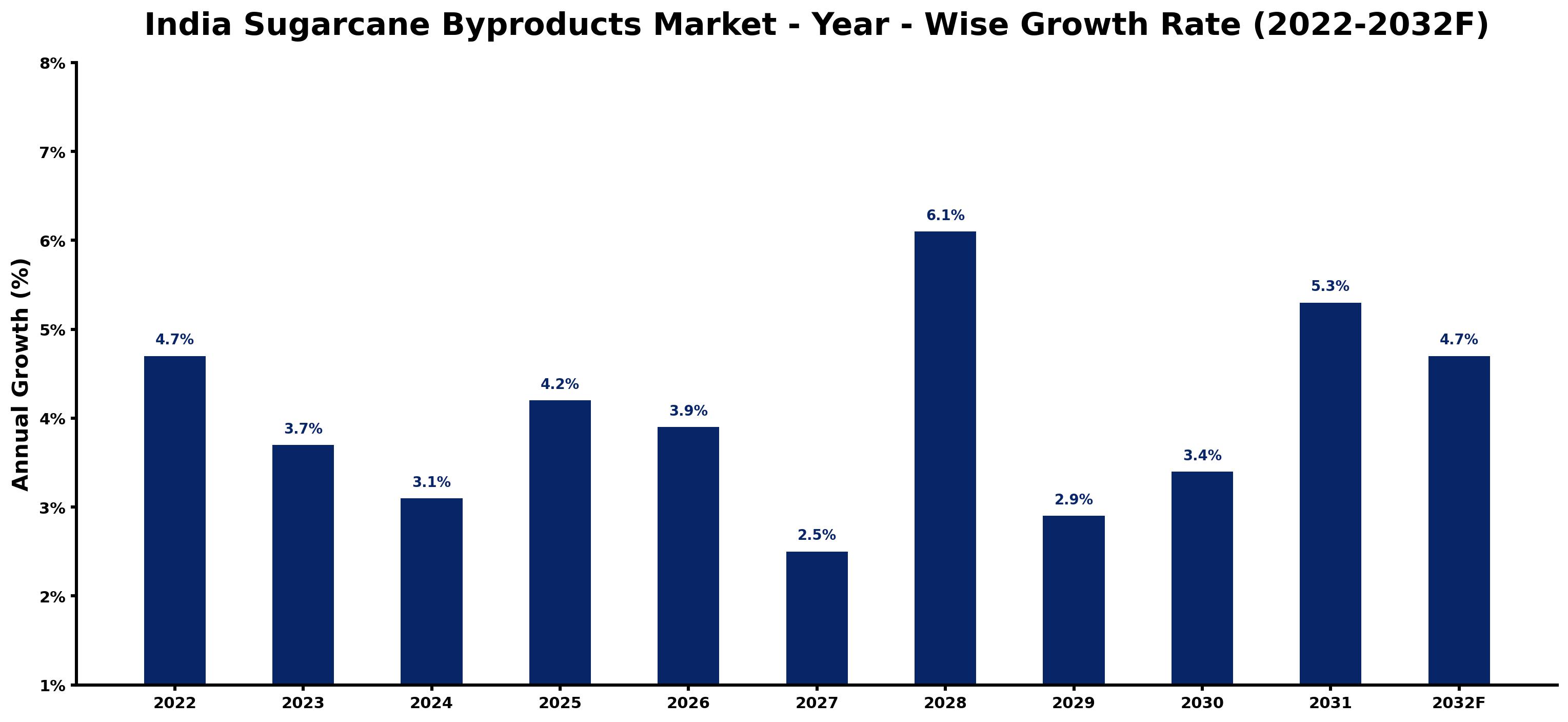
Annual growth estimates for each year appear below with the principal reason behind them, explaining the shifts that set the pace of the market.
| Year | Estimated Annual Growth (%) | Market Rationale |
| 2022 | 4.7 | The market experienced solid growth due to strong domestic demand for sugarcane byproducts. |
| 2023 | 3.7 | Growth slowed as the market adjusted to changing agricultural practices and byproduct utilization. |
| 2024 | 3.1 | A further slowdown occurred as producers faced challenges in meeting quality standards for byproducts. |
| 2025 | 4.2 | The market rebounded with increased interest in sustainable packaging solutions using bagasse. |
| 2026 | 3.9 | Growth slowed again as competition intensified in the bioenergy sector. |
| 2027 | 2.5 | The market continued to grow slowly as producers adapted to new agricultural regulations. |
| 2028 | 6.1 | A surge in demand for industrial alcohol boosted growth significantly this year. |
| 2029 | 2.9 | The growth rate slowed as market saturation began to impact new investments. |
| 2030 | 3.4 | A slight increase in growth occurred as eco-friendly initiatives gained traction. |
| 2031 | 5.3 | Growth accelerated again due to rising investments in cleaner technologies for byproduct utilization. |
| 2032 | 4.7 | The market growth rate slowed as the industry stabilised after a period of rapid expansion. |
Note: Market size estimations and growth projections presented in this report are based on 6Wresearch's proprietary forecasting methodology, utilizing the latest available industry data, government publications, and primary research inputs.
India Sugarcane Byproducts Market Synopsis
Sugarcane Byproducts Market in India includes materials like bagasse, molasses, and vinasse produced during sugarcane processing. These byproducts play an important role in agriculture, packaging, and chemical production. The market is expanding due to rising demand from agriculture and bioenergy sectors, bolstered by initiatives such as the National Biofuel Policy.
Market Dynamics Impact Analysis (2026–2032)
| Factor | Type | Impact | Primary Segment Affected |
| Growing demand for biofuels drives the use of molasses in alcohol production. | Driver | High | Industrial Alcohol |
| Rising interest in eco-friendly packaging solutions boosts the use of bagasse. | Driver | High | Packaging Industry |
| Increased investment in organic farming creates demand for bio-compost from byproducts. | Opportunity | High | Bio-compost |
| The expansion of the chemical industry opens new applications for sugarcane byproducts. | Opportunity | Medium | Chemical Industry |
| Quality control regulations may limit the use of certain byproducts in fertilizers. | Restraint | High | Fertilizer Additive |
| Market saturation in the packaging sector could restrict growth opportunities. | Restraint | Medium | Packaging Industry |
| Producers face challenges in adapting to new agricultural regulations. | Challenge | High | Sugar Mills |
| Competition from alternative materials may hinder market expansion. | Challenge | Medium | Eco Packaging Firms |
Evaluation of Drivers in India Sugarcane Byproducts Market (2026–2032)
The main growth drivers and the segments they affect most are set out below.
| Drivers | Primary Segment Affected | Why It Matters (Evidence) |
| Increased production of industrial alcohol from molasses boosts demand. | Industrial Alcohol | The molasses market in India is valued at around 500 million USD, leading to higher purchases by alcohol manufacturers. |
| Growing use of bagasse in eco-friendly packaging solutions drives demand. | Packaging Industry | Bagasse is increasingly used for sustainable packaging, particularly in urban areas, attracting more buyers. |
| Rising investments in organic farming promote the use of bio-compost. | Bio-compost | The Soil Health Management Scheme supports organic farming, increasing demand for bio-compost derived from sugarcane byproducts. |
| The chemical industry is expanding its applications for sugarcane byproducts. | Chemical Industry | New standards for industrial alcohol production are encouraging more investments in this area. |
| The push for sustainable practices in agriculture boosts demand for soil amendments. | Soil Amendment | Over 60% of sugarcane byproducts are utilized in agriculture, particularly for soil improvement. |
Growth in the Sugarcane Byproducts market in India stems from the increased production of industrial alcohol, heightened investments in organic farming, and the rising use of bagasse in eco-friendly packaging solutions. The molasses market, valued at approximately 500 million USD, fuels purchases by alcohol manufacturers. The Soil Health Management Scheme encourages organic farming, resulting in greater demand for bio-compost. New standards for industrial alcohol production are attracting investments in the chemical sector. The emphasis on sustainable practices in agriculture further elevates the need for soil amendments, with over 60% of sugarcane byproducts applied in agriculture.
Evaluation of Restraints in India Sugarcane Byproducts Market
The following restraints limit how fast demand can grow.
| Market Restraint | Primary Segment Affected | Why It Matters (Evidence) |
| Outdated processing technology leads to high waste rates during byproduct extraction. | Sugar Mills | Many sugar mills operate with outdated equipment, resulting in waste rates of up to 20%. |
| Fluctuating sugar prices create cost pressures for producers. | Bagasse | These pressures can reduce profitability, forcing producers to limit byproduct production. |
| Regulatory hurdles complicate the incorporation of byproducts in fertilizers. | Fertilizer Additive | The Fertilizer Control Order complicates compliance, causing delays for suppliers. |
| Supply chain challenges arise due to high agricultural consumption of byproducts. | Agriculture | Over 60% of byproducts are consumed in agriculture, impacting availability for other industries. |
| Limited market awareness of the benefits of sugarcane byproducts. | Bagasse | Many potential buyers are unaware of the sustainable applications of these byproducts. |
India Sugarcane Byproducts Market Challenges
The India Sugarcane Byproducts Market still has to solve a few problems, and the first is technology. Many sugar mills rely on outdated processing methods, resulting in a waste rate of up to 20% during byproduct extraction, which directly impacts producers' efficiency. Cost pressures also affect profitability, as fluctuating sugar prices can lead to reduced byproduct production, costing suppliers potential revenue. Regulatory hurdles complicate the incorporation of byproducts in fertilizers under the Fertilizer Control Order, causing delays for suppliers in meeting market demands. Supply chain challenges arise since over 60% of sugarcane byproducts are consumed in agriculture, creating competition for resources and limiting availability for other industries.
Trends in the India Sugarcane Byproducts Market
The trends below show where the India Sugarcane Byproducts Market is heading.
- Shift towards Sustainable Packaging Solutions: The National Biofuel Policy is driving the use of bagasse in eco-friendly packaging, particularly in urban markets. This trend is projected to boost demand for sustainable materials by 25% by 2025.
- Transition to Organic Farming Practices: Since 2021, the Ministry of Agriculture's Soil Health Management Scheme has promoted organic farming, resulting in a 30% rise in the use of bio-compost derived from sugarcane byproducts in agriculture.
- Emergence of Bioenergy Applications: In 2022, the Indian Biogas Association began advocating for vinasse in biogas production, increasing its application in over 50% of sugarcane growing regions. This trend is expected to raise biogas production capacity by 15%.
- Growth of Industrial Alcohol Market: The Bureau of Indian Standards has introduced new guidelines for industrial alcohol production from molasses, leading to an anticipated market growth of 6.1% by 2028.
Investment Opportunities in the India Sugarcane Byproducts Market
The following opportunities in the India Sugarcane Byproducts Market pair current demand with a clear way in.
- Eco Packaging Firms Seeking Sustainable Materials: With a growing market for sustainable packaging, eco packaging firms are increasingly looking for bagasse. The market for eco-friendly packaging is projected to reach 200 million USD by 2025, creating opportunities for suppliers.
- Organic Fertilizer Brands Expanding Product Lines: The demand for organic fertilizers is rising, with a market gap of 100 million USD for bio-compost. Organic fertilizer brands are looking to source more bio-compost from sugarcane byproducts.
- Chemical Industry Investing in Byproduct Utilization: The chemical industry is projected to grow by 6.9% in the coming years, creating opportunities for suppliers of sugarcane byproducts. Companies can enter this market by partnering with local manufacturers.
- Research Institutions Exploring New Applications: Research institutions are increasingly studying the potential of bagasse as a bioenergy source. With funding of 50 million USD allocated for research, this presents opportunities for innovation in sustainable energy.
Government Initiatives in the India Sugarcane Byproducts Market
The National Biofuel Policy 2022, introduced by the Ministry of Petroleum and Natural Gas, aims to enhance biofuel production from sugarcane byproducts, targeting a 20% blend by 2025. This policy builds on previous initiatives to promote sustainable energy sources, encouraging the use of molasses for industrial alcohol production. Additionally, the Fertilizer Control Order 2021, issued by the Ministry of Chemicals and Fertilizers, regulates the quality and safety of sugarcane byproducts used in fertilizers, ensuring compliance with industry standards. This regulation helps maintain product integrity and supports agricultural practices that rely on these byproducts.
The Ministry of Agriculture oversees the Soil Health Management Scheme, which supports the use of organic amendments, including sugarcane byproducts, to improve soil fertility. This scheme funds various projects aimed at enhancing agricultural productivity through organic farming practices. Furthermore, the Bureau of Indian Standards develops and approves standards for industrial alcohol production from molasses, ensuring that manufacturers adhere to quality benchmarks. These measures collectively facilitate the integration of sugarcane byproducts into multiple sectors, enhancing their market viability.
Future Insight of the India Sugarcane Byproducts Market
The India Sugarcane Byproducts Market is set for significant changes by 2032, driven by several key factors. The National Policy on Biofuels will likely boost the demand for industrial alcohol, with the molasses market valued at around 500 million USD as of 2023. Investments in cleaner technologies will improve byproduct utilization, benefiting both buyers and suppliers. The Ministry of Agriculture's initiatives to promote organic farming will expand the market for bio-composting. Research into vinasse for biogas production will also open new avenues for sustainable applications.
Market Segmentation Analysis
The analysis below covers each segmentation, its leading category in 2025 and its fastest-growing category through 2032.
By Byproduct Type – Bagasse Dominated, Molasses Expected to Grow Fastest
According to Sumit Sagar, AM at 6Wresearch, Bagasse held a 43% share of the India Sugarcane Byproducts Market by byproduct type in 2025. Bagasse holds the largest share due to its extensive use in Maharashtra and Uttar Pradesh for paper production and bioenergy applications. The substantial availability of bagasse as a byproduct from India's 30 million tons of sugarcane production makes it a preferred choice for various industries. Molasses are projected to grow fastest, at a CAGR of 6.2% during 2026–2032. The molasses segment is experiencing rapid growth, primarily due to the Indian government's promotion of biofuels which increases demand for industrial alcohol. This segment's market value of around 500 million USD in 2023 indicates a strong upward trend in its utilization. Suppliers should focus on enhancing production capabilities for molasses to meet the growing demand in biofuel applications.
By Derivative Product – Paper Pulp Dominated, Industrial Alcohol Expected to Grow Fastest
Paper Pulp accounted for a 40% market share by derivative product in 2025. Paper pulp leads the market as it is derived from bagasse, which is widely available due to the high sugarcane production in India. The established use of bagasse in paper production solidifies its position as the top derivative product. Industrial Alcohol is set to record the highest CAGR in this split, 5.7% over 2026–2032. Industrial alcohol is the fastest-growing derivative product, propelled by the increasing applications in various industries and the government's support for its production from molasses. This segment's growth aligns with national biofuel initiatives, ensuring a steady rise in demand. Manufacturers should invest in refining processes to enhance the quality and yield of industrial alcohol from molasses.
By Industry Application – Packaging Industry Dominated, Chemical Industry Expected to Grow Fastest
The largest industry application category in 2025 was Packaging Industry, with a 38% share of total revenue. The packaging industry commands the largest share as it utilises bagasse for eco-friendly packaging solutions, responding to the rising demand for sustainable materials. The shift towards green packaging in urban areas has further solidified this industry's position. The quickest growth will come from Chemical Industry, forecast to expand at a CAGR of 6.9% between 2026 and 2032. The chemical industry is the fastest-growing application, leveraging sugarcane byproducts in various processes, which is increasingly recognised for its potential. As industries seek sustainable alternatives, the chemical sector's interest in these byproducts continues to expand. Companies in the chemical sector should explore partnerships to integrate sugarcane byproducts into their production processes.
By End User – Eco Packaging Firms Dominated, Solvent Manufacturers Expected to Grow Fastest
In 2025, Eco Packaging Firms led the end user split with a 35% share. Eco packaging firms dominate the market as they rely heavily on bagasse for sustainable packaging solutions, reflecting the growing consumer preference for environmentally friendly products. This trend is particularly strong in urban markets where sustainability is a key purchasing factor. Over 2026–2032, Solvent Manufacturers are expected to post the fastest growth, at a CAGR of 5.9%. Solvent manufacturers are experiencing the fastest growth, driven by the rising demand for industrial alcohol derived from molasses. As regulations favour bio-based solvents, this segment is poised for significant expansion in the coming years. Suppliers must align their offerings with the needs of solvent manufacturers to capitalise on this growing market.
Key Attractiveness of the Report
- 10 Years of Market Numbers
- Historical Data Starting from 2022 to 2025
- Base Year 2025
- Forecast Data until 2032
- Key Performance Indicators Impacting the Market
- Major Upcoming Developments and Projects
Key Highlights of the Report:
- India Sugarcane Byproducts Market Outlook
- Market Size of India Sugarcane Byproducts Market, 2025
- Forecast of India Sugarcane Byproducts Market, 2032
- Historical Data and Forecast of India Sugarcane Byproducts Revenues & Volume for the Period 2022 - 2032F
- India Sugarcane Byproducts Market Trend Evolution
- India Sugarcane Byproducts Market Drivers and Challenges
- India Sugarcane Byproducts Price Trends
- India Sugarcane Byproducts Porter's Five Forces
- India Sugarcane Byproducts Industry Life Cycle
- Historical Data and Forecast of India Sugarcane Byproducts Market Revenues & Volume By Byproduct Type for the Period 2022 - 2032F
- Historical Data and Forecast of India Sugarcane Byproducts Market Revenues & Volume By Bagasse for the Period 2022 - 2032F
- Historical Data and Forecast of India Sugarcane Byproducts Market Revenues & Volume By Molasses for the Period 2022 - 2032F
- Historical Data and Forecast of India Sugarcane Byproducts Market Revenues & Volume By Filter Mud for the Period 2022 - 2032F
- Historical Data and Forecast of India Sugarcane Byproducts Market Revenues & Volume By Vinasse for the Period 2022 - 2032F
- Historical Data and Forecast of India Sugarcane Byproducts Market Revenues & Volume By Derivative Product for the Period 2022 - 2032F
- Historical Data and Forecast of India Sugarcane Byproducts Market Revenues & Volume By Paper Pulp for the Period 2022 - 2032F
- Historical Data and Forecast of India Sugarcane Byproducts Market Revenues & Volume By Industrial Alcohol for the Period 2022 - 2032F
- Historical Data and Forecast of India Sugarcane Byproducts Market Revenues & Volume By Bio-compost for the Period 2022 - 2032F
- Historical Data and Forecast of India Sugarcane Byproducts Market Revenues & Volume By Fertilizer Additive for the Period 2022 - 2032F
- Historical Data and Forecast of India Sugarcane Byproducts Market Revenues & Volume By Industry Application for the Period 2022 - 2032F
- Historical Data and Forecast of India Sugarcane Byproducts Market Revenues & Volume By Packaging Industry for the Period 2022 - 2032F
- Historical Data and Forecast of India Sugarcane Byproducts Market Revenues & Volume By Chemical Industry for the Period 2022 - 2032F
- Historical Data and Forecast of India Sugarcane Byproducts Market Revenues & Volume By Agriculture for the Period 2022 - 2032F
- Historical Data and Forecast of India Sugarcane Byproducts Market Revenues & Volume By Soil Amendment for the Period 2022 - 2032F
- Historical Data and Forecast of India Sugarcane Byproducts Market Revenues & Volume By End User for the Period 2022 - 2032F
- Historical Data and Forecast of India Sugarcane Byproducts Market Revenues & Volume By Eco Packaging Firms for the Period 2022 - 2032F
- Historical Data and Forecast of India Sugarcane Byproducts Market Revenues & Volume By Solvent Manufacturers for the Period 2022 - 2032F
- Historical Data and Forecast of India Sugarcane Byproducts Market Revenues & Volume By Organic Fertilizer Brands for the Period 2022 - 2032F
- Historical Data and Forecast of India Sugarcane Byproducts Market Revenues & Volume By Sugar Mills for the Period 2022 - 2032F
- India Sugarcane Byproducts Import Export Trade Statistics
- Market Opportunity Assessment By Byproduct Type
- Market Opportunity Assessment By Derivative Product
- Market Opportunity Assessment By Industry Application
- Market Opportunity Assessment By End User
- India Sugarcane Byproducts Top Companies Market Share
- India Sugarcane Byproducts Competitive Benchmarking By Technical and Operational Parameters
- India Sugarcane Byproducts Company Profiles
- India Sugarcane Byproducts Key Strategic Recommendations
Market Covered
Segments analysed in this report are listed below.
By Byproduct Type
- Bagasse
- Molasses
- Filter Mud
- Vinasse
By Derivative Product
- Paper Pulp
- Industrial Alcohol
- Bio-compost
- Fertilizer Additive
By Industry Application
- Packaging Industry
- Chemical Industry
- Agriculture
- Soil Amendment
By End User
- Eco Packaging Firms
- Solvent Manufacturers
- Organic Fertilizer Brands
- Sugar Mills































