India Supply Chain Transparency Market Size & Growth Rate
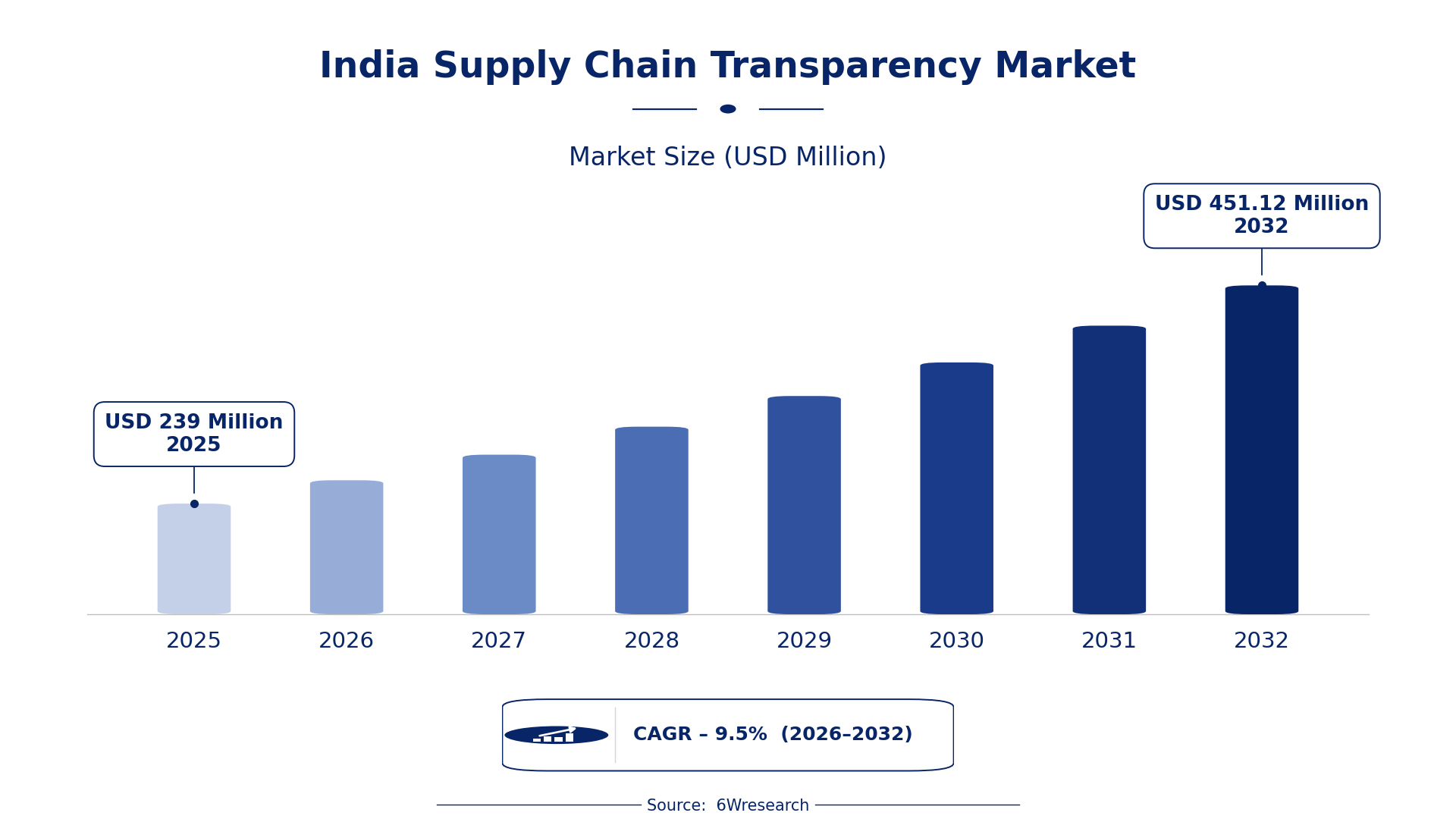
According to 6Wresearch internal database and industry insights, the India Supply Chain Transparency Market was valued at USD 239.0 million in 2025 and is projected to reach USD 451.12 million by 2032, growing at a CAGR of approximately 9.5% during 2026–2032.
India Supply Chain Transparency Market Highlights
| Report Metric | Details |
| Report Name | India Supply Chain Transparency Market |
| Market Size 2025 | USD 239.0 million |
| Market Size 2032 | USD 451.12 million |
| Absolute Growth 2025–2032 | USD 212.12 million |
| CAGR 2026–2032 | 9.5% |
| Peak Annual Growth | 12.1% in 2032 |
| Forecast Period | 2026–2032 |
| Historical Data | 2022–2025 |
| Base Year | 2025 |
| Leading Transparency Type, 2025 | End-to-End Traceability (40% share) |
| Leading Technology Used, 2025 | Blockchain (49% share) |
| Leading Focus Area, 2025 | Supplier Verification (42% share) |
| Leading End User, 2025 | Retail Chains (46% share) |
| Fastest-Growing Transparency Type | Compliance Visibility (12.0% CAGR) |
| Fastest-Growing Technology Used | IoT (12.0% CAGR) |
| Fastest-Growing Focus Area | Sustainability Reporting (11.2% CAGR) |
| Fastest-Growing End User | Manufacturing Firms (11.6% CAGR) |
| Growing Sector | Retail Chains |
| Key End Users | Retail Chains, Manufacturing Firms, Consumer Brands, Global Enterprises |
India Supply Chain Transparency Market Year-wise Growth Rate and Key Drivers (2022–2032)
This graph illustrates the annual growth rates of the market from 2022 to 2032, highlighting a steady upward trajectory and projected market expansion over the forecast period.
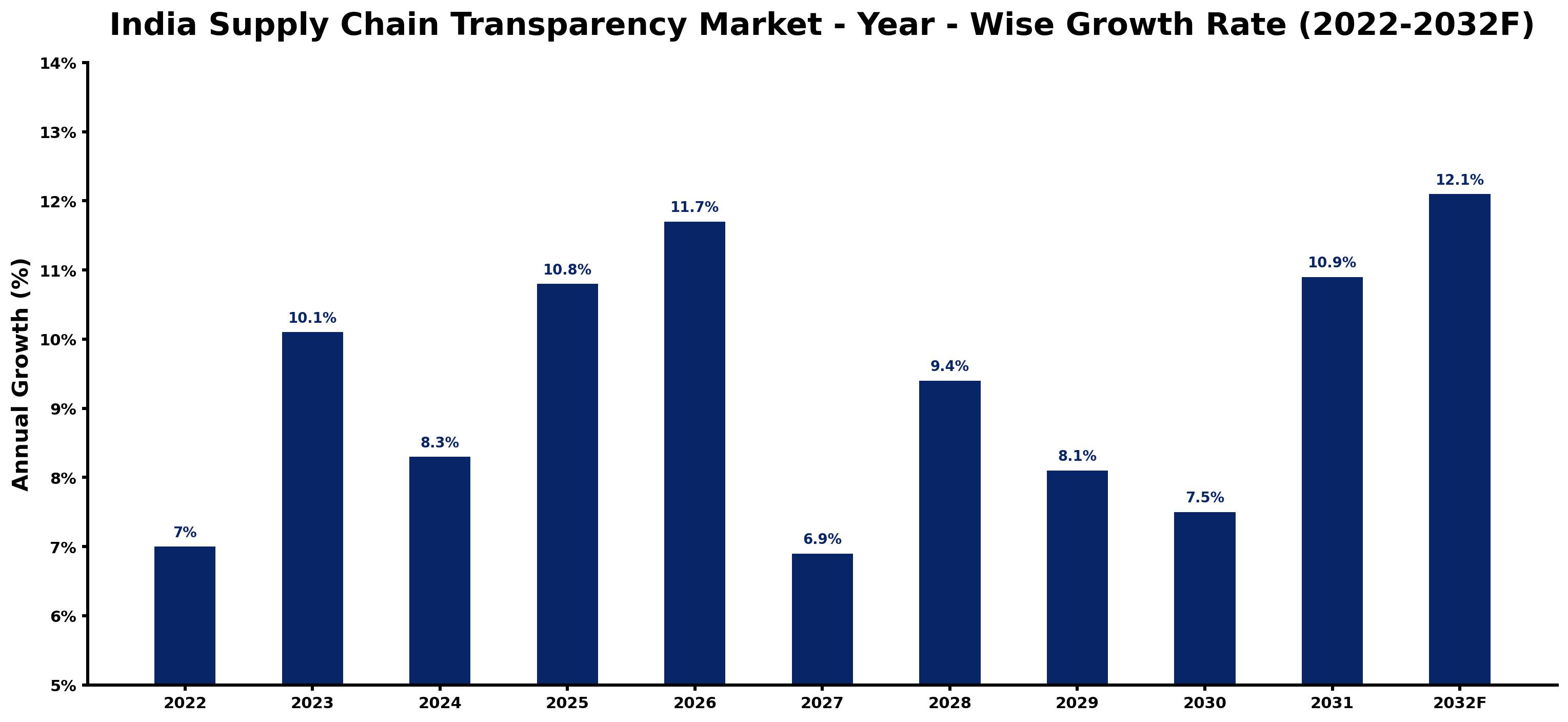
Year by year, the estimates below pair each growth rate with the development that shaped it.
| Year | Estimated Annual Growth (%) | Market Rationale |
| 2022 | 7.0 | The market showed steady demand as industries began adopting transparency technologies through initiatives like Digital India. |
| 2023 | 10.1 | Investment in supply chain transparency technologies increased among manufacturers, driven by rising consumer expectations for traceability. |
| 2024 | 8.3 | Growth slowed as companies adjusted to compliance regulations and standards established by the Bureau of Indian Standards in 2022. |
| 2025 | 10.8 | The market experienced a surge due to heightened consumer demand for transparency and compliance visibility among retail chains. |
| 2026 | 11.7 | Continued investment in technologies like blockchain is expected to drive market growth further, enhancing data integrity. |
| 2027 | 6.9 | Growth is projected to slow as companies face challenges in effectively implementing new systems and technologies. |
| 2028 | 9.4 | The market is expected to rebound as retail chains expand their transparency initiatives and compliance efforts following the National Logistics Policy. |
| 2029 | 8.1 | A slowdown is anticipated as the market adjusts to evolving consumer expectations and regulatory pressures from the FSSAI. |
| 2030 | 7.5 | Growth is projected to slow as firms face challenges in meeting regulatory requirements effectively, impacting operational efficiency. |
| 2031 | 10.9 | The market is expected to accelerate as manufacturers seek to improve operational efficiency and compliance through technology. |
| 2032 | 12.1 | The peak growth year will be driven by the National Logistics Policy's impact on transparency initiatives across sectors. |
Note: Market size estimations and growth projections presented in this report are based on 6Wresearch's proprietary forecasting methodology, utilizing the latest available industry data, government publications, and primary research inputs.
India Supply Chain Transparency Market Synopsis
Supply Chain Transparency in India refers to the integration of technologies that improve visibility across supply chains. This includes blockchain, IoT, and AI analytics, which track products from origin to consumer. The India Supply Chain Transparency Market is growing due to rising investments from domestic industries, particularly in retail and manufacturing. Over 70% of Indian manufacturers are actively investing in these technologies as of 2023. The Digital India programme aims to drive technology adoption in supply chains, further increasing demand for transparency solutions.
Market Dynamics Impact Analysis (2026–2032)
| Factor | Type | Impact | Primary Segment Affected |
| Investment in transparency technologies by manufacturers | Driver | High | End-to-End Traceability |
| Growing consumer demand for transparency in products | Driver | High | Supplier Verification |
| Retail chains expanding their supply chain practices | Opportunity | High | Retail Chains |
| Manufacturing firms seeking compliance and efficiency improvements | Opportunity | High | Manufacturing Firms |
| Challenges in implementing new transparency technologies | Restraint | Medium | Blockchain |
| Regulatory compliance costs impacting smaller firms | Restraint | Medium | Compliance Visibility |
| Supply Chain Transparency market in India faces significant implementation challenges | Challenge | High | Real-Time Monitoring |
| Limited awareness of the benefits of transparency | Challenge | Medium | ESG Transparency |
Evaluation of Drivers in India Supply Chain Transparency Market (2026–2032)
The table below links each growth driver to the segment it affects and the evidence for it.
| Drivers | Primary Segment Affected | Why It Matters (Evidence) |
| Increased investment in blockchain technology | Blockchain | Over 70% of Indian manufacturers are investing in supply chain transparency technologies, improving data integrity and security. |
| Rising consumer demand for product traceability | End-to-End Traceability | Retail chains are focusing on transparency to meet consumer expectations, driving increased purchases for traceable products. |
| Expansion of the Digital India initiative | IoT | The initiative aims to improve digital infrastructure, facilitating real-time data collection and monitoring capabilities among producers. |
| Compliance with FSSAI regulations | Compliance Visibility | The FSSAI mandates traceability in food supply chains, increasing demand for compliance solutions among food producers. |
| Growing focus on sustainability in supply chains | Sustainability Reporting | The National Institute of Fashion Technology promotes sustainability practices, encouraging transparency and compliance in the textile sector. |
Expansion of the Supply Chain Transparency market in India is backed by increased investment in blockchain technology, rising consumer demand for product traceability, and the push for technology adoption through national initiatives. Over 70% of Indian manufacturers are investing in these technologies, which improves data integrity and security across supply chains. Retail chains are focusing on transparency to meet consumer expectations, driving increased purchases for traceable products. The Digital India initiative aims to improve digital infrastructure, facilitating real-time data collection and monitoring essential for effective supply chain management. Compliance with FSSAI regulations mandates traceability in food supply chains, increasing demand for compliance solutions among producers.
Evaluation of Restraints in India Supply Chain Transparency Market
The following restraints limit how fast demand can grow.
| Market Restraint | Primary Segment Affected | Why It Matters (Evidence) |
| Implementation challenges in adopting new technologies | Blockchain | Many firms struggle with integrating blockchain into existing systems, delaying transparency initiatives and increasing costs. |
| High costs associated with compliance and technology upgrades | Compliance Visibility | Smaller firms find it difficult to meet regulatory requirements due to financial constraints, impacting their competitiveness. |
| Limited understanding of transparency benefits among firms | ESG Transparency | Many companies are unaware of how transparency can improve their brand value and customer trust, hindering adoption. |
| Inconsistent regulatory frameworks across sectors | Real-Time Monitoring | Different standards create confusion, hindering effective implementation of monitoring solutions across industries. |
| Resistance to change within traditional supply chains | Supplier Verification | Established firms may be reluctant to adopt new verification processes, slowing market growth and innovation. |
India Supply Chain Transparency Market Challenges
The Supply Chain Transparency market in India faces a notable technological challenge due to slow adoption of advanced solutions. Many producers encounter difficulties in implementing blockchain and IoT technologies, resulting in delays in achieving transparency and costing buyers around 15% in operational inefficiencies. The high initial investment required for these technologies deters smaller manufacturers, placing them at a competitive disadvantage compared to larger firms. Compounding these issues, 60% of firms struggle to comply with the Bureau of Indian Standards' guidelines, leading to potential fines and lost business opportunities for those unable to adapt.
Trends in the India Supply Chain Transparency Market
The trends below show where the India Supply Chain Transparency Market is heading.
- Shift from Traditional to Digital Supply Chain Practices: Over 70% of Indian manufacturers are investing in supply chain transparency technologies as of 2023. This shift is driving more efficient operations and better compliance with regulations, enhancing overall supply chain visibility.
- Transition to Real-Time Monitoring Solutions: The National Logistics Policy, introduced in 2021, aims to improve logistics efficiency. This initiative is encouraging the adoption of real-time monitoring technologies across various sectors, allowing for better inventory management.
- Emergence of Blockchain as a Key Technology: Blockchain technology is becoming essential for ensuring data integrity in supply chains. By 2025, it is projected to hold a 49% market share, reflecting its growing importance in enhancing transparency.
- Focus on Sustainability Reporting in Supply Chains: The National Institute of Fashion Technology promotes sustainability in the textile supply chain. This focus is expected to drive the growth of sustainability reporting practices in the coming years, aligning with consumer preferences.
Investment Opportunities in the India Supply Chain Transparency Market
Investors looking at the India Supply Chain Transparency Market should consider the following areas.
- Retail Chains Seeking Transparency Solutions: Retail chains are increasingly focused on transparency, driven by consumer demand. The Indian retail market is projected to grow at 10% from 2023 to 2028, presenting opportunities for suppliers to enter this space through partnerships and technology offerings.
- Manufacturing Firms Needing Compliance Technologies: Manufacturing firms are actively seeking solutions for compliance visibility. The implementation of the Production-Linked Incentive scheme offers opportunities for suppliers to provide necessary technologies and services to improve operational practices.
- Supplier Verification Services for Small Businesses: Small businesses are looking for reliable supplier verification services to enhance compliance. The MSME Competitive Improvement Programme provides a pathway for suppliers to enter this market by offering tailored solutions.
- Investment in Real-Time Monitoring Technologies: There is a growing demand for real-time monitoring solutions across various sectors. Suppliers can capitalise on this opportunity by collaborating with logistics firms to develop tailored solutions that meet specific industry requirements.
Government Initiatives in the India Supply Chain Transparency Market
The Digital India initiative, launched by the Ministry of Electronics and Information Technology in 2020, aims to improve digital infrastructure for supply chain transparency. This initiative complements existing regulations by promoting technology adoption among businesses. In 2021, the Ministry of Commerce introduced the National Logistics Policy to streamline logistics and improve visibility across sectors, providing a framework for companies to enhance operational practices. These measures support the growth of supply chain transparency by encouraging investments in technology and infrastructure, benefiting producers and buyers alike.
The FSSAI's Food Safety and Standards (Packaging) Regulations, updated in 2022, require traceability measures in food supply chains to ensure safety. This regulation mandates that food producers implement tracking systems, improving transparency for consumers. The Ministry of Micro, Small and Medium Enterprises launched the MSME Competitive (Quality) Improvement Programme in 2023 to enhance supply chain practices among small businesses. This programme provides funding and resources to improve compliance and operational efficiency, benefiting smaller firms striving to meet industry standards.
Future Insight of the India Supply Chain Transparency Market
The Supply Chain Transparency market in India will undergo substantial changes by 2032, driven by the Digital India programme's focus on technology integration. By 2025, the National Logistics Policy aims to improve logistics efficiency, benefiting both buyers and suppliers through streamlined operations. As the retail market grows, projected to exceed $1 trillion by 2028, the demand for transparent supply chains will rise, prompting manufacturers to strengthen compliance and traceability efforts. The Make in India initiative will further encourage domestic production, refining supply chain practices across various sectors.
Market Segmentation Analysis
Each segment group is reviewed below, with the leader by share and the fastest grower by CAGR.
By Transparency Type – End-to-End Traceability Dominated, Compliance Visibility Expected to Grow Fastest
According to Sumit Sagar, AM at 6Wresearch, in 2025, End-to-End Traceability led the transparency type split with a 40% share. End-to-End Traceability holds the largest share as it is essential for tracking product origins and ensuring compliance across various sectors. This is particularly evident in the food industry, where traceability is mandated to guarantee safety and quality standards. Compliance Visibility is set to record the highest CAGR in this split, 12.0% over 2026–2032. Compliance Visibility is rapidly growing due to increasing regulatory requirements both locally and internationally. For instance, the FSSAI's mandates for traceability in the food supply chain are pushing companies to adopt these solutions swiftly. Suppliers must prioritise compliance visibility solutions to meet evolving regulatory demands and enhance their market share.
By Technology Used – Blockchain Dominated, IoT Expected to Grow Fastest
The largest technology used category in 2025 was Blockchain, with a 49% share of total revenue. Blockchain technology leads the market share as it is fundamental for ensuring data integrity and security in supply chains. Its adoption is particularly crucial for sectors requiring high levels of trust and transparency, such as food and pharmaceuticals. Over 2026–2032, IoT is expected to post the fastest growth, at a CAGR of 12.0%. IoT is the fastest-growing technology in this market, driven by the need for real-time data collection and monitoring. The increasing investment from over 70% of Indian manufacturers in IoT solutions highlights its critical role in enhancing supply chain transparency. Suppliers should invest in IoT technologies to stay competitive and meet the growing demand for real-time visibility in supply chains.
By Focus Area – Supplier Verification Dominated, Sustainability Reporting Expected to Grow Fastest
Supplier Verification held a 42% share of the India Supply Chain Transparency Market by focus area in 2025. Supplier Verification commands the largest share as it is crucial for ensuring supplier reliability and compliance, especially in industries like retail where consumer trust is paramount. This focus area is vital for businesses aiming to maintain high standards and avoid disruptions. Sustainability Reporting is projected to grow fastest, at a CAGR of 11.2% during 2026–2032. Sustainability Reporting is growing rapidly as companies face mounting pressure to demonstrate their environmental impact. The increasing emphasis on sustainability in sectors like textiles, promoted by institutions, is driving this trend. Buyers are increasingly prioritising suppliers who can provide robust sustainability reporting, impacting supplier selection processes.
By End User – Retail Chains Dominated, Manufacturing Firms Expected to Grow Fastest
Retail Chains took a 46% share of end user in 2025, more than any other category. Retail Chains dominate the market share due to high consumer demand for transparency in product sourcing and supply chain practices. Their significant investment in supply chain transparency technologies reflects the need to build consumer trust and loyalty. The quickest growth will come from Manufacturing Firms, forecast to expand at a CAGR of 11.6% between 2026 and 2032. Manufacturing Firms are the fastest-growing end users, as they seek compliance and efficiency improvements to meet regulatory standards. The Indian government's initiatives to boost the manufacturing sector further drive this demand for transparency solutions. Suppliers targeting manufacturing firms must align their offerings with compliance needs to capture this expanding market segment.
Key Attractiveness of the Report
- 10 Years of Market Numbers
- Historical Data Starting from 2022 to 2025
- Base Year 2025
- Forecast Data until 2032
- Key Performance Indicators Impacting the Market
- Major Upcoming Developments and Projects
Key Highlights of the Report:
- India Supply Chain Transparency Market Outlook
- Market Size of India Supply Chain Transparency Market, 2025
- Forecast of India Supply Chain Transparency Market, 2032
- Historical Data and Forecast of India Supply Chain Transparency Revenues & Volume for the Period 2022 - 2032F
- India Supply Chain Transparency Market Trend Evolution
- India Supply Chain Transparency Market Drivers and Challenges
- India Supply Chain Transparency Price Trends
- India Supply Chain Transparency Porter's Five Forces
- India Supply Chain Transparency Industry Life Cycle
- Historical Data and Forecast of India Supply Chain Transparency Market Revenues & Volume By Transparency Type for the Period 2022 - 2032F
- Historical Data and Forecast of India Supply Chain Transparency Market Revenues & Volume By End-to-End Traceability for the Period 2022 - 2032F
- Historical Data and Forecast of India Supply Chain Transparency Market Revenues & Volume By Real-Time Monitoring for the Period 2022 - 2032F
- Historical Data and Forecast of India Supply Chain Transparency Market Revenues & Volume By ESG Transparency for the Period 2022 - 2032F
- Historical Data and Forecast of India Supply Chain Transparency Market Revenues & Volume By Compliance Visibility for the Period 2022 - 2032F
- Historical Data and Forecast of India Supply Chain Transparency Market Revenues & Volume By Technology Used for the Period 2022 - 2032F
- Historical Data and Forecast of India Supply Chain Transparency Market Revenues & Volume By Blockchain for the Period 2022 - 2032F
- Historical Data and Forecast of India Supply Chain Transparency Market Revenues & Volume By IoT for the Period 2022 - 2032F
- Historical Data and Forecast of India Supply Chain Transparency Market Revenues & Volume By AI Analytics for the Period 2022 - 2032F
- Historical Data and Forecast of India Supply Chain Transparency Market Revenues & Volume By Cloud Software for the Period 2022 - 2032F
- Historical Data and Forecast of India Supply Chain Transparency Market Revenues & Volume By Focus Area for the Period 2022 - 2032F
- Historical Data and Forecast of India Supply Chain Transparency Market Revenues & Volume By Supplier Verification for the Period 2022 - 2032F
- Historical Data and Forecast of India Supply Chain Transparency Market Revenues & Volume By Inventory Management for the Period 2022 - 2032F
- Historical Data and Forecast of India Supply Chain Transparency Market Revenues & Volume By Sustainability Reporting for the Period 2022 - 2032F
- Historical Data and Forecast of India Supply Chain Transparency Market Revenues & Volume By Regulatory Audits for the Period 2022 - 2032F
- Historical Data and Forecast of India Supply Chain Transparency Market Revenues & Volume By End User for the Period 2022 - 2032F
- Historical Data and Forecast of India Supply Chain Transparency Market Revenues & Volume By Retail Chains for the Period 2022 - 2032F
- Historical Data and Forecast of India Supply Chain Transparency Market Revenues & Volume By Manufacturing Firms for the Period 2022 - 2032F
- Historical Data and Forecast of India Supply Chain Transparency Market Revenues & Volume By Consumer Brands for the Period 2022 - 2032F
- Historical Data and Forecast of India Supply Chain Transparency Market Revenues & Volume By Global Enterprises for the Period 2022 - 2032F
- India Supply Chain Transparency Import Export Trade Statistics
- Market Opportunity Assessment By Transparency Type
- Market Opportunity Assessment By Technology Used
- Market Opportunity Assessment By Focus Area
- Market Opportunity Assessment By End User
- India Supply Chain Transparency Top Companies Market Share
- India Supply Chain Transparency Competitive Benchmarking By Technical and Operational Parameters
- India Supply Chain Transparency Company Profiles
- India Supply Chain Transparency Key Strategic Recommendations
Market Covered
This report examines the market across the segments below.
By Transparency Type
- End-to-End Traceability
- Real-Time Monitoring
- ESG Transparency
- Compliance Visibility
By Technology Used
- Blockchain
- IoT
- AI Analytics
- Cloud Software
By Focus Area
- Supplier Verification
- Inventory Management
- Sustainability Reporting
- Regulatory Audits
By End User
- Retail Chains
- Manufacturing Firms
- Consumer Brands
- Global Enterprises































