India Supply Chain Visibility Market Size & Growth Rate
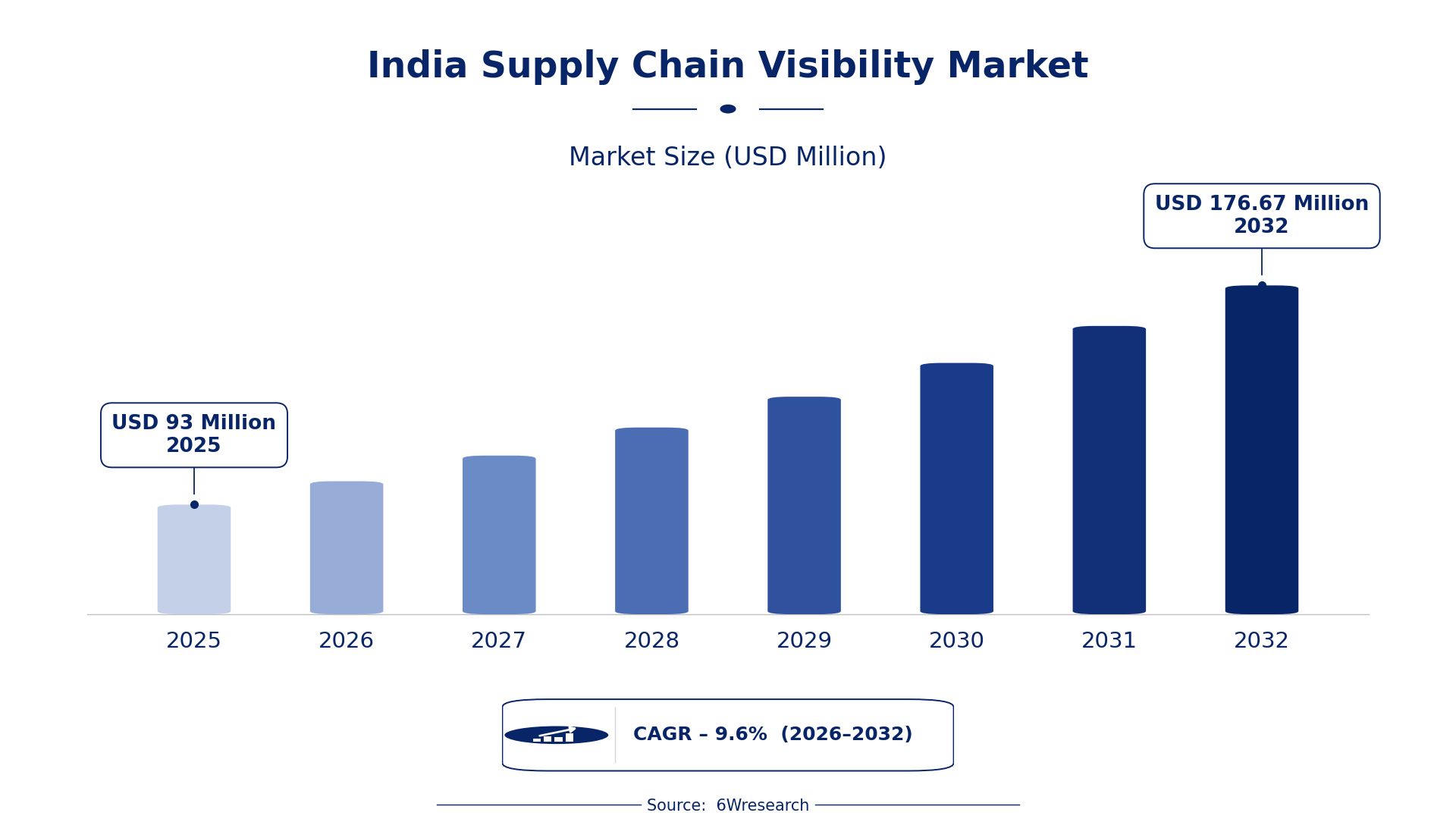
According to 6Wresearch internal database and industry insights, the India Supply Chain Visibility Market was valued at USD 93.0 million in 2025 and is projected to reach USD 176.67 million by 2032, growing at a CAGR of approximately 9.6% during 2026–2032.
India Supply Chain Visibility Market Highlights
| Report Metric | Details |
| Report Name | India Supply Chain Visibility Market |
| Market Size 2025 | USD 93.0 million |
| Market Size 2032 | USD 176.67 million |
| Absolute Growth 2025–2032 | USD 83.67 million |
| CAGR 2026–2032 | 9.6% |
| Peak Annual Growth | 11.6% in 2026 |
| Forecast Period | 2026–2032 |
| Historical Data | 2022–2025 |
| Base Year | 2025 |
| Leading Visibility Scope, 2025 | Outbound Logistics (51% share) |
| Leading Platform Type, 2025 | SaaS (38% share) |
| Leading Application Area, 2025 | Supplier Networks (45% share) |
| Leading End User, 2025 | FMCG Companies (36% share) |
| Fastest-Growing Visibility Scope | Multi-tier Supplier View (12.4% CAGR) |
| Fastest-Growing Platform Type | AI-Driven Analytics (12.2% CAGR) |
| Fastest-Growing Application Area | Risk Monitoring (11.1% CAGR) |
| Fastest-Growing End User | 3PL Providers (10.9% CAGR) |
| Growing Sector | Risk Monitoring |
| Key End Users | FMCG Companies, 3PL Providers, OEMs, Enterprise Buyers |
India Supply Chain Visibility Market Year-wise Growth Rate and Key Drivers (2022–2032)
This graph illustrates the annual growth rates of the market from 2022 to 2032, highlighting a steady upward trajectory and projected market expansion over the forecast period.
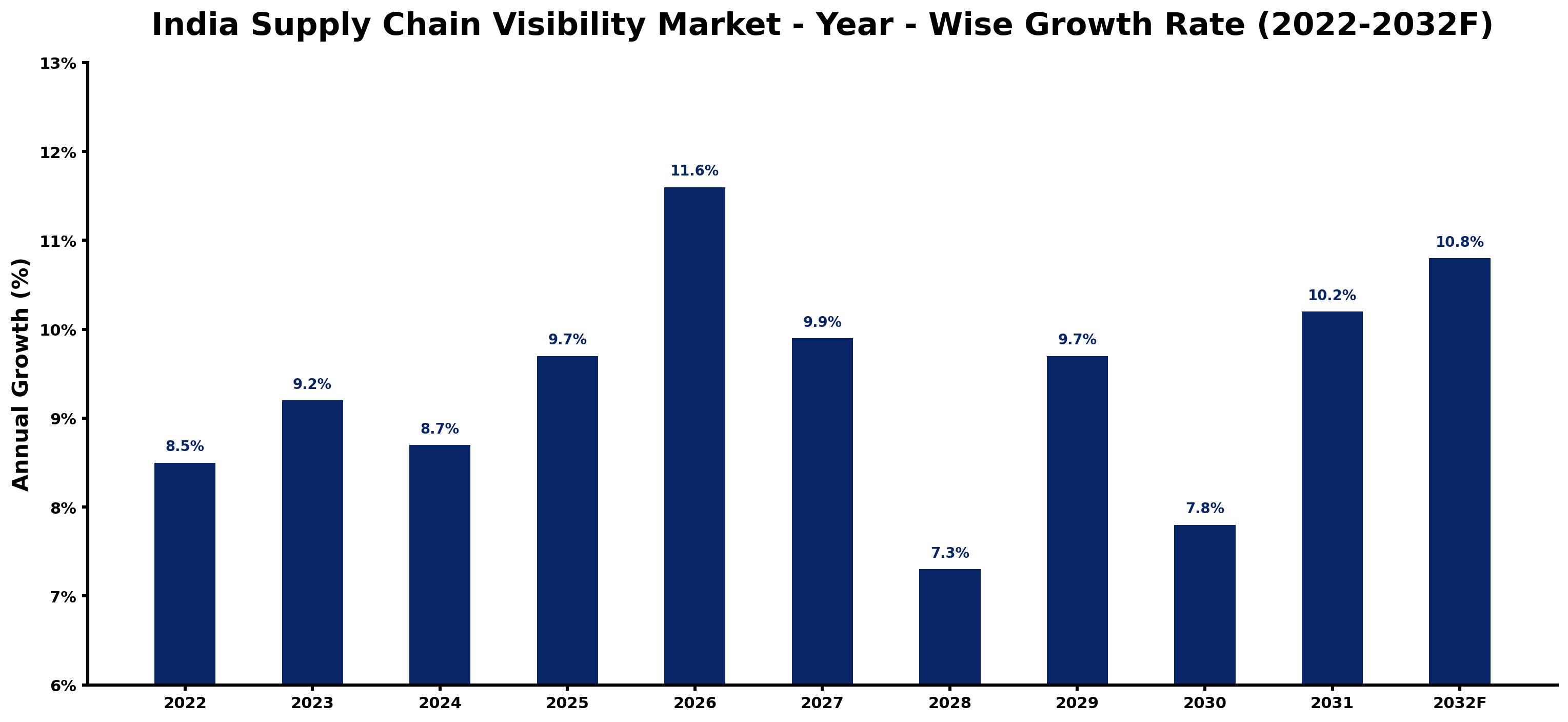
The following table presents the estimated annual growth rate for each year together with the principal factor influencing market performance.
| Year | Estimated Annual Growth (%) | Market Rationale |
| 2022 | 8.5 | The market experienced steady demand from logistics and manufacturing sectors. |
| 2023 | 9.2 | Increased adoption of visibility solutions by FMCG companies drove growth. |
| 2024 | 8.7 | Growth slowed as companies adjusted to new technology implementations. |
| 2025 | 9.7 | Demand surged with the rise of e-commerce, boosting visibility needs. |
| 2026 | 11.6 | The peak growth was driven by substantial investments in supply chain technology. |
| 2027 | 9.9 | Growth slowed as market players consolidated their technology investments. |
| 2028 | 7.3 | Adoption of AI-driven analytics began to influence purchasing decisions. |
| 2029 | 9.7 | FMCG companies increased their investments in supply chain visibility solutions. |
| 2030 | 7.8 | Growth slowed as the National Logistics Policy began to impact operations. |
| 2031 | 10.2 | Demand rose as 3PL providers expanded their service offerings. |
| 2032 | 10.8 | The market is expected to grow as the Gati Shakti initiative enhances infrastructure. |
Note: Market size estimations and growth projections presented in this report are based on 6Wresearch's proprietary forecasting methodology, utilizing the latest available industry data, government publications, and primary research inputs.
India Supply Chain Visibility Market Synopsis
The India Supply Chain Visibility Market includes technologies and processes that enable real-time tracking of supply chain operations. This encompasses software solutions and data analytics that boost operational efficiency and customer satisfaction. The market is growing due to increasing demand from sectors such as e-commerce and FMCG. More than 80% of FMCG companies are implementing these solutions to enhance transparency and efficiency. Government initiatives, particularly the Gati Shakti initiative, are propelling market expansion.
Market Dynamics Impact Analysis (2026–2032)
| Factor | Type | Impact | Primary Segment Affected |
| Increased investment in logistics technology | Driver | High | Inbound Logistics |
| Growing e-commerce sector driving visibility needs | Driver | High | Outbound Logistics |
| Investment in AI-driven analytics solutions | Opportunity | Medium | AI-Driven Analytics |
| Expansion of distribution centers across India | Opportunity | High | Distribution Centers |
| High implementation costs for visibility solutions | Restraint | High | Inventory Visibility |
| Limited awareness among smaller manufacturers | Restraint | Medium | Multi-tier Supplier View |
| Shortage of skilled workforce in logistics | Challenge | High | 3PL Providers |
| Competition from international logistics firms | Challenge | Medium | FMCG Companies |
Evaluation of Drivers in India Supply Chain Visibility Market (2026–2032)
The main growth drivers and the segments they affect most are set out below.
| Drivers | Primary Segment Affected | Why It Matters (Evidence) |
| Rising e-commerce demand | Outbound Logistics | India's e-commerce sector is expected to grow to $200 billion by 2026, increasing visibility solution purchases. |
| Adoption of AI technologies | AI-Driven Analytics | The adoption of AI in supply chain management is projected to increase by 30% by 2025, driving demand for analytics solutions. |
| Government initiatives | Inbound Logistics | The Gati Shakti initiative aims to improve infrastructure, leading to increased investments in supply chain visibility. |
| Growth in FMCG sector | FMCG Companies | Over 80% of FMCG companies are adopting visibility solutions to improve operational efficiency and customer satisfaction. |
| Expansion of distribution centers | Distribution Centers | India has over 1,500 operational distribution centers, highlighting the need for enhanced visibility solutions. |
The e-commerce sector is projected to grow significantly, which drives visibility solution purchases. FMCG companies are adopting these solutions to enhance operational efficiency, while the adoption of AI in supply chain management is expected to rise, further driving demand for analytics solutions.
Evaluation of Restraints in India Supply Chain Visibility Market
The key brakes on demand, and where they bite hardest, are shown below.
| Market Restraint | Primary Segment Affected | Why It Matters (Evidence) |
| High implementation costs for visibility solutions | Inventory Visibility | The initial investment for advanced visibility solutions can exceed ₹10 million, limiting adoption among smaller firms. |
| Limited awareness among smaller manufacturers | Multi-tier Supplier View | Many small manufacturers lack knowledge about the benefits of visibility solutions, hindering market growth. |
| Shortage of skilled workforce in logistics | 3PL Providers | The Logistics Skill Development Program aims to train over 1 million workers, but shortages still exist. |
| Integration challenges with existing systems | AI-Driven Analytics | Many companies face difficulties integrating new visibility solutions with legacy systems, delaying implementation. |
| Regulatory compliance costs | Supplier Networks | Compliance with BIS standards can incur additional costs, impacting smaller suppliers' ability to invest. |
India Supply Chain Visibility Market Challenges
Over 80% of FMCG companies in India face supply chain visibility issues due to outdated tracking systems, leading to inefficiencies that can increase operational costs by up to 20%. Compliance with regulations set by the Bureau of Indian Standards creates delays for importers and distributors, costing them as much as 15% in potential revenue losses. Buyers encounter transparency challenges, as insufficient visibility can lead to stockouts or overstock situations, negatively impacting customer satisfaction and loyalty. Many producers lag in technology adoption, with only 30% investing in advanced solutions, causing them to miss opportunities for optimising their supply chain operations.
Trends in the India Supply Chain Visibility Market
Four trends stand out in the India Supply Chain Visibility Market.
- Shift from Traditional to Digital Solutions: India is moving from traditional supply chain methods to digital solutions, spurred by the Gati Shakti initiative. This shift has resulted in increased investments in technology, with over ₹1 trillion allocated for infrastructure development.
- Growing Use of AI in Supply Chain Management: The adoption of AI-driven analytics is on the rise, with an expected growth of 30% by 2025. This trend is particularly noticeable among logistics providers seeking to improve operational efficiency.
- Increased Focus on Risk Monitoring: Risk monitoring is becoming a key priority for supplier networks, with a CAGR of 11.1% projected from 2026 to 2032. This change is driven by the need for more effective risk management strategies.
- Expansion of Distribution Centers: India has over 1,500 operational distribution centres, reflecting a shift towards more efficient logistics operations. This expansion is crucial for addressing the growing demand for visibility solutions.
Investment Opportunities in the India Supply Chain Visibility Market
Some of the investment opportunities in the India Supply Chain Visibility Market are mentioned below.
- Supply Chain Visibility Solutions: With over 80% of FMCG companies adopting visibility solutions, there is a strong opportunity to supply advanced technologies. This demand is particularly strong in urban areas like Mumbai.
- AI-Driven Analytics Services: The expected increase in AI adoption by 2025 presents a chance to provide analytics services to logistics firms. Targeting 3PL providers in Delhi could yield substantial returns.
- Training Programs for Logistics Workforce: The ongoing need for skilled workers in logistics creates an opportunity to invest in training programs. The Logistics Skill Development Program aims to train over 1 million workers by 2025.
- Integration Services for Legacy Systems: As companies face integration challenges, there is a demand for services that facilitate the integration of visibility solutions. Focusing on mid-sized manufacturers in Pune can be beneficial.
Government Initiatives in the India Supply Chain Visibility Market
The National Logistics Policy, introduced by the Ministry of Commerce in 2022, aims to reduce logistics costs to 8% of GDP by 2025. This policy enhances supply chain efficiency by streamlining operations and promoting investment in technology. The Gati Shakti Master Plan, launched in 2021, focuses on developing integrated infrastructure for supply chain operations across India. This strategy aims to improve connectivity and minimise delays in logistics processes.
In 2023, the Indian government allocated ₹1 trillion for infrastructure development to support supply chains. The Logistics Skill Development Program, initiated in 2020 by the Ministry of Skill Development, aims to train over 1 million workers in logistics by 2025, improving the workforce's capabilities in supply chain visibility.
Future Insight of the India Supply Chain Visibility Market
The Supply Chain Visibility Market in India will experience substantial transformation by 2032, driven by the government's Gati Shakti initiative aimed at enhancing infrastructure. AI integration in supply chain management will increase by 30% by 2025, enabling suppliers to utilise data for improved decision-making. The Logistics Skill Council's initiatives will develop a skilled workforce, ensuring effective implementation of supply chain technologies.
Market Segmentation Analysis
The report offers a comprehensive study of the following market segments and their leading categories in the market.
By Visibility Scope – Outbound Logistics Dominated, Multi-tier Supplier View Expected to Grow Fastest
According to Sumit Sagar, AM at 6Wresearch, the largest visibility scope category in 2025 was Outbound Logistics, with a 51% share of total revenue. Outbound logistics holds the largest share in India as it is vital for managing product delivery, particularly for FMCG companies that rely heavily on timely distribution. The increasing operational efficiency demands in sectors like e-commerce further solidify its dominance in the market. Multi-tier Supplier View is set to record the highest CAGR in this split, 12.4% over 2026–2032. The multi-tier supplier view is experiencing rapid growth due to the rising complexity of supply chains, especially as companies strive to understand their supplier networks better. With the e-commerce sector projected to reach $200 billion by 2026, the need for comprehensive visibility solutions will only intensify. Suppliers must focus on enhancing their visibility offerings to meet the growing demands of businesses seeking efficient supply chain management.
By Platform Type – SaaS Dominated, AI-Driven Analytics Expected to Grow Fastest
SaaS took a 38% share of platform type in 2025, more than any other category. SaaS solutions dominate the market as they are widely used for software delivery, providing flexibility and scalability that businesses require. This model is particularly appealing to companies in logistics and manufacturing, where operational efficiency is paramount. Over 2026–2032, AI-Driven Analytics is expected to post the fastest growth, at a CAGR of 12.2%. AI-driven analytics is rapidly becoming the fastest-growing platform type as companies increasingly utilise these insights to enhance decision-making processes. The anticipated 30% increase in AI adoption in supply chain management by 2025 underscores this trend. Buyers should prioritise SaaS and AI-driven analytics to leverage advanced capabilities for improved supply chain visibility.
By Application Area – Supplier Networks Dominated, Risk Monitoring Expected to Grow Fastest
In 2025, Supplier Networks led the application area split with a 45% share. Supplier networks account for the largest share as they are integral for managing relationships and ensuring smooth operations within the supply chain. The emphasis on collaboration and transparency in supplier interactions makes this area crucial for companies across various sectors. The quickest growth will come from Risk Monitoring, forecast to expand at a CAGR of 11.1% between 2026 and 2032. Risk monitoring is the fastest-growing application area as businesses recognise the importance of identifying and mitigating supply chain risks in real-time. The establishment of standards by the Bureau of Indian Standards in 2022 further highlights the need for robust risk management solutions. Suppliers should enhance their risk monitoring capabilities to attract clients focused on safeguarding their supply chain operations.
By End User – FMCG Companies Dominated, 3PL Providers Expected to Grow Fastest
With a 36% revenue share in 2025, FMCG Companies was the largest end user category. FMCG companies represent the largest share of the end-user market, as they require efficient supply chain visibility to manage fast-moving consumer goods effectively. The high volume of goods and the need for rapid turnover make supply chain solutions indispensable in this sector. 3PL Providers are projected to grow fastest, at a CAGR of 10.9% during 2026–2032. 3PL providers are the fastest-growing end-user segment, driven by their essential role in logistics management and the increasing demand for outsourced logistics solutions. As more companies turn to 3PLs for efficiency, this segment's growth will likely accelerate. Suppliers should tailor their solutions to meet the specific needs of 3PL providers to capitalise on this expanding market segment.
Key Attractiveness of the Report
- 10 Years of Market Numbers
- Historical Data Starting from 2022 to 2025
- Base Year 2025
- Forecast Data until 2032
- Key Performance Indicators Impacting the Market
- Major Upcoming Developments and Projects
Key Highlights of the Report:
- India Supply Chain Visibility Market Outlook
- Market Size of India Supply Chain Visibility Market, 2025
- Forecast of India Supply Chain Visibility Market, 2032
- Historical Data and Forecast of India Supply Chain Visibility Revenues & Volume for the Period 2022 - 2032F
- India Supply Chain Visibility Market Trend Evolution
- India Supply Chain Visibility Market Drivers and Challenges
- India Supply Chain Visibility Price Trends
- India Supply Chain Visibility Porter's Five Forces
- India Supply Chain Visibility Industry Life Cycle
- Historical Data and Forecast of India Supply Chain Visibility Market Revenues & Volume By Visibility Scope for the Period 2022 - 2032F
- Historical Data and Forecast of India Supply Chain Visibility Market Revenues & Volume By Inbound Logistics for the Period 2022 - 2032F
- Historical Data and Forecast of India Supply Chain Visibility Market Revenues & Volume By Outbound Logistics for the Period 2022 - 2032F
- Historical Data and Forecast of India Supply Chain Visibility Market Revenues & Volume By Inventory Visibility for the Period 2022 - 2032F
- Historical Data and Forecast of India Supply Chain Visibility Market Revenues & Volume By Multi-tier Supplier View for the Period 2022 - 2032F
- Historical Data and Forecast of India Supply Chain Visibility Market Revenues & Volume By Platform Type for the Period 2022 - 2032F
- Historical Data and Forecast of India Supply Chain Visibility Market Revenues & Volume By SaaS for the Period 2022 - 2032F
- Historical Data and Forecast of India Supply Chain Visibility Market Revenues & Volume By Cloud for the Period 2022 - 2032F
- Historical Data and Forecast of India Supply Chain Visibility Market Revenues & Volume By Mobile/Web Dashboard for the Period 2022 - 2032F
- Historical Data and Forecast of India Supply Chain Visibility Market Revenues & Volume By AI-Driven Analytics for the Period 2022 - 2032F
- Historical Data and Forecast of India Supply Chain Visibility Market Revenues & Volume By Application Area for the Period 2022 - 2032F
- Historical Data and Forecast of India Supply Chain Visibility Market Revenues & Volume By Supplier Networks for the Period 2022 - 2032F
- Historical Data and Forecast of India Supply Chain Visibility Market Revenues & Volume By Distribution Centers for the Period 2022 - 2032F
- Historical Data and Forecast of India Supply Chain Visibility Market Revenues & Volume By Retail Stores for the Period 2022 - 2032F
- Historical Data and Forecast of India Supply Chain Visibility Market Revenues & Volume By Risk Monitoring for the Period 2022 - 2032F
- Historical Data and Forecast of India Supply Chain Visibility Market Revenues & Volume By End User for the Period 2022 - 2032F
- Historical Data and Forecast of India Supply Chain Visibility Market Revenues & Volume By OEMs for the Period 2022 - 2032F
- Historical Data and Forecast of India Supply Chain Visibility Market Revenues & Volume By 3PL Providers for the Period 2022 - 2032F
- Historical Data and Forecast of India Supply Chain Visibility Market Revenues & Volume By FMCG Companies for the Period 2022 - 2032F
- Historical Data and Forecast of India Supply Chain Visibility Market Revenues & Volume By Enterprise Buyers for the Period 2022 - 2032F
- India Supply Chain Visibility Import Export Trade Statistics
- Market Opportunity Assessment By Visibility Scope
- Market Opportunity Assessment By Platform Type
- Market Opportunity Assessment By Application Area
- Market Opportunity Assessment By End User
- India Supply Chain Visibility Top Companies Market Share
- India Supply Chain Visibility Competitive Benchmarking By Technical and Operational Parameters
- India Supply Chain Visibility Company Profiles
- India Supply Chain Visibility Key Strategic Recommendations
Market Covered
The report offers an extensive study of the following market segments.
By Visibility Scope
- Inbound Logistics
- Outbound Logistics
- Inventory Visibility
- Multi-tier Supplier View
By Platform Type
- SaaS
- Cloud
- Mobile/Web Dashboard
- AI-Driven Analytics
By Application Area
- Supplier Networks
- Distribution Centers
- Retail Stores
- Risk Monitoring
By End User
- OEMs
- 3PL Providers
- FMCG Companies
- Enterprise Buyers































