India Suspension Force Sensors Market Size & Growth Rate
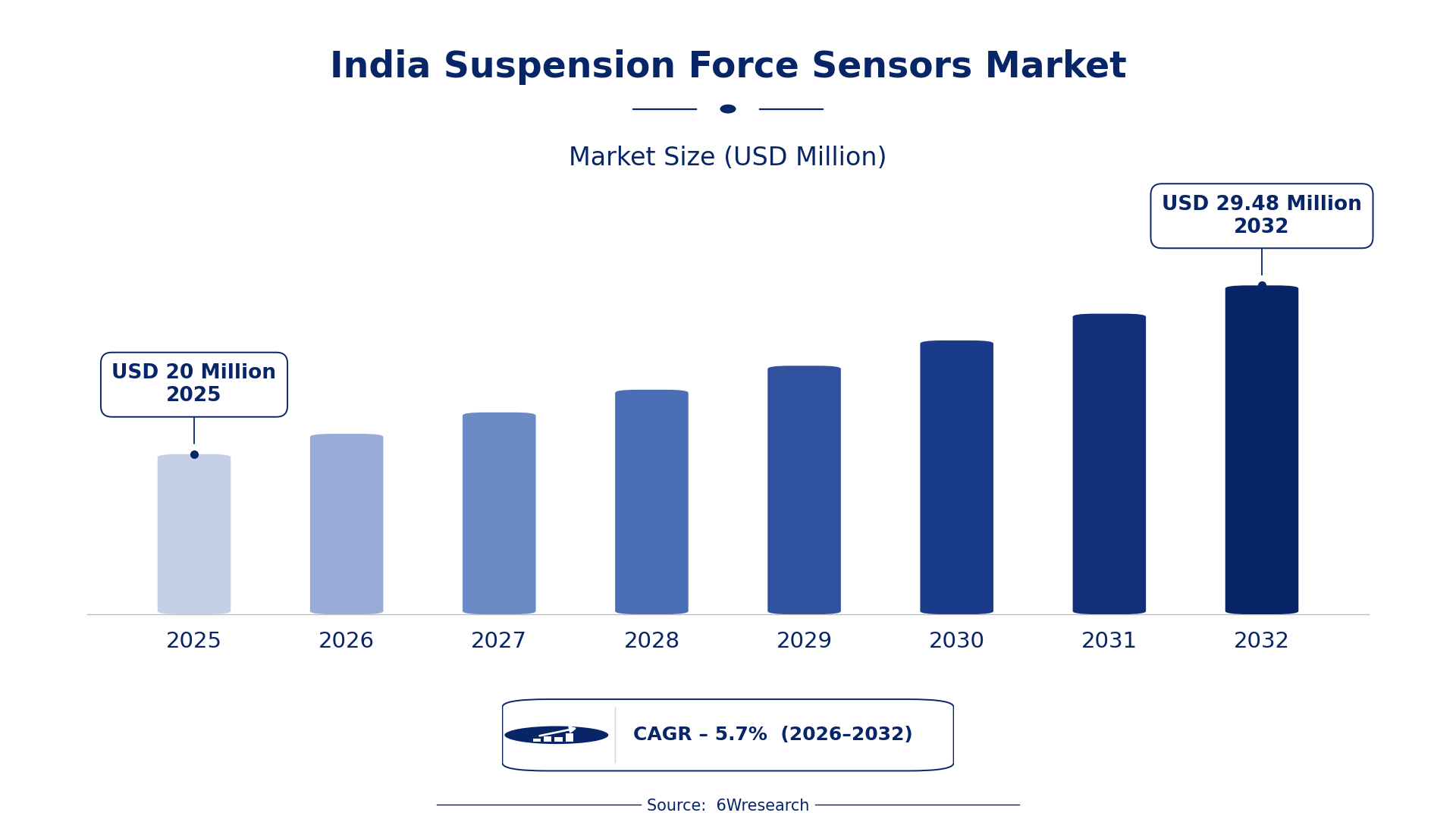
According to 6Wresearch internal database and industry insights, the India Suspension Force Sensors Market was valued at USD 20.0 million in 2025 and is projected to reach USD 29.48 million by 2032, growing at a CAGR of approximately 5.7% during 2026–2032.
India Suspension Force Sensors Market Highlights
| Report Metric | Details |
| Report Name | India Suspension Force Sensors Market |
| Market Size 2025 | USD 20.0 million |
| Market Size 2032 | USD 29.48 million |
| Absolute Growth 2025–2032 | USD 9.48 million |
| CAGR 2026–2032 | 5.7% |
| Peak Annual Growth | 7.9% in 2028 |
| Forecast Period | 2026–2032 |
| Historical Data | 2022–2025 |
| Base Year | 2025 |
| Leading Sensor Type, 2025 | Strain Gauge Sensors (39% share) |
| Leading Output Signal, 2025 | Analog (34% share) |
| Leading Application, 2025 | Load Detection (52% share) |
| Leading End User, 2025 | Auto OEMs (41% share) |
| Fastest-Growing Sensor Type | Piezoelectric Sensors (7.7% CAGR) |
| Fastest-Growing Output Signal | Digital (7.5% CAGR) |
| Fastest-Growing Application | Suspension Tuning (8.1% CAGR) |
| Fastest-Growing End User | Motorsports Teams (7.8% CAGR) |
| Growing Sector | Automotive |
| Key End Users | Auto OEMs, Luxury Vehicle Manufacturers, EV Suspension Developers, Motorsports Teams |
India Suspension Force Sensors Market Year-wise Growth Rate and Key Drivers (2022–2032)
This graph illustrates the annual growth rates of the market from 2022 to 2032, highlighting a steady upward trajectory and projected market expansion over the forecast period.
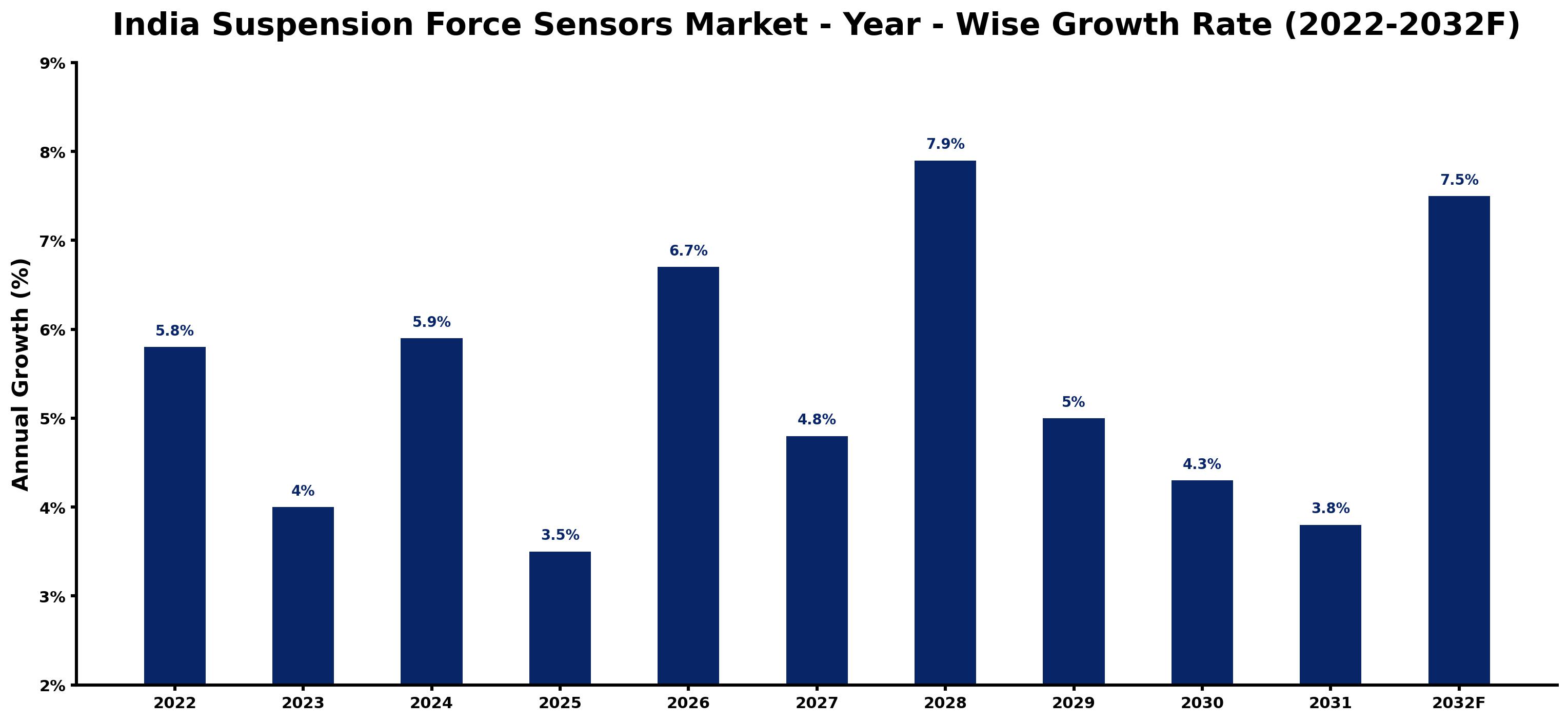
The following table presents the estimated annual growth rate for each year together with the principal factor influencing market performance.
| Year | Estimated Annual Growth (%) | Market Rationale |
| 2022 | 5.8 | The market experienced steady growth, driven by increased automotive production in India. |
| 2023 | 4.0 | Growth slowed due to a temporary dip in vehicle demand amid economic adjustments. |
| 2024 | 5.9 | Growth accelerated as the automotive sector rebounded, supported by rising consumer interest in vehicles. |
| 2025 | 3.5 | A slowdown occurred as manufacturers faced supply chain constraints affecting production timelines. |
| 2026 | 6.7 | Growth is expected to resume with increased investment in electric vehicle technology and infrastructure development. |
| 2027 | 4.8 | A slowdown is projected as manufacturers adjust to evolving market conditions and consumer preferences. |
| 2028 | 7.9 | The market is expected to peak with heightened demand for advanced suspension systems in luxury vehicles. |
| 2029 | 5.0 | Growth is likely to slow again as market saturation begins to affect new vehicle sales. |
| 2030 | 4.3 | The market will continue to grow, driven by the increasing adoption of electric vehicles in India. |
| 2031 | 3.8 | A further slowdown is anticipated as the market stabilises amid competitive pressures. |
| 2032 | 7.5 | The market is projected to grow rapidly, driven by innovation in suspension technologies. |
Note: Market size estimations and growth projections presented in this report are based on 6Wresearch's proprietary forecasting methodology, utilizing the latest available industry data, government publications, and primary research inputs.
India Suspension Force Sensors Market Synopsis
Suspension Force Sensors are devices used to measure the force on a vehicle's suspension system in India. These sensors are primarily made using strain gauge or piezoelectric technology and are essential for load detection and ride optimization. The India Suspension Force Sensors Market is growing due to rising automotive production and increasing demand from auto OEMs and luxury vehicle manufacturers. The adoption of electric vehicles is anticipated to reach 30% of total sales by 2030, further driving this growth.
Market Dynamics Impact Analysis (2026–2032)
| Factor | Type | Impact | Primary Segment Affected |
| Rising automotive production and demand for advanced vehicle technologies | Driver | High | Load Detection |
| Growing interest in electric vehicles and their performance requirements | Driver | High | Adaptive Suspension |
| Increased investment in automotive electronics and sensor technologies | Opportunity | High | Suspension Tuning |
| Expansion of luxury vehicle manufacturing in India | Opportunity | High | Ride Optimization |
| Supply chain disruptions affecting sensor availability | Restraint | High | Strain Gauge Sensors |
| Regulatory compliance costs for automotive components | Restraint | Medium | Piezoelectric Sensors |
| High initial investment costs for advanced sensor technologies | Challenge | Medium | MEMS Sensors |
| Limited awareness of the benefits of advanced suspension systems | Challenge | Medium | Capacitive Sensors |
Evaluation of Drivers in India Suspension Force Sensors Market (2026–2032)
Below mentioned are some major drivers and their influence on market dynamics.
| Drivers | Primary Segment Affected | Why It Matters (Evidence) |
| Increased vehicle production | Load Detection | Over 4 million vehicles were produced in India in 2022, leading to higher demand for sensors. |
| Rising adoption of electric vehicles | Adaptive Suspension | The adoption of electric vehicles is projected to reach 30% of total sales by 2030. |
| Investment in automotive electronics | Suspension Tuning | The automotive electronics market in India is anticipated to reach $22 billion by 2025. |
| Demand for luxury vehicles | Ride Optimization | The demand for luxury vehicles in India surged by 20% in 2023, increasing the need for advanced suspension systems. |
| Government initiatives supporting automotive R&D | Strain Gauge Sensors | The National Automotive Testing and R&D Infrastructure Project aims to improve vehicle testing capabilities. |
Growth in the Suspension Force Sensors market in India stems from rising vehicle production, greater adoption of electric vehicles, and substantial investment in automotive electronics. In 2022, over 4 million vehicles were produced in India, driving the need for load detection sensors. The demand for luxury vehicles surged by 20% in 2023, prompting manufacturers to invest in high-performance suspension systems.
Evaluation of Restraints in India Suspension Force Sensors Market
Below mentioned are some major restraints and their influence on market dynamics.
| Market Restraint | Primary Segment Affected | Why It Matters (Evidence) |
| Supply chain disruptions | Strain Gauge Sensors | Manufacturers faced delays in sensor production due to global supply chain issues, affecting availability. |
| Regulatory compliance costs | Piezoelectric Sensors | Compliance with Automotive Industry Standards (AIS) increases costs for manufacturers, impacting pricing. |
| High initial investment costs | MEMS Sensors | The advanced technology requires substantial capital investment, limiting market entry for new players. |
| Limited consumer awareness | Capacitive Sensors | Many buyers are unaware of the benefits of advanced suspension systems, hindering adoption. |
| Competition from alternative technologies | Digital | The rise of digital sensors may limit the market share of traditional analog sensors. |
India Suspension Force Sensors Market Challenges
Over 4 million vehicles produced in India in 2022 highlight the pressing need for advanced suspension force sensors, yet technology adoption is stymied by insufficient R&D funding in the automotive sector. This funding gap limits innovation for producers, leading to outdated sensor designs that fail to meet current performance expectations. Supply chain issues exacerbate sensor availability, as local suppliers find it challenging to meet the growing requirements from luxury vehicle manufacturers, resulting in production delays. Consequently, buyers are confronted with escalating costs, as sensor prices have surged by 15% due to producers seeking alternatives to adhere to Automotive Industry Standards.
Trends in the India Suspension Force Sensors Market
Buyers and suppliers in the India Suspension Force Sensors Market are adjusting to the following trends.
- Shift towards Electric Vehicle Suspension Systems: The Faster Adoption and Manufacturing of Hybrid and Electric Vehicles (FAME) scheme initiated in 2021 promotes the development of electric vehicle suspension systems. The adoption of electric vehicles is expected to grow to 30% of total sales by 2030.
- Transition from Analog to Digital Sensors: The automotive sector is increasingly adopting digital output sensors for precise data transmission. Digital sensors are projected to grow at a CAGR of 7.5% from 2026 to 2032, reflecting a shift in technology preference.
- Emergence of Adaptive Suspension Technologies: The demand for adaptive suspension systems is rising, driven by luxury vehicle manufacturers focusing on performance. This segment is expected to grow rapidly, with a CAGR of 8.1% from 2026 to 2032.
- Growing Focus on Ride Optimization: In 2023, the demand for ride optimisation technologies surged, particularly in luxury vehicles. This segment accounted for a significant share of the market, with load detection remaining critical for ensuring vehicle safety.
Investment Opportunities in the India Suspension Force Sensors Market
Some of the investment opportunities in the India Suspension Force Sensors Market are mentioned below.
- Partnerships with Electric Vehicle Manufacturers: Now is the time for sensor producers to partner with electric vehicle manufacturers to supply advanced suspension systems. The adoption of electric vehicles is expected to grow to 30% of total sales by 2030.
- Investment in Luxury Vehicle Manufacturing: With the demand for luxury vehicles increasing by 20% in 2023, there is an opportunity for suppliers to invest in high-quality suspension systems. Collaborating with luxury vehicle manufacturers can enhance market entry.
- Approval for Advanced Sensor Technologies: The automotive electronics market is anticipated to reach $22 billion by 2025, creating opportunities for suppliers of advanced sensor technologies. Engaging with regulatory bodies for compliance can facilitate market access.
- Expansion in Automotive R&D Facilities: The National Automotive Testing and R&D Infrastructure Project aims to enhance vehicle testing capabilities, providing opportunities for sensor manufacturers to collaborate in R&D. This initiative supports innovation and development in the sector.
Government Initiatives in the India Suspension Force Sensors Market
The Bureau of Indian Standards (BIS) regulates automotive components, including suspension force sensors, ensuring compliance with safety and performance standards. The Automotive Industry Standards (AIS) govern the testing and certification processes, impacting manufacturers' operational costs and pricing strategies. Compliance with these standards is essential for market participation and affects pricing strategies. The Ministry of Heavy Industries launched the Faster Adoption and Manufacturing of Hybrid and Electric Vehicles (FAME) scheme in 2021, which allocates funding for electric vehicle technology development, enhancing R&D capabilities.
The National Automotive Testing and R&D Infrastructure Project, administered by the Ministry of Heavy Industries, promotes the development of electric vehicle technologies. This initiative has allocated significant funding to support R&D in the automotive sector, enhancing testing capabilities and encouraging innovation. The Automotive Research Association of India (ARAI) plays a vital role in approving new technologies, ensuring they meet regulatory requirements. This allows manufacturers to introduce advanced suspension systems that comply with safety standards.
Future Insight of the India Suspension Force Sensors Market
The India Suspension Force Sensors Market will undergo significant changes by 2032, with electric vehicles expected to constitute 30% of total sales. The National Automotive Testing and R&D Infrastructure Project will improve testing capabilities, ensuring that sensors meet rigorous performance criteria. The Faster Adoption and Manufacturing of Hybrid and Electric Vehicles scheme will drive advancements in sensor technology. As a result, suppliers will see increased demand for high-quality sensors that enhance ride quality, while buyers will benefit from better vehicle performance.
Market Segmentation Analysis
Each segment group is reviewed below, with the leader by share and the fastest grower by CAGR.
By Sensor Type – Strain Gauge Sensors Dominated, Piezoelectric Sensors Expected to Grow Fastest
According to Sumit Sagar, AM at 6Wresearch, Strain Gauge Sensors held a 39% share of the India Suspension Force Sensors Market by sensor type in 2025. Strain gauge sensors dominate the market due to their widespread use in accurately measuring forces in vehicle suspension systems. Their reliability is particularly valued by auto OEMs, especially in high-end vehicles where precision is critical. Piezoelectric Sensors are set to record the highest CAGR in this split, 7.7% over 2026–2032. The rapid growth of piezoelectric sensors is attributed to their ability to measure dynamic forces, which are essential for high-performance applications. As the demand for performance tuning increases, this segment is expected to expand significantly. Suppliers should concentrate on advancing piezoelectric sensor technologies to cater to the growing performance requirements in the automotive sector.
By Output Signal – Analog Dominated, Digital Expected to Grow Fastest
With a 34% revenue share in 2025, Analog was the largest output signal category. Analog output signals lead the market as they are the standard format for many suspension force sensors, ensuring compatibility with existing automotive systems. This established presence provides a solid market share among manufacturers. Digital is projected to grow fastest, at a CAGR of 7.5% during 2026–2032. Digital output signals are witnessing swift growth due to their ability to transmit data with greater accuracy, which is increasingly important in modern automotive applications. The shift towards digital technology is likely to accelerate as vehicles become more reliant on data. Buyers should consider the advantages of adopting digital output sensors to enhance data accuracy and integration in advanced automotive systems.
By Application – Load Detection Dominated, Suspension Tuning Expected to Grow Fastest
Load Detection took a 52% share of application in 2025, more than any other category. Load detection is the foremost application for suspension force sensors, as it is vital for ensuring vehicle safety and performance. This importance is underscored by stringent safety standards within the automotive industry that necessitate reliable load measurement. Over 2026–2032, Suspension Tuning is expected to post the fastest growth, at a CAGR of 8.1%. Suspension tuning is rapidly gaining traction as manufacturers aim to optimise vehicle handling, especially in performance and luxury segments. This growing focus on tuning is expected to drive significant growth in this application area. Suppliers should invest in technologies that support advanced suspension tuning to align with the shifting preferences of performance-driven consumers.
By End User – Auto OEMs Dominated, Motorsports Teams Expected to Grow Fastest
In 2025, Auto OEMs led the end user split with a 41% share. Auto OEMs represent the largest user group for suspension force sensors, integrating these devices across a wide array of vehicle models. Their substantial production volumes are crucial in maintaining the overall market share. The quickest growth will come from Motorsports Teams, forecast to expand at a CAGR of 7.8% between 2026 and 2032. Motorsports teams are increasingly incorporating suspension force sensors for performance tuning and safety, resulting in rapid growth in this segment. The competitive dynamics of motorsports create a strong demand for advanced sensor technologies. Suppliers should aim to deliver customised solutions for motorsports teams that enhance performance and safety in high-pressure environments.
Key Attractiveness of the Report
- 10 Years of Market Numbers
- Historical Data Starting from 2022 to 2025
- Base Year 2025
- Forecast Data until 2032
- Key Performance Indicators Impacting the Market
- Major Upcoming Developments and Projects
Key Highlights of the Report:
- India Suspension Force Sensors Market Outlook
- Market Size of India Suspension Force Sensors Market, 2025
- Forecast of India Suspension Force Sensors Market, 2032
- Historical Data and Forecast of India Suspension Force Sensors Revenues & Volume for the Period 2022 - 2032F
- India Suspension Force Sensors Market Trend Evolution
- India Suspension Force Sensors Market Drivers and Challenges
- India Suspension Force Sensors Price Trends
- India Suspension Force Sensors Porter's Five Forces
- India Suspension Force Sensors Industry Life Cycle
- Historical Data and Forecast of India Suspension Force Sensors Market Revenues & Volume By Sensor Type for the Period 2022 - 2032F
- Historical Data and Forecast of India Suspension Force Sensors Market Revenues & Volume By Strain Gauge Sensors for the Period 2022 - 2032F
- Historical Data and Forecast of India Suspension Force Sensors Market Revenues & Volume By Piezoelectric Sensors for the Period 2022 - 2032F
- Historical Data and Forecast of India Suspension Force Sensors Market Revenues & Volume By Capacitive Sensors for the Period 2022 - 2032F
- Historical Data and Forecast of India Suspension Force Sensors Market Revenues & Volume By MEMS Sensors for the Period 2022 - 2032F
- Historical Data and Forecast of India Suspension Force Sensors Market Revenues & Volume By Output Signal for the Period 2022 - 2032F
- Historical Data and Forecast of India Suspension Force Sensors Market Revenues & Volume By Analog for the Period 2022 - 2032F
- Historical Data and Forecast of India Suspension Force Sensors Market Revenues & Volume By Digital for the Period 2022 - 2032F
- Historical Data and Forecast of India Suspension Force Sensors Market Revenues & Volume By Voltage-Based for the Period 2022 - 2032F
- Historical Data and Forecast of India Suspension Force Sensors Market Revenues & Volume By Compact Format for the Period 2022 - 2032F
- Historical Data and Forecast of India Suspension Force Sensors Market Revenues & Volume By Application for the Period 2022 - 2032F
- Historical Data and Forecast of India Suspension Force Sensors Market Revenues & Volume By Load Detection for the Period 2022 - 2032F
- Historical Data and Forecast of India Suspension Force Sensors Market Revenues & Volume By Suspension Tuning for the Period 2022 - 2032F
- Historical Data and Forecast of India Suspension Force Sensors Market Revenues & Volume By Adaptive Suspension for the Period 2022 - 2032F
- Historical Data and Forecast of India Suspension Force Sensors Market Revenues & Volume By Ride Optimization for the Period 2022 - 2032F
- Historical Data and Forecast of India Suspension Force Sensors Market Revenues & Volume By End User for the Period 2022 - 2032F
- Historical Data and Forecast of India Suspension Force Sensors Market Revenues & Volume By Auto OEMs for the Period 2022 - 2032F
- Historical Data and Forecast of India Suspension Force Sensors Market Revenues & Volume By Motorsports Teams for the Period 2022 - 2032F
- Historical Data and Forecast of India Suspension Force Sensors Market Revenues & Volume By Luxury Vehicle Manufacturers for the Period 2022 - 2032F
- Historical Data and Forecast of India Suspension Force Sensors Market Revenues & Volume By EV Suspension Developers for the Period 2022 - 2032F
- India Suspension Force Sensors Import Export Trade Statistics
- Market Opportunity Assessment By Sensor Type
- Market Opportunity Assessment By Output Signal
- Market Opportunity Assessment By Application
- Market Opportunity Assessment By End User
- India Suspension Force Sensors Top Companies Market Share
- India Suspension Force Sensors Competitive Benchmarking By Technical and Operational Parameters
- India Suspension Force Sensors Company Profiles
- India Suspension Force Sensors Key Strategic Recommendations
Market Covered
This report examines the market across the segments below.
By Sensor Type
- Strain Gauge Sensors
- Piezoelectric Sensors
- Capacitive Sensors
- MEMS Sensors
By Output Signal
- Analog
- Digital
- Voltage-Based
- Compact Format
By Application
- Load Detection
- Suspension Tuning
- Adaptive Suspension
- Ride Optimization
By End User
- Auto OEMs
- Motorsports Teams
- Luxury Vehicle Manufacturers
- EV Suspension Developers































