India Suspension Position Sensor Market Size & Growth Rate
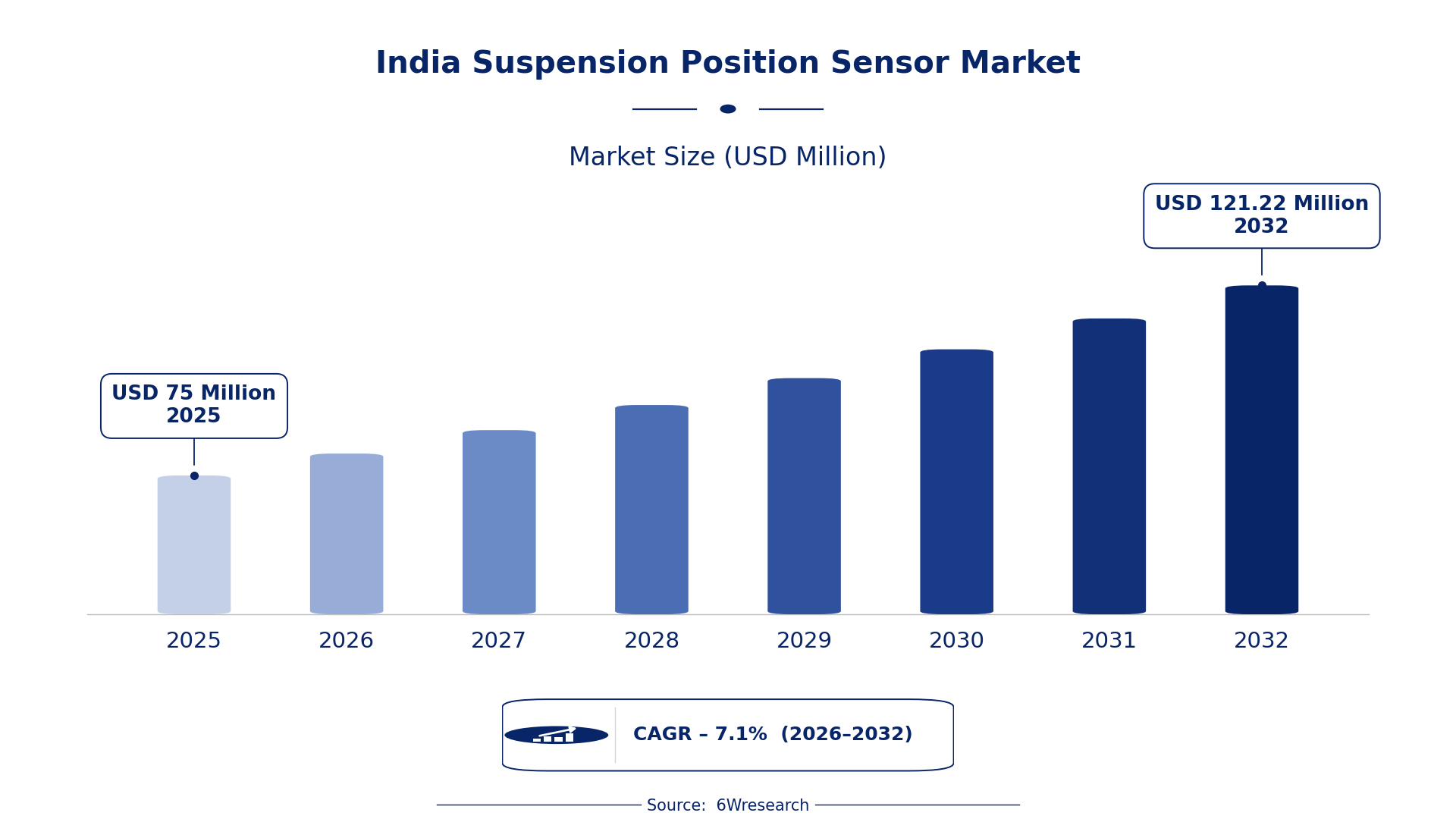
According to 6Wresearch internal database and industry insights, the India Suspension Position Sensor Market was valued at USD 75.0 million in 2025 and is projected to reach USD 121.22 million by 2032, growing at a CAGR of approximately 7.1% during 2026–2032.
India Suspension Position Sensor Market Highlights
| Report Metric | Details |
| Report Name | India Suspension Position Sensor Market |
| Market Size 2025 | USD 75.0 million |
| Market Size 2032 | USD 121.22 million |
| Absolute Growth 2025–2032 | USD 46.22 million |
| CAGR 2026–2032 | 7.1% |
| Peak Annual Growth | 9.6% in 2030 |
| Forecast Period | 2026–2032 |
| Historical Data | 2022–2025 |
| Base Year | 2025 |
| Leading Sensor Type, 2025 | Hall Effect Sensors (43% share) |
| Leading Measurement Mechanism, 2025 | Magnetic Field (36% share) |
| Leading Vehicle Segment, 2025 | Passenger Cars (44% share) |
| Leading End User, 2025 | OEMs (41% share) |
| Fastest-Growing Sensor Type | Linear Potentiometers (8.2% CAGR) |
| Fastest-Growing Measurement Mechanism | Resistive (9.5% CAGR) |
| Fastest-Growing Vehicle Segment | EVs & Hybrids (8.5% CAGR) |
| Fastest-Growing End User | Automotive Tier Suppliers (8.8% CAGR) |
| Growing Sector | Automotive |
| Key End Users | OEMs, Automotive Tier Suppliers, Sensor Manufacturers |
India Suspension Position Sensor Market Year-wise Growth Rate and Key Drivers (2022–2032)
This graph illustrates the annual growth rates of the market from 2022 to 2032, highlighting a steady upward trajectory and projected market expansion over the forecast period.
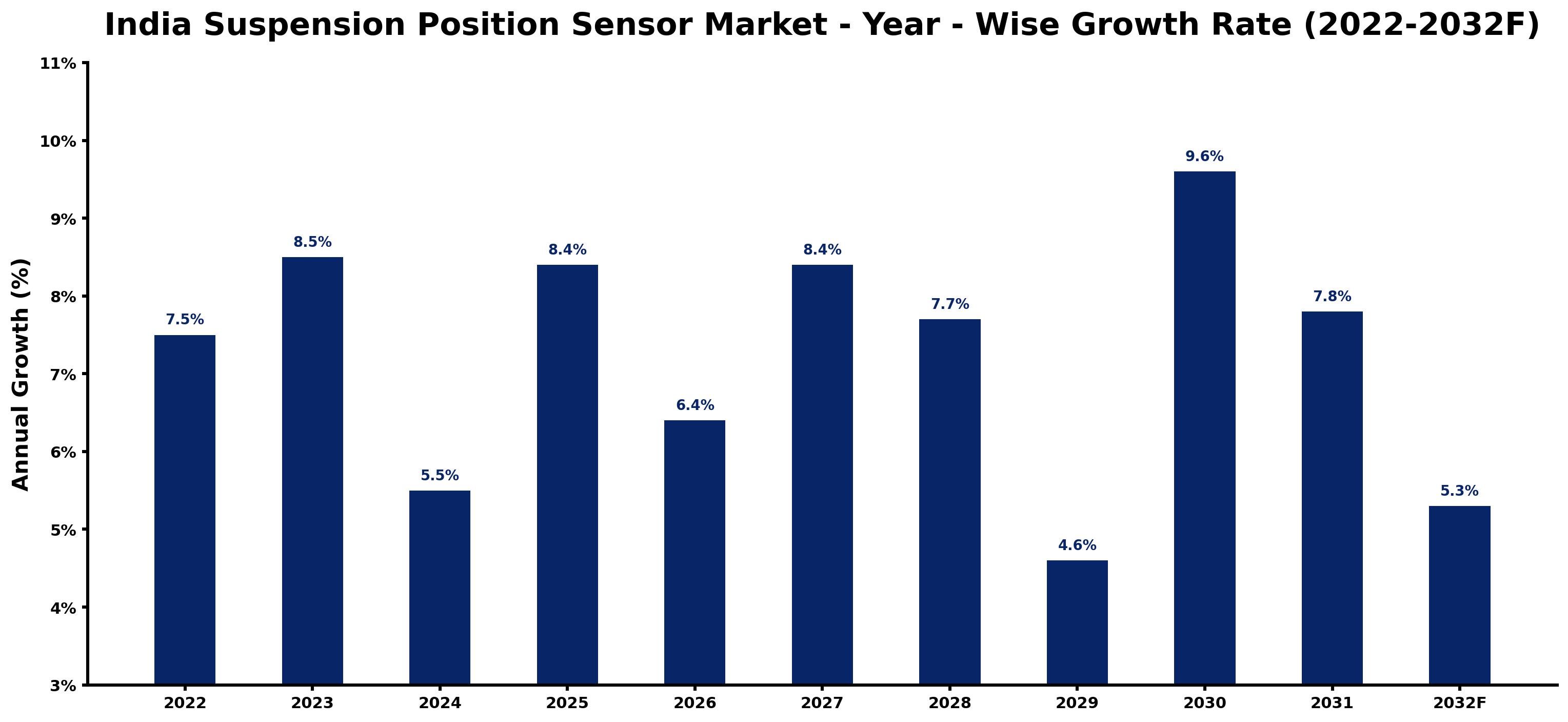
Year by year, the estimates below pair each growth rate with the development that shaped it.
| Year | Estimated Annual Growth (%) | Market Rationale |
| 2022 | 7.5 | The market showed steady growth due to rising vehicle production and demand for stability features. |
| 2023 | 8.5 | Growth accelerated as the automotive sector expanded, supported by increased sensor technology adoption. |
| 2024 | 5.5 | Growth slowed as manufacturers adjusted to supply chain challenges and fluctuating component availability. |
| 2025 | 8.4 | Demand surged again, driven by the passenger car segment reaching new production milestones. |
| 2026 | 6.4 | Growth is expected to decelerate as the market adapts to new safety regulations impacting sensor integration. |
| 2027 | 8.4 | A rebound is projected as OEMs increase production in response to consumer demand for advanced features. |
| 2028 | 7.7 | Growth is anticipated to slow again as market saturation in certain segments begins to take effect. |
| 2029 | 4.6 | The market is expected to experience a slowdown as demand stabilises amid economic uncertainties. |
| 2030 | 9.6 | A significant increase in growth is projected, driven by the push for electric vehicle adoption. |
| 2031 | 7.8 | Growth is expected to decelerate slightly as the market adjusts to evolving consumer preferences and technology. |
| 2032 | 5.3 | The market will continue to grow, albeit at a slower pace, reflecting maturity in the sector. |
Note: Market size estimations and growth projections presented in this report are based on 6Wresearch's proprietary forecasting methodology, utilizing the latest available industry data, government publications, and primary research inputs.
India Suspension Position Sensor Market Synopsis
The India Suspension Position Sensor Market includes electronic devices that measure the positions of vehicle suspensions. These sensors enhance vehicle stability and ride comfort while enabling advanced driver-assistance systems. Growth in this market is driven by rising vehicle production, with the passenger car segment expected to reach 3 million units by 2025. The push for electric vehicle adoption is also increasing demand, supported by initiatives such as the National Electric Mobility Mission Plan, which aims for 30% electric vehicle penetration by 2030.
Market Dynamics Impact Analysis (2026–2032)
| Factor | Type | Impact | Primary Segment Affected |
| Increasing vehicle production in the passenger car segment | Driver | High | Passenger Cars |
| Adoption of advanced driver-assistance systems in vehicles | Driver | High | OEMs |
| Growing demand for electric vehicles in India | Opportunity | High | EVs & Hybrids |
| Expansion of automotive manufacturing hubs in India | Opportunity | Medium | Commercial Vehicles |
| Supply chain disruptions affecting component availability | Restraint | High | Hall Effect Sensors |
| High costs of advanced sensor technologies | Restraint | Medium | Hall Effect Sensors |
| Regulatory changes impacting sensor integration timelines | Challenge | High | Hall Effect Sensors |
| Competition from alternative sensor technologies | Challenge | Medium | Optical Sensors |
Evaluation of Drivers in India Suspension Position Sensor Market (2026–2032)
Below mentioned are some major drivers and their influence on market dynamics.
| Drivers | Primary Segment Affected | Why It Matters (Evidence) |
| Rising vehicle production in India | Passenger Cars | The passenger car segment is projected to reach 3 million units by 2025, increasing demand for suspension position sensors. |
| Adoption of advanced driver-assistance systems | OEMs | The demand for safety features in vehicles drives OEMs to integrate more sensors, improving stability and comfort. |
| Government initiatives promoting electric vehicles | EVs & Hybrids | The National Electric Mobility Mission Plan aims for 30% electric vehicle penetration by 2030, boosting sensor demand. |
| Growth in the automotive component manufacturing sector | Commercial Vehicles | The automotive sector contributes approximately 7.1% to India's GDP, increasing demand for components including sensors. |
| Technological advancements in sensor manufacturing | Hall Effect Sensors | The Bureau of Indian Standards updated automotive sensor standards in 2021, encouraging innovation in sensor technologies. |
The passenger car segment is projected to reach 3 million units by 2025, driving sensor demand. The National Electric Mobility Mission Plan aims for 30% electric vehicle penetration by 2030, further supporting growth. The automotive sector contributes approximately 7.1% to the country's GDP, increasing demand for components including sensors. Technological advancements in manufacturing processes are improving the performance and reliability of sensors, leading to increased adoption in various vehicle types.
Evaluation of Restraints in India Suspension Position Sensor Market
The table below lists the restraints and the evidence behind each.
| Market Restraint | Primary Segment Affected | Why It Matters (Evidence) |
| Supply chain disruptions | Hall Effect Sensors | Supply chain challenges have led to delays in component availability, affecting production schedules and increasing costs for manufacturers. |
| High costs of advanced sensor technologies | Hall Effect Sensors | The investment required for advanced sensor technologies can deter smaller manufacturers from adopting these innovations, limiting market growth. |
| Regulatory changes affecting sensor integration | Hall Effect Sensors | New regulations complicate the integration of sensors into existing vehicle designs, delaying product launches for OEMs. |
| Competition from alternative sensor technologies | Optical Sensors | Emerging technologies may offer lower-cost solutions, putting pressure on traditional sensor manufacturers to innovate. |
| Market saturation in certain segments | Passenger Cars | As the market matures, growth rates may decline due to saturation in sensor adoption among established vehicle models. |
India Suspension Position Sensor Market Challenges
The India Suspension Position Sensor market encounters notable supply chain challenges, largely due to a heavy reliance on imported components. This dependence can delay production by up to three months for manufacturers. Compliance with the Bureau of Indian Standards adds hurdles, extending approval times by an average of six weeks, which disrupts production schedules for suppliers. Local manufacturers face difficulties in adopting advanced sensor technologies, potentially resulting in a 12% decrease in competitiveness against international players. Skills shortages in the automotive sector impede innovation, costing producers valuable market opportunities and limiting growth.
Trends in the India Suspension Position Sensor Market
Several trends are reshaping the India Suspension Position Sensor Market; the most important are set out below.
- Shift towards Electric Vehicles in India: India is increasingly adopting electric vehicles, with the National Electric Mobility Mission Plan aiming for 30% penetration by 2030, which is expected to boost sensor demand significantly.
- Transition from Traditional to Advanced Sensors: The automotive industry is moving from traditional sensors to advanced technologies like Hall Effect Sensors, with updated standards promoting safety and performance improvements in vehicles.
- Emergence of Smart Vehicle Technologies: Smart vehicle technologies are gaining traction, focusing on enhancing driver-assistance systems. In 2022, the Automotive Research Association of India reported a rise in sensor technology adoption by manufacturers.
- Growing Demand for Safety Features: The demand for enhanced safety features in vehicles is rising, driven by regulatory requirements. The Ministry of Road Transport and Highways mandated advanced safety features in new vehicles since 2022.
Investment Opportunities in the India Suspension Position Sensor Market
Several openings in the India Suspension Position Sensor Market merit attention from investors.
- Expansion of Electric Vehicle Manufacturing: The push for electric vehicles creates opportunities for sensor manufacturers. With the Indian government allocating $1.4 billion for infrastructure development in 2023, suppliers can partner with local manufacturers to meet demand for sensors.
- Investment in Advanced Sensor Technologies: Investing in advanced sensor technologies is essential as the market evolves. The Automotive Skill Development Council aims to train 500,000 individuals by 2025, creating a skilled workforce for sensor manufacturing.
- Development of Automotive Testing Facilities: The National Automotive Testing and R&D Infrastructure Project is improving testing capabilities. This initiative supports the growth of sensor technologies, providing opportunities for suppliers to engage with testing facilities.
- Collaboration with OEMs for New Models: Collaborating with OEMs to develop sensors for new vehicle models presents significant opportunities. The automotive sector's growth, projected to reach $300 billion by 2026, underscores the potential for sensor integration.
Government Initiatives in the India Suspension Position Sensor Market
The Automotive Mission Plan 2026, launched in 2021, aims to establish India as a global hub for automotive manufacturing, focusing on innovation and sustainability. This initiative builds on previous efforts to promote electric vehicle adoption and infrastructure development, creating a supportive environment for manufacturers and suppliers.
In 2023, the Indian government allocated $1.4 billion for electric vehicle infrastructure development, overseen by the Ministry of Heavy Industries. This funding supports the expansion of charging stations and manufacturing capabilities, facilitating the growth of the electric vehicle market and increasing demand for related components, including sensors.
Future Insight of the India Suspension Position Sensor Market
The India Suspension Position Sensor market is set to evolve by 2032, driven by multiple factors. The government's commitment to electric vehicle adoption aims for a 30% penetration by 2030, which will create a heightened need for advanced sensors. The Automotive Mission Plan 2026 envisions a sustainable automotive sector, prompting increased investments in sensor technologies. The National Automotive Testing and R&D Infrastructure Project will improve testing facilities, fostering collaboration between suppliers and manufacturers, and ultimately enhancing product quality.
Market Segmentation Analysis
The report offers a comprehensive study of the following market segments and their leading categories in the market.
By Sensor Type – Hall Effect Sensors Dominated, Linear Potentiometers Expected to Grow Fastest
According to Sumit Sagar, AM at 6Wresearch, with a 43% revenue share in 2025, Hall Effect Sensors was the largest sensor type category. Hall Effect Sensors dominate the market share due to their reliability and non-contact measurement capabilities, crucial for enhancing vehicle stability. Their widespread application in the growing passenger car segment, expected to reach 3 million units by 2025, solidifies their leading position. The quickest growth will come from Linear Potentiometers, forecast to expand at a CAGR of 8.2% between 2026 and 2032. Linear Potentiometers are experiencing the fastest growth because they provide precise position measurement, which is increasingly important for modern suspension systems. The surge in demand for accurate feedback mechanisms in vehicles is propelling this segment's rapid expansion. This suggests that suppliers should focus on advancing Linear Potentiometers to meet the rising market demands.
By Measurement Mechanism – Magnetic Field Dominated, Resistive Expected to Grow Fastest
Magnetic Field accounted for a 36% market share by measurement mechanism in 2025. Magnetic Field measurement mechanisms are preferred for their accuracy in detecting suspension positions, making them vital in modern automotive applications. Their integration into advanced vehicle systems aligns with the industry's shift towards higher performance and safety standards. Resistive is set to record the highest CAGR in this split, 9.5% over 2026–2032. Resistive mechanisms are gaining traction due to their cost-effectiveness and reliability in traditional suspension systems. As vehicle production ramps up, the demand for these mechanisms is expected to surge, driving their growth. Buyers should consider the balance between cost and performance when selecting measurement mechanisms for suspension position sensors.
By Vehicle Segment – Passenger Cars Dominated, EVs & Hybrids Expected to Grow Fastest
The largest vehicle segment category in 2025 was Passenger Cars, with a 44% share of total revenue. Passenger Cars represent the largest segment for suspension position sensors, largely due to their high production volumes and the need for improved ride comfort and stability. The automotive sector's contribution of 7.1% to India's GDP highlights the significance of this segment. EVs & Hybrids are projected to grow fastest, at a CAGR of 8.5% during 2026–2032. EVs & Hybrids are the fastest-growing segment as they incorporate advanced technologies that require sophisticated suspension systems. The government's push for electric vehicle adoption to 30% by 2030 is a key factor driving this growth. Suppliers should prioritise innovations tailored for EVs & Hybrids to capitalise on the expanding market opportunities.
By End User – OEMs Dominated, Automotive Tier Suppliers Expected to Grow Fastest
OEMs took a 41% share of end user in 2025, more than any other category. OEMs are the primary end users of suspension position sensors, as they integrate these components into vehicle manufacturing processes. Their substantial role in the automotive supply chain solidifies their leading market share. Over 2026–2032, Automotive Tier Suppliers are expected to post the fastest growth, at a CAGR of 8.8%. Automotive Tier Suppliers are rapidly expanding their influence by supplying essential components, including suspension position sensors, to OEMs. This growth is fuelled by the increasing complexity of vehicle systems requiring advanced sensor technologies. Suppliers must strengthen relationships with Automotive Tier Suppliers to ensure their products meet the evolving demands of OEMs.
Key Attractiveness of the Report
- 10 Years of Market Numbers
- Historical Data Starting from 2022 to 2025
- Base Year 2025
- Forecast Data until 2032
- Key Performance Indicators Impacting the Market
- Major Upcoming Developments and Projects
Key Highlights of the Report:
- India Suspension Position Sensor Market Outlook
- Market Size of India Suspension Position Sensor Market, 2025
- Forecast of India Suspension Position Sensor Market, 2032
- Historical Data and Forecast of India Suspension Position Sensor Revenues & Volume for the Period 2022 - 2032F
- India Suspension Position Sensor Market Trend Evolution
- India Suspension Position Sensor Market Drivers and Challenges
- India Suspension Position Sensor Price Trends
- India Suspension Position Sensor Porter's Five Forces
- India Suspension Position Sensor Industry Life Cycle
- Historical Data and Forecast of India Suspension Position Sensor Market Revenues & Volume By Sensor Type for the Period 2022 - 2032F
- Historical Data and Forecast of India Suspension Position Sensor Market Revenues & Volume By Linear Potentiometers for the Period 2022 - 2032F
- Historical Data and Forecast of India Suspension Position Sensor Market Revenues & Volume By Hall Effect Sensors for the Period 2022 - 2032F
- Historical Data and Forecast of India Suspension Position Sensor Market Revenues & Volume By Optical Sensors for the Period 2022 - 2032F
- Historical Data and Forecast of India Suspension Position Sensor Market Revenues & Volume By Inductive Sensors for the Period 2022 - 2032F
- Historical Data and Forecast of India Suspension Position Sensor Market Revenues & Volume By Measurement Mechanism for the Period 2022 - 2032F
- Historical Data and Forecast of India Suspension Position Sensor Market Revenues & Volume By Resistive for the Period 2022 - 2032F
- Historical Data and Forecast of India Suspension Position Sensor Market Revenues & Volume By Magnetic Field for the Period 2022 - 2032F
- Historical Data and Forecast of India Suspension Position Sensor Market Revenues & Volume By Light-Based for the Period 2022 - 2032F
- Historical Data and Forecast of India Suspension Position Sensor Market Revenues & Volume By Electromagnetic for the Period 2022 - 2032F
- Historical Data and Forecast of India Suspension Position Sensor Market Revenues & Volume By Vehicle Segment for the Period 2022 - 2032F
- Historical Data and Forecast of India Suspension Position Sensor Market Revenues & Volume By Passenger Cars for the Period 2022 - 2032F
- Historical Data and Forecast of India Suspension Position Sensor Market Revenues & Volume By Sports Cars for the Period 2022 - 2032F
- Historical Data and Forecast of India Suspension Position Sensor Market Revenues & Volume By Commercial Vehicles for the Period 2022 - 2032F
- Historical Data and Forecast of India Suspension Position Sensor Market Revenues & Volume By EVs & Hybrids for the Period 2022 - 2032F
- Historical Data and Forecast of India Suspension Position Sensor Market Revenues & Volume By End User for the Period 2022 - 2032F
- Historical Data and Forecast of India Suspension Position Sensor Market Revenues & Volume By OEMs for the Period 2022 - 2032F
- Historical Data and Forecast of India Suspension Position Sensor Market Revenues & Volume By Advanced Electronics Firms for the Period 2022 - 2032F
- Historical Data and Forecast of India Suspension Position Sensor Market Revenues & Volume By Sensor Manufacturers for the Period 2022 - 2032F
- Historical Data and Forecast of India Suspension Position Sensor Market Revenues & Volume By Automotive Tier Suppliers for the Period 2022 - 2032F
- India Suspension Position Sensor Import Export Trade Statistics
- Market Opportunity Assessment By Sensor Type
- Market Opportunity Assessment By Measurement Mechanism
- Market Opportunity Assessment By Vehicle Segment
- Market Opportunity Assessment By End User
- India Suspension Position Sensor Top Companies Market Share
- India Suspension Position Sensor Competitive Benchmarking By Technical and Operational Parameters
- India Suspension Position Sensor Company Profiles
- India Suspension Position Sensor Key Strategic Recommendations
Market Covered
This report examines the market across the segments below.
By Sensor Type
- Linear Potentiometers
- Hall Effect Sensors
- Optical Sensors
- Inductive Sensors
By Measurement Mechanism
- Resistive
- Magnetic Field
- Light-Based
- Electromagnetic
By Vehicle Segment
- Passenger Cars
- Sports Cars
- Commercial Vehicles
- EVs & Hybrids
By End User
- OEMs
- Advanced Electronics Firms
- Sensor Manufacturers
- Automotive Tier Suppliers































