India Sustainable Agriculture Input Market Size & Growth Rate
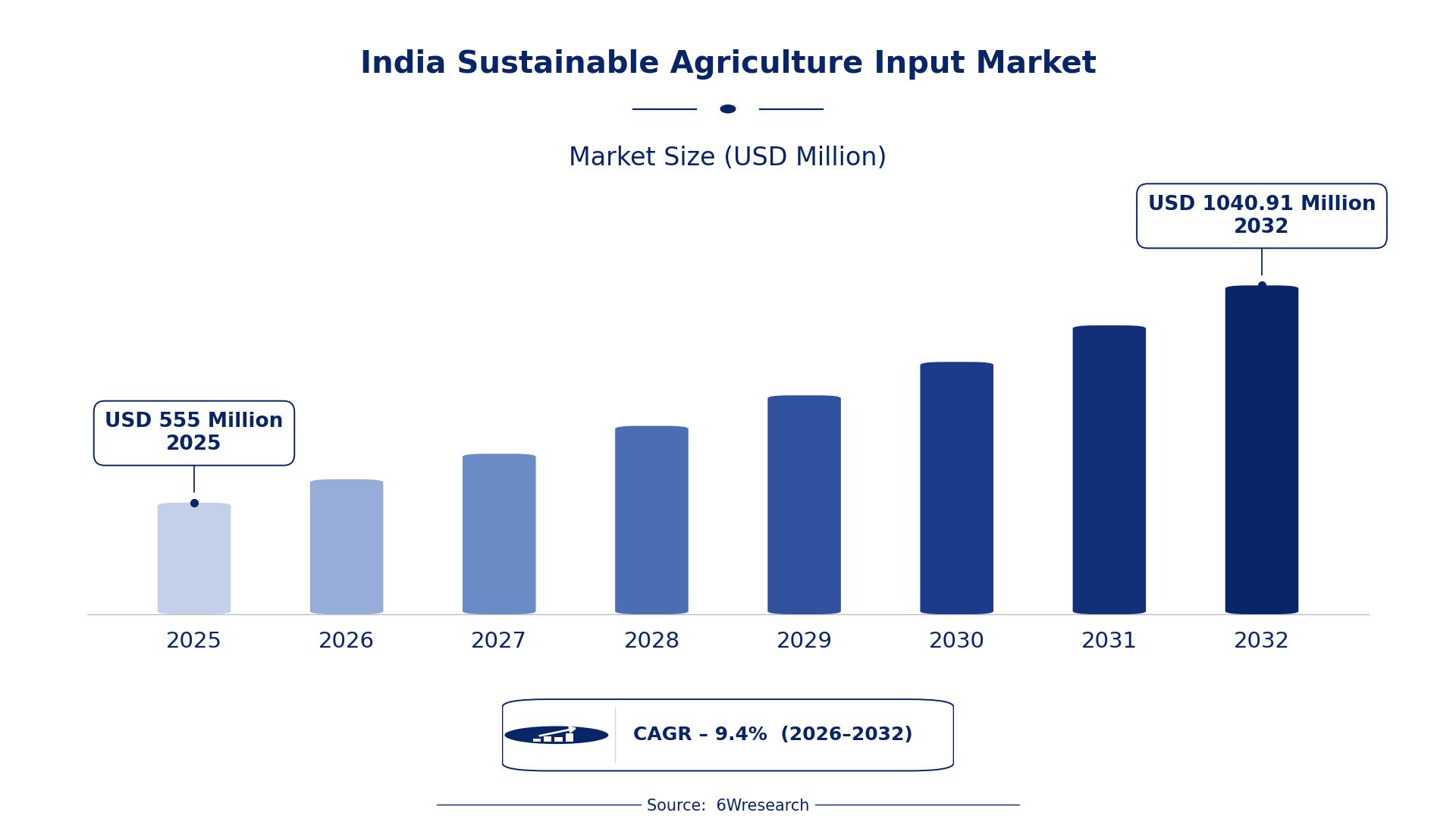
According to 6Wresearch internal database and industry insights, the India Sustainable Agriculture Input Market was valued at USD 555.0 million in 2025 and is projected to reach USD 1,040.91 million by 2032, growing at a CAGR of approximately 9.4% during 2026–2032.
India Sustainable Agriculture Input Market Highlights
| Report Metric | Details |
| Report Name | India Sustainable Agriculture Input Market |
| Market Size 2025 | USD 555.0 million |
| Market Size 2032 | USD 1,040.91 million |
| Absolute Growth 2025–2032 | USD 485.91 million |
| CAGR 2026–2032 | 9.4% |
| Peak Annual Growth | 11.8% in 2030 |
| Forecast Period | 2026–2032 |
| Historical Data | 2022–2025 |
| Base Year | 2025 |
| Leading Input Type, 2025 | Organic Fertilizers (44% share) |
| Leading Use Category, 2025 | Nutrient Management (39% share) |
| Leading Application Crop, 2025 | Cereals & Oilseeds (40% share) |
| Leading End User, 2025 | Regenerative Farmers (46% share) |
| Fastest-Growing Input Type | Biostimulants (10.7% CAGR) |
| Fastest-Growing Use Category | Growth Enhancement (11.9% CAGR) |
| Fastest-Growing Application Crop | Fruits & Vegetables (11.5% CAGR) |
| Growing Sector | Organic Farming |
| Key End Users | Regenerative Farmers, Crop Input Retailers, Agri Cooperatives |
India Sustainable Agriculture Input Market Year-wise Growth Rate and Key Drivers (2022–2032)
This graph illustrates the annual growth rates of the market from 2022 to 2032, highlighting a steady upward trajectory and projected market expansion over the forecast period.
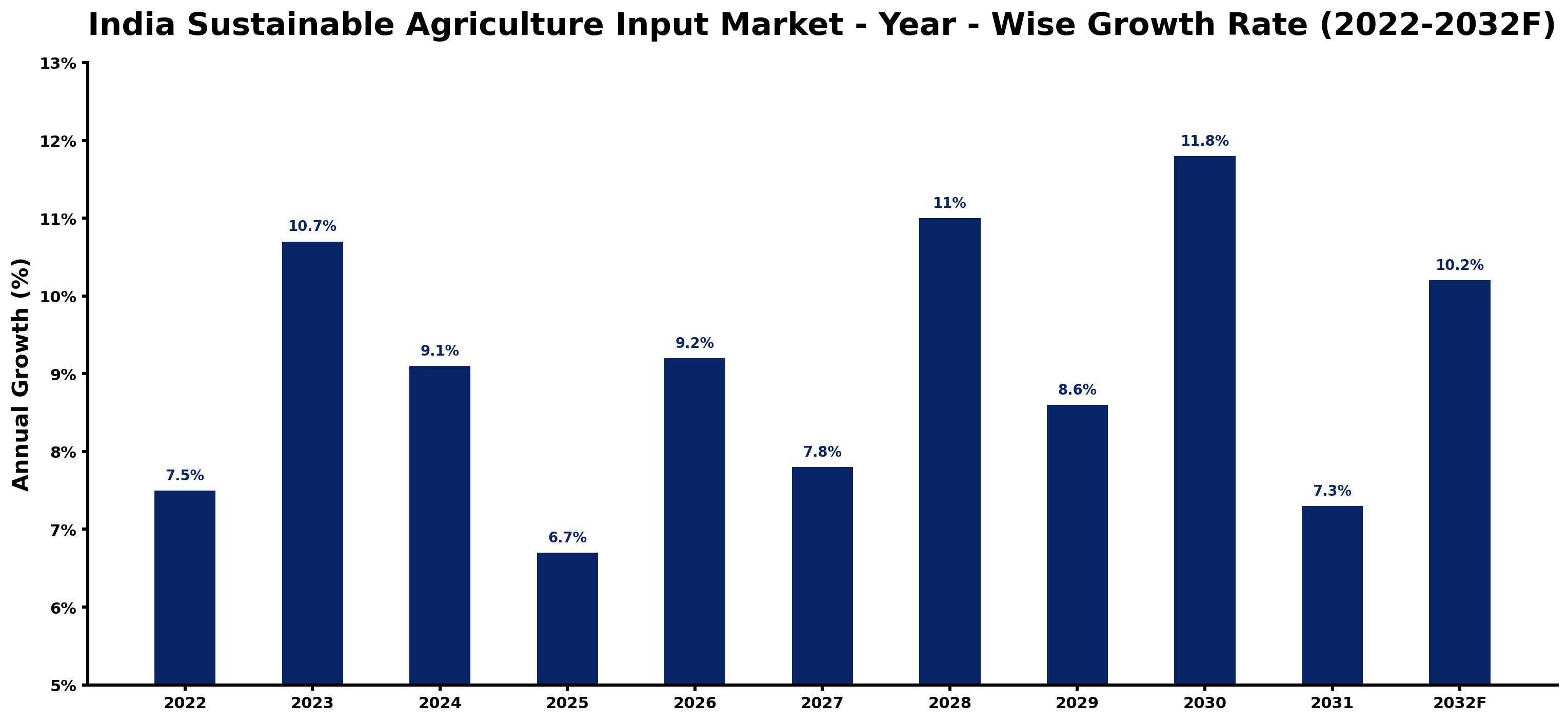
The following table presents the estimated annual growth rate for each year together with the principal factor influencing market performance.
| Year | Estimated Annual Growth (%) | Market Rationale |
| 2022 | 7.5 | The market experienced steady growth due to the National Mission for Sustainable Agriculture promoting organic practices. |
| 2023 | 10.7 | Growth accelerated as the government promoted organic farming through the National Programme for Organic Production. |
| 2024 | 9.1 | A slight slowdown occurred as the market adjusted to the Fertilizer Control Order's new regulations. |
| 2025 | 6.7 | Continued growth was observed, although at a slower pace, as farmers explored diverse sustainable inputs. |
| 2026 | 9.2 | The market is expected to rebound with renewed interest in biostimulants and eco-friendly herbicides. |
| 2027 | 7.8 | A slowdown is projected as market conditions shift towards established practices. |
| 2028 | 11.0 | Growth is expected to surge again as demand for organic vegetables in urban markets increases significantly. |
| 2029 | 8.6 | The market is projected to slow slightly, reflecting adjustments in supply chains and farmer adoption rates. |
| 2030 | 11.8 | A peak growth year is expected, driven by heightened investments in sustainable agriculture technologies. |
| 2031 | 7.3 | Growth is projected to decelerate as the market stabilises after the previous peak. |
| 2032 | 10.2 | A resurgence in growth is expected as organic farming gains further traction. |
Note: Market size estimations and growth projections presented in this report are based on 6Wresearch's proprietary forecasting methodology, utilizing the latest available industry data, government publications, and primary research inputs.
India Sustainable Agriculture Input Market Synopsis
The India Sustainable Agriculture Input Market includes organic fertilizers, biostimulants, eco-friendly herbicides, and biocontrol agents. These products come from natural sources, aimed at boosting crop yield while reducing environmental impact. The market is growing due to increasing domestic demand for organic produce and government initiatives that promote sustainable practices. In 2022, the area under organic cultivation reached 3.1 million hectares, marking a clear shift towards eco-friendly farming. With a goal to expand organic farming to 10% of total agricultural land by 2025, the market is poised for considerable growth.
Market Dynamics Impact Analysis (2026–2032)
| Factor | Type | Impact | Primary Segment Affected |
| Government initiatives promoting organic farming practices. | Driver | High | Nutrient Management |
| Increasing urban demand for organic vegetables and fruits. | Driver | High | Fruits & Vegetables |
| Growing interest in biostimulants among regenerative farmers. | Opportunity | High | Biostimulants |
| Investment in eco-friendly herbicides to meet regulatory standards. | Opportunity | High | Eco-Friendly Herbicides |
| Challenges in supply chain logistics for sustainable inputs. | Restraint | Medium | Organic Fertilizers |
| Limited awareness among traditional farmers about sustainable practices. | Restraint | Medium | Biocontrol Agents |
| Market faces challenges in integrating new technologies effectively. | Challenge | High | Growth Enhancement |
| Competition from conventional agricultural inputs remains significant. | Challenge | High | Weed Control |
Evaluation of Drivers in India Sustainable Agriculture Input Market (2026–2032)
The table below links each growth driver to the segment it affects and the evidence for it.
| Drivers | Primary Segment Affected | Why It Matters (Evidence) |
| Government initiatives such as the National Mission for Sustainable Agriculture promote organic inputs. | Organic Fertilizers | This initiative aims to increase organic fertilizer usage, targeting 1.5 million tons by 2025. |
| Urban demand for organic produce is rising, particularly in metropolitan areas. | Fruits & Vegetables | In 2023, demand for organic vegetables in urban markets increased by 25%. |
| The Soil Health Card Scheme provides farmers with tailored recommendations for sustainable practices. | Nutrient Management | This scheme encourages balanced fertilizer use, improving crop health and productivity. |
| The growing adoption of biostimulants is driven by their effectiveness in promoting crop resilience. | Biostimulants | Over 30% of Indian farmers reported using biostimulants for crop enhancement in 2023. |
| The Pradhan Mantri Krishi Sinchai Yojana promotes efficient water use in agriculture. | Growth Enhancement | This initiative supports sustainable farming practices, leading to increased crop yields. |
Demand for organic vegetables surged by 25% in 2023, prompting farmers to invest in sustainable inputs. The Soil Health Card Scheme provides tailored recommendations, improving nutrient management and crop health. Over 30% of farmers reported using biostimulants, reflecting their growing importance in promoting crop resilience. These factors contribute to a thriving market for sustainable agriculture inputs.
Evaluation of Restraints in India Sustainable Agriculture Input Market
Below mentioned are some major restraints and their influence on market dynamics.
| Market Restraint | Primary Segment Affected | Why It Matters (Evidence) |
| Supply chain logistics for sustainable inputs can be inefficient. | Organic Fertilizers | This inefficiency can delay product availability, affecting farmer adoption rates. |
| Traditional farmers may lack awareness of sustainable agricultural practices. | Biocontrol Agents | Limited knowledge hinders the adoption of eco-friendly pest management solutions. |
| Regulatory compliance can be complex for new sustainable products. | Eco-Friendly Herbicides | Navigating these regulations can slow market entry for new solutions. |
| Market competition from conventional inputs remains a barrier. | Weed Control | Farmers may prefer established chemical herbicides over newer organic options. |
| High initial costs of sustainable inputs can deter adoption. | Growth Enhancement | Financial constraints limit farmers' willingness to invest in new technologies. |
India Sustainable Agriculture Input Market Challenges
The India Sustainable Agriculture Input Market faces a few practical problems, starting with high costs for buyers. Organic fertilizers and biostimulants can be up to 30% more expensive than conventional options, which strains the budgets of smallholder farmers. Regulatory hurdles complicate access; the Fertilizer Control Order imposes strict guidelines that can delay product availability, impacting farmers' planting schedules. Competition from cheaper synthetic inputs challenges suppliers, as many farmers opt for lower-cost alternatives, undermining the market for sustainable products. Technology adoption is also sluggish; many farmers lack access to modern sustainable practices, limiting the effectiveness of available inputs.
Trends in the India Sustainable Agriculture Input Market
The trends below show where the India Sustainable Agriculture Input Market is heading.
- Shift towards Organic Fertilizers: The National Mission for Sustainable Agriculture launched in 2021 promotes organic fertilizers, aiming for 1.5 million tons by 2025. This initiative is reshaping the market, encouraging farmers to adopt eco-friendly practices.
- Regenerative Farmers Leading the Way: Regenerative farmers are increasingly adopting sustainable inputs, with 46% using organic fertilizers in 2025. This trend highlights a growing commitment to environmentally friendly farming practices.
- Urban Markets Driving Demand for Organic Produce: Urban areas are experiencing a surge in demand for organic vegetables, with a 25% increase reported in 2023. This trend is pushing farmers to invest in sustainable agriculture inputs.
- Focus on Biostimulants for Crop Resilience: In 2023, over 30% of farmers reported using biostimulants, reflecting their growing importance in promoting crop resilience. This trend indicates a shift towards more sustainable farming practices.
Investment Opportunities in the India Sustainable Agriculture Input Market
Below are the investment opportunities with the strongest case in the India Sustainable Agriculture Input Market.
- Investment in Eco-Friendly Herbicides: With a projected market growth of 10.7% for eco-friendly herbicides, there is an opportunity for suppliers. Farmers are increasingly seeking sustainable alternatives to conventional herbicides.
- Expansion of Biostimulants Market: The biostimulants market is expected to grow, presenting a lucrative opportunity for investment. Regenerative farmers are key buyers in this segment, driving demand for innovative products.
- Support for Organic Farming Initiatives: The government allocated INR 500 crore for promoting organic farming initiatives in 2023. This funding creates opportunities for businesses to partner with agri cooperatives to distribute sustainable inputs.
- Growing Demand in Urban Areas: The demand for organic vegetables in urban markets increased by 25% in 2023, creating an opportunity for suppliers. Collaborating with local retailers can enhance market access.
Government Initiatives in the India Sustainable Agriculture Input Market
The Ministry of Agriculture and Farmers' Welfare oversees the implementation of sustainable agriculture programs, including the Soil Health Card Scheme. This scheme funds soil assessments for farmers, helping them optimise fertilizer use and improve crop health. The National Programme for Organic Production certifies organic products, ensuring quality and marketability. This certification process supports farmers in accessing premium markets for their organic produce. The National Mission for Sustainable Agriculture aims to promote organic farming practices with a budget of INR 2,000 crore over five years, significantly benefiting sustainable agriculture input producers.
Agri cooperatives play a significant role in distributing sustainable inputs to farmers. They leverage government funding to improve access to organic products, ensuring that farmers receive the necessary support for adopting sustainable practices. The National Biodiversity Action Plan also promotes strategies for integrating biodiversity into agriculture, further assisting farmers in sustainable crop management. The Pradhan Mantri Krishi Sinchai Yojana focuses on efficient water use, enhancing sustainable farming initiatives.
Future Insight of the India Sustainable Agriculture Input Market
Several forward-looking factors should support the India Sustainable Agriculture Input Market in the coming years. The National Mission for Sustainable Agriculture aims to increase organic farming to 10% of total agricultural land by 2025, expanding the market significantly. Government funding, including INR 500 crore allocated in 2023 for organic initiatives, will enhance resources for farmers. Urban demand for organic vegetables, which surged by 25% in 2023, will encourage suppliers to diversify their product offerings. Research from agricultural institutions will refine sustainable input technologies, improving their effectiveness.
Market Segmentation Analysis
The report offers a comprehensive study of the following market segments and their leading categories in the market.
By Input Type – Organic Fertilizers Dominated, Biostimulants Expected to Grow Fastest
According to Sumit Sagar, AM at 6Wresearch, Organic Fertilizers held a 44% share of the India Sustainable Agriculture Input Market by input type in 2025. Organic fertilizers command the largest market share in India's sustainable agriculture input sector due to their widespread adoption among farmers for enhancing soil fertility and crop yield. The National Mission for Sustainable Agriculture actively supports organic farming, reinforcing the significance of organic fertilizers in the market. Over 2026–2032, Biostimulants are expected to post the fastest growth, at a CAGR of 10.7%. Biostimulants are experiencing rapid growth, with over 30% of Indian farmers utilising them in 2023 to enhance plant growth and resilience against environmental stress. As the organic farming trend continues to gain momentum, the demand for biostimulants is expected to rise sharply, further solidifying their market position. Suppliers should consider expanding their biostimulant product lines to meet the increasing demand from farmers focused on sustainable practices.
By Use Category – Nutrient Management Dominated, Growth Enhancement Expected to Grow Fastest
The largest use category category in 2025 was Nutrient Management, with a 39% share of total revenue. Nutrient management captures the largest market share as it is critical for optimising crop nutrition and health, which farmers prioritise for sustainable yields. The Soil Health Card Scheme implemented by the government promotes balanced fertilizer use, strengthening nutrient management's dominant role in the market. Growth Enhancement is projected to grow fastest, at a CAGR of 11.9% during 2026–2032. Growth enhancement is the fastest-growing category, spurred by the pressing need to boost crop productivity and quality, especially in urban areas where the demand for organic vegetables surged by 25% in 2023. As nutrient management practices improve, growth enhancement solutions are likely to see heightened adoption. Buyers should prioritise nutrient management strategies to ensure optimal crop health and yield in an increasingly competitive agricultural landscape.
By Application Crop – Cereals & Oilseeds Dominated, Fruits & Vegetables Expected to Grow Fastest
Cereals & Oilseeds accounted for a 40% market share by application crop in 2025. Cereals and oilseeds dominate the market share as major crops benefiting from sustainable inputs, reflecting the staple food requirements of the Indian population. The increasing area under organic cultivation, which reached 3.1 million hectares in 2022, further solidifies this segment's position. The quickest growth will come from Fruits & Vegetables, forecast to expand at a CAGR of 11.5% between 2026 and 2032. Fruits and vegetables are the fastest-growing segment due to the high demand for organic produce in urban markets, with a notable increase in consumption observed in 2023. This trend indicates a shift towards healthier eating habits, propelling growth in this category. Suppliers should consider expanding their product lines to cater to the growing demand for organic fruits and vegetables in urban areas.
By End User – Regenerative Farmers Dominated and Is Expected to Record the Fastest Growth
Regenerative Farmers took a 46% share of end user in 2025, more than any other category. Regenerative farmers command the largest market share as they actively seek sustainable inputs for eco-friendly farming, aligning with the government's initiatives for organic agriculture. Their commitment to sustainability is reflected in the increasing adoption of organic farming practices across India. The same category are also set to grow fastest, at a CAGR of 11.3% during 2026–2032. Regenerative farmers are also the fastest-growing segment, as their dedication to sustainable practices fuels the demand for organic inputs. This dual status indicates a strong commitment to sustainable agriculture that is expected to continue expanding. Suppliers must engage with regenerative farmers to align their product offerings with the growing demand for eco-friendly agricultural practices.
Key Attractiveness of the Report
- 10 Years of Market Numbers
- Historical Data Starting from 2022 to 2025
- Base Year 2025
- Forecast Data until 2032
- Key Performance Indicators Impacting the Market
- Major Upcoming Developments and Projects
Key Highlights of the Report:
- India Sustainable Agriculture Input Market Outlook
- Market Size of India Sustainable Agriculture Input Market, 2025
- Forecast of India Sustainable Agriculture Input Market, 2032
- Historical Data and Forecast of India Sustainable Agriculture Input Revenues & Volume for the Period 2022 - 2032F
- India Sustainable Agriculture Input Market Trend Evolution
- India Sustainable Agriculture Input Market Drivers and Challenges
- India Sustainable Agriculture Input Price Trends
- India Sustainable Agriculture Input Porter's Five Forces
- India Sustainable Agriculture Input Industry Life Cycle
- Historical Data and Forecast of India Sustainable Agriculture Input Market Revenues & Volume By Input Type for the Period 2022 - 2032F
- Historical Data and Forecast of India Sustainable Agriculture Input Market Revenues & Volume By Organic Fertilizers for the Period 2022 - 2032F
- Historical Data and Forecast of India Sustainable Agriculture Input Market Revenues & Volume By Biostimulants for the Period 2022 - 2032F
- Historical Data and Forecast of India Sustainable Agriculture Input Market Revenues & Volume By Eco-Friendly Herbicides for the Period 2022 - 2032F
- Historical Data and Forecast of India Sustainable Agriculture Input Market Revenues & Volume By Biocontrol Agents for the Period 2022 - 2032F
- Historical Data and Forecast of India Sustainable Agriculture Input Market Revenues & Volume By Use Category for the Period 2022 - 2032F
- Historical Data and Forecast of India Sustainable Agriculture Input Market Revenues & Volume By Nutrient Management for the Period 2022 - 2032F
- Historical Data and Forecast of India Sustainable Agriculture Input Market Revenues & Volume By Growth Enhancement for the Period 2022 - 2032F
- Historical Data and Forecast of India Sustainable Agriculture Input Market Revenues & Volume By Weed Control for the Period 2022 - 2032F
- Historical Data and Forecast of India Sustainable Agriculture Input Market Revenues & Volume By Pest & Disease Resistance for the Period 2022 - 2032F
- Historical Data and Forecast of India Sustainable Agriculture Input Market Revenues & Volume By Application Crop for the Period 2022 - 2032F
- Historical Data and Forecast of India Sustainable Agriculture Input Market Revenues & Volume By Pulses & Legumes for the Period 2022 - 2032F
- Historical Data and Forecast of India Sustainable Agriculture Input Market Revenues & Volume By Cereals & Oilseeds for the Period 2022 - 2032F
- Historical Data and Forecast of India Sustainable Agriculture Input Market Revenues & Volume By Fruits & Vegetables for the Period 2022 - 2032F
- Historical Data and Forecast of India Sustainable Agriculture Input Market Revenues & Volume By Horticulture Crops for the Period 2022 - 2032F
- Historical Data and Forecast of India Sustainable Agriculture Input Market Revenues & Volume By End User for the Period 2022 - 2032F
- Historical Data and Forecast of India Sustainable Agriculture Input Market Revenues & Volume By Regenerative Farmers for the Period 2022 - 2032F
- Historical Data and Forecast of India Sustainable Agriculture Input Market Revenues & Volume By Crop Input Retailers for the Period 2022 - 2032F
- Historical Data and Forecast of India Sustainable Agriculture Input Market Revenues & Volume By Agrochemical Distributors for the Period 2022 - 2032F
- Historical Data and Forecast of India Sustainable Agriculture Input Market Revenues & Volume By Agri Cooperatives for the Period 2022 - 2032F
- India Sustainable Agriculture Input Import Export Trade Statistics
- Market Opportunity Assessment By Input Type
- Market Opportunity Assessment By Use Category
- Market Opportunity Assessment By Application Crop
- Market Opportunity Assessment By End User
- India Sustainable Agriculture Input Top Companies Market Share
- India Sustainable Agriculture Input Competitive Benchmarking By Technical and Operational Parameters
- India Sustainable Agriculture Input Company Profiles
- India Sustainable Agriculture Input Key Strategic Recommendations
Market Covered
The report offers an extensive study of the following market segments.
By Input Type
- Organic Fertilizers
- Biostimulants
- Eco-Friendly Herbicides
- Biocontrol Agents
By Use Category
- Nutrient Management
- Growth Enhancement
- Weed Control
- Pest & Disease Resistance
By Application Crop
- Pulses & Legumes
- Cereals & Oilseeds
- Fruits & Vegetables
- Horticulture Crops
By End User
- Regenerative Farmers
- Crop Input Retailers
- Agrochemical Distributors
- Agri Cooperatives































