India Sustainable Battery Market Size & Growth Rate
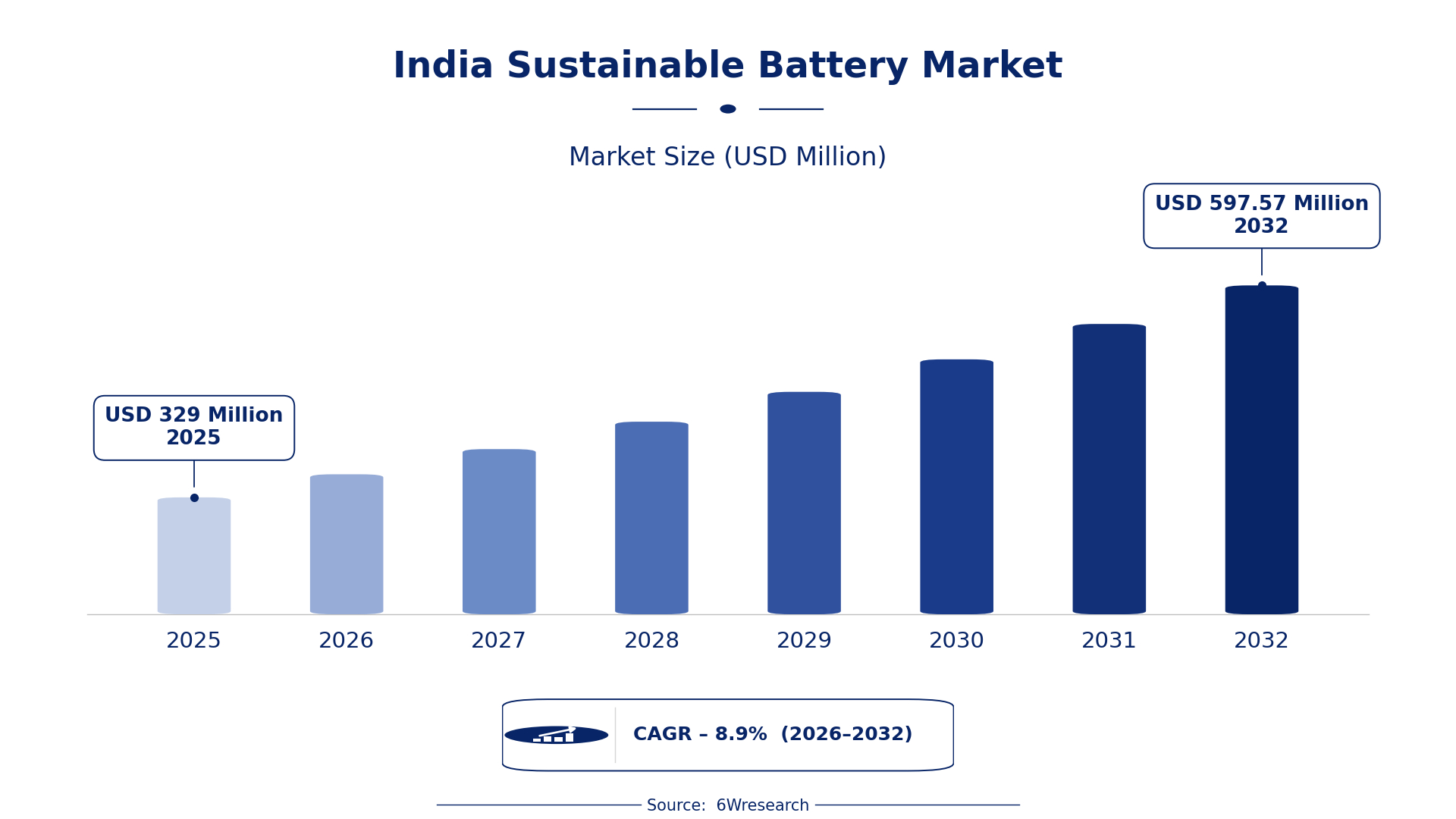
According to 6Wresearch internal database and industry insights, the India Sustainable Battery Market was valued at USD 329.0 million in 2025 and is projected to reach USD 597.57 million by 2032, growing at a CAGR of approximately 8.9% during 2026–2032.
India Sustainable Battery Market Highlights
| Report Metric | Details |
| Report Name | India Sustainable Battery Market |
| Market Size 2025 | USD 329.0 million |
| Market Size 2032 | USD 597.57 million |
| Absolute Growth 2025–2032 | USD 268.57 million |
| CAGR 2026–2032 | 8.9% |
| Peak Annual Growth | 10.7% in 2027 |
| Forecast Period | 2026–2032 |
| Historical Data | 2022–2025 |
| Base Year | 2025 |
| Leading Battery Type, 2025 | Solid-State Batteries (41% share) |
| Leading Chemistry Used, 2025 | Lithium Metal (47% share) |
| Leading Application Sector, 2025 | Electric Vehicles (38% share) |
| Leading End User, 2025 | EV Manufacturers (41% share) |
| Fastest-Growing Battery Type | Sodium-Ion Batteries (11.4% CAGR) |
| Fastest-Growing Chemistry Used | Water-Based Electrolyte (10.7% CAGR) |
| Fastest-Growing Application Sector | Grid Storage (10.1% CAGR) |
| Fastest-Growing End User | Renewable Energy Firms (10.9% CAGR) |
| Growing Sector | Grid Storage |
| Key End Users | Electric Vehicles, Grid Storage, Consumer Electronics, Mobility & Tools |
India Sustainable Battery Market Year-wise Growth Rate and Key Drivers (2022–2032)
This graph illustrates the annual growth rates of the market from 2022 to 2032, highlighting a steady upward trajectory and projected market expansion over the forecast period.
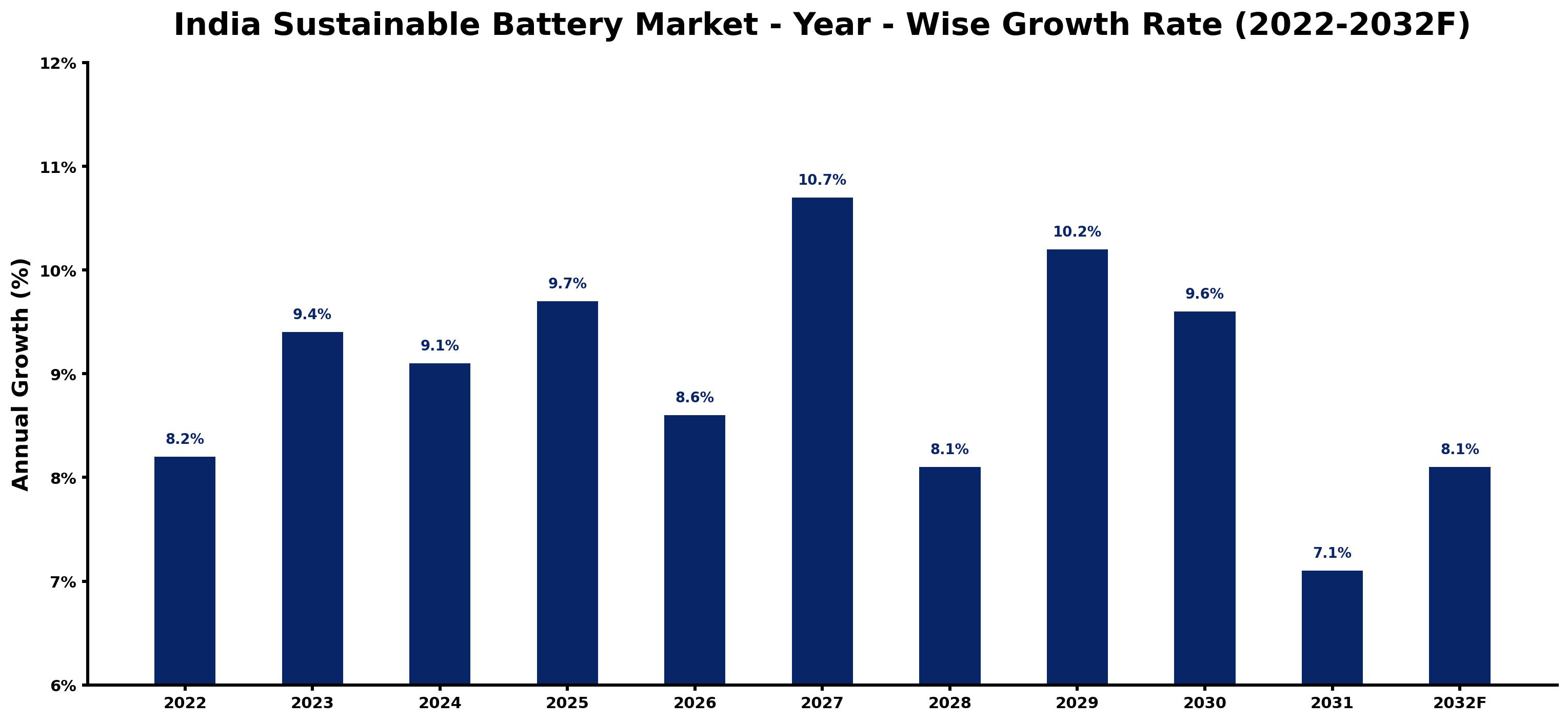
The table below sets out the estimated growth rate for each year and the main factor behind it.
| Year | Estimated Annual Growth (%) | Market Rationale |
| 2022 | 8.2 | The market showed steady growth, driven by increasing electric vehicle adoption under the National Electric Mobility Mission Plan. |
| 2023 | 9.4 | Demand accelerated due to heightened production of lithium-ion batteries for EVs, supporting the growing market. |
| 2024 | 9.1 | Growth slowed slightly as manufacturers adjusted to supply chain challenges affecting production timelines. |
| 2025 | 9.7 | The market peaked as electric vehicle sales surged under government initiatives promoting battery manufacturing. |
| 2026 | 8.6 | A slowdown occurred as supply chain challenges began to impact production, affecting overall growth. |
| 2027 | 10.7 | Growth rebounded sharply with new investments in battery technology and local manufacturing capabilities. |
| 2028 | 8.1 | Demand slowed again as the market stabilised after rapid expansion in previous years. |
| 2029 | 10.2 | A resurgence in growth was noted, driven by renewable energy integration and storage needs. |
| 2030 | 9.6 | Growth moderated as the market matured and competition intensified in the battery sector. |
| 2031 | 7.1 | The market continued to grow, albeit at a slower pace due to increasing competition and market saturation. |
| 2032 | 8.1 | A slight increase in growth is projected as new technologies emerge, creating market opportunities. |
Note: Market size estimations and growth projections presented in this report are based on 6Wresearch's proprietary forecasting methodology, utilizing the latest available industry data, government publications, and primary research inputs.
India Sustainable Battery Market Synopsis
Sustainable batteries in India are advanced energy storage solutions designed for efficiency and environmental sustainability. These batteries are primarily used in electric vehicles, renewable energy storage, and consumer electronics. The India Sustainable Battery Market is projected to expand, driven by the government's goal for 30% electric vehicles by 2030 and a renewable energy capacity of 150 GW in 2023. The National Battery Storage Mission and increasing local production further fuel demand, indicating a strong future for sustainable battery solutions in India.
Market Dynamics Impact Analysis (2026–2032)
| Factor | Type | Impact | Primary Segment Affected |
| Government initiatives promoting electric vehicle adoption and battery manufacturing. | Driver | High | Electric Vehicles |
| Rising renewable energy capacity necessitating efficient energy storage solutions. | Driver | High | Grid Storage |
| Growing demand for lithium-ion battery recycling solutions. | Opportunity | Medium | Recyclable Li-ion |
| Investment in sodium-ion battery technology for diverse applications. | Opportunity | Medium | Sodium-Ion Batteries |
| Challenges in sourcing raw materials for battery production. | Restraint | High | Lithium Metal |
| Regulatory compliance costs for battery manufacturers. | Restraint | Medium | Solid-State Batteries |
| Supply chain disruptions affecting battery production timelines. | Challenge | High | Redox Flow Batteries |
| Competition from alternative energy storage technologies. | Challenge | Medium | Water-Based Electrolyte |
Evaluation of Drivers in India Sustainable Battery Market (2026–2032)
The factors lifting demand, and the evidence behind each, are summarised below.
| Drivers | Primary Segment Affected | Why It Matters (Evidence) |
| Government incentives for electric vehicle adoption increase battery demand. | Electric Vehicles | The National Electric Mobility Mission Plan aims for 30% electric vehicles by 2030, boosting battery purchases. |
| Rising renewable energy capacity drives demand for grid storage solutions. | Grid Storage | India's renewable energy capacity reached 150 GW in 2023, necessitating more efficient energy storage. |
| Increased production of lithium-ion batteries supports electric vehicle growth. | Lithium Metal | India produced 1.5 million lithium-ion batteries for electric vehicles in 2022, enhancing supply. |
| Growing market for battery recycling solutions reduces environmental impact. | Recyclable Li-ion | The lithium-ion battery recycling market is set to grow significantly by 2025, attracting investment. |
| Emerging technologies like sodium-ion batteries expand application possibilities. | Sodium-Ion Batteries | In 2023, India initiated a programme to promote research in sodium-ion battery technology. |
The Sustainable Battery market in India is expanding due to increasing demand from electric vehicles, a growing renewable energy capacity, and enhanced local production capabilities. The National Electric Mobility Mission Plan's target of 30% electric vehicles by 2030 is a key driver for battery demand. In 2022, India produced 1.5 million lithium-ion batteries, bolstering the electric vehicle sector. With renewable energy capacity reaching 150 GW in 2023, the requirement for grid storage solutions is propelling further demand. The lithium-ion battery recycling market is expected to see substantial growth by 2025, reflecting a shift towards sustainability.
Evaluation of Restraints in India Sustainable Battery Market
The main factors holding the market back are set out below.
| Market Restraint | Primary Segment Affected | Why It Matters (Evidence) |
| Sourcing raw materials for battery production remains a challenge. | Lithium Metal | Supply chain issues have led to increased costs and delays in production timelines. |
| Compliance with battery safety standards adds operational costs. | Solid-State Batteries | The Bureau of Indian Standards set guidelines for battery safety standards in 2023, increasing compliance costs. |
| Limited infrastructure for battery recycling hampers growth. | Recyclable Li-ion | Current recycling facilities are insufficient to meet projected demand by 2025, limiting market expansion. |
| High competition from alternative energy storage technologies. | Water-Based Electrolyte | Emerging technologies are attracting investment, diverting attention from traditional battery solutions. |
| Regulatory compliance can slow down new product introductions. | Redox Flow Batteries | Manufacturers face delays in approvals due to stringent regulations, affecting market entry. |
India Sustainable Battery Market Challenges
In the India Sustainable Battery Market, buyers struggle with the underdeveloped sodium-ion battery technology, which limits production capabilities and delays the introduction of new products. Workforce shortages in advanced battery manufacturing hinder the sector's ability to meet rising demand, causing delays in sustainable battery supply. Regulatory changes from the Bureau of Indian Standards regarding safety guidelines complicate the approval process for new battery models, potentially extending market entry timelines for suppliers. High costs associated with electric vehicle infrastructure, with the government committing $1 billion by 2025, place financial pressure on consumers transitioning to electric mobility.
Trends in the India Sustainable Battery Market
Below mentioned are some of the trends shaping the India Sustainable Battery Market growth.
- National Battery Storage Mission Boosting Local Manufacturing: The National Battery Storage Mission, initiated in 2021, aims to enhance domestic battery manufacturing with a budget of ₹10,000 crore. This initiative is poised to strengthen local production capabilities.
- Growth of Lithium-Ion Battery Recycling Market: In 2022, the lithium-ion battery recycling market in India was expected to experience significant growth by 2025. This movement towards recycling is motivated by environmental concerns and regulatory demands.
- Sodium-Ion Battery Technology Gaining Attention: In 2023, India launched a programme to encourage research in sodium-ion battery technology, anticipating advancements in this field. This emerging technology is likely to broaden application possibilities.
- Electric Vehicle Adoption Accelerating: India's objective of achieving 30% electric vehicles by 2030 under the National Electric Mobility Mission Plan is driving rapid growth in the sustainable battery market. This ambitious target is promoting innovation and investment.
Investment Opportunities in the India Sustainable Battery Market
Several openings in the India Sustainable Battery Market merit attention from investors.
- Investment in Lithium-Ion Battery Recycling Solutions: The lithium-ion battery recycling market is projected to expand by 2025, presenting opportunities for companies to invest in recycling technologies and facilities. This transition is beneficial for both manufacturers and consumers.
- Supply of Sodium-Ion Batteries for Diverse Applications: With government support for research in sodium-ion battery technology, there is a growing opportunity to supply this emerging technology. Collaborating with research institutions can facilitate market entry.
- Partnerships for Electric Vehicle Infrastructure Development: As India's renewable energy capacity reaches 150 GW, the demand for grid storage solutions is increasing. Renewable energy firms are seeking dependable battery suppliers to support their projects.
- Expansion of Recycling Facilities for Sustainable Practices: The rising emphasis on recycling solutions offers an opportunity to invest in new facilities. Local governments are promoting initiatives that encourage sustainable practices in battery production.
Government Initiatives in the India Sustainable Battery Market
The National Battery Storage Mission launched in 2021 aims to boost domestic battery manufacturing and storage capacity, with a budget of ₹10,000 crore. This measure builds on the National Electric Mobility Mission Plan 2020, which promotes electric vehicle adoption and battery manufacturing, targeting 30% electric vehicles by 2030. These initiatives collectively strengthen the framework for sustainable battery production in India.
The Ministry of Power oversees the National Battery Storage Mission, funding projects that aim to increase battery manufacturing capabilities. The Ministry of Heavy Industries manages the National Electric Mobility Mission Plan, approving various subsidies for local production of sustainable batteries. These agencies support the growth of the sustainable battery market in India.
Future Insight of the India Sustainable Battery Market
The India Sustainable Battery Market is poised for notable changes by 2032, driven by government initiatives to electrify 30% of vehicles by 2030, which will increase demand for sustainable batteries. The National Battery Storage Mission will improve local manufacturing capabilities, ensuring a consistent supply of energy solutions. By 2025, growth in the lithium-ion battery recycling market will help lower material costs, benefiting both producers and buyers. With India's renewable energy capacity at 150 GW, the rising need for efficient energy storage will further advance market developments.
Market Segmentation Analysis
The analysis below covers each segmentation, its leading category in 2025 and its fastest-growing category through 2032.
By Battery Type – Solid-State Batteries Dominated, Sodium-Ion Batteries Expected to Grow Fastest
According to Sumit Sagar, AM at 6Wresearch, the largest battery type category in 2025 was Solid-State Batteries, with a 41% share of total revenue. Solid-State Batteries hold the largest market share because they are vital for electric vehicles, offering higher energy density that meets increasing consumer expectations. The government's goal of 30% electric vehicles by 2030 highlights the critical role of solid-state technology in India's automotive sector. The quickest growth will come from Sodium-Ion Batteries, forecast to expand at a CAGR of 11.4% between 2026 and 2032. Sodium-Ion Batteries are experiencing rapid growth as an emerging technology, driven by a surge in interest for alternative energy storage options. The 2023 initiative to boost sodium-ion research demonstrates a strong commitment to advancing this innovative sector. Suppliers should focus on developing solid-state technologies while also investing in sodium-ion research to seize emerging market opportunities.
By Chemistry Used – Lithium Metal Dominated, Water-Based Electrolyte Expected to Grow Fastest
In 2025, Lithium Metal led the chemistry used split with a 47% share. Lithium Metal leads the market share as it is vital for high-performance battery applications, especially in the electric vehicle sector. The production of 1.5 million lithium-ion batteries in 2022 underscores its critical role in fulfilling energy requirements. Over 2026–2032, Water-Based Electrolyte is expected to post the fastest growth, at a CAGR of 10.7%. Water-Based Electrolyte is gaining momentum due to its safety benefits in battery technology, appealing to manufacturers seeking safer solutions. The recent guidelines from the Bureau of Indian Standards in 2023 further support the shift towards safer battery options. Buyers should seek suppliers who are innovating with water-based electrolytes to ensure compliance with safety standards and improve overall battery performance.
By Application Sector – Electric Vehicles Dominated, Grid Storage Expected to Grow Fastest
Electric Vehicles took a 38% share of application sector in 2025, more than any other category. Electric Vehicles represent the largest share of the market as the primary application driving battery demand in India. The government's ambitious targets for electric vehicle adoption underscore the critical role of sustainable batteries in this sector. Grid Storage is projected to grow fastest, at a CAGR of 10.1% during 2026–2032. Grid Storage is the fastest-growing application sector, essential for integrating India's expanding renewable energy capacity of 150 GW. The National Battery Storage Mission launched in 2021 further emphasises the importance of grid storage solutions. Suppliers must align their strategies with the growing demand for grid storage solutions to capitalise on the renewable energy transition.
By End User – EV Manufacturers Dominated, Renewable Energy Firms Expected to Grow Fastest
EV Manufacturers held a 41% share of the India Sustainable Battery Market by end user in 2025. EV Manufacturers constitute the largest end user group, significantly impacting the market share of sustainable batteries as they are the primary consumers in the electric vehicle sector. The Indian government's $1 billion allocation for electric vehicle infrastructure development by 2025 underscores their pivotal role in the market. Renewable Energy Firms are set to record the highest CAGR in this split, 10.9% over 2026–2032. Renewable Energy Firms are the fastest-growing end users, propelled by their pressing need for efficient energy storage solutions to support grid integration. The increasing demand for sustainable energy sources is driving rapid advancements in this sector. Suppliers should collaborate with renewable energy firms to develop tailored battery solutions that effectively meet their specific storage needs.
Key Attractiveness of the Report
- 10 Years of Market Numbers
- Historical Data Starting from 2022 to 2025
- Base Year 2025
- Forecast Data until 2032
- Key Performance Indicators Impacting the Market
- Major Upcoming Developments and Projects
Key Highlights of the Report:
- India Sustainable Battery Market Outlook
- Market Size of India Sustainable Battery Market, 2025
- Forecast of India Sustainable Battery Market, 2032
- Historical Data and Forecast of India Sustainable Battery Revenues & Volume for the Period 2022 - 2032F
- India Sustainable Battery Market Trend Evolution
- India Sustainable Battery Market Drivers and Challenges
- India Sustainable Battery Price Trends
- India Sustainable Battery Porter's Five Forces
- India Sustainable Battery Industry Life Cycle
- Historical Data and Forecast of India Sustainable Battery Market Revenues & Volume By Battery Type for the Period 2022 - 2032F
- Historical Data and Forecast of India Sustainable Battery Market Revenues & Volume By Solid-State Batteries for the Period 2022 - 2032F
- Historical Data and Forecast of India Sustainable Battery Market Revenues & Volume By Redox Flow Batteries for the Period 2022 - 2032F
- Historical Data and Forecast of India Sustainable Battery Market Revenues & Volume By Sodium-Ion Batteries for the Period 2022 - 2032F
- Historical Data and Forecast of India Sustainable Battery Market Revenues & Volume By Recyclable Li-ion for the Period 2022 - 2032F
- Historical Data and Forecast of India Sustainable Battery Market Revenues & Volume By Chemistry Used for the Period 2022 - 2032F
- Historical Data and Forecast of India Sustainable Battery Market Revenues & Volume By Lithium Metal for the Period 2022 - 2032F
- Historical Data and Forecast of India Sustainable Battery Market Revenues & Volume By Water-Based Electrolyte for the Period 2022 - 2032F
- Historical Data and Forecast of India Sustainable Battery Market Revenues & Volume By Abundant Minerals for the Period 2022 - 2032F
- Historical Data and Forecast of India Sustainable Battery Market Revenues & Volume By Circular Supply Chain for the Period 2022 - 2032F
- Historical Data and Forecast of India Sustainable Battery Market Revenues & Volume By Application Sector for the Period 2022 - 2032F
- Historical Data and Forecast of India Sustainable Battery Market Revenues & Volume By Electric Vehicles for the Period 2022 - 2032F
- Historical Data and Forecast of India Sustainable Battery Market Revenues & Volume By Grid Storage for the Period 2022 - 2032F
- Historical Data and Forecast of India Sustainable Battery Market Revenues & Volume By Consumer Electronics for the Period 2022 - 2032F
- Historical Data and Forecast of India Sustainable Battery Market Revenues & Volume By Mobility & Tools for the Period 2022 - 2032F
- Historical Data and Forecast of India Sustainable Battery Market Revenues & Volume By End User for the Period 2022 - 2032F
- Historical Data and Forecast of India Sustainable Battery Market Revenues & Volume By EV Manufacturers for the Period 2022 - 2032F
- Historical Data and Forecast of India Sustainable Battery Market Revenues & Volume By Renewable Energy Firms for the Period 2022 - 2032F
- Historical Data and Forecast of India Sustainable Battery Market Revenues & Volume By Device OEMs for the Period 2022 - 2032F
- Historical Data and Forecast of India Sustainable Battery Market Revenues & Volume By Battery OEMs for the Period 2022 - 2032F
- India Sustainable Battery Import Export Trade Statistics
- Market Opportunity Assessment By Battery Type
- Market Opportunity Assessment By Chemistry Used
- Market Opportunity Assessment By Application Sector
- Market Opportunity Assessment By End User
- India Sustainable Battery Top Companies Market Share
- India Sustainable Battery Competitive Benchmarking By Technical and Operational Parameters
- India Sustainable Battery Company Profiles
- India Sustainable Battery Key Strategic Recommendations
Market Covered
The report offers an extensive study of the following market segments.
By Battery Type
- Solid-State Batteries
- Redox Flow Batteries
- Sodium-Ion Batteries
- Recyclable Li-ion
By Chemistry Used
- Lithium Metal
- Water-Based Electrolyte
- Abundant Minerals
- Circular Supply Chain
By Application Sector
- Electric Vehicles
- Grid Storage
- Consumer Electronics
- Mobility & Tools
By End User
- EV Manufacturers
- Renewable Energy Firms
- Device OEMs
- Battery OEMs































