India Sustainable Crop Protection Market Size & Growth Rate
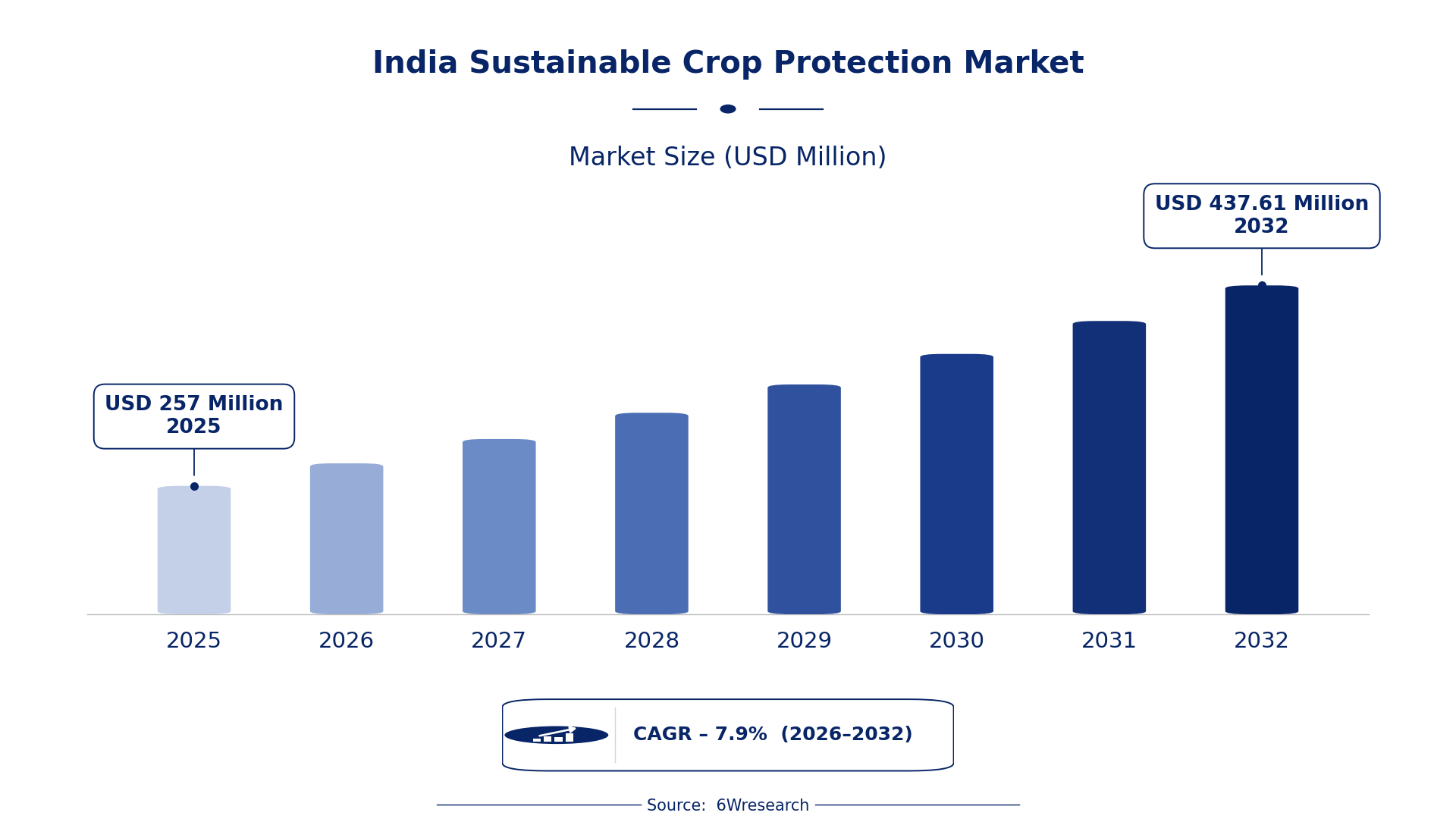
According to 6Wresearch internal database and industry insights, the India Sustainable Crop Protection Market was valued at USD 257.0 million in 2025 and is projected to reach USD 437.61 million by 2032, growing at a CAGR of approximately 7.9% during 2026–2032.
India Sustainable Crop Protection Market Highlights
| Report Metric | Details |
| Report Name | India Sustainable Crop Protection Market |
| Market Size 2025 | USD 257.0 million |
| Market Size 2032 | USD 437.61 million |
| Absolute Growth 2025–2032 | USD 180.61 million |
| CAGR 2026–2032 | 7.9% |
| Peak Annual Growth | 9.8% in 2029 |
| Forecast Period | 2026–2032 |
| Historical Data | 2022–2025 |
| Base Year | 2025 |
| Leading Protection Type, 2025 | Biopesticides (34% share) |
| Leading Source Type, 2025 | Botanical/Insect-Derived (42% share) |
| Leading Application Mode, 2025 | Sprays or Dusts (49% share) |
| Leading End User, 2025 | Organic Growers (45% share) |
| Fastest-Growing Protection Type | Biofungicides (10.6% CAGR) |
| Fastest-Growing Source Type | Fungi/Bacteria-Based (9.8% CAGR) |
| Fastest-Growing Application Mode | Soil Drench or Foliar (8.9% CAGR) |
| Fastest-Growing End User | Horticulture Farms (9.3% CAGR) |
| Growing Sector | Horticulture |
| Key End Users | Organic Growers, Horticulture Farms, Smallholders |
India Sustainable Crop Protection Market Year-wise Growth Rate and Key Drivers (2022–2032)
This graph illustrates the annual growth rates of the market from 2022 to 2032, highlighting a steady upward trajectory and projected market expansion over the forecast period.
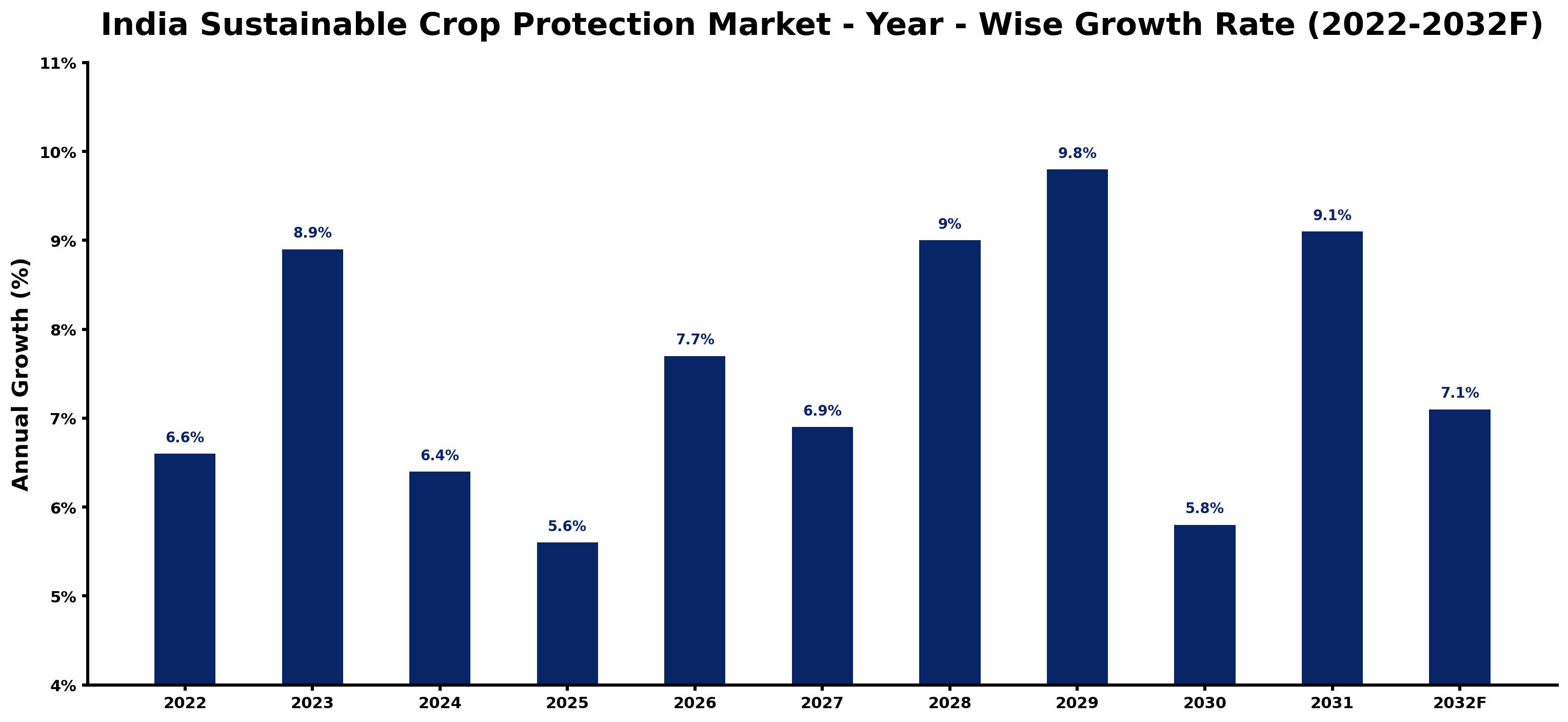
Year by year, the estimates below pair each growth rate with the development that shaped it.
| Year | Estimated Annual Growth (%) | Market Rationale |
| 2022 | 6.6 | The market experienced steady growth driven by increasing organic farming practices and the support of the National Programme for Organic Production. |
| 2023 | 8.9 | Demand surged as more farmers adopted sustainable methods, reflecting a growing interest in organic solutions and the benefits of biopesticides. |
| 2024 | 6.4 | Growth slowed slightly due to regulatory complexities affecting the introduction of new sustainable products in the market. |
| 2025 | 5.6 | A further slowdown occurred as farmers adjusted to new standards under the Fertilizer Control Order, 1985. |
| 2026 | 7.7 | Renewed interest in biopesticides is expected following successful pilot projects conducted by agricultural institutes. |
| 2027 | 6.9 | Growth is projected to decelerate as some buyers face challenges in sourcing sustainable inputs due to supply chain disruptions. |
| 2028 | 9.0 | Demand is anticipated to accelerate again, driven by increased awareness of environmental sustainability and government support for organic farming initiatives. |
| 2029 | 9.8 | The peak growth year will see investments in organic farming initiatives across the country, bolstered by the National Mission on Sustainable Agriculture. |
| 2030 | 5.8 | Growth is expected to slow as the market stabilises following rapid expansion in previous years, influenced by market fragmentation. |
| 2031 | 9.1 | A resurgence in demand will occur as horticulture farms seek innovative pest management solutions supported by the Soil Health Card Scheme. |
| 2032 | 7.1 | The market will continue to grow, supported by ongoing government initiatives promoting sustainable agriculture and the Organic Farming Policy. |
Note: Market size estimations and growth projections presented in this report are based on 6Wresearch's proprietary forecasting methodology, utilizing the latest available industry data, government publications, and primary research inputs.
India Sustainable Crop Protection Market Synopsis
Sustainable Crop Protection in India focuses on environmentally friendly pest management methods that utilise natural substances and microorganisms. This market primarily caters to organic growers, horticulture farms, and smallholders aiming to reduce chemical residues. The India Sustainable Crop Protection Market is growing due to increasing demand for organic farming solutions, with over 30% of agricultural land dedicated to organic cultivation as of 2023. Initiatives like the National Programme for Organic Production further promote this growth by establishing standards and encouraging sustainable practices.
Market Dynamics Impact Analysis (2026–2032)
| Factor | Type | Impact | Primary Segment Affected |
| Growing demand for biopesticides among organic growers | Driver | High | Biopesticides |
| Increased focus on sustainable agricultural practices by horticulture farms | Driver | High | Biofungicides |
| Investment in organic farming initiatives is rising, creating opportunities for suppliers | Opportunity | High | Organic Growers |
| The expansion of horticulture farms is driving demand for effective pest management solutions | Opportunity | High | Horticulture Farms |
| Limited awareness among farmers about sustainable practices can hinder adoption | Restraint | Medium | Smallholders |
| Regulatory complexities can slow down the introduction of new products | Restraint | Medium | Biopesticides |
| Supply chain disruptions affect the availability of sustainable inputs for farmers | Challenge | High | Organic Growers |
| Competition from traditional chemical pesticides poses challenges for market penetration | Challenge | Medium | Biofungicides |
Evaluation of Drivers in India Sustainable Crop Protection Market (2026–2032)
Key forces behind demand, with the segment each one moves most, are listed below.
| Drivers | Primary Segment Affected | Why It Matters (Evidence) |
| Increased adoption of biopesticides among organic growers | Biopesticides | The biopesticides market in India is projected to reach INR 1,200 crores by 2025, encouraging more farmers to switch to sustainable options. |
| Growing interest in sustainable practices among horticulture farms | Horticulture Farms | The Indian government aims to increase organic farming area to 10 million hectares by 2025, boosting demand for sustainable products. |
| Research and development on biopesticides by agricultural institutes | Biopesticides | Research from agricultural institutes improves biopesticide efficacy, supporting farmer confidence in these products. |
| Regulatory frameworks promoting organic farming standards | Biofungicides | The National Programme for Organic Production (NPOP) regulates standards, ensuring quality control and consumer trust. |
| Support from government initiatives for sustainable practices | Organic Growers | The Pradhan Mantri Kisan Samman Nidhi Yojana provides funding for farmers adopting sustainable methods. |
The Sustainable Crop Protection market in India is expanding as organic growers, horticulture farms, and smallholders increasingly adopt sustainable practices. Horticulture, contributing 30% to agricultural GDP, drives demand for effective solutions. Research from agricultural institutes enhances the effectiveness of biopesticides, providing farmers with better tools.
Evaluation of Restraints in India Sustainable Crop Protection Market
The key brakes on demand, and where they bite hardest, are shown below.
| Market Restraint | Primary Segment Affected | Why It Matters (Evidence) |
| Limited awareness of sustainable practices among smallholders | Smallholders | Many smallholders lack knowledge about sustainable crop protection methods, hindering adoption and growth. |
| Regulatory complexities slow product introduction | Biopesticides | Navigating regulatory requirements can delay the launch of new sustainable products in the market. |
| Supply chain disruptions affect availability of inputs | Organic Growers | Logistical challenges can lead to shortages of essential sustainable inputs for farmers. |
| Competition from traditional chemical pesticides | Biofungicides | Chemical pesticides are often cheaper and more readily available, making them attractive to some farmers. |
| Market fragmentation limits economies of scale | Biopesticides | A fragmented market can lead to higher costs for producers, affecting pricing and availability. |
India Sustainable Crop Protection Market Challenges
Buyers in the India Sustainable Crop Protection market face high costs due to limited access to effective sustainable solutions, which can increase expenses by up to 20% compared to conventional pesticides. Suppliers encounter intense competition from chemical alternatives, compelling them to lower prices and potentially reducing profit margins by around 15%. A skills gap among farmers regarding sustainable practices delays the adoption of eco-friendly methods, risking potential yield losses of 10% for those relying on outdated techniques. Technology limitations impede the development of new sustainable products, hindering innovation and affecting both producers and suppliers in their growth efforts.
Trends in the India Sustainable Crop Protection Market
Four trends stand out in the India Sustainable Crop Protection Market.
- National Mission on Sustainable Agriculture Promoting Biopesticides: The National Mission on Sustainable Agriculture, launched in 2021, promotes biopesticides as a key component of sustainable farming. This initiative aims to boost the market for biopesticides, aligning with the government's organic farming goals.
- 30% of Agricultural Land Under Organic Cultivation: As of 2023, over 30% of India's agricultural land is under organic cultivation, reflecting a shift towards sustainable practices. This trend is driving demand for effective crop protection solutions that comply with organic standards.
- Horticulture Farms Increasing Adoption of Sustainable Practices: Horticulture farms are increasingly adopting sustainable crop protection methods, driven by the need for quality produce. This sector's growth, contributing 30% to agricultural GDP, underscores the importance of sustainable solutions for pest management.
- Growing Interest in Organic Farming Among Smallholders: Smallholders are showing a growing interest in organic farming, supported by government initiatives. This shift is expected to drive demand for sustainable crop protection products in rural areas.
Investment Opportunities in the India Sustainable Crop Protection Market
Below are the investment opportunities with the strongest case in the India Sustainable Crop Protection Market.
- Rising Demand for Organic Inputs: With over 30% of agricultural land under organic cultivation, there is an increasing need for sustainable crop protection products. Input suppliers can target organic growers to meet this demand and expand their market presence.
- Investment in Research and Development: The increasing focus on biopesticides presents opportunities for investment in research and development. Agricultural research institutes can collaborate with private entities to improve product efficacy and market reach.
- Expansion of Horticulture Farms: The growth of horticulture farms creates a significant opportunity for suppliers of sustainable crop protection products. Targeting this sector can lead to increased sales and market penetration.
- Government Support for Organic Farming Initiatives: Government initiatives, such as the Pradhan Mantri Kisan Samman Nidhi Yojana, provide funding for sustainable practices. Suppliers can align with these programmes to access new markets and support farmers.
Government Initiatives in the India Sustainable Crop Protection Market
The Organic Farming Policy, established in 2020, aims to increase organic farming area and promote sustainable agricultural practices across India. This policy encourages farmers to adopt environmentally friendly methods, ensuring quality control in organic produce. The Fertilizer Control Order, 1985, also recognises biopesticides, ensuring their quality and safety for consumers. These measures collectively support the growth of the Sustainable Crop Protection market by establishing a clear regulatory framework for producers and buyers alike.
In 2023, the government allocated INR 500 crores for promoting organic farming initiatives through various schemes. The Indian Council of Agricultural Research (ICAR) plays an important role in funding research on sustainable agricultural practices, including biopesticides. The Soil Health Card Scheme, launched in 2015 and updated in 2022, provides farmers with essential information on soil health, supporting sustainable crop protection methods. These initiatives aim to empower farmers with the knowledge and resources needed for effective pest management.
Future Insight of the India Sustainable Crop Protection Market
By 2032, buyers and suppliers in the India Sustainable Crop Protection market can expect a substantial increase in organic farming, with the area projected to reach 10 million hectares due to government support initiatives. The biopesticides market is anticipated to grow, reaching INR 1,200 crores by 2025, driven by rising consumer demand for environmentally friendly solutions. Enhanced research from institutions like the Indian Agricultural Research Institute will improve the efficacy of sustainable products, equipping farmers with better tools. The implementation of ISO 22000 standards will ensure higher quality assurance in organic produce, boosting consumer confidence.
Market Segmentation Analysis
The analysis below covers each segmentation, its leading category in 2025 and its fastest-growing category through 2032.
By Protection Type – Biopesticides Dominated, Biofungicides Expected to Grow Fastest
According to Sumit Sagar, AM at 6Wresearch, with a 34% revenue share in 2025, Biopesticides was the largest protection type category. Biopesticides hold the largest market share in India as they are extensively used for pest control in organic farming, which has over 30% of agricultural land under organic cultivation. This widespread adoption is supported by the National Programme for Organic Production, ensuring compliance with organic standards. Over 2026–2032, Biofungicides are expected to post the fastest growth, at a CAGR of 10.6%. Biofungicides are experiencing rapid growth due to their effectiveness against specific fungal diseases, a critical concern for farmers in maintaining crop health. The increasing focus on sustainable practices in horticulture, which contributes to 30% of India's agricultural GDP, drives this demand. Suppliers should focus on developing biofungicides to meet the rising needs of horticulture farms seeking sustainable solutions.
By Source Type – Botanical/Insect-Derived Dominated, Fungi/Bacteria-Based Expected to Grow Fastest
The largest source type category in 2025 was Botanical/Insect-Derived, with a 42% share of total revenue. Botanical/Insect-Derived products dominate the market share as they are derived from plants and are integral to organic farming practices in India. Their established acceptance is reinforced by the National Programme for Organic Production, which sets the standards for organic cultivation. Fungi/Bacteria-Based is projected to grow fastest, at a CAGR of 9.8% during 2026–2032. Fungi/Bacteria-Based products are witnessing the fastest growth due to their precision in targeting specific pests and diseases, making them attractive to farmers. The government's financial backing for organic farming initiatives further fuels the rapid uptake of these effective solutions. Suppliers should prioritise the development of fungi/bacteria-based products to meet the rising demand for sustainable crop protection in India.
By Application Mode – Sprays or Dusts Dominated, Soil Drench or Foliar Expected to Grow Fastest
Sprays or Dusts accounted for a 49% market share by application mode in 2025. Sprays or Dusts dominate the market as the most common application methods for biopesticides, providing farmers with effective and straightforward pest control options. This method's widespread use is attributed to its ease of application and adaptability across various agricultural practices in India. The quickest growth will come from Soil Drench or Foliar, forecast to expand at a CAGR of 8.9% between 2026 and 2032. Soil Drench or Foliar application methods are rapidly gaining traction as they deliver active ingredients directly to plants, addressing pest issues with greater efficiency. The surge in popularity of these methods is driven by their effectiveness in horticulture, a key sector contributing to India's agricultural GDP. Suppliers should prioritise the development of soil drench or foliar application products to meet the growing preferences of farmers for targeted pest management.
By End User – Organic Growers Dominated, Horticulture Farms Expected to Grow Fastest
In 2025, Organic Growers led the end user split with a 45% share. Organic Growers represent the largest share of the market as they are the primary end users of sustainable crop protection products, driven by the increasing area under organic cultivation. Their commitment to environmentally friendly practices aligns with the government's push for organic farming initiatives. Horticulture Farms are set to record the highest CAGR in this split, 9.3% over 2026–2032. Horticulture Farms are the fastest-growing end user segment, reflecting the heightened demand for biopesticides and biofungicides to protect high-value crops. The government's support for horticulture through various missions further accelerates this growth, making it a key focus area for suppliers. Suppliers should tailor their offerings to meet the specific needs of horticulture farms, which are increasingly prioritising sustainable crop protection solutions.
Key Attractiveness of the Report
- 10 Years of Market Numbers
- Historical Data Starting from 2022 to 2025
- Base Year 2025
- Forecast Data until 2032
- Key Performance Indicators Impacting the Market
- Major Upcoming Developments and Projects
Key Highlights of the Report:
- India Sustainable Crop Protection Market Outlook
- Market Size of India Sustainable Crop Protection Market, 2025
- Forecast of India Sustainable Crop Protection Market, 2032
- Historical Data and Forecast of India Sustainable Crop Protection Revenues & Volume for the Period 2022 - 2032F
- India Sustainable Crop Protection Market Trend Evolution
- India Sustainable Crop Protection Market Drivers and Challenges
- India Sustainable Crop Protection Price Trends
- India Sustainable Crop Protection Porter's Five Forces
- India Sustainable Crop Protection Industry Life Cycle
- Historical Data and Forecast of India Sustainable Crop Protection Market Revenues & Volume By Protection Type for the Period 2022 - 2032F
- Historical Data and Forecast of India Sustainable Crop Protection Market Revenues & Volume By Biopesticides for the Period 2022 - 2032F
- Historical Data and Forecast of India Sustainable Crop Protection Market Revenues & Volume By Biofungicides for the Period 2022 - 2032F
- Historical Data and Forecast of India Sustainable Crop Protection Market Revenues & Volume By Natural Repellents for the Period 2022 - 2032F
- Historical Data and Forecast of India Sustainable Crop Protection Market Revenues & Volume By Fermentation Products for the Period 2022 - 2032F
- Historical Data and Forecast of India Sustainable Crop Protection Market Revenues & Volume By Source Type for the Period 2022 - 2032F
- Historical Data and Forecast of India Sustainable Crop Protection Market Revenues & Volume By Botanical/Insect-Derived for the Period 2022 - 2032F
- Historical Data and Forecast of India Sustainable Crop Protection Market Revenues & Volume By Fungi/Bacteria-Based for the Period 2022 - 2032F
- Historical Data and Forecast of India Sustainable Crop Protection Market Revenues & Volume By Plant Extracts for the Period 2022 - 2032F
- Historical Data and Forecast of India Sustainable Crop Protection Market Revenues & Volume By Microbial for the Period 2022 - 2032F
- Historical Data and Forecast of India Sustainable Crop Protection Market Revenues & Volume By Application Mode for the Period 2022 - 2032F
- Historical Data and Forecast of India Sustainable Crop Protection Market Revenues & Volume By Sprays or Dusts for the Period 2022 - 2032F
- Historical Data and Forecast of India Sustainable Crop Protection Market Revenues & Volume By Soil Drench or Foliar for the Period 2022 - 2032F
- Historical Data and Forecast of India Sustainable Crop Protection Market Revenues & Volume By Foggers for the Period 2022 - 2032F
- Historical Data and Forecast of India Sustainable Crop Protection Market Revenues & Volume By Field Use for the Period 2022 - 2032F
- Historical Data and Forecast of India Sustainable Crop Protection Market Revenues & Volume By End User for the Period 2022 - 2032F
- Historical Data and Forecast of India Sustainable Crop Protection Market Revenues & Volume By Organic Growers for the Period 2022 - 2032F
- Historical Data and Forecast of India Sustainable Crop Protection Market Revenues & Volume By Horticulture Farms for the Period 2022 - 2032F
- Historical Data and Forecast of India Sustainable Crop Protection Market Revenues & Volume By Smallholders for the Period 2022 - 2032F
- Historical Data and Forecast of India Sustainable Crop Protection Market Revenues & Volume By Input Suppliers for the Period 2022 - 2032F
- India Sustainable Crop Protection Import Export Trade Statistics
- Market Opportunity Assessment By Protection Type
- Market Opportunity Assessment By Source Type
- Market Opportunity Assessment By Application Mode
- Market Opportunity Assessment By End User
- India Sustainable Crop Protection Top Companies Market Share
- India Sustainable Crop Protection Competitive Benchmarking By Technical and Operational Parameters
- India Sustainable Crop Protection Company Profiles
- India Sustainable Crop Protection Key Strategic Recommendations
Market Covered
This report examines the market across the segments below.
By Protection Type
- Biopesticides
- Biofungicides
- Natural Repellents
- Fermentation Products
By Source Type
- Botanical/Insect-Derived
- Fungi/Bacteria-Based
- Plant Extracts
- Microbial
By Application Mode
- Sprays or Dusts
- Soil Drench or Foliar
- Foggers
- Field Use
By End User
- Organic Growers
- Horticulture Farms
- Smallholders
- Input Suppliers































