India Sustainable Energy Market Size & Growth Rate
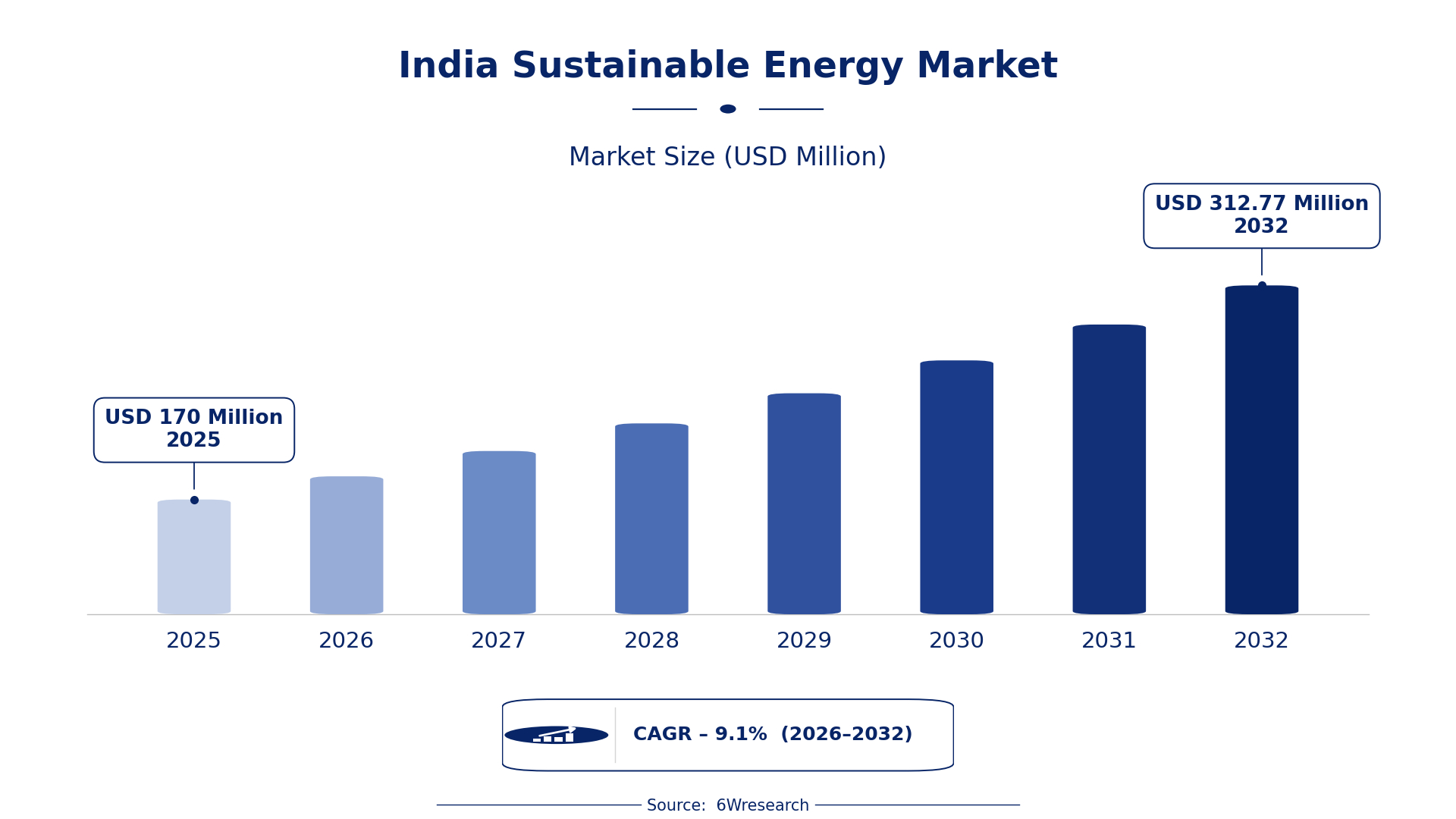
According to 6Wresearch internal database and industry insights, the India Sustainable Energy Market was valued at USD 170.0 million in 2025 and is projected to reach USD 312.77 million by 2032, growing at a CAGR of approximately 9.1% during 2026–2032.
India Sustainable Energy Market Highlights
| Report Metric | Details |
| Report Name | India Sustainable Energy Market |
| Market Size 2025 | USD 170.0 million |
| Market Size 2032 | USD 312.77 million |
| Absolute Growth 2025–2032 | USD 142.77 million |
| CAGR 2026–2032 | 9.1% |
| Peak Annual Growth | 11.3% in 2026 |
| Forecast Period | 2026–2032 |
| Historical Data | 2022–2025 |
| Base Year | 2025 |
| Leading Energy Source, 2025 | Solar Power (49% share) |
| Leading Generation Technology, 2025 | PV/Concentrated Solar (37% share) |
| Leading End Use Segment, 2025 | Residential/Commercial (45% share) |
| Leading End User, 2025 | Utility Companies (40% share) |
| Fastest-Growing Energy Source | Wind Energy (11.3% CAGR) |
| Fastest-Growing Generation Technology | Onshore/Offshore (10.5% CAGR) |
| Fastest-Growing End Use Segment | Grid Supply (11.5% CAGR) |
| Fastest-Growing End User | IPPs (10.3% CAGR) |
| Growing Sector | Residential/Commercial |
| Key End Users | Utility Companies, IPPs, Government Bodies |
India Sustainable Energy Market Year-wise Growth Rate and Key Drivers (2022–2032)
This graph illustrates the annual growth rates of the market from 2022 to 2032, highlighting a steady upward trajectory and projected market expansion over the forecast period.
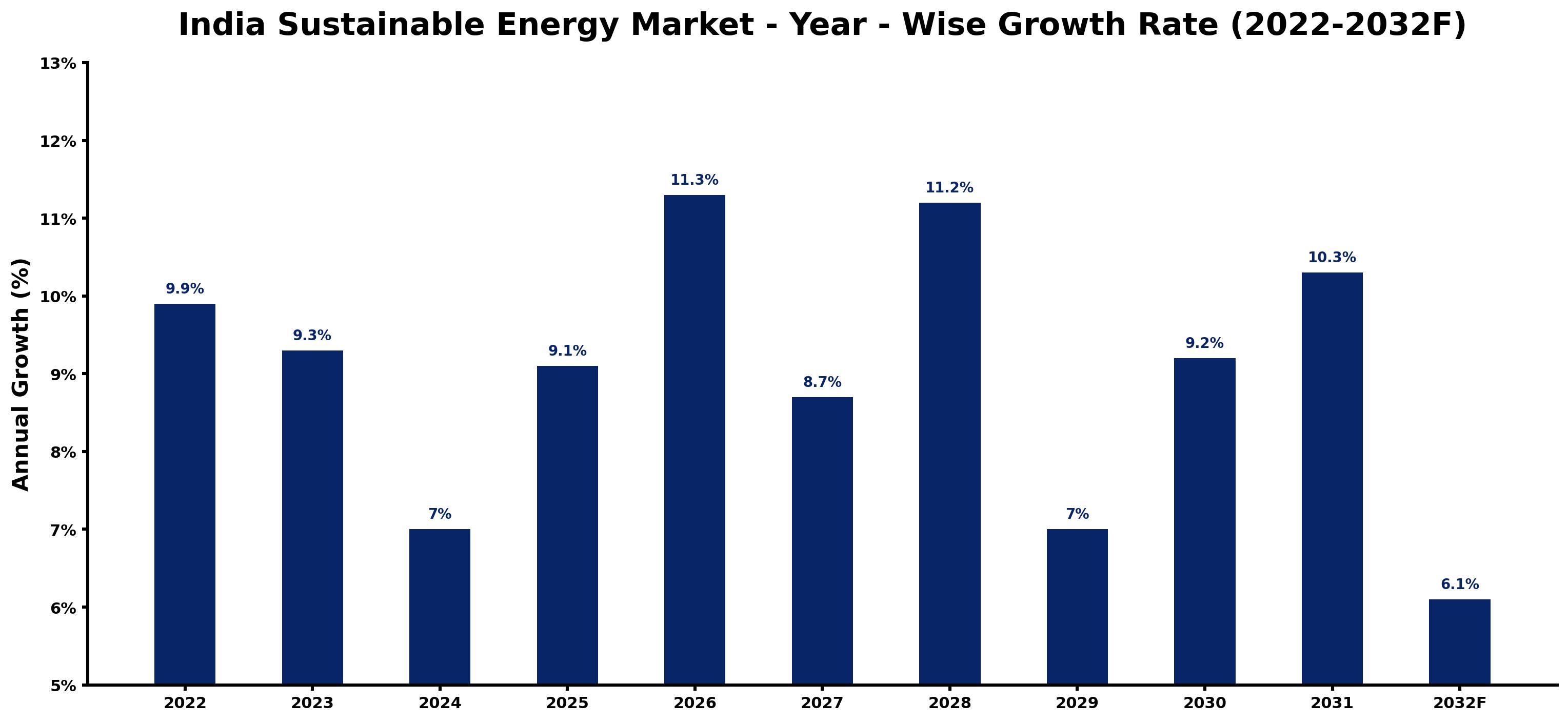
Annual growth estimates for each year appear below with the principal reason behind them, explaining the shifts that set the pace of the market.
| Year | Estimated Annual Growth (%) | Market Rationale |
| 2022 | 9.9 | The market experienced strong growth driven by increased investments in renewable energy projects. |
| 2023 | 9.3 | Growth slowed due to regulatory challenges and delays in project approvals affecting investments. |
| 2024 | 7.0 | The market continued to slow as developers faced supply chain disruptions and rising material costs. |
| 2025 | 9.1 | Growth accelerated as government initiatives spurred new renewable energy projects and investments. |
| 2026 | 11.3 | The peak growth year is expected to see a surge in demand driven by the National Solar Mission's targets. |
| 2027 | 8.7 | Growth is projected to slow as competition intensifies among renewable energy producers and project financing becomes tighter. |
| 2028 | 11.2 | Demand is expected to rebound with increased investments in hybrid renewable energy projects and grid enhancements. |
| 2029 | 7.0 | Growth is projected to slow again due to delays in project approvals under the National Wind-Solar Hybrid Policy. |
| 2030 | 9.2 | Demand will rise with the government's commitment to achieve 500 GW of renewable energy capacity by 2030. |
| 2031 | 10.3 | Growth is expected to continue as utility companies expand their renewable energy portfolios to meet regulatory requirements. |
| 2032 | 6.1 | The market growth is projected to slow as the focus shifts to optimizing existing renewable energy systems. |
Note: Market size estimations and growth projections presented in this report are based on 6Wresearch's proprietary forecasting methodology, utilizing the latest available industry data, government publications, and primary research inputs.
India Sustainable Energy Market Synopsis
Sustainable Energy in India encompasses renewable sources like solar, wind, biomass, and hydro, primarily used for electricity generation and heating. The solar power capacity reached over 60 GW in 2023, while wind energy capacity stands at approximately 40 GW. The India Sustainable Energy Market is expanding due to strong domestic demand, government initiatives, and private investments in renewable infrastructure. The National Solar Mission targets 100 GW of solar capacity by 2022, driving further growth. With over 300 million people lacking access to electricity, the need for sustainable energy solutions is pressing.
Market Dynamics Impact Analysis (2026–2032)
| Factor | Type | Impact | Primary Segment Affected |
| Government initiatives promoting renewable energy projects | Driver | High | Solar Power |
| Growing investments in renewable energy infrastructure | Driver | High | Wind Energy |
| Increasing demand for electricity in rural areas | Opportunity | High | Rural Electrification |
| Rising interest in hybrid renewable energy projects | Opportunity | Medium | Grid Supply |
| Regulatory challenges causing project delays | Restraint | High | Biomass Energy |
| Supply chain disruptions affecting material availability | Restraint | Medium | Hydro Energy |
| High initial investment costs for renewable projects | Challenge | High | Utility Companies |
| Competition among renewable energy producers | Challenge | Medium | IPPs |
Evaluation of Drivers in India Sustainable Energy Market (2026–2032)
Below mentioned are some major drivers and their influence on market dynamics.
| Drivers | Primary Segment Affected | Why It Matters (Evidence) |
| Increased investments in solar power infrastructure | Solar Power | The solar power capacity in India reached over 60 GW as of 2023, prompting utility companies to invest more in solar projects. |
| Growing demand for wind energy solutions | Wind Energy | Wind energy capacity stands at approximately 40 GW, encouraging independent power producers to expand their portfolios. |
| Government targets for renewable energy capacity | Grid Supply | India aims to achieve 500 GW of renewable energy capacity by 2030, driving utility companies to improve grid supply. |
| Rural electrification initiatives | Rural Electrification | Over 300 million people in India still lack access to electricity, creating demand for sustainable energy solutions. |
| Hybrid project development incentives | Biomass Energy | The National Wind-Solar Hybrid Policy promotes hybrid projects, increasing interest in biomass energy for rural applications. |
Expansion of the Sustainable Energy market in India is backed by increased investments in solar power infrastructure, with capacity reaching over 60 GW in 2023. Demand for wind energy solutions is rising, as capacity stands at approximately 40 GW, prompting independent power producers to expand their portfolios. Government targets for renewable energy capacity, aiming for 500 GW by 2030, drive utility companies to improve grid supply. Rural electrification initiatives are vital, with over 300 million people still lacking access to electricity, creating significant demand for sustainable solutions. The National Wind-Solar Hybrid Policy is attracting interest in biomass applications in rural areas, further diversifying the energy mix.
Evaluation of Restraints in India Sustainable Energy Market
The following restraints limit how fast demand can grow.
| Market Restraint | Primary Segment Affected | Why It Matters (Evidence) |
| Regulatory challenges causing project delays | Solar Power | The National Solar Mission faced delays in approvals, impacting project timelines and investment confidence. |
| Supply chain disruptions affecting material availability | Wind Energy | Global supply chain issues have led to shortages in components needed for wind turbine production. |
| High initial investment costs for renewable projects | Rural Electrification | Upfront costs deter many potential investors from entering the rural energy market. |
| Competition among renewable energy producers | Utility Companies | Intensifying competition is leading to price wars, reducing profit margins for utility companies. |
| Limited financing options for biomass projects | Biomass Energy | The biomass sector struggles to secure funding due to perceived risks and lower returns. |
India Sustainable Energy Market Challenges
The India Sustainable Energy Market faces a notable technology gap, as many renewable projects contend with outdated systems. Limited access to advanced technologies can escalate project costs by up to 20% for suppliers. High initial investment costs pose a challenge for buyers, with upfront capital often exceeding 30% of total project budgets, complicating their investment capabilities. Lengthy regulatory approval processes can postpone project timelines by six months, causing frustration for both buyers and suppliers. Additionally, a shortage of skilled workers in the renewable sector can delay project execution timelines by up to a year for producers.
Trends in the India Sustainable Energy Market
Several trends are reshaping the India Sustainable Energy Market; the most important are set out below.
- Shift Towards Hybrid Renewable Energy Projects: India is increasing its focus on hybrid renewable energy projects, as highlighted by the National Wind-Solar Hybrid Policy of 2021. This approach optimises energy output and efficiency, with a projected capacity increase of 10%.
- Growing Adoption of Solar Energy in Urban Areas: Urban areas are experiencing a surge in solar energy adoption, driven by the Atal Mission for Rejuvenation and Urban Transformation. The initiative aims to improve urban energy solutions, with solar installations increasing by 25% in 2023.
- Expansion of Rural Electrification Initiatives: Rural electrification efforts are expanding significantly, connecting millions since 2014. The government aims to provide electricity access to over 100 million people by 2025, enhancing energy security in underserved regions.
- Increased Focus on Energy Storage Solutions: The National Energy Storage Mission aims to improve storage solutions by 2025, addressing the intermittency of renewable sources. This initiative is expected to boost energy storage capacity by 40%.
Investment Opportunities in the India Sustainable Energy Market
The following opportunities in the India Sustainable Energy Market pair current demand with a clear way in.
- Rural Electrification Needs: Rural areas require sustainable energy solutions, creating opportunities for investment in solar and wind projects. Government initiatives are driving demand for renewable energy in underserved regions, with a target to connect millions more by 2025.
- Investment in Energy Storage Facilities: The National Energy Storage Mission aims to improve storage solutions by 2025, creating opportunities for investment in energy storage facilities. This is necessary for balancing supply and demand in the renewable sector.
- Hybrid Renewable Energy Projects: The focus on hybrid projects is growing, supported by government incentives. Utility companies are exploring partnerships to develop these projects, aiming for efficiency and reliability in energy supply.
- Investment in Wind Energy Infrastructure: With wind energy capacity reaching approximately 40 GW, there are opportunities for investment in wind energy infrastructure. Independent power producers are looking to expand their portfolios in states like Tamil Nadu.
Government Initiatives in the India Sustainable Energy Market
The National Policy on Biofuels, established by the Ministry of Petroleum and Natural Gas in 2022, aims to increase biofuel production to 20% by 2025, enhancing energy security. The National Solar Mission, initiated by the Ministry of New and Renewable Energy in 2021, targets achieving 100 GW of solar power capacity by 2022, promoting solar technology adoption. The Renewable Energy Management Center, established in 2021, coordinates and implements renewable energy projects across the country, ensuring effective project execution and funding for initiatives.
The Ministry of New and Renewable Energy oversees the National Solar Mission and the National Wind-Solar Hybrid Policy, which promotes hybrid projects to optimise energy output. The Renewable Energy Management Center supports various renewable energy initiatives, ensuring effective implementation and funding for projects. Additionally, the Clean Energy Fund provides financial support for renewable energy projects, facilitating development and deployment across India.
Future Insight of the India Sustainable Energy Market
The India Sustainable Energy Market will evolve by 2032, driven by government initiatives and technological advancements. The National Energy Storage Mission aims to enhance storage solutions, improving energy reliability for buyers. The International Solar Alliance will expand export opportunities for suppliers, promoting solar energy on a global scale. The National Biofuel Policy will stimulate biofuel production, diversifying energy sources. By 2030, India aims to achieve 500 GW of renewable energy capacity, significantly enhancing energy access for over 300 million people still lacking electricity.
Market Segmentation Analysis
The report offers a comprehensive study of the following market segments and their leading categories in the market.
By Energy Source – Solar Power Dominated, Wind Energy Expected to Grow Fastest
According to Sumit Sagar, AM at 6Wresearch, Solar Power took a 49% share of energy source in 2025, more than any other category. Solar power commands the largest market share in India, primarily due to its extensive application in electricity generation across residential and commercial sectors. The solar capacity reached over 60 GW as of 2023, showcasing the robust demand and investment in this renewable energy source. Over 2026–2032, Wind Energy is expected to post the fastest growth, at a CAGR of 11.3%. Wind energy is on a rapid growth trajectory, bolstered by initiatives such as the National Wind-Solar Hybrid Policy, which promotes efficiency in renewable projects. With around 40 GW of wind energy capacity, this segment is poised for significant expansion as the demand for clean energy escalates. Suppliers should enhance their solar and wind energy offerings to capitalise on the increasing market share.
By Generation Technology – PV/Concentrated Solar Dominated, Onshore/Offshore Expected to Grow Fastest
With a 37% revenue share in 2025, PV/Concentrated Solar was the largest generation technology category. PV/Concentrated solar technology leads the market due to its essential role in harnessing solar energy for electricity production. This technology is critical for achieving India's ambitious renewable energy targets and is widely adopted in various projects. Onshore/Offshore is projected to grow fastest, at a CAGR of 10.5% during 2026–2032. Onshore and offshore wind generation technologies are experiencing the fastest growth, driven by substantial investments in large-scale wind projects. This segment's expansion aligns with India's aim to significantly increase its renewable energy capacity by 2030. Buyers should consider investing in onshore and offshore technologies to leverage advancements in wind energy generation.
By End Use Segment – Residential/Commercial Dominated, Grid Supply Expected to Grow Fastest
In 2025, Residential/Commercial led the end use segment split with a 45% share. The residential and commercial segment holds the largest market share, driven by significant demand for solar and wind energy solutions. This segment's growth is highlighted by the rising number of installations in urban areas seeking sustainable energy options. Grid Supply is set to record the highest CAGR in this split, 11.5% over 2026–2032. Grid supply is the fastest-growing end-use segment, crucial for meeting national renewable energy targets. As more renewable energy sources are integrated into the grid, the importance of this segment will continue to rise. Suppliers must align their strategies to meet the growing demand for grid supply solutions in the renewable energy sector.
By End User – Utility Companies Dominated, IPPs Expected to Grow Fastest
Utility Companies accounted for a 40% market share by end user in 2025. Utility companies lead the market as they play a vital role in integrating renewable energy into the grid. Their established infrastructure and regulatory backing enable them to effectively manage the increasing share of renewable sources. The quickest growth will come from IPPs, forecast to expand at a CAGR of 10.3% between 2026 and 2032. Independent power producers (IPPs) are rapidly emerging as key players in renewable energy generation. Their flexibility and focus on renewable projects position them well for future growth in the energy market. Buyers should engage with IPPs to explore innovative renewable energy solutions that align with their sustainability objectives.
Key Attractiveness of the Report
- 10 Years of Market Numbers
- Historical Data Starting from 2022 to 2025
- Base Year 2025
- Forecast Data until 2032
- Key Performance Indicators Impacting the Market
- Major Upcoming Developments and Projects
Key Highlights of the Report:
- India Sustainable Energy Market Outlook
- Market Size of India Sustainable Energy Market, 2025
- Forecast of India Sustainable Energy Market, 2032
- Historical Data and Forecast of India Sustainable Energy Revenues & Volume for the Period 2022 - 2032F
- India Sustainable Energy Market Trend Evolution
- India Sustainable Energy Market Drivers and Challenges
- India Sustainable Energy Price Trends
- India Sustainable Energy Porter's Five Forces
- India Sustainable Energy Industry Life Cycle
- Historical Data and Forecast of India Sustainable Energy Market Revenues & Volume By Energy Source for the Period 2022 - 2032F
- Historical Data and Forecast of India Sustainable Energy Market Revenues & Volume By Solar Power for the Period 2022 - 2032F
- Historical Data and Forecast of India Sustainable Energy Market Revenues & Volume By Wind Energy for the Period 2022 - 2032F
- Historical Data and Forecast of India Sustainable Energy Market Revenues & Volume By Biomass Energy for the Period 2022 - 2032F
- Historical Data and Forecast of India Sustainable Energy Market Revenues & Volume By Hydro Energy for the Period 2022 - 2032F
- Historical Data and Forecast of India Sustainable Energy Market Revenues & Volume By Generation Technology for the Period 2022 - 2032F
- Historical Data and Forecast of India Sustainable Energy Market Revenues & Volume By PV/Concentrated Solar for the Period 2022 - 2032F
- Historical Data and Forecast of India Sustainable Energy Market Revenues & Volume By Onshore/Offshore for the Period 2022 - 2032F
- Historical Data and Forecast of India Sustainable Energy Market Revenues & Volume By Anaerobic Digesters for the Period 2022 - 2032F
- Historical Data and Forecast of India Sustainable Energy Market Revenues & Volume By Micro/Mini Hydro for the Period 2022 - 2032F
- Historical Data and Forecast of India Sustainable Energy Market Revenues & Volume By End Use Segment for the Period 2022 - 2032F
- Historical Data and Forecast of India Sustainable Energy Market Revenues & Volume By Residential/Commercial for the Period 2022 - 2032F
- Historical Data and Forecast of India Sustainable Energy Market Revenues & Volume By Grid Supply for the Period 2022 - 2032F
- Historical Data and Forecast of India Sustainable Energy Market Revenues & Volume By Industrial Heat & Power for the Period 2022 - 2032F
- Historical Data and Forecast of India Sustainable Energy Market Revenues & Volume By Rural Electrification for the Period 2022 - 2032F
- Historical Data and Forecast of India Sustainable Energy Market Revenues & Volume By End User for the Period 2022 - 2032F
- Historical Data and Forecast of India Sustainable Energy Market Revenues & Volume By Utility Companies for the Period 2022 - 2032F
- Historical Data and Forecast of India Sustainable Energy Market Revenues & Volume By IPPs for the Period 2022 - 2032F
- Historical Data and Forecast of India Sustainable Energy Market Revenues & Volume By Agro-Industries for the Period 2022 - 2032F
- Historical Data and Forecast of India Sustainable Energy Market Revenues & Volume By Government Bodies for the Period 2022 - 2032F
- India Sustainable Energy Import Export Trade Statistics
- Market Opportunity Assessment By Energy Source
- Market Opportunity Assessment By Generation Technology
- Market Opportunity Assessment By End Use Segment
- Market Opportunity Assessment By End User
- India Sustainable Energy Top Companies Market Share
- India Sustainable Energy Competitive Benchmarking By Technical and Operational Parameters
- India Sustainable Energy Company Profiles
- India Sustainable Energy Key Strategic Recommendations
Market Covered
Segments analysed in this report are listed below.
By Energy Source
- Solar Power
- Wind Energy
- Biomass Energy
- Hydro Energy
By Generation Technology
- PV/Concentrated Solar
- Onshore/Offshore
- Anaerobic Digesters
- Micro/Mini Hydro
By End Use Segment
- Residential/Commercial
- Grid Supply
- Industrial Heat & Power
- Rural Electrification
By End User
- Utility Companies
- IPPs
- Agro-Industries
- Government Bodies































