India Sustainable Films Market Size & Growth Rate
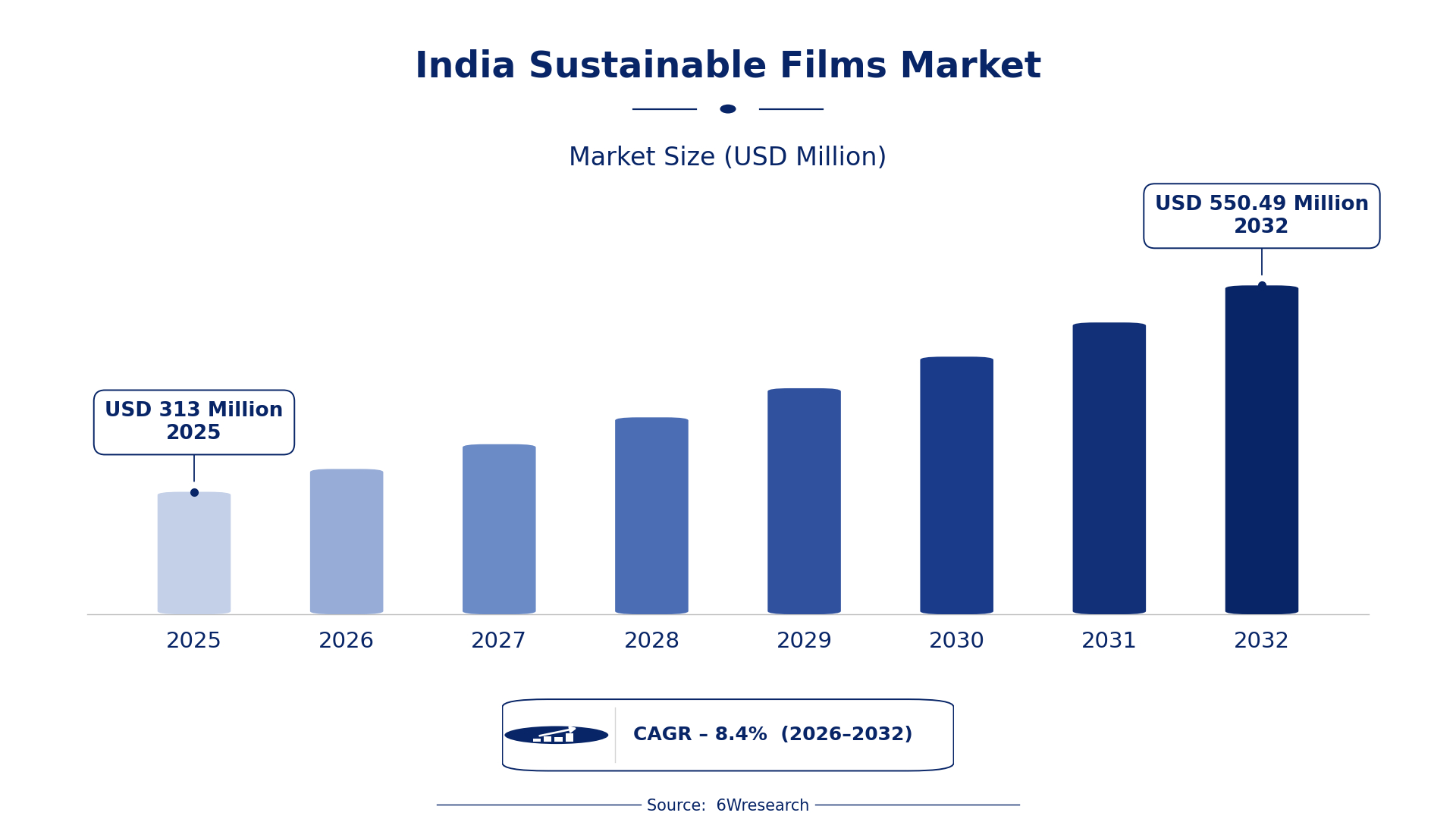
According to 6Wresearch internal database and industry insights, the India Sustainable Films Market was valued at USD 313.0 million in 2025 and is projected to reach USD 550.49 million by 2032, growing at a CAGR of approximately 8.4% during 2026–2032.
India Sustainable Films Market Highlights
| Report Metric | Details |
| Report Name | India Sustainable Films Market |
| Market Size 2025 | USD 313.0 million |
| Market Size 2032 | USD 550.49 million |
| Absolute Growth 2025–2032 | USD 237.49 million |
| CAGR 2026–2032 | 8.4% |
| Peak Annual Growth | 11.1% in 2032 |
| Forecast Period | 2026–2032 |
| Historical Data | 2022–2025 |
| Base Year | 2025 |
| Leading Sustainable Films, 2025 | Biodegradable Films (48% share) |
| Leading Product Type, 2025 | PLA Films (52% share) |
| Leading Material Type, 2025 | Polylactic Acid (45% share) |
| Leading Distribution Channel, 2025 | Direct Sales (38% share) |
| Leading End User Industry, 2025 | Food Packaging (40% share) |
| Fastest-Growing Sustainable Films | Compostable Films (10.1% CAGR) |
| Fastest-Growing Product Type | Starch-Based Films (10.1% CAGR) |
| Fastest-Growing Material Type | Corn Starch (10.1% CAGR) |
| Fastest-Growing Distribution Channel | Online Platforms (9.8% CAGR) |
| Fastest-Growing End User Industry | Retail & E-Commerce (10.0% CAGR) |
| Growing Sector | Food Packaging |
| Key End Users | Food manufacturers, agricultural producers, e-commerce retailers, packaging companies |
India Sustainable Films Market Year-wise Growth Rate and Key Drivers (2022–2032)
This graph illustrates the annual growth rates of the market from 2022 to 2032, highlighting a steady upward trajectory and projected market expansion over the forecast period.
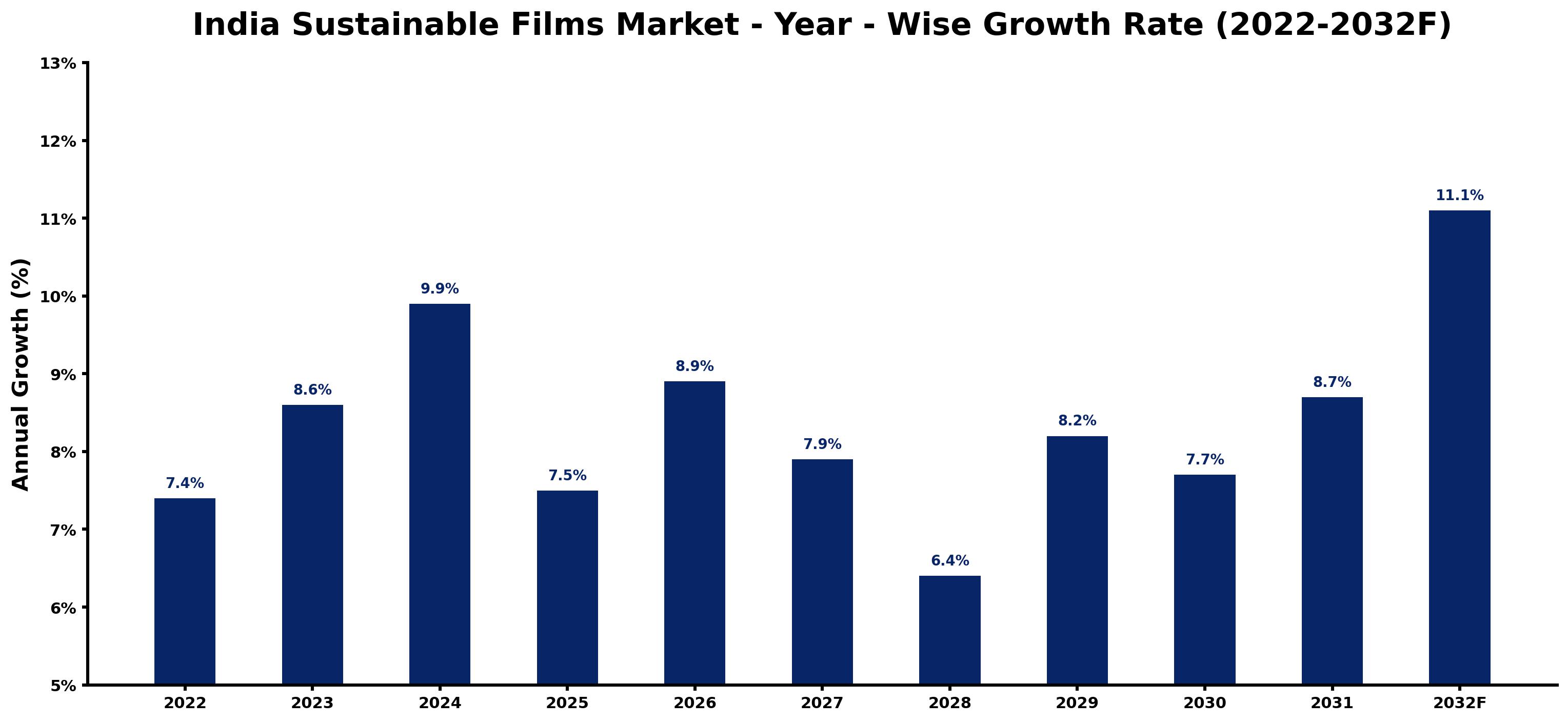
Year by year, the estimates below pair each growth rate with the development that shaped it.
| Year | Estimated Annual Growth (%) | Market Rationale |
| 2022 | 7.4 | The market experienced steady growth due to the 'Swachh Bharat Mission' promoting biodegradable materials. |
| 2023 | 8.6 | Demand rose as the Food Safety and Standards Authority of India promoted sustainable packaging practices. |
| 2024 | 9.9 | Growth accelerated with the introduction of the Plastic Waste Management Rules encouraging biodegradable materials. |
| 2025 | 7.5 | A slight slowdown occurred as the market adjusted to new regulations and consumer preferences. |
| 2026 | 8.9 | Investment in local production facilities is expected to increase demand for PLA films. |
| 2027 | 7.9 | The market will continue to grow, although at a slower rate due to logistical challenges in distribution. |
| 2028 | 6.4 | Growth is projected to slow further as the market faces increased competition from traditional packaging materials. |
| 2029 | 8.2 | Demand is expected to pick up again as e-commerce packaging needs surge, boosting sustainable film usage. |
| 2030 | 7.7 | A slowdown is anticipated as market saturation begins to affect growth rates. |
| 2031 | 8.7 | Growth will resume as the agricultural sector expands its use of biodegradable films. |
| 2032 | 11.1 | The market is projected to peak with a rise in demand driven by eco-friendly initiatives. |
Note: Market size estimations and growth projections presented in this report are based on 6Wresearch's proprietary forecasting methodology, utilizing the latest available industry data, government publications, and primary research inputs.
India Sustainable Films Market Synopsis
Sustainable Films in India consist of materials crafted to reduce environmental impact, primarily derived from renewable resources like polylactic acid (PLA). These films find extensive use in packaging applications, especially within food and agriculture, aiming to decrease plastic waste. The India Sustainable Films Market is expanding due to increasing regulatory support for eco-friendly products and growing consumer awareness. With the agricultural sector responsible for 20% of sustainable film consumption, demand is set to rise. Initiatives such as the 'Swachh Bharat Mission' further promote the use of biodegradable materials in urban waste management.
Market Dynamics Impact Analysis (2026–2032)
| Factor | Type | Impact | Primary Segment Affected |
| Increasing regulatory support for eco-friendly products | Driver | High | Biodegradable Films |
| Growing consumer demand for sustainable packaging solutions | Driver | High | PLA Films |
| Rising demand for sustainable packaging in e-commerce | Opportunity | High | Compostable Films |
| Expansion of the agricultural sector's use of biodegradable materials | Opportunity | High | Biodegradable Films |
| Challenges in sourcing raw materials for production | Restraint | Medium | PLA Films |
| Higher production costs compared to traditional plastics | Restraint | Medium | Compostable Films |
| Supply chain disruptions affecting timely delivery | Challenge | High | Recyclable Films |
| Limited consumer awareness about sustainable options | Challenge | Medium | Water-Soluble Films |
Evaluation of Drivers in India Sustainable Films Market (2026–2032)
Below mentioned are some major drivers and their influence on market dynamics.
| Drivers | Primary Segment Affected | Why It Matters (Evidence) |
| Investment in local production facilities | PLA Films | India produces over 1 million tons of corn starch annually, increasing local supply. |
| Growing demand from the food packaging sector | Biodegradable Films | The agricultural sector accounts for 20% of sustainable film usage, boosting purchases. |
| Regulatory support for eco-friendly packaging | Compostable Films | The 'Plastic Waste Management Rules' encourage the use of biodegradable materials. |
| Expansion of e-commerce packaging needs | Recyclable Films | The Indian retail sector is adopting sustainable packaging, with 30% of new products featuring eco-friendly materials. |
| Rising consumer awareness of environmental issues | Biodegradable Films | The 'Swachh Bharat Mission' promotes the use of biodegradable materials in urban waste management. |
The Sustainable Films market in India is expanding as investment in local production facilities, increasing usage in food packaging, and support for eco-friendly materials drive growth. Over 1 million tons of corn starch produced annually boosts local supply for PLA films. The agricultural sector accounts for 20% of sustainable film usage, which propels demand. Consumer awareness of environmental issues continues to rise, further supporting market expansion.
Evaluation of Restraints in India Sustainable Films Market
The key brakes on demand, and where they bite hardest, are shown below.
| Market Restraint | Primary Segment Affected | Why It Matters (Evidence) |
| Challenges in sourcing raw materials for production | PLA Films | India's reliance on specific crops for materials can lead to supply shortages. |
| Higher production costs compared to traditional plastics | Compostable Films | Producers face increased costs, affecting pricing strategies and market competitiveness. |
| Supply chain disruptions affecting timely delivery | Recyclable Films | Logistical issues can delay the distribution of sustainable films to end-users. |
| Limited consumer awareness about sustainable options | Water-Soluble Films | Many consumers remain unaware of the benefits of sustainable films, hindering growth. |
| Competition from traditional packaging materials | Biodegradable Films | Established plastic products dominate the market, making it difficult for sustainable alternatives to gain traction. |
India Sustainable Films Market Challenges
India's sustainable films market contends with fierce competition from traditional plastic products, which are often less expensive, leading producers to face profit margin reductions of up to 15%. Buyers in the food packaging industry often hesitate to switch to sustainable films due to their higher costs, which can be 20% more than conventional alternatives, thus delaying the transition to eco-friendly solutions. Rising raw material costs, particularly for corn starch, have increased production expenses for manufacturers, potentially resulting in higher prices for buyers and hindering market growth. Compliance with regulations like the Plastic Waste Management Rules necessitates substantial investment from producers, diverting resources away from product development.
Trends in the India Sustainable Films Market
Several trends are reshaping the India Sustainable Films Market; the most important are set out below.
- Shift towards Biodegradable Packaging Solutions: In 2023, the Indian government introduced the 'Plastic Waste Management Rules', advocating for biodegradable materials with a target of reducing plastic waste by 50% by 2025. This shift encourages manufacturers to adopt sustainable films, broadening market opportunities.
- Growing Adoption of E-commerce Packaging: Since 2022, the Indian retail sector has experienced a marked increase in sustainable packaging, with 30% of new products featuring eco-friendly materials. This trend is transforming packaging strategies across various sectors, driving demand for sustainable films.
- Increase in Agricultural Use of Biodegradable Films: The agricultural sector's uptake of biodegradable films has surged, motivated by the need for sustainable crop protection solutions. This trend is expected to account for 20% of sustainable film consumption by 2025, creating new market opportunities.
- Regulatory Push for Eco-friendly Materials: The 'Swachh Bharat Mission', reinforced in 2022, promotes the use of biodegradable materials in urban waste management. This initiative is boosting demand for sustainable films, as municipalities strive to meet environmental standards.
Investment Opportunities in the India Sustainable Films Market
Several openings in the India Sustainable Films Market merit attention from investors.
- E-commerce Sector's Demand for Sustainable Packaging: With the Indian e-commerce market anticipated to grow, the demand for sustainable packaging solutions is increasing. Retailers are increasingly seeking biodegradable films to align with consumer preferences for eco-friendly products.
- Agricultural Sector's Shift to Biodegradable Solutions: The agricultural sector is progressively adopting biodegradable films for crop protection, driven by sustainability objectives. This shift presents an opportunity for suppliers to cater to the rising demand for eco-friendly materials.
- Investment in Local Production Facilities: As the government champions local production through initiatives like 'Make in India', there is a growing need for sustainable films. Suppliers can enter the market by collaborating with local manufacturers to fulfil this demand.
- Expansion of Retail & E-Commerce Packaging Solutions: The retail sector is evolving, with a notable demand for sustainable packaging solutions. Suppliers can take advantage of this trend by providing innovative biodegradable films tailored for e-commerce requirements.
Government Initiatives in the India Sustainable Films Market
In 2023, the Ministry of Environment launched the 'Plastic Waste Management Rules', promoting the use of biodegradable materials with a target of reducing plastic waste by 50% by 2025. This measure encourages producers to adopt sustainable films in their packaging solutions. The updated 'National Biofuel Policy' in 2021 includes incentives for sustainable packaging solutions, aiming for a 20% increase in bio-based materials in packaging by 2025, further supporting the market.
The Bureau of Indian Standards (BIS) oversees the approval of biodegradable films, ensuring compliance with guidelines for food packaging. The agency's standards, including ISO 17088:2012, provide a framework for producers to certify their products, increasing market credibility. Additionally, the 'Swachh Bharat Mission' allocates INR 500 crores for promoting biodegradable materials in urban waste management, funding initiatives that boost sustainable film adoption.
Future Insight of the India Sustainable Films Market
The sustainable films market in India is set for notable evolution by 2032, driven by increasing consumer awareness and strong regulatory support for eco-friendly products. Initiatives such as the 'Swachh Bharat Mission' and 'Atmanirbhar Bharat' will encourage local manufacturing and reduce reliance on imports. By 2025, the biodegradable film market is projected to reach 200,000 tons, with the food packaging sector being a key driver of this demand. Emerging recycling technologies will improve sustainability, creating new opportunities for both buyers and suppliers.
Market Segmentation Analysis
The report offers a comprehensive study of the following market segments and their leading categories in the market.
By Sustainable Films – Biodegradable Films Dominated, Compostable Films Expected to Grow Fastest
According to Sumit Sagar, AM at 6Wresearch, with a 48% revenue share in 2025, Biodegradable Films was the largest sustainable films category. Biodegradable films hold the largest share in the India Sustainable Films Market due to their extensive application in food packaging, which is crucial for reducing plastic waste. The agricultural sector's notable usage, accounting for 20% of sustainable film consumption, highlights the strong demand in this segment. Over 2026–2032, Compostable Films are expected to post the fastest growth, at a CAGR of 10.1%. Compostable films are witnessing rapid growth, primarily driven by their increasing use in agricultural applications, particularly for enhancing soil health and effective waste management. The growing environmental consciousness among the Indian populace further accelerates this segment's expansion. Suppliers should enhance their compostable film offerings to address the rising demand from the agricultural sector.
By Product Type – PLA Films Dominated, Starch-Based Films Expected to Grow Fastest
In 2025, PLA Films led the product type split with a 52% share. PLA films lead the market share as they are predominantly used in food packaging due to their compostable nature, appealing to environmentally aware consumers. The support from regulatory frameworks advocating sustainable packaging practices further reinforces their widespread acceptance. Starch-Based Films are set to record the highest CAGR in this split, 10.1% over 2026–2032. Starch-based films are experiencing the fastest growth, mainly due to their biodegradability and effectiveness in food and agricultural packaging. The increasing inclination towards eco-friendly materials in these sectors is a key driver of their demand. Manufacturers should focus on developing starch-based films to capitalise on this expanding market segment.
By Material Type – Polylactic Acid Dominated, Corn Starch Expected to Grow Fastest
Polylactic Acid took a 45% share of material type in 2025, more than any other category. Polylactic acid is the leading material type in the sustainable films market, primarily utilised in food packaging and disposable items, significantly driving its market share. The material's compostability aligns well with regulatory initiatives promoting sustainable packaging solutions. The quickest growth will come from Corn Starch, forecast to expand at a CAGR of 10.1% between 2026 and 2032. Corn starch is the fastest-growing material type, increasingly used in biodegradable films for food packaging, which is gaining popularity among consumers. This growth is bolstered by India's substantial corn starch production, exceeding 1 million tons annually. Suppliers should consider expanding their product offerings to include corn starch-based films to cater to rising consumer preferences.
By Distribution Channel – Direct Sales Dominated, Online Platforms Expected to Grow Fastest
The largest distribution channel category in 2025 was Direct Sales, with a 38% share of total revenue. Direct sales account for the largest share in the distribution of sustainable films, as this channel is commonly employed for supplying manufacturers requiring these materials. This direct approach facilitates a streamlined supply chain for bulk orders. Online Platforms are projected to grow fastest, at a CAGR of 9.8% during 2026–2032. Online platforms are the fastest-growing distribution channel, effectively catering to consumer and small business sales in the sustainable films market. The surge in e-commerce and shifting consumer purchasing behaviours are propelling this channel's rapid growth. Vendors should enhance their online presence to capture the increasing segment of consumers seeking sustainable packaging solutions.
By End User Industry – Food Packaging Dominated, Retail & E-Commerce Expected to Grow Fastest
Food Packaging held a 40% share of the India Sustainable Films Market by end user industry in 2025. Food packaging is the largest end user industry for sustainable films, significantly driving demand as it aligns with the necessity to reduce plastic waste in packaging. The sector's commitment to sustainability has solidified its market share. Over 2026–2032, Retail & E-Commerce is expected to post the fastest growth, at a CAGR of 10.0%. Retail and e-commerce are the fastest-growing end user industries, increasingly necessitating sustainable packaging solutions for online sales. This shift towards eco-friendly packaging is driven by consumer demand for sustainable products. Companies should tailor their offerings to meet the specific requirements of the retail and e-commerce sectors for sustainable packaging.
Key Attractiveness of the Report
- 10 Years of Market Numbers
- Historical Data Starting from 2022 to 2025
- Base Year 2025
- Forecast Data until 2032
- Key Performance Indicators Impacting the Market
- Major Upcoming Developments and Projects
Key Highlights of the Report:
- India Sustainable Films Market Outlook
- Market Size of India Sustainable Films Market, 2025
- Forecast of India Sustainable Films Market, 2032
- Historical Data and Forecast of India Sustainable Films Revenues & Volume for the Period 2022 - 2032F
- India Sustainable Films Market Trend Evolution
- India Sustainable Films Market Drivers and Challenges
- India Sustainable Films Price Trends
- India Sustainable Films Porter's Five Forces
- India Sustainable Films Industry Life Cycle
- Historical Data and Forecast of India Sustainable Films Market Revenues & Volume By Sustainable Films for the Period 2022 - 2032F
- Historical Data and Forecast of India Sustainable Films Market Revenues & Volume By Biodegradable Films for the Period 2022 - 2032F
- Historical Data and Forecast of India Sustainable Films Market Revenues & Volume By Compostable Films for the Period 2022 - 2032F
- Historical Data and Forecast of India Sustainable Films Market Revenues & Volume By Recyclable Films for the Period 2022 - 2032F
- Historical Data and Forecast of India Sustainable Films Market Revenues & Volume By Water-Soluble Films for the Period 2022 - 2032F
- Historical Data and Forecast of India Sustainable Films Market Revenues & Volume By Product Type for the Period 2022 - 2032F
- Historical Data and Forecast of India Sustainable Films Market Revenues & Volume By PLA Films for the Period 2022 - 2032F
- Historical Data and Forecast of India Sustainable Films Market Revenues & Volume By Starch-Based Films for the Period 2022 - 2032F
- Historical Data and Forecast of India Sustainable Films Market Revenues & Volume By Polyethylene Films for the Period 2022 - 2032F
- Historical Data and Forecast of India Sustainable Films Market Revenues & Volume By PVOH Films for the Period 2022 - 2032F
- Historical Data and Forecast of India Sustainable Films Market Revenues & Volume By Material Type for the Period 2022 - 2032F
- Historical Data and Forecast of India Sustainable Films Market Revenues & Volume By Polylactic Acid for the Period 2022 - 2032F
- Historical Data and Forecast of India Sustainable Films Market Revenues & Volume By Corn Starch for the Period 2022 - 2032F
- Historical Data and Forecast of India Sustainable Films Market Revenues & Volume By Recyclable PE for the Period 2022 - 2032F
- Historical Data and Forecast of India Sustainable Films Market Revenues & Volume By Polyvinyl Alcohol for the Period 2022 - 2032F
- Historical Data and Forecast of India Sustainable Films Market Revenues & Volume By Distribution Channel for the Period 2022 - 2032F
- Historical Data and Forecast of India Sustainable Films Market Revenues & Volume By Direct Sales for the Period 2022 - 2032F
- Historical Data and Forecast of India Sustainable Films Market Revenues & Volume By Online Platforms for the Period 2022 - 2032F
- Historical Data and Forecast of India Sustainable Films Market Revenues & Volume By Industrial Distributors for the Period 2022 - 2032F
- Historical Data and Forecast of India Sustainable Films Market Revenues & Volume By Specialty Stores for the Period 2022 - 2032F
- Historical Data and Forecast of India Sustainable Films Market Revenues & Volume By End User Industry for the Period 2022 - 2032F
- Historical Data and Forecast of India Sustainable Films Market Revenues & Volume By Food Packaging for the Period 2022 - 2032F
- Historical Data and Forecast of India Sustainable Films Market Revenues & Volume By Retail & E-Commerce for the Period 2022 - 2032F
- Historical Data and Forecast of India Sustainable Films Market Revenues & Volume By Agricultural Sector for the Period 2022 - 2032F
- Historical Data and Forecast of India Sustainable Films Market Revenues & Volume By Detergent Industry for the Period 2022 - 2032F
- India Sustainable Films Import Export Trade Statistics
- Market Opportunity Assessment By Sustainable Films
- Market Opportunity Assessment By Product Type
- Market Opportunity Assessment By Material Type
- Market Opportunity Assessment By Distribution Channel
- Market Opportunity Assessment By End User Industry
- India Sustainable Films Top Companies Market Share
- India Sustainable Films Competitive Benchmarking By Technical and Operational Parameters
- India Sustainable Films Company Profiles
- India Sustainable Films Key Strategic Recommendations
Market Covered
This report examines the market across the segments below.
By Sustainable Films
- Biodegradable Films
- Compostable Films
- Recyclable Films
- Water-Soluble Films
By Product Type
- PLA Films
- Starch-Based Films
- Polyethylene Films
- PVOH Films
By Material Type
- Polylactic Acid
- Corn Starch
- Recyclable PE
- Polyvinyl Alcohol
By Distribution Channel
- Direct Sales
- Online Platforms
- Industrial Distributors
- Specialty Stores
By End User Industry
- Food Packaging
- Retail & E-Commerce
- Agricultural Sector
- Detergent Industry































