India Sustainable Materials Market Size & Growth Rate
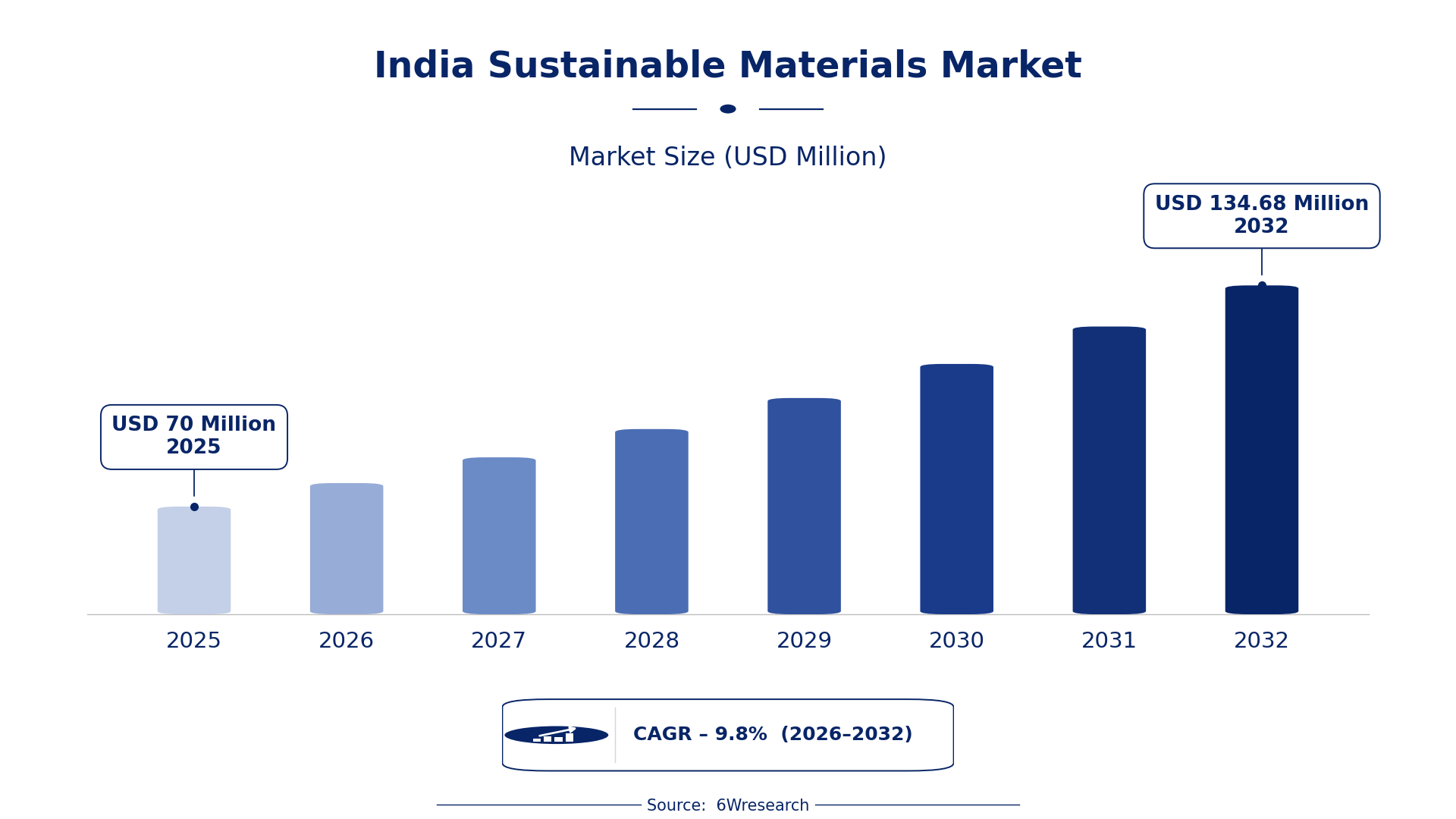
According to 6Wresearch internal database and industry insights, the India Sustainable Materials Market was valued at USD 70.0 million in 2025 and is projected to reach USD 134.68 million by 2032, growing at a CAGR of approximately 9.8% during 2026–2032.
India Sustainable Materials Market Highlights
| Report Metric | Details |
| Report Name | India Sustainable Materials Market |
| Market Size 2025 | USD 70.0 million |
| Market Size 2032 | USD 134.68 million |
| Absolute Growth 2025–2032 | USD 64.68 million |
| CAGR 2026–2032 | 9.8% |
| Peak Annual Growth | 12.2% in 2031 |
| Forecast Period | 2026–2032 |
| Historical Data | 2022–2025 |
| Base Year | 2025 |
| Leading Sustainable Materials, 2025 | Bioplastics (39% share) |
| Leading Product Type, 2025 | Construction Material (43% share) |
| Leading Material Type, 2025 | Recycled Aggregates (44% share) |
| Leading Distribution Channel, 2025 | Industrial Distributors (41% share) |
| Leading End User Industry, 2025 | Packaging Manufacturers (45% share) |
| Fastest-Growing Sustainable Materials | Natural Fibers (12.4% CAGR) |
| Fastest-Growing Product Type | Pellets (12.2% CAGR) |
| Fastest-Growing Material Type | PLA (11.7% CAGR) |
| Fastest-Growing Distribution Channel | Online Platforms (12.0% CAGR) |
| Fastest-Growing End User Industry | Infrastructure Projects (10.9% CAGR) |
| Growing Sector | Infrastructure Projects |
| Key End Users | Packaging Manufacturers, Infrastructure Projects, Automotive Interiors, Electronics & Appliances |
India Sustainable Materials Market Year-wise Growth Rate and Key Drivers (2022–2032)
This graph illustrates the annual growth rates of the market from 2022 to 2032, highlighting a steady upward trajectory and projected market expansion over the forecast period.
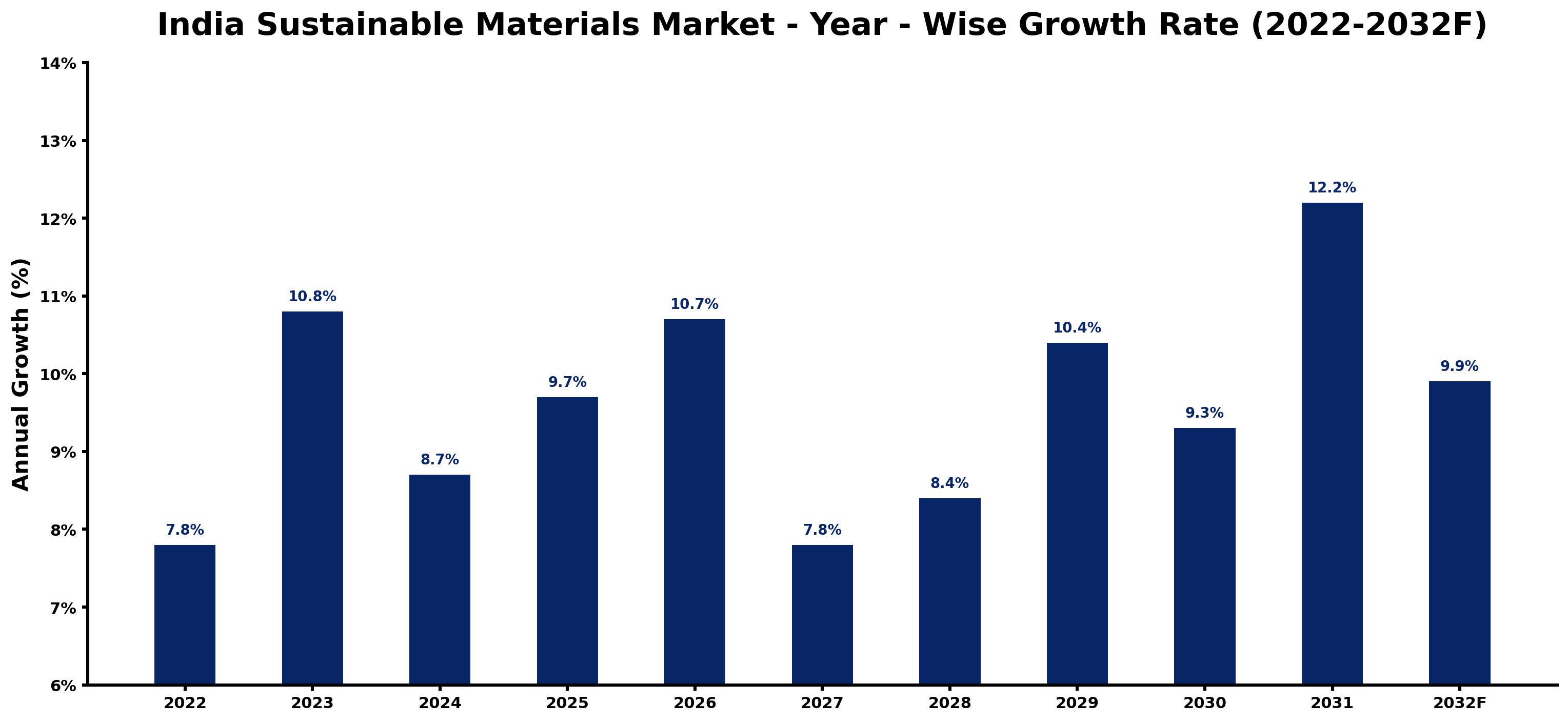
Year by year, the estimates below pair each growth rate with the development that shaped it.
| Year | Estimated Annual Growth (%) | Market Rationale |
| 2022 | 7.8 | The market experienced steady growth, driven by the Plastic Waste Management Rules mandating recycling practices. |
| 2023 | 10.8 | Demand surged as infrastructure projects in Maharashtra adopted green concrete for sustainability, supported by the Indian Green Building Council. |
| 2024 | 8.7 | Growth slowed due to a temporary adjustment in production capacities across sectors, particularly in bioplastics and recycled metals. |
| 2025 | 9.7 | Urbanisation boosted the need for sustainable construction materials, with a focus on achieving 50% recycled content in construction materials by 2025. |
| 2026 | 10.7 | Investment in natural fibers gained momentum, responding to eco-friendly packaging demands from the textile industry. |
| 2027 | 7.8 | A slowdown occurred as the market adjusted to new regulations and standards, particularly in the bioplastics sector. |
| 2028 | 8.4 | Growth picked up as the automotive sector increased its focus on sustainable materials, targeting a 30% rise in sustainable interiors by 2025. |
| 2029 | 10.4 | Infrastructure projects expanded, leading to a higher demand for recycled aggregates, driven by urbanisation trends. |
| 2030 | 9.3 | Growth moderated as the market stabilised after rapid expansion in previous years, particularly in the construction materials segment. |
| 2031 | 12.2 | A peak in demand is expected as the government sets ambitious targets for recycled content in construction materials, driving further investment. |
| 2032 | 9.9 | Growth is projected to slow slightly as the market matures, but sustainable practices remain a priority across various sectors. |
Note: Market size estimations and growth projections presented in this report are based on 6Wresearch's proprietary forecasting methodology, utilizing the latest available industry data, government publications, and primary research inputs.
India Sustainable Materials Market Synopsis
Sustainable Materials in India include eco-friendly alternatives that minimise environmental impact, such as bioplastics, green concrete, and recycled metals. These materials are created from renewable resources and recycling processes, primarily catering to the construction, packaging, and automotive sectors. The India Sustainable Materials Market is expanding due to urbanisation and government initiatives like the National Policy on Biofuels, which targets 20% ethanol blending by 2025. Furthermore, the Smart Cities Mission encourages sustainable urban infrastructure, further boosting demand. With a population exceeding 1.4 billion, the market is set for robust growth as sustainability gains importance across various sectors.
Market Dynamics Impact Analysis (2026–2032)
| Factor | Type | Impact | Primary Segment Affected |
| Increasing urbanisation drives demand for sustainable construction materials. | Driver | High | Construction Material |
| The automotive sector's focus on sustainable interiors boosts the use of recycled metals. | Driver | High | Recycled Metals |
| Investment in green technologies creates opportunities for local suppliers. | Opportunity | High | Bioplastics |
| The growing emphasis on eco-friendly packaging opens new markets for natural fibers. | Opportunity | High | Natural Fibers |
| High production costs limit the adoption of sustainable materials in some sectors. | Restraint | Medium | Bioplastics |
| Limited consumer awareness hampers the growth of sustainable materials in packaging. | Restraint | Medium | Packaging Manufacturers |
| Buyers face challenges in sourcing high-quality sustainable materials locally. | Challenge | High | Construction Material |
| Suppliers struggle with fluctuating raw material prices impacting production costs. | Challenge | Medium | Recycled Metals |
Evaluation of Drivers in India Sustainable Materials Market (2026–2032)
Key forces behind demand, with the segment each one moves most, are listed below.
| Drivers | Primary Segment Affected | Why It Matters (Evidence) |
| Urbanisation is increasing the demand for sustainable construction materials. | Construction Material | The Smart Cities Mission promotes sustainable urban infrastructure, leading to a projected increase in construction material demand by 50% by 2025. |
| The automotive sector's shift towards sustainability drives the use of recycled metals. | Recycled Metals | India's automotive industry aims for a 30% increase in sustainable materials for interiors by 2025, boosting demand for recycled metals. |
| Investment in green technologies is expanding the bioplastics market. | Bioplastics | The Indian government allocated INR 10,000 crore in 2023 to promote green technologies, supporting the bioplastics sector's growth. |
| Growing consumer demand for eco-friendly packaging fuels natural fiber usage. | Natural Fibers | The textile industry aims to increase the use of natural fibers to 25% by 2025, driving demand for sustainable materials. |
| Government initiatives support the recycling of materials, boosting market growth. | Recycled Aggregates | The Plastic Waste Management Rules encourage recycling, increasing the use of recycled aggregates in construction. |
Market growth in India for Sustainable Materials rests on rising urbanisation, increased investment in green technologies, and growing end-use demand from various sectors. The focus on sustainable urban infrastructure is projected to increase construction material demand by 50% by 2025, particularly driven by the Smart Cities Mission. The automotive sector's emphasis on sustainable interiors is expected to drive a notable rise in recycled metals, with a target of 30% increase by 2025. Consumer demand for eco-friendly packaging continues to rise, with the textile industry aiming to increase natural fiber usage to 25% by 2025, further boosting market growth.
Evaluation of Restraints in India Sustainable Materials Market
The table below lists the restraints and the evidence behind each.
| Market Restraint | Primary Segment Affected | Why It Matters (Evidence) |
| High costs of eco-friendly materials due to limited supply. | Bioplastics | This limits the affordability for manufacturers, raising production costs by up to 30%. |
| Skills shortages in sustainable practices hinder production capabilities. | Green Concrete | This results in project delays, extending timelines for construction firms by several months. |
| Technology gaps in recycling processes lead to inefficiencies. | Recycled Metals | These inefficiencies inflate operational costs by 20% for manufacturers. |
| Supply chain disruptions affect sourcing of sustainable materials. | Natural Fibers | This can lead to significant project delays, impacting urban development timelines. |
| Regulatory compliance costs increase operational expenses. | Construction Material | Manufacturers must invest in certifications and compliance measures, raising overall costs. |
India Sustainable Materials Market Challenges
Buyers in the India Sustainable Materials Market encounter high costs due to the limited availability of eco-friendly alternatives, which can raise production expenses by up to 30%. Skills shortages in sustainable practices prevent suppliers from meeting growing demand, causing project delays that may extend timelines by several months for construction firms. Technology gaps in recycling processes lead to inefficiencies, inflating operational costs by 20% for manufacturers. Supply chain disruptions in sourcing sustainable materials can result in significant project delays, impacting urban development schedules for municipalities.
Trends in the India Sustainable Materials Market
Below mentioned are some of the trends shaping the India Sustainable Materials Market growth.
- Shift towards Eco-Friendly Packaging Solutions: India's packaging industry is increasingly embracing sustainable materials, with a projected 25% rise in natural fibre usage by 2025. This shift is driven by consumer demand for environmentally friendly options, reflected in the growing use of jute and hemp.
- Transition to Green Building Practices: The Indian Green Building Council is advocating for green concrete in new constructions, with major infrastructure projects across Maharashtra adopting these materials. This trend is reshaping the use of sustainable materials in the coming years.
- Emergence of Online Platforms for Sustainable Products: Online platforms are becoming a popular distribution channel for sustainable materials, with a projected growth of 12% in this sector. This shift provides consumers with easier access to eco-friendly options and supports local suppliers.
- Focus on Recycling Initiatives: The Plastic Waste Management Rules are driving an increase in recycling efforts throughout India, targeting 50% recycled content in construction materials by 2025. This initiative is reshaping the market for sustainable materials.
Investment Opportunities in the India Sustainable Materials Market
Some of the investment opportunities in the India Sustainable Materials Market are mentioned below.
- Supply of Bioplastics for Eco-Friendly Packaging: With the Indian government targeting 20% ethanol blending by 2025, there is a growing demand for bioplastics. Companies can invest in production facilities to meet the rising needs of packaging manufacturers.
- Investment in Green Concrete for Infrastructure Projects: The increasing adoption of green concrete in major infrastructure projects presents an opportunity for suppliers. With a projected growth of 10% in this sector, partnerships with construction firms can facilitate market entry.
- Natural Fibers for Sustainable Textiles: The textile industry aims to increase natural fibre usage to 25% by 2025, creating a demand for sustainable materials. Suppliers can engage with textile manufacturers to provide eco-friendly options.
- Recycled Aggregates for Sustainable Construction: With the target of 50% recycled content in construction materials by 2025, there is an opportunity for suppliers of recycled aggregates. Collaborating with construction firms can enhance market presence.
Government Initiatives in the India Sustainable Materials Market
The Plastic Waste Management Rules, established by the Ministry of Environment, Forest and Climate Change in 2021, mandate recycling and promote sustainable alternatives to plastics. These rules require manufacturers to adopt eco-friendly practices, impacting production processes and material sourcing significantly. Additionally, the National Policy on Biofuels, launched by the Ministry of Petroleum and Natural Gas in 2021, aims for 20% ethanol blending by 2025, promoting the use of sustainable materials across sectors.
The Atmanirbhar Bharat initiative, announced in 2020, supports local production of sustainable materials and reduces dependency on imports. The Smart Cities Mission, initiated by the Ministry of Housing and Urban Affairs in 2020, encourages the use of sustainable materials in urban infrastructure projects, influencing buyer decisions and market growth. This initiative funds projects that incorporate green technologies, enhancing overall sustainability in urban development.
Future Insight of the India Sustainable Materials Market
The India Sustainable Materials Market will undergo notable changes by 2032, benefiting both buyers and suppliers. Government initiatives such as the National Policy on Biofuels will drive the adoption of sustainable materials across various sectors. The target of 50% recycled content in construction materials will reshape industry standards and promote eco-friendly practices. The market for recycled metals is projected to grow by 40%, aligning with urbanisation trends and the increasing demand for sustainable solutions.
Market Segmentation Analysis
The report offers a comprehensive study of the following market segments and their leading categories in the market.
By Sustainable Materials – Bioplastics Dominated, Natural Fibers Expected to Grow Fastest
According to Sumit Sagar, AM at 6Wresearch, Bioplastics took a 39% share of sustainable materials in 2025, more than any other category. Bioplastics hold the largest share in the India Sustainable Materials Market due to their significant demand for eco-friendly packaging solutions, particularly in food and beverage sectors. The National Policy on Biofuels, which targets 20% ethanol blending by 2025, further supports this trend. Over 2026–2032, Natural Fibers are expected to post the fastest growth, at a CAGR of 12.4%. Natural Fibers are experiencing rapid growth as they are increasingly utilised in textiles and composites, driven by the textile industry's aim to increase natural fiber usage to 25% by 2025. This growth will likely widen the lead of bioplastics as sustainability becomes a key focus. Suppliers should enhance their bioplastics offerings to meet the rising demand from packaging manufacturers.
By Product Type – Construction Material Dominated, Pellets Expected to Grow Fastest
Construction Material accounted for a 43% market share by product type in 2025. Construction Material dominates the market share as it is essential for green building practices, which are gaining traction across India. The Indian government's target of 50% recycled content in construction materials by 2025 underscores the importance of this segment. Pellets are projected to grow fastest, at a CAGR of 12.2% during 2026–2032. Pellets are the fastest-growing segment, primarily used in manufacturing various sustainable products, driven by the increasing demand for eco-friendly alternatives in multiple industries. This growth in pellets will complement the ongoing expansion of construction materials. Buyers should consider sourcing construction materials that incorporate sustainable practices to align with government initiatives.
By Material Type – Recycled Aggregates Dominated, PLA Expected to Grow Fastest
Recycled Aggregates held a 44% share of the India Sustainable Materials Market by material type in 2025. Recycled Aggregates lead the market share due to their extensive application in construction, especially in urban development projects prioritising sustainability. The Bureau of Indian Standards has established guidelines that promote the use of recycled aggregates in building practices. The quickest growth will come from PLA, forecast to expand at a CAGR of 11.7% between 2026 and 2032. PLA is the fastest-growing material type, widely recognised for its role in biodegradable packaging, which is increasingly favoured by consumers seeking eco-friendly options. As demand for sustainable packaging rises, PLA's growth will further support the position of recycled aggregates. Suppliers should focus on developing PLA and recycled aggregates to cater to the growing market for sustainable materials.
By Distribution Channel – Industrial Distributors Dominated, Online Platforms Expected to Grow Fastest
The largest distribution channel category in 2025 was Industrial Distributors, with a 41% share of total revenue. Industrial Distributors command the largest share as they are essential for supplying sustainable materials across various industries, ensuring a steady flow of products. Their established networks effectively facilitate the distribution of eco-friendly materials to construction and manufacturing sectors. Online Platforms are set to record the highest CAGR in this split, 12.0% over 2026–2032. Online Platforms are emerging as the fastest-growing distribution channel, driven by the increasing trend of e-commerce and the rising demand for sustainable products. This shift towards online purchasing will likely strengthen the position of industrial distributors as they adapt to new sales channels. Suppliers must enhance their online presence to capture the growing market of consumers seeking sustainable materials.
By End User Industry – Packaging Manufacturers Dominated, Infrastructure Projects Expected to Grow Fastest
With a 45% revenue share in 2025, Packaging Manufacturers was the largest end user industry category. Packaging Manufacturers account for the largest share as they are major consumers of sustainable materials, particularly bioplastics and recycled content. The sector's increasing emphasis on eco-friendly packaging solutions drives the demand for these materials. Over 2026–2032, Infrastructure Projects are expected to post the fastest growth, at a CAGR of 10.9%. Infrastructure Projects represent the fastest-growing end user industry, with substantial demand for sustainable construction materials driven by government initiatives like the Smart Cities Mission. This growth will further solidify the position of packaging manufacturers as they adapt to changing market needs. Buyers in infrastructure should prioritise sourcing sustainable materials to align with national development goals.
Key Attractiveness of the Report
- 10 Years of Market Numbers
- Historical Data Starting from 2022 to 2025
- Base Year 2025
- Forecast Data until 2032
- Key Performance Indicators Impacting the Market
- Major Upcoming Developments and Projects
Key Highlights of the Report:
- India Sustainable Materials Market Outlook
- Market Size of India Sustainable Materials Market, 2025
- Forecast of India Sustainable Materials Market, 2032
- Historical Data and Forecast of India Sustainable Materials Revenues & Volume for the Period 2022 - 2032F
- India Sustainable Materials Market Trend Evolution
- India Sustainable Materials Market Drivers and Challenges
- India Sustainable Materials Price Trends
- India Sustainable Materials Porter's Five Forces
- India Sustainable Materials Industry Life Cycle
- Historical Data and Forecast of India Sustainable Materials Market Revenues & Volume By Sustainable Materials for the Period 2022 - 2032F
- Historical Data and Forecast of India Sustainable Materials Market Revenues & Volume By Bioplastics for the Period 2022 - 2032F
- Historical Data and Forecast of India Sustainable Materials Market Revenues & Volume By Green Concrete for the Period 2022 - 2032F
- Historical Data and Forecast of India Sustainable Materials Market Revenues & Volume By Natural Fibers for the Period 2022 - 2032F
- Historical Data and Forecast of India Sustainable Materials Market Revenues & Volume By Recycled Metals for the Period 2022 - 2032F
- Historical Data and Forecast of India Sustainable Materials Market Revenues & Volume By Product Type for the Period 2022 - 2032F
- Historical Data and Forecast of India Sustainable Materials Market Revenues & Volume By Pellets for the Period 2022 - 2032F
- Historical Data and Forecast of India Sustainable Materials Market Revenues & Volume By Construction Material for the Period 2022 - 2032F
- Historical Data and Forecast of India Sustainable Materials Market Revenues & Volume By Fiber Sheets for the Period 2022 - 2032F
- Historical Data and Forecast of India Sustainable Materials Market Revenues & Volume By Raw Material for the Period 2022 - 2032F
- Historical Data and Forecast of India Sustainable Materials Market Revenues & Volume By Material Type for the Period 2022 - 2032F
- Historical Data and Forecast of India Sustainable Materials Market Revenues & Volume By PLA, PBS for the Period 2022 - 2032F
- Historical Data and Forecast of India Sustainable Materials Market Revenues & Volume By Recycled Aggregates for the Period 2022 - 2032F
- Historical Data and Forecast of India Sustainable Materials Market Revenues & Volume By Hemp, Jute for the Period 2022 - 2032F
- Historical Data and Forecast of India Sustainable Materials Market Revenues & Volume By Reclaimed Aluminum for the Period 2022 - 2032F
- Historical Data and Forecast of India Sustainable Materials Market Revenues & Volume By Distribution Channel for the Period 2022 - 2032F
- Historical Data and Forecast of India Sustainable Materials Market Revenues & Volume By Industrial Distributors for the Period 2022 - 2032F
- Historical Data and Forecast of India Sustainable Materials Market Revenues & Volume By Direct Sales for the Period 2022 - 2032F
- Historical Data and Forecast of India Sustainable Materials Market Revenues & Volume By Online Platforms for the Period 2022 - 2032F
- Historical Data and Forecast of India Sustainable Materials Market Revenues & Volume By Specialty Suppliers for the Period 2022 - 2032F
- Historical Data and Forecast of India Sustainable Materials Market Revenues & Volume By End User Industry for the Period 2022 - 2032F
- Historical Data and Forecast of India Sustainable Materials Market Revenues & Volume By Packaging Manufacturers for the Period 2022 - 2032F
- Historical Data and Forecast of India Sustainable Materials Market Revenues & Volume By Infrastructure Projects for the Period 2022 - 2032F
- Historical Data and Forecast of India Sustainable Materials Market Revenues & Volume By Automotive Interiors for the Period 2022 - 2032F
- Historical Data and Forecast of India Sustainable Materials Market Revenues & Volume By Electronics & Appliances for the Period 2022 - 2032F
- India Sustainable Materials Import Export Trade Statistics
- Market Opportunity Assessment By Sustainable Materials
- Market Opportunity Assessment By Product Type
- Market Opportunity Assessment By Material Type
- Market Opportunity Assessment By Distribution Channel
- Market Opportunity Assessment By End User Industry
- India Sustainable Materials Top Companies Market Share
- India Sustainable Materials Competitive Benchmarking By Technical and Operational Parameters
- India Sustainable Materials Company Profiles
- India Sustainable Materials Key Strategic Recommendations
Market Covered
This report examines the market across the segments below.
By Sustainable Materials
- Bioplastics
- Green Concrete
- Natural Fibers
- Recycled Metals
By Product Type
- Pellets
- Construction Material
- Fiber Sheets
- Raw Material
By Material Type
- PLA
- PBS
- Recycled Aggregates
- Hemp
- Jute
- Reclaimed Aluminum
By Distribution Channel
- Industrial Distributors
- Direct Sales
- Online Platforms
- Specialty Suppliers
By End User Industry
- Packaging Manufacturers
- Infrastructure Projects
- Automotive Interiors
- Electronics & Appliances































