India sustainable polymer solutions in automotive Market Size & Growth Rate
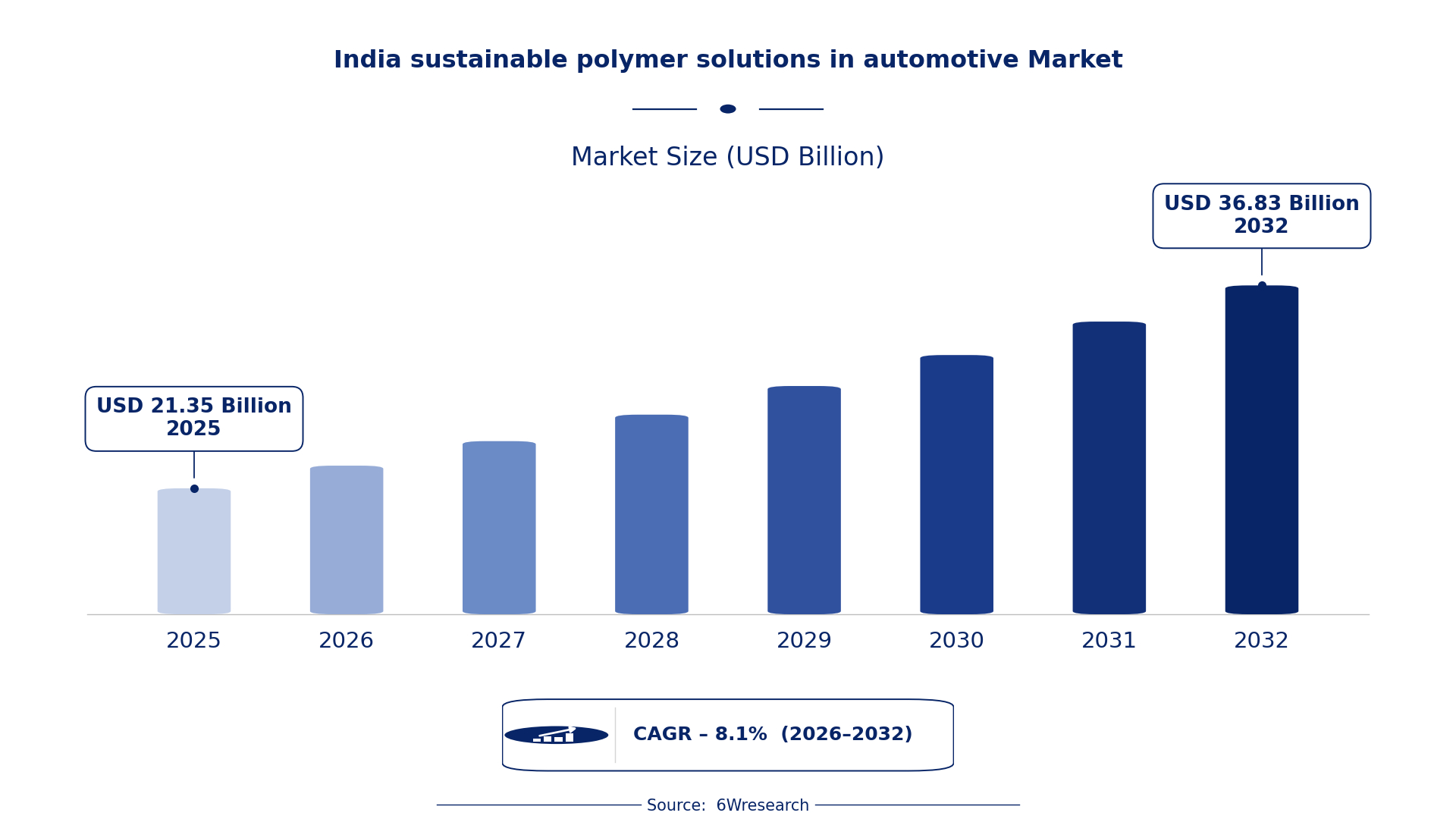
According to 6Wresearch internal database and industry insights, the India sustainable polymer solutions in automotive Market was valued at USD 21.35 billion in 2025 and is projected to reach USD 36.83 billion by 2032, growing at a CAGR of approximately 8.1% during 2026–2032.
India sustainable polymer solutions in automotive Market Highlights
| Report Metric | Details |
| Report Name | India sustainable polymer solutions in automotive Market |
| Market Size 2025 | USD 21.35 billion |
| Market Size 2032 | USD 36.83 billion |
| Absolute Growth 2025–2032 | USD 15.48 billion |
| CAGR 2026–2032 | 8.1% |
| Peak Annual Growth | 10.5% in 2031 |
| Forecast Period | 2026–2032 |
| Historical Data | 2022–2025 |
| Base Year | 2025 |
| Leading Polymer Type, 2025 | Bio-Polyamide (42% share) |
| Leading Source Type, 2025 | Castor Oil (48% share) |
| Leading Component Application, 2025 | Under-the-Hood Parts (40% share) |
| Leading End User, 2025 | Car Manufacturers (43% share) |
| Fastest-Growing Polymer Type | Recycled Polypropylene (9.5% CAGR) |
| Fastest-Growing Source Type | Post-Consumer Plastics (10.2% CAGR) |
| Fastest-Growing Component Application | Interior Trims (10.3% CAGR) |
| Fastest-Growing End User | Tier 1 Suppliers (10.4% CAGR) |
| Growing Sector | automotive |
| Key End Users | Car Manufacturers, Tier 1 Suppliers, EV OEMs, Lightweight Vehicle OEMs |
India sustainable polymer solutions in automotive Market Year-wise Growth Rate and Key Drivers (2022–2032)
This graph illustrates the annual growth rates of the market from 2022 to 2032, highlighting a steady upward trajectory and projected market expansion over the forecast period.
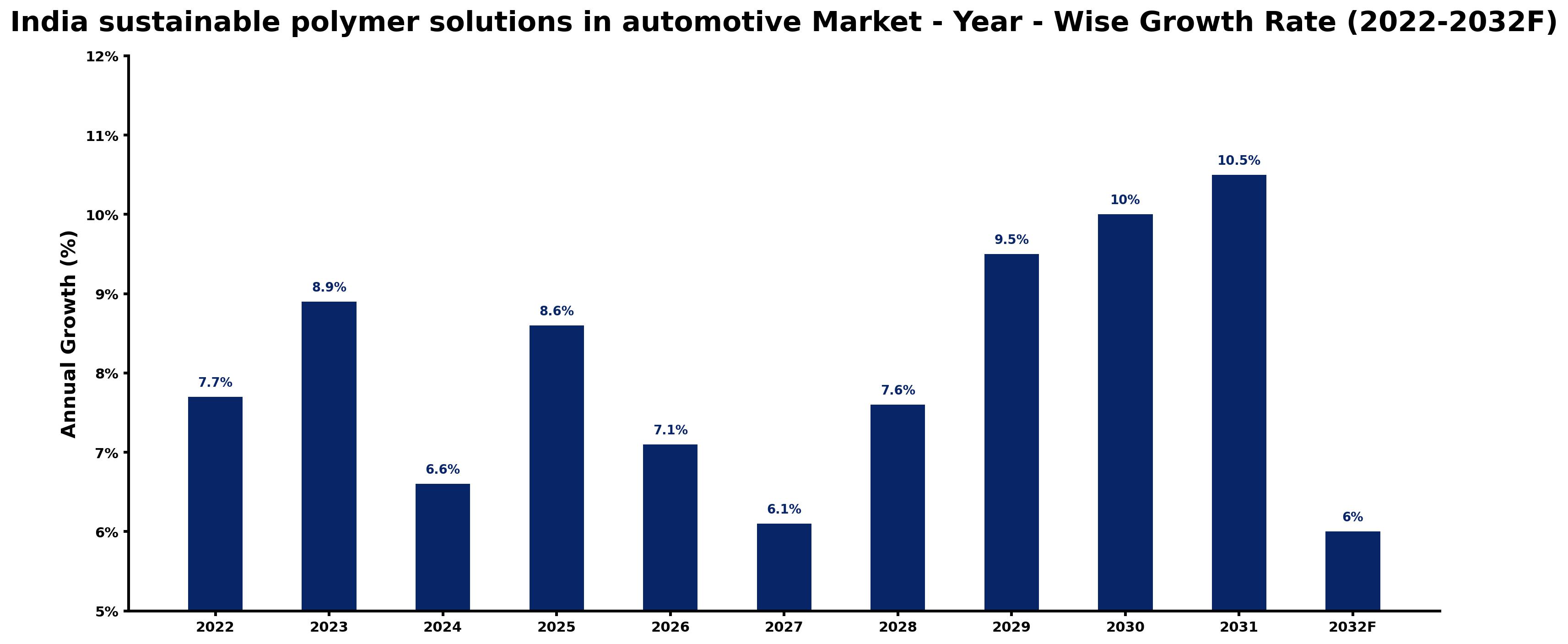
Year by year, the estimates below pair each growth rate with the development that shaped it.
| Year | Estimated Annual Growth (%) | Market Rationale |
| 2022 | 7.7 | The automotive sector experienced steady demand for sustainable materials amid rising environmental awareness. |
| 2023 | 8.9 | Growth accelerated due to increased production of electric vehicles and supportive government initiatives. |
| 2024 | 6.6 | Demand growth slowed as manufacturers adjusted to new material standards and production processes. |
| 2025 | 8.6 | The market rebounded with renewed investments in lightweight materials and sustainability practices. |
| 2026 | 7.1 | Growth decelerated as manufacturers faced challenges in sourcing sustainable feedstocks. |
| 2027 | 6.1 | Demand continued to slow as the market adjusted to evolving consumer preferences. |
| 2028 | 7.6 | A resurgence in demand was driven by innovations in sustainable polymer applications. |
| 2029 | 9.5 | Growth accelerated again as electric vehicle adoption surged and sustainability became a priority. |
| 2030 | 10.0 | The market expanded further with increased investments in sustainable technologies and infrastructure. |
| 2031 | 10.5 | Peak growth was achieved as manufacturers fully embraced sustainable practices in production. |
| 2032 | 6.0 | Growth is expected to slow as the market matures and competition increases. |
Note: Market size estimations and growth projections presented in this report are based on 6Wresearch's proprietary forecasting methodology, utilizing the latest available industry data, government publications, and primary research inputs.
India sustainable polymer solutions in automotive Market Synopsis
Sustainable polymer solutions in the automotive market in India encompass eco-friendly materials sourced from renewable resources or recycled plastics. These polymers are manufactured through processes that reduce environmental impact and are utilised in lightweight components to improve fuel efficiency. The market is expanding due to growing domestic demand, fuelled by heightened environmental awareness and government initiatives that advocate for sustainability. The automotive sector plays a crucial role in the nation's GDP, with increasing investments directed towards sustainable technologies. As the industry progresses, the uptake of sustainable materials is set to rise, presenting new opportunities for manufacturers and suppliers.
Market Dynamics Impact Analysis (2026–2032)
| Factor | Type | Impact | Primary Segment Affected |
| Growing demand for lightweight materials to enhance fuel efficiency | Driver | High | Under-the-Hood Parts |
| Increased adoption of electric vehicles requiring sustainable materials | Driver | High | Car Manufacturers |
| Rising investments in sustainable technologies by automotive manufacturers | Opportunity | High | Tier 1 Suppliers |
| Government initiatives supporting the use of sustainable materials in production | Opportunity | High | Car Manufacturers |
| Challenges in sourcing sustainable feedstocks for production | Restraint | Medium | Recycled Polypropylene |
| High costs associated with the development of new sustainable materials | Restraint | Medium | Bio-Polyamide |
| Supply chain disruptions affecting material availability | Challenge | High | Thermoplastic Elastomers |
| Competition from traditional materials limiting market penetration | Challenge | Medium | PLA Composites |
Evaluation of Drivers in India sustainable polymer solutions in automotive Market (2026–2032)
Key forces behind demand, with the segment each one moves most, are listed below.
| Drivers | Primary Segment Affected | Why It Matters (Evidence) |
| Increased production of electric vehicles | Recycled Polypropylene | This drives demand for sustainable materials, with 1.5 million electric vehicles produced in 2022. |
| Government initiatives promoting sustainability | Bio-Polyamide | Updated guidelines from the Bureau of Indian Standards support the use of sustainable materials in automotive production. |
| Growing environmental awareness among consumers | Thermoplastic Elastomers | This leads to higher demand for eco-friendly automotive components, particularly in interior trims. |
| Investment in lightweight materials for fuel efficiency | Under-the-Hood Parts | The automotive lightweighting market is projected to reach $20 billion by 2025, prompting manufacturers to invest. |
| Research and development in sustainable materials | Post-Consumer Plastics | Supported by the Ministry of Heavy Industries, improving recycling practices and driving demand. |
The sustainable polymer solutions in automotive market in India is growing on the back of increasing production of electric vehicles, government initiatives promoting sustainability, and rising environmental awareness among consumers. In 2022, India produced 1.5 million electric vehicles, driving demand for sustainable materials. Updated guidelines from the Bureau of Indian Standards support the use of bio-based and recycled materials in automotive manufacturing. The automotive lightweighting market is expected to reach $20 billion by 2025, prompting manufacturers to invest in lightweight components. The Ministry of Heavy Industries supports research into sustainable materials, improving recycling practices and increasing demand for eco-friendly alternatives.
Evaluation of Restraints in India sustainable polymer solutions in automotive Market
The main factors holding the market back are set out below.
| Market Restraint | Primary Segment Affected | Why It Matters (Evidence) |
| Challenges in sourcing sustainable feedstocks | Recycled Polypropylene | This limits production capabilities, as manufacturers struggle to find reliable sources, impacting output by approximately 15%. |
| High costs associated with developing new sustainable materials | Bio-Polyamide | This impacts profitability, making it difficult for smaller manufacturers to compete effectively. |
| Supply chain disruptions affecting material availability | Thermoplastic Elastomers | These disruptions delay production schedules, impacting delivery times for automotive manufacturers and increasing lead times by up to 20%. |
| Competition from traditional materials limiting market penetration | PLA Composites | This makes it challenging for sustainable alternatives to gain market share, hindering growth opportunities. |
| Regulatory challenges in material certification | Post-Consumer Plastics | This complicates the approval process, delaying product launches and increasing time to market by several months. |
India sustainable polymer solutions in automotive Market Challenges
Buyers in the sustainable polymer solutions in the automotive market in India face high costs due to limited access to eco-friendly materials, inflating production expenses by up to 15%. Suppliers encounter inefficiencies from outdated technology, which delays production and disrupts buyers' project schedules. Increased competition from traditional materials leads to aggressive pricing strategies, forcing producers to reduce profit margins while transitioning to sustainable alternatives. Supply chain disruptions arise from a heavy reliance on imported raw materials, resulting in shortages and extended lead times for manufacturers, complicating their ability to fulfil growing orders.
Trends in the India sustainable polymer solutions in automotive Market
Buyers and suppliers in the India sustainable polymer solutions in automotive Market are adjusting to the following trends.
- Shift from Traditional to Sustainable Materials: The automotive industry is increasingly adopting sustainable materials to meet environmental standards. In 2023, the Bureau of Indian Standards updated guidelines for sustainable automotive materials, ensuring quality and performance standards are met.
- Emergence of Electric Vehicle Focused Materials: In 2023, the Indian government launched the National Electric Mobility Mission Plan, which aims to boost electric vehicle adoption. This initiative is expected to significantly increase the demand for lightweight materials.
- Transition to Lightweight Components: The automotive lightweighting market in India is anticipated to reach $20 billion by 2025. This shift is driven by the need to improve fuel efficiency and reduce emissions in vehicles.
- Growing Use of Recycled Materials: The use of recycled polypropylene in interior trims is becoming more prevalent, contributing to circular economy initiatives. This trend supports sustainability goals while promoting resource efficiency.
Investment Opportunities in the India sustainable polymer solutions in automotive Market
Several openings in the India sustainable polymer solutions in automotive Market merit attention from investors.
- Partnerships with Tier 1 Suppliers: Manufacturers should explore partnerships with Tier 1 suppliers to develop sustainable materials. The automotive industry is set to invest $8 billion in sustainable technologies by 2025.
- Investment in Research for Bio-Based Feedstocks: Investing in bio-based feedstocks, particularly castor oil, is essential for meeting sustainability goals. The National Policy on Biofuels promotes the use of bio-based materials in automotive applications.
- Approval Pathways for Sustainable Materials: With the updated guidelines from the Bureau of Indian Standards, manufacturers can seek certification for sustainable materials more easily. This opens up opportunities for new entrants in the market.
- Expansion into Electric Vehicle Manufacturing: As electric vehicle adoption increases, suppliers should focus on lightweight materials for EVs. The target of 1 million EV charging stations by 2030 will drive demand for such materials.
Government Initiatives in the India sustainable polymer solutions in automotive Market
The Faster Adoption and Manufacturing of Hybrid and Electric Vehicles (FAME) II scheme, launched by the Ministry of Heavy Industries in 2022, promotes electric vehicles and the use of sustainable materials in automotive production. This initiative builds on the National Electric Mobility Mission Plan, initiated in 2021, which aims to boost electric vehicle adoption and support sustainable practices in manufacturing. These measures collectively encourage manufacturers to invest in eco-friendly materials, ensuring compliance with evolving standards and increasing the market's sustainability.
The Automotive Research Association of India (ARAI) is instrumental in implementing these initiatives by developing standards for sustainable automotive materials. In 2023, ARAI was tasked with enhancing research and development in this area, ensuring that manufacturers can meet quality benchmarks. Additionally, the Ministry of Environment, Forest and Climate Change supports initiatives for sustainable materials in manufacturing, funding projects that focus on eco-friendly practices and technologies, with an allocation of ₹500 million for such initiatives.
Future Insight of the India sustainable polymer solutions in automotive Market
The outlook for sustainable polymer solutions in the automotive market in India by 2032 will be shaped by several transformative factors. The National Electric Mobility Mission Plan will drive electric vehicle adoption, creating a strong demand for lightweight components. By 2030, the establishment of 1 million EV charging stations will necessitate the integration of eco-friendly materials in vehicle design. The automotive industry is projected to invest $8 billion in sustainable technologies by 2025, fostering advancements in production processes and material innovation.
Market Segmentation Analysis
Each segment group is reviewed below, with the leader by share and the fastest grower by CAGR.
By Polymer Type – Bio-Polyamide Dominated, Recycled Polypropylene Expected to Grow Fastest
According to Sumit Sagar, AM at 6Wresearch, with a 42% revenue share in 2025, Bio-Polyamide was the largest polymer type category. Bio-polyamides dominate the market share because they are critical in producing lightweight automotive parts that significantly enhance fuel efficiency. Their widespread adoption is largely driven by manufacturers striving to meet the sustainability guidelines established by the Bureau of Indian Standards. The quickest growth will come from Recycled Polypropylene, forecast to expand at a CAGR of 9.5% between 2026 and 2032. The rapid growth of recycled polypropylene is propelled by its extensive application in various automotive components, which aligns with India's circular economy initiatives. As the automotive sector increasingly prioritises sustainability, this segment is poised for remarkable expansion. Suppliers must focus on developing sustainable polymer solutions to meet the growing demand from automotive manufacturers.
By Source Type – Castor Oil Dominated, Post-Consumer Plastics Expected to Grow Fastest
Castor Oil held a 48% share of the India sustainable polymer solutions in automotive Market by source type in 2025. Castor oil is the leading source type as it serves as a key feedstock for bio-based polymers, which are essential for sustainable automotive applications. Its use is supported by government policies promoting biofuels and sustainable practices in manufacturing. Post-Consumer Plastics are projected to grow fastest, at a CAGR of 10.2% during 2026–2032. Post-consumer plastics are experiencing the fastest growth due to their direct recycling for automotive components, which supports the industry's shift towards sustainability. This trend is driven by increasing environmental awareness among consumers and regulatory support. Buyers should consider sourcing materials from suppliers who utilise post-consumer plastics to align with sustainability goals and regulatory requirements.
By Component Application – Under-the-Hood Parts Dominated, Interior Trims Expected to Grow Fastest
Under-the-Hood Parts took a 40% share of component application in 2025, more than any other category. Under-the-hood parts capture the largest market share due to their essential role in vehicle performance and efficiency, making them a primary focus for manufacturers committed to sustainability. The push for lightweight materials in these applications is reinforced by government initiatives promoting eco-friendly automotive solutions. Over 2026–2032, Interior Trims are expected to post the fastest growth, at a CAGR of 10.3%. Interior trims represent the fastest-growing application segment, driven by their significant contribution to vehicle aesthetics and functionality. As consumer preferences shift towards sustainable options, this segment is anticipated to experience rapid growth. Manufacturers should invest in sustainable materials for interior trims to align with consumer expectations and comply with environmental regulations.
By End User – Car Manufacturers Dominated, Tier 1 Suppliers Expected to Grow Fastest
Car Manufacturers accounted for a 43% market share by end user in 2025. Car manufacturers hold the largest market share as they are the primary users of sustainable polymers in vehicle production, reflecting the industry's commitment to eco-friendly practices. Their substantial investments in sustainable technologies underscore the increasing importance of these materials in automotive manufacturing. Tier 1 Suppliers are set to record the highest CAGR in this split, 10.4% over 2026–2032. Tier 1 suppliers are the fastest-growing end user segment, as they play a crucial role in supplying sustainable materials to OEMs for vehicle assembly. Their heightened involvement in sustainable practices is vital for meeting the demands of car manufacturers. Suppliers should strengthen collaborations with Tier 1 suppliers to ensure a consistent demand for sustainable polymer solutions in the automotive sector.
Key Attractiveness of the Report
- 10 Years of Market Numbers
- Historical Data Starting from 2022 to 2025
- Base Year 2025
- Forecast Data until 2032
- Key Performance Indicators Impacting the Market
- Major Upcoming Developments and Projects
Key Highlights of the Report:
- India sustainable polymer solutions in automotive Market Outlook
- Market Size of India sustainable polymer solutions in automotive Market, 2025
- Forecast of India sustainable polymer solutions in automotive Market, 2032
- Historical Data and Forecast of India sustainable polymer solutions in automotive Revenues & Volume for the Period 2022 - 2032F
- India sustainable polymer solutions in automotive Market Trend Evolution
- India sustainable polymer solutions in automotive Market Drivers and Challenges
- India sustainable polymer solutions in automotive Price Trends
- India sustainable polymer solutions in automotive Porter's Five Forces
- India sustainable polymer solutions in automotive Industry Life Cycle
- Historical Data and Forecast of India sustainable polymer solutions in automotive Market Revenues & Volume By Polymer Type for the Period 2022 - 2032F
- Historical Data and Forecast of India sustainable polymer solutions in automotive Market Revenues & Volume By Bio-Polyamide for the Period 2022 - 2032F
- Historical Data and Forecast of India sustainable polymer solutions in automotive Market Revenues & Volume By Recycled Polypropylene for the Period 2022 - 2032F
- Historical Data and Forecast of India sustainable polymer solutions in automotive Market Revenues & Volume By Thermoplastic Elastomers for the Period 2022 - 2032F
- Historical Data and Forecast of India sustainable polymer solutions in automotive Market Revenues & Volume By PLA Composites for the Period 2022 - 2032F
- Historical Data and Forecast of India sustainable polymer solutions in automotive Market Revenues & Volume By Source Type for the Period 2022 - 2032F
- Historical Data and Forecast of India sustainable polymer solutions in automotive Market Revenues & Volume By Castor Oil for the Period 2022 - 2032F
- Historical Data and Forecast of India sustainable polymer solutions in automotive Market Revenues & Volume By Post-Consumer Plastics for the Period 2022 - 2032F
- Historical Data and Forecast of India sustainable polymer solutions in automotive Market Revenues & Volume By Hybrid Recyclables for the Period 2022 - 2032F
- Historical Data and Forecast of India sustainable polymer solutions in automotive Market Revenues & Volume By Corn-Based Blends for the Period 2022 - 2032F
- Historical Data and Forecast of India sustainable polymer solutions in automotive Market Revenues & Volume By Component Application for the Period 2022 - 2032F
- Historical Data and Forecast of India sustainable polymer solutions in automotive Market Revenues & Volume By Under-the-Hood Parts for the Period 2022 - 2032F
- Historical Data and Forecast of India sustainable polymer solutions in automotive Market Revenues & Volume By Interior Trims for the Period 2022 - 2032F
- Historical Data and Forecast of India sustainable polymer solutions in automotive Market Revenues & Volume By Seals, Gaskets for the Period 2022 - 2032F
- Historical Data and Forecast of India sustainable polymer solutions in automotive Market Revenues & Volume By Dashboard Panels for the Period 2022 - 2032F
- Historical Data and Forecast of India sustainable polymer solutions in automotive Market Revenues & Volume By End User for the Period 2022 - 2032F
- Historical Data and Forecast of India sustainable polymer solutions in automotive Market Revenues & Volume By Car Manufacturers for the Period 2022 - 2032F
- Historical Data and Forecast of India sustainable polymer solutions in automotive Market Revenues & Volume By Tier 1 Suppliers for the Period 2022 - 2032F
- Historical Data and Forecast of India sustainable polymer solutions in automotive Market Revenues & Volume By EV OEMs for the Period 2022 - 2032F
- Historical Data and Forecast of India sustainable polymer solutions in automotive Market Revenues & Volume By Lightweight Vehicle OEMs for the Period 2022 - 2032F
- India sustainable polymer solutions in automotive Import Export Trade Statistics
- Market Opportunity Assessment By Polymer Type
- Market Opportunity Assessment By Source Type
- Market Opportunity Assessment By Component Application
- Market Opportunity Assessment By End User
- India sustainable polymer solutions in automotive Top Companies Market Share
- India sustainable polymer solutions in automotive Competitive Benchmarking By Technical and Operational Parameters
- India sustainable polymer solutions in automotive Company Profiles
- India sustainable polymer solutions in automotive Key Strategic Recommendations
Market Covered
This report examines the market across the segments below.
By Polymer Type
- Bio-Polyamide
- Recycled Polypropylene
- Thermoplastic Elastomers
- PLA Composites
By Source Type
- Castor Oil
- Post-Consumer Plastics
- Hybrid Recyclables
- Corn-Based Blends
By Component Application
- Under-the-Hood Parts
- Interior Trims
- Seals
- Gaskets
- Dashboard Panels
By End User
- Car Manufacturers
- Tier 1 Suppliers
- EV OEMs
- Lightweight Vehicle OEMs































