India Sustainable Propulsion Market Size & Growth Rate
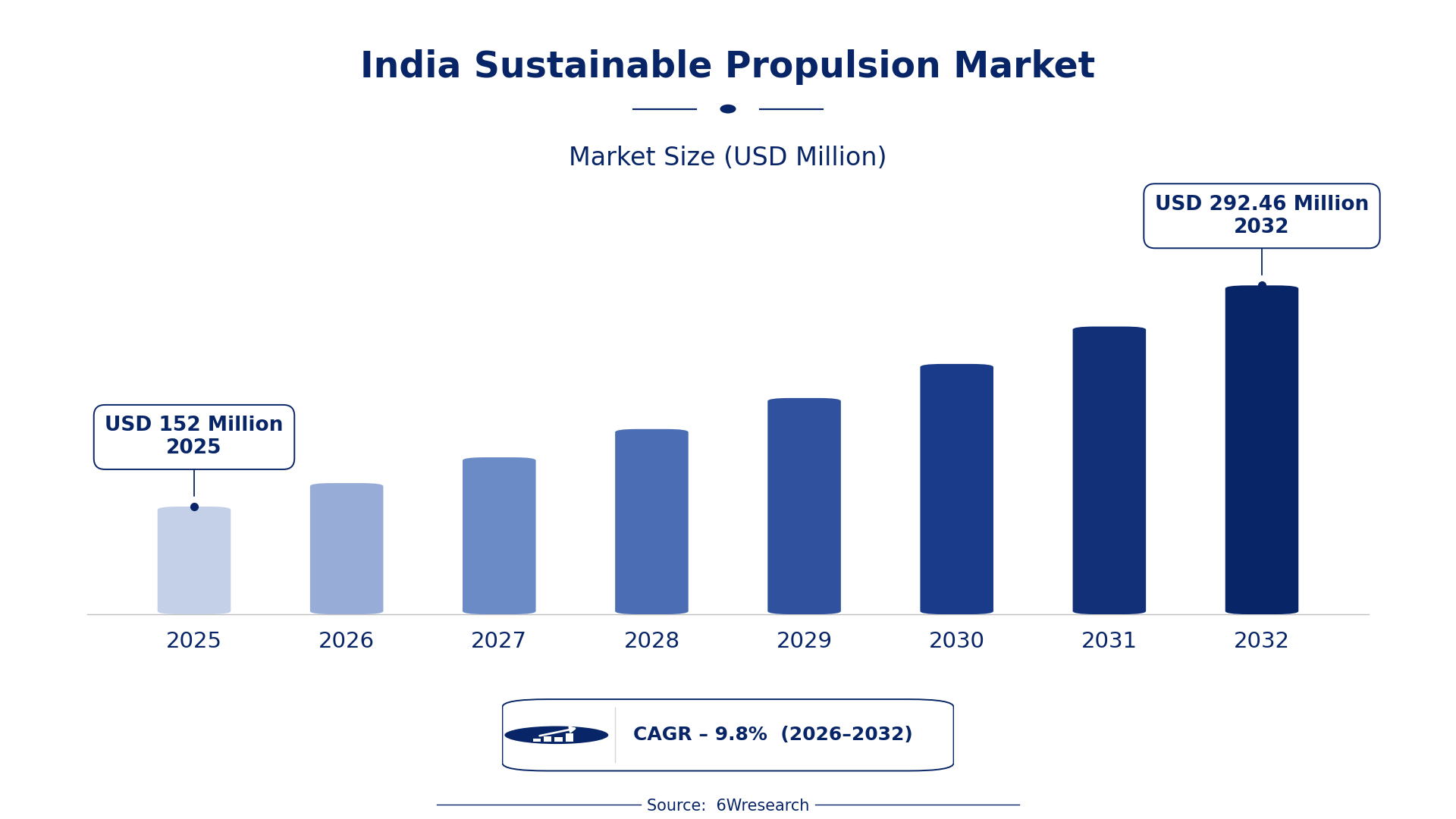
According to 6Wresearch internal database and industry insights, the India Sustainable Propulsion Market was valued at USD 152.0 million in 2025 and is projected to reach USD 292.46 million by 2032, growing at a CAGR of approximately 9.8% during 2026–2032.
India Sustainable Propulsion Market Highlights
| Report Metric | Details |
| Report Name | India Sustainable Propulsion Market |
| Market Size 2025 | USD 152.0 million |
| Market Size 2032 | USD 292.46 million |
| Absolute Growth 2025–2032 | USD 140.46 million |
| CAGR 2026–2032 | 9.8% |
| Peak Annual Growth | 12.3% in 2032 |
| Forecast Period | 2026–2032 |
| Historical Data | 2022–2025 |
| Base Year | 2025 |
| Leading Propulsion Type, 2025 | Electric Drivetrain (41% share) |
| Leading Energy Source, 2025 | Lithium-ion Battery (48% share) |
| Leading Vehicle Segment, 2025 | Compact & Luxury EVs (46% share) |
| Leading End User, 2025 | Car OEMs (44% share) |
| Fastest-Growing Propulsion Type | Hydrogen Fuel Cell (11.1% CAGR) |
| Fastest-Growing Energy Source | Hydrogen Gas (12.6% CAGR) |
| Fastest-Growing Vehicle Segment | Commercial Buses (11.4% CAGR) |
| Fastest-Growing End User | Mobility Startups (12.1% CAGR) |
| Growing Sector | Electric Vehicles |
| Key End Users | Car OEMs, Fleet Operators, City Mobility Agencies, Mobility Startups |
India Sustainable Propulsion Market Year-wise Growth Rate and Key Drivers (2022–2032)
This graph illustrates the annual growth rates of the market from 2022 to 2032, highlighting a steady upward trajectory and projected market expansion over the forecast period.
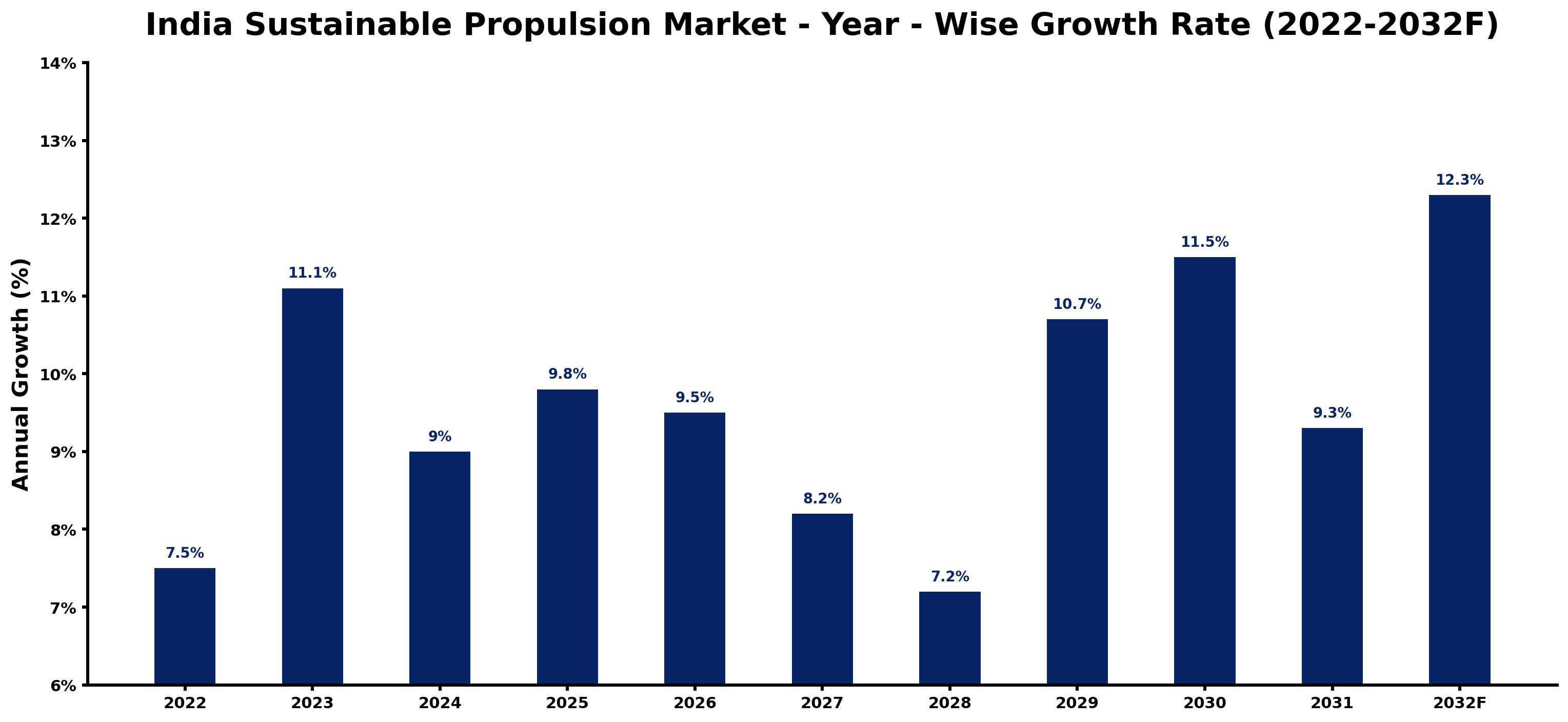
Each row of the following table gives one year's estimated growth and the event or demand shift that explains it.
| Year | Estimated Annual Growth (%) | Market Rationale |
| 2022 | 7.5 | The market experienced steady growth due to increasing consumer interest in sustainable transport solutions. |
| 2023 | 11.1 | The introduction of new government initiatives accelerated the adoption of electric vehicles across the country. |
| 2024 | 9.0 | Growth slowed as supply chain issues affected the availability of key components for electric vehicles. |
| 2025 | 9.8 | Increased investments in charging infrastructure boosted market performance and consumer confidence in electric mobility. |
| 2026 | 9.5 | Demand growth slowed as the market adjusted to the rapid expansion seen in previous years. |
| 2027 | 8.2 | The market continued to grow, albeit at a slower pace, as consumer preferences shifted towards hybrid vehicles. |
| 2028 | 7.2 | Market growth slowed further due to supply constraints in lithium-ion battery production. |
| 2029 | 10.7 | A resurgence in demand for electric vehicles led to a notable increase in market growth rates. |
| 2030 | 11.5 | The government's commitment to achieving 30% electric vehicle penetration by 2030 spurred further investment and interest. |
| 2031 | 9.3 | Market growth slowed as the industry faced challenges in scaling production to meet rising demand. |
| 2032 | 12.3 | The market is expected to peak as advancements in technology and infrastructure support sustainable propulsion. |
Note: Market size estimations and growth projections presented in this report are based on 6Wresearch's proprietary forecasting methodology, utilizing the latest available industry data, government publications, and primary research inputs.
India Sustainable Propulsion Market Synopsis
The Sustainable Propulsion Market in India encompasses technologies aimed at reducing environmental impact in transportation, focusing on electric drivetrains, hydrogen fuel cells, and hybrid systems. These innovations are crucial for improving energy efficiency and cutting greenhouse gas emissions. The market is expanding due to strong government initiatives, including the National Electric Mobility Mission Plan, which targets 30% electric vehicle penetration by 2030. Demand from car OEMs and fleet operators is also driving investments in electric and hybrid vehicles.
Market Dynamics Impact Analysis (2026–2032)
| Factor | Type | Impact | Primary Segment Affected |
| Government incentives for electric vehicles boost consumer adoption and infrastructure development. | Driver | High | Electric Drivetrain |
| Growing demand for public transport solutions drives the need for electric buses. | Driver | High | Commercial Buses |
| Investment in electric vehicle infrastructure is increasing, particularly in urban areas. | Opportunity | High | Light Urban Vehicles |
| The push for hydrogen fuel technology opens new avenues for innovation and investment. | Opportunity | Medium | Hydrogen Fuel Cell |
| Supply chain disruptions hinder the availability of critical components for electric vehicles. | Restraint | High | Lithium-ion Battery |
| High initial costs of electric vehicles can deter potential buyers from making purchases. | Restraint | Medium | Compact & Luxury EVs |
| Competition from traditional fuel vehicles remains a significant barrier to market growth. | Challenge | High | Hybrid Powertrains |
| Technological challenges in battery production may delay the rollout of electric vehicles. | Challenge | Medium | Electric Drivetrain |
Evaluation of Drivers in India Sustainable Propulsion Market (2026–2032)
The factors lifting demand, and the evidence behind each, are summarised below.
| Drivers | Primary Segment Affected | Why It Matters (Evidence) |
| Government incentives under the FAME II scheme promote electric vehicle sales. | Electric Drivetrain | The scheme's budget of ₹10,000 crore encourages buyers to invest in electric vehicles. |
| The National Electric Mobility Mission Plan aims for 30% electric vehicle penetration by 2030. | Lithium-ion Battery | This target drives demand for lithium-ion batteries as essential components for electric vehicles. |
| Increased investments in charging infrastructure support the growth of electric vehicles. | Commercial Buses | The expansion of electric bus fleets necessitates more charging stations. |
| Rising consumer awareness of environmental issues boosts demand for sustainable transport. | Compact & Luxury EVs | Consumers are increasingly seeking eco-friendly options, leading to higher sales of electric vehicles. |
| The National Hydrogen Mission promotes hydrogen fuel technology development. | Hydrogen Fuel Cell | This initiative encourages investment in hydrogen production and utilization, expanding market opportunities. |
The push for hydrogen fuel technology is creating new avenues for innovation and investment in this sector. Cities are investing in electric bus fleets, which increases demand for lithium-ion batteries. The growing focus on sustainability is leading consumers to seek more eco-friendly transport options, which is reflected in the rising sales of electric vehicles. With a target of 30% electric vehicle penetration by 2030, the market is poised for robust growth.
Evaluation of Restraints in India Sustainable Propulsion Market
The table below lists the restraints and the evidence behind each.
| Market Restraint | Primary Segment Affected | Why It Matters (Evidence) |
| Supply chain disruptions affect the availability of lithium-ion batteries. | Lithium-ion Battery | These disruptions have led to delays in production and increased costs for manufacturers. |
| High upfront costs of electric vehicles deter potential buyers. | Compact & Luxury EVs | Many consumers find electric vehicles less affordable compared to traditional options. |
| Limited charging infrastructure in rural areas restricts electric vehicle adoption. | Electric Drivetrain | Without adequate charging facilities, consumers are hesitant to switch to electric vehicles. |
| Competition from traditional fuel vehicles remains a barrier. | Hybrid Powertrains | Consumers often prefer familiar gasoline vehicles over newer electric or hybrid options. |
| Technological challenges in battery production may delay electric vehicle rollouts. | Hydrogen Fuel Cell | These challenges can increase production costs and limit availability. |
India Sustainable Propulsion Market Challenges
Producers in the India Sustainable Propulsion market face supply chain challenges due to limited local manufacturing of essential components, which can delay production timelines and increase costs by up to 20% for electric vehicle manufacturers. Importers encounter technological hurdles, as the reliance on foreign battery technology leads to longer lead times and potential stock shortages. Buyers experience frustration from inadequate charging infrastructure, which restricts electric vehicle adoption and limits consumer choices. The overall cost of sustainable propulsion technologies remains high, with government incentives only partially addressing the ₹10,000 crore budget needed to improve accessibility for buyers.
Trends in the India Sustainable Propulsion Market
Several trends are reshaping the India Sustainable Propulsion Market; the most important are set out below.
- Shift Towards Electric Buses: City Mobility Agencies are increasingly adopting electric buses to reduce emissions in urban transport. In Delhi, the electric bus fleet is expected to grow significantly, with plans for 1,000 new electric buses by 2025.
- Rising Adoption of Hydrogen Fuel Technology: The Indian government is promoting hydrogen fuel technology as a sustainable energy source. The National Hydrogen Mission aims to develop hydrogen production capabilities, targeting a 10% share in transportation by 2030.
- Increased Focus on Lithium-ion Battery Production: The lithium-ion battery market is experiencing growth, driven by EV demand. India aims to establish a domestic battery manufacturing capacity of 50 GWh by 2025, reducing dependence on imports.
- Expansion of Electric Vehicle Charging Infrastructure: The Ministry of Road Transport and Highways has introduced guidelines for EV charging infrastructure. By 2025, India plans to install 6,000 charging stations across major cities to support electric vehicle growth.
Investment Opportunities in the India Sustainable Propulsion Market
Below are the investment opportunities with the strongest case in the India Sustainable Propulsion Market.
- Investment in Charging Infrastructure: City Mobility Agencies are actively seeking to expand electric vehicle charging stations. With a projected need for 6,000 stations by 2025, local partnerships can facilitate rapid deployment.
- Growth in Hydrogen Fuel Applications: The National Hydrogen Mission creates opportunities for suppliers of hydrogen fuel technology. With a target of 10% market share in transportation by 2030, investment in production facilities is essential.
- Demand for Electric Buses: City Mobility Agencies are increasingly investing in electric buses for public transport. With the electric bus market expected to grow, suppliers can benefit from partnerships with local governments.
- Emerging Market for Compact EVs: Car OEMs are focusing on compact electric vehicles due to rising consumer demand. With a growing market share, suppliers can invest in production capabilities to meet this demand.
Government Initiatives in the India Sustainable Propulsion Market
The National Electric Mobility Mission Plan 2020, launched by the Ministry of Heavy Industries, aims to promote electric vehicle adoption with a budget of ₹10,000 crore. This initiative supports manufacturers and buyers by providing incentives that lower the cost of electric vehicles. The FAME II scheme, initiated in 2019, offers financial support for electric and hybrid vehicle purchases, facilitating infrastructure development and encouraging consumers to switch to sustainable options.
The Ministry of Heavy Industries oversees the implementation of electric vehicle policies, approving funding for various initiatives. The Automotive Research Association of India plays a role in developing standards for electric vehicles, ensuring safety and performance compliance. Furthermore, the Ministry of Road Transport and Highways has introduced guidelines for electric vehicle charging infrastructure, which supports the expansion of charging networks across the country. These measures improve the market environment for sustainable propulsion.
Future Insight of the India Sustainable Propulsion Market
By 2032, buyers and suppliers in the India Sustainable Propulsion market can expect a substantial rise in electric vehicle adoption, driven by the government's National Electric Mobility Mission Plan. The lithium-ion battery market will expand, supporting the growing demand for sustainable propulsion technologies and enhancing energy efficiency. The National Hydrogen Mission will promote cleaner transportation options, while the implementation of safety and performance standards by the Bureau of Indian Standards will ensure higher quality vehicles. These elements will create a more robust market environment.
Market Segmentation Analysis
The analysis below covers each segmentation, its leading category in 2025 and its fastest-growing category through 2032.
By Propulsion Type – Electric Drivetrain Dominated, Hydrogen Fuel Cell Expected to Grow Fastest
According to Sumit Sagar, AM at 6Wresearch, with a 41% revenue share in 2025, Electric Drivetrain was the largest propulsion type category. Electric drivetrains dominate the market share due to their essential role in powering electric vehicles, which are gaining traction in India. The government's commitment to electric mobility, highlighted by the National Electric Mobility Mission Plan, is driving significant growth in this sector. Hydrogen Fuel Cell is set to record the highest CAGR in this split, 11.1% over 2026–2032. Hydrogen fuel cells are experiencing rapid growth, primarily spurred by the National Hydrogen Mission, which promotes hydrogen technology for vehicles. This initiative is set to enhance the adoption of hydrogen-powered vehicles significantly in the coming years. Suppliers should focus on advancing electric drivetrain technologies while also considering hydrogen fuel cell innovations to stay competitive in the market.
By Energy Source – Lithium-ion Battery Dominated, Hydrogen Gas Expected to Grow Fastest
Lithium-ion Battery took a 48% share of energy source in 2025, more than any other category. Lithium-ion batteries dominate the market share as they are the main energy storage solution for electric vehicles, essential for their efficiency and performance. The expected growth in this segment aligns with the rising demand for electric vehicles across India. Hydrogen Gas are projected to grow fastest, at a CAGR of 12.6% during 2026–2032. Hydrogen gas is the fastest-growing energy source, mainly due to its application as fuel for hydrogen fuel cells, which are becoming more prevalent in transportation. Government initiatives promoting hydrogen technology are set to drive this growth further. Buyers should consider diversifying their energy sources by incorporating hydrogen gas solutions alongside lithium-ion batteries to maintain competitiveness.
By Vehicle Segment – Compact & Luxury EVs Dominated, Commercial Buses Expected to Grow Fastest
Compact & Luxury EVs accounted for a 46% market share by vehicle segment in 2025. Compact and luxury electric vehicles hold the largest market share, reflecting a strong consumer preference for these segments in India's automotive landscape. The increasing availability of electric models in these categories is attracting more buyers, further solidifying their position. The quickest growth will come from Commercial Buses, forecast to expand at a CAGR of 11.4% between 2026 and 2032. Commercial buses represent the fastest-growing segment, largely due to the deployment of electric bus fleets in various Indian cities. This shift towards electric public transport is supported by government initiatives that encourage the adoption of electric mobility solutions. Manufacturers should prioritise the development of commercial electric buses to cater to the increasing demand in public transport systems.
By End User – Car OEMs Dominated, Mobility Startups Expected to Grow Fastest
The largest end user category in 2025 was Car OEMs, with a 44% share of total revenue. Car OEMs command the largest market share as they are the primary manufacturers of vehicles, playing a crucial role in the adoption of sustainable propulsion technologies. Their ongoing commitment to producing electric vehicles is essential for the overall growth of the market. Over 2026–2032, Mobility Startups are expected to post the fastest growth, at a CAGR of 12.1%. Mobility startups are the fastest-growing end user, propelled by their focus on innovative urban transport solutions that leverage sustainable propulsion technologies. This trend is reshaping the transportation landscape in urban environments. Suppliers should actively engage with mobility startups to explore collaborative opportunities that align with the future of urban transportation.
Key Attractiveness of the Report
- 10 Years of Market Numbers
- Historical Data Starting from 2022 to 2025
- Base Year 2025
- Forecast Data until 2032
- Key Performance Indicators Impacting the Market
- Major Upcoming Developments and Projects
Key Highlights of the Report:
- India Sustainable Propulsion Market Outlook
- Market Size of India Sustainable Propulsion Market, 2025
- Forecast of India Sustainable Propulsion Market, 2032
- Historical Data and Forecast of India Sustainable Propulsion Revenues & Volume for the Period 2022 - 2032F
- India Sustainable Propulsion Market Trend Evolution
- India Sustainable Propulsion Market Drivers and Challenges
- India Sustainable Propulsion Price Trends
- India Sustainable Propulsion Porter's Five Forces
- India Sustainable Propulsion Industry Life Cycle
- Historical Data and Forecast of India Sustainable Propulsion Market Revenues & Volume By Propulsion Type for the Period 2022 - 2032F
- Historical Data and Forecast of India Sustainable Propulsion Market Revenues & Volume By Electric Drivetrain for the Period 2022 - 2032F
- Historical Data and Forecast of India Sustainable Propulsion Market Revenues & Volume By Hydrogen Fuel Cell for the Period 2022 - 2032F
- Historical Data and Forecast of India Sustainable Propulsion Market Revenues & Volume By Hybrid Powertrains for the Period 2022 - 2032F
- Historical Data and Forecast of India Sustainable Propulsion Market Revenues & Volume By Solar-Powered Motors for the Period 2022 - 2032F
- Historical Data and Forecast of India Sustainable Propulsion Market Revenues & Volume By Energy Source for the Period 2022 - 2032F
- Historical Data and Forecast of India Sustainable Propulsion Market Revenues & Volume By Lithium-ion Battery for the Period 2022 - 2032F
- Historical Data and Forecast of India Sustainable Propulsion Market Revenues & Volume By Hydrogen Gas for the Period 2022 - 2032F
- Historical Data and Forecast of India Sustainable Propulsion Market Revenues & Volume By Gasoline + Battery for the Period 2022 - 2032F
- Historical Data and Forecast of India Sustainable Propulsion Market Revenues & Volume By Photovoltaic Cells for the Period 2022 - 2032F
- Historical Data and Forecast of India Sustainable Propulsion Market Revenues & Volume By Vehicle Segment for the Period 2022 - 2032F
- Historical Data and Forecast of India Sustainable Propulsion Market Revenues & Volume By Compact & Luxury EVs for the Period 2022 - 2032F
- Historical Data and Forecast of India Sustainable Propulsion Market Revenues & Volume By Commercial Buses for the Period 2022 - 2032F
- Historical Data and Forecast of India Sustainable Propulsion Market Revenues & Volume By Plug-in Hybrids for the Period 2022 - 2032F
- Historical Data and Forecast of India Sustainable Propulsion Market Revenues & Volume By Light Urban Vehicles for the Period 2022 - 2032F
- Historical Data and Forecast of India Sustainable Propulsion Market Revenues & Volume By End User for the Period 2022 - 2032F
- Historical Data and Forecast of India Sustainable Propulsion Market Revenues & Volume By Car OEMs for the Period 2022 - 2032F
- Historical Data and Forecast of India Sustainable Propulsion Market Revenues & Volume By Fleet Operators for the Period 2022 - 2032F
- Historical Data and Forecast of India Sustainable Propulsion Market Revenues & Volume By City Mobility Agencies for the Period 2022 - 2032F
- Historical Data and Forecast of India Sustainable Propulsion Market Revenues & Volume By Mobility Startups for the Period 2022 - 2032F
- India Sustainable Propulsion Import Export Trade Statistics
- Market Opportunity Assessment By Propulsion Type
- Market Opportunity Assessment By Energy Source
- Market Opportunity Assessment By Vehicle Segment
- Market Opportunity Assessment By End User
- India Sustainable Propulsion Top Companies Market Share
- India Sustainable Propulsion Competitive Benchmarking By Technical and Operational Parameters
- India Sustainable Propulsion Company Profiles
- India Sustainable Propulsion Key Strategic Recommendations
Market Covered
This report examines the market across the segments below.
By Propulsion Type
- Electric Drivetrain
- Hydrogen Fuel Cell
- Hybrid Powertrains
- Solar-Powered Motors
By Energy Source
- Lithium-ion Battery
- Hydrogen Gas
- Gasoline + Battery
- Photovoltaic Cells
By Vehicle Segment
- Compact & Luxury EVs
- Commercial Buses
- Plug-in Hybrids
- Light Urban Vehicles
By End User
- Car OEMs
- Fleet Operators
- City Mobility Agencies
- Mobility Startups































