India Sustainable Protein Market Size & Growth Rate
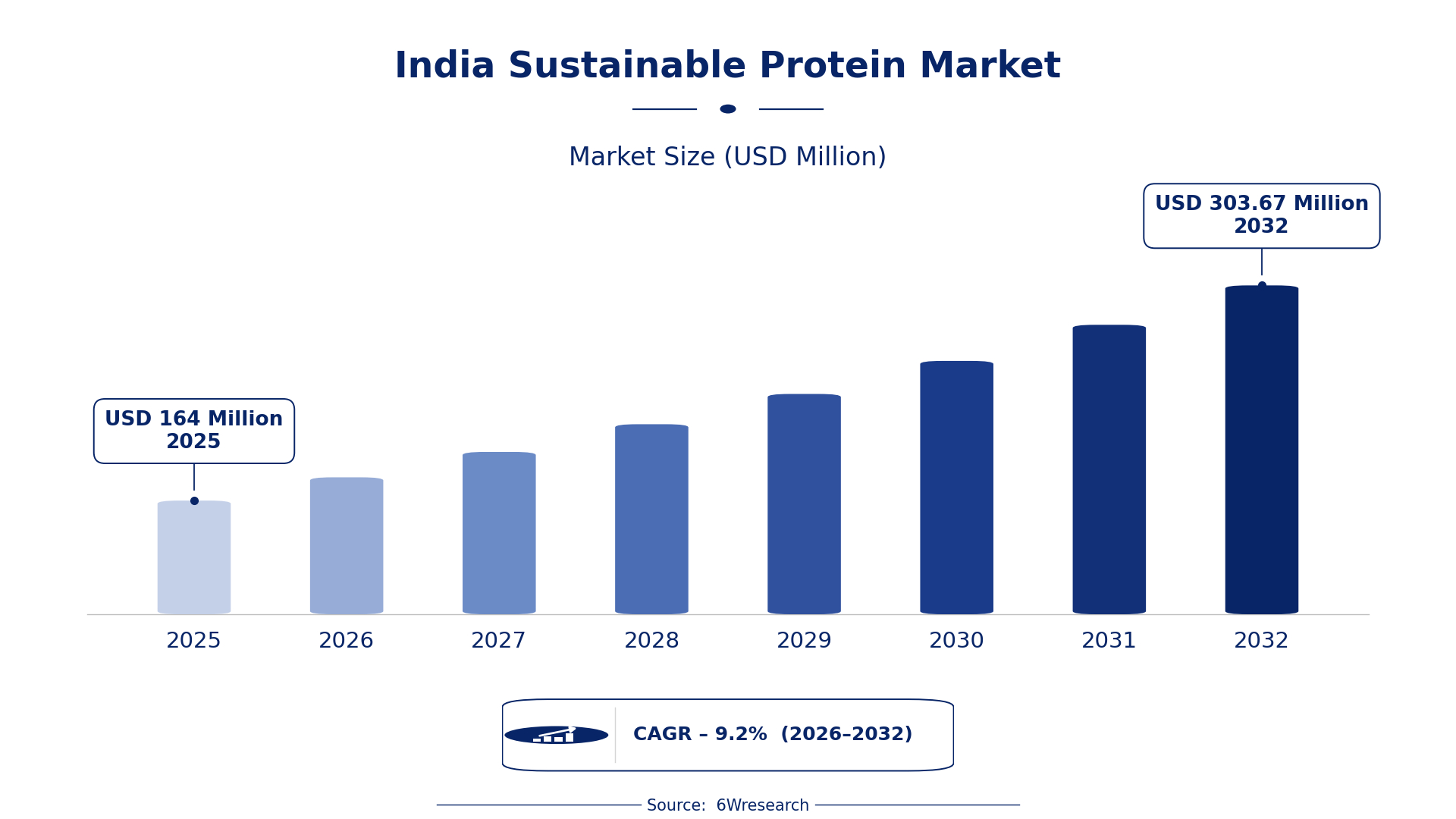
According to 6Wresearch internal database and industry insights, the India Sustainable Protein Market was valued at USD 164.0 million in 2025 and is projected to reach USD 303.67 million by 2032, growing at a CAGR of approximately 9.2% during 2026–2032.
India Sustainable Protein Market Highlights
| Report Metric | Details |
| Report Name | India Sustainable Protein Market |
| Market Size 2025 | USD 164.0 million |
| Market Size 2032 | USD 303.67 million |
| Absolute Growth 2025–2032 | USD 139.67 million |
| CAGR 2026–2032 | 9.2% |
| Peak Annual Growth | 11.0% in 2027 |
| Forecast Period | 2026–2032 |
| Historical Data | 2022–2025 |
| Base Year | 2025 |
| Leading Protein Type, 2025 | Plant-Based Proteins (47% share) |
| Leading Source Material, 2025 | Soy (32% share) |
| Leading Application Sector, 2025 | Meat Alternatives (41% share) |
| Leading End User, 2025 | Food Tech Companies (45% share) |
| Fastest-Growing Protein Type | Insect-Based Proteins (10.5% CAGR) |
| Fastest-Growing Source Material | Crickets/Black Soldier Fly (11.8% CAGR) |
| Fastest-Growing Application Sector | Nutraceuticals (11.7% CAGR) |
| Fastest-Growing End User | Clean Meat Startups (10.3% CAGR) |
| Growing Sector | Nutraceuticals |
| Key End Users | Meat Alternatives, Nutraceuticals, Pet & Animal Feed, Alternative Meats |
India Sustainable Protein Market Year-wise Growth Rate and Key Drivers (2022–2032)
This graph illustrates the annual growth rates of the market from 2022 to 2032, highlighting a steady upward trajectory and projected market expansion over the forecast period.
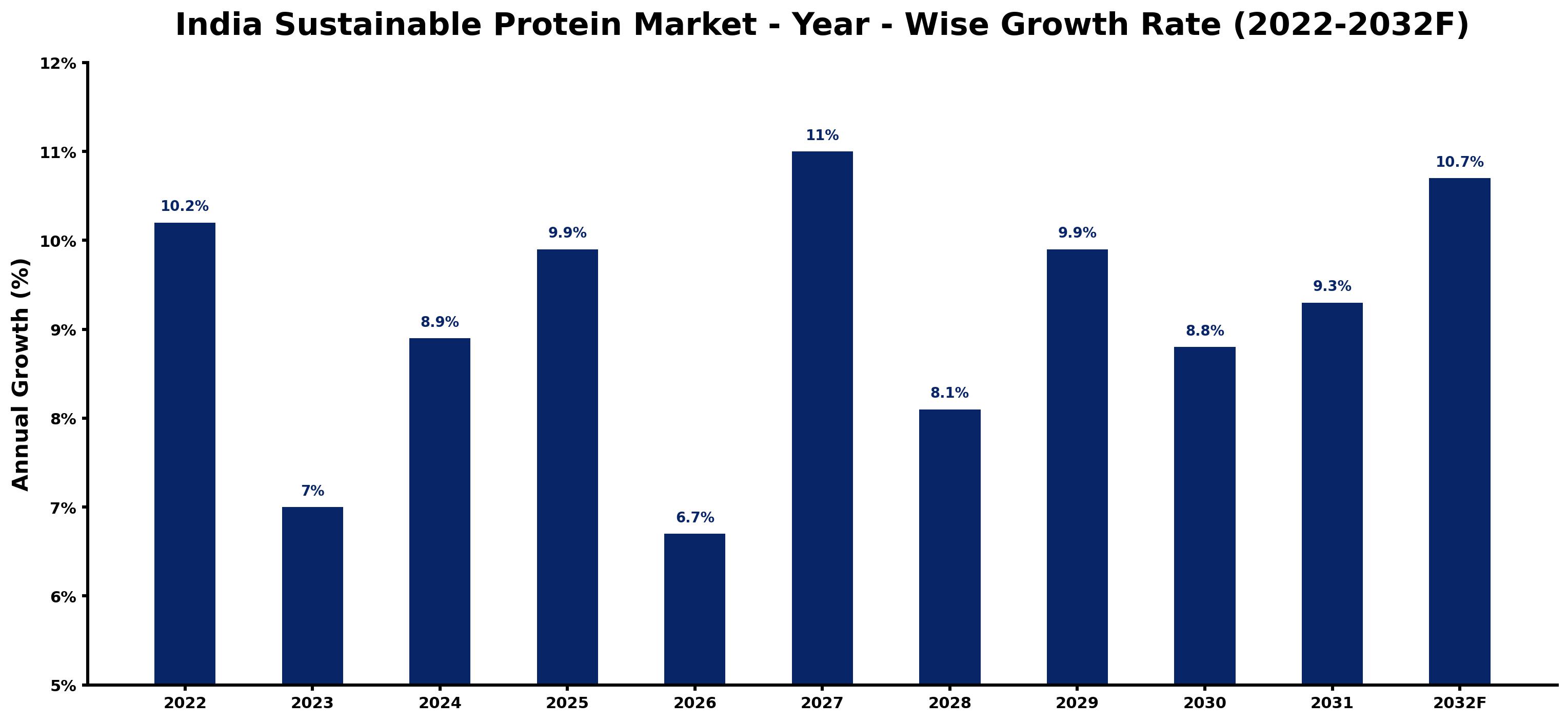
Annual growth estimates for each year appear below with the principal reason behind them, explaining the shifts that set the pace of the market.
| Year | Estimated Annual Growth (%) | Market Rationale |
| 2022 | 10.2 | The market showed strong demand for sustainable protein due to rising health consciousness. |
| 2023 | 7.0 | Consumer awareness stabilised as the 'Atmanirbhar Bharat' initiative began to influence purchasing patterns. |
| 2024 | 8.9 | Food tech companies expanded their product lines with sustainable options, boosting demand. |
| 2025 | 9.9 | Urban consumers drove faster growth, seeking meat alternatives and healthier choices. |
| 2026 | 6.7 | Regulatory adjustments are expected to slow growth as the market adapts to new standards. |
| 2027 | 11.0 | A surge in interest for sustainable protein will lead to peak growth driven by innovation. |
| 2028 | 8.1 | Market maturity is projected to slow growth, but interest in sustainable options persists. |
| 2029 | 9.9 | Urban populations are expected to increase demand for diverse protein sources. |
| 2030 | 8.8 | Market stabilisation will slow growth slightly, but interest in alternatives remains strong. |
| 2031 | 9.3 | A renewed focus on health and sustainability will drive faster growth in the sector. |
| 2032 | 10.7 | Sustainable protein demand is projected to rise as consumer preferences shift towards environmental concerns. |
Note: Market size estimations and growth projections presented in this report are based on 6Wresearch's proprietary forecasting methodology, utilizing the latest available industry data, government publications, and primary research inputs.
India Sustainable Protein Market Synopsis
Sustainable Protein in India encompasses protein sources that have a lower environmental impact compared to traditional animal proteins. These proteins originate from plants, insects, algae, and lab-grown cells, and are incorporated into food products, animal feed, and supplements. The India Sustainable Protein Market is expanding, fuelled by a population exceeding 1.4 billion and a growing health consciousness among consumers. Key buyer groups include food tech companies and wellness brands that are broadening their product lines to satisfy increasing demand.
Market Dynamics Impact Analysis (2026–2032)
| Factor | Type | Impact | Primary Segment Affected |
| Growing urban population increasing demand for meat alternatives | Driver | High | Meat Alternatives |
| Rising interest in insect-based proteins for animal feed | Driver | High | Insect-Based Proteins |
| Expanding market for clean meat technologies | Opportunity | Medium | Cultivated Meat |
| Increasing investment in food tech innovation | Opportunity | Medium | Food Tech Companies |
| Regulatory challenges in lab-grown meat approval processes | Restraint | High | Cultivated Meat |
| Limited consumer awareness of insect-based proteins | Restraint | Medium | Insect-Based Proteins |
| Sustainable Protein Market in India faces practical problems | Challenge | High | Plant-Based Proteins |
| High production costs for lab-grown proteins hinder market growth | Challenge | Medium | Cultivated Meat |
Evaluation of Drivers in India Sustainable Protein Market (2026–2032)
Below mentioned are some major drivers and their influence on market dynamics.
| Drivers | Primary Segment Affected | Why It Matters (Evidence) |
| Increasing health consciousness among consumers | Plant-Based Proteins | This trend leads to higher purchases of plant-based products, with the market projected to grow by 10% annually. |
| Urbanisation driving demand for meat alternatives | Meat Alternatives | Urban consumers are increasingly seeking sustainable options, pushing the market towards growth, projected at 9%. |
| Rising interest in alternative proteins for animal feed | Insect-Based Proteins | Feed manufacturers are adopting these proteins, enhancing the supply chain for sustainable sources, with a growth rate of 10%. |
| Government initiatives promoting local production | Plant-Based Proteins | The 'Atmanirbhar Bharat' initiative boosts local sustainable protein production, increasing availability and projected to grow by 9%. |
| Technological advancements in food processing | Clean Meat Startups | Innovations in lab-grown meat technologies are attracting investments and expanding market potential, with growth expected at 10%. |
The Indian population exceeds 1.4 billion, driving demand for sustainable protein sources. The plant-based protein market is expanding as urban consumers seek meat alternatives, with a projected annual growth rate of 10%. Technological advancements in food processing are attracting investments, further expanding market potential, with growth expected at 10%.
Evaluation of Restraints in India Sustainable Protein Market
The main factors holding the market back are set out below.
| Market Restraint | Primary Segment Affected | Why It Matters (Evidence) |
| Regulatory hurdles in lab-grown meat production | Cultivated Meat | Approval processes for lab-grown proteins are lengthy, delaying market entry and affecting suppliers, with potential delays of up to six months. |
| Consumer scepticism towards insect-based proteins | Insect-Based Proteins | Limited awareness and acceptance hinder the growth of insect-based protein products in the market, affecting sales by approximately 15%. |
| High production costs for sustainable protein sources | Plant-Based Proteins | Costs associated with production limit affordability for consumers, impacting purchasing decisions by around 20%. |
| Inconsistent supply chains for alternative proteins | Plant-Based Proteins | Supply chain disruptions can lead to shortages, affecting availability for food tech companies, potentially reducing market supply by 10%. |
| Limited research on long-term effects of alternative proteins | Nutraceuticals | Insufficient studies on health impacts may deter consumers from adopting these products, limiting market growth by 5%. |
India Sustainable Protein Market Challenges
The India Sustainable Protein Market encounters several practical issues, with regulatory compliance being a primary concern. The Food Safety and Standards Authority of India enforces strict regulations that can delay product launches by up to six months, affecting producers aiming to introduce new offerings. A skills gap exists, as many workers lack expertise in sustainable protein technologies, which can hinder production rates for suppliers. Technological limitations also present challenges; many producers struggle with outdated equipment, leading to inefficiencies that can raise costs by 20%. Supply chain disruptions may arise due to reliance on specific raw materials, causing delays in delivery and impacting buyers' ability to meet consumer interest in sustainable protein alternatives.
Trends in the India Sustainable Protein Market
The trends below show where the India Sustainable Protein Market is heading.
- Shift from Animal to Plant-Based Proteins: Since 2022, there has been a notable shift towards plant-based proteins in India, as health trends influence consumer choices. The plant-based protein market is projected to grow by 10% annually, with urban consumers increasingly seeking meat alternatives.
- Emergence of Insect-Based Proteins: In recent years, insect-based proteins have gained traction as an alternative protein source. The Indian market for insect-based protein is expected to expand by 15%, reflecting rising interest in sustainable food options.
- Growth of Clean Meat Startups: Since 2023, clean meat startups have been emerging in India, focusing on lab-grown proteins. The state of Karnataka has seen a rise in these startups, reflecting growing consumer interest in sustainable protein sources, with a projected growth rate of 10%.
- Increased Focus on Nutraceuticals: From 2022 onwards, there has been an increased focus on nutraceuticals in India. The Indian nutraceutical market was valued at approximately $4 billion in 2022, indicating strong demand for health-oriented products, with growth expected at 11%.
Investment Opportunities in the India Sustainable Protein Market
Investors looking at the India Sustainable Protein Market should consider the following areas.
- Supply of Plant-Based Protein Products: With the plant-based protein market projected to grow significantly, food tech companies are seeking innovative products. The demand for alternatives is rising, particularly in urban areas where health consciousness is increasing.
- Investment in Clean Meat Technologies: Now is an opportune time to invest in clean meat technologies, as consumer interest in lab-grown proteins is growing. Clean meat startups in Karnataka are looking for partners to expand their offerings.
- Development of Insect-Based Protein Products: The insect-based protein market is expanding, driven by rising interest in alternative sources. Feed manufacturers are increasingly looking for suppliers of insect-based proteins to enhance their offerings.
- Expansion of Nutraceutical Offerings: With the nutraceutical market valued at approximately $4 billion, there is a significant opportunity to develop health-oriented products. Wellness brands are actively seeking innovative protein sources to meet consumer demand.
Government Initiatives in the India Sustainable Protein Market
The Food Safety and Standards Authority of India regulates sustainable protein products through updated guidelines established in 2022, enhancing safety standards for lab-grown meat production. The 'Atmanirbhar Bharat' initiative, launched in 2020, aims to boost local production of sustainable proteins, reducing import dependency and promoting self-sufficiency. The National Mission on Sustainable Agriculture, initiated in 2021, focuses on developing plant-based and alternative proteins, encouraging investment in sustainable practices. These measures support the growth of sustainable protein sources, ensuring compliance with safety and quality standards for producers and buyers alike.
The Ministry of Food Processing Industries oversees the implementation of various schemes, including funding for research and development in sustainable protein technologies. The Indian Council of Agricultural Research is actively promoting alternative protein sources for animal feed, enhancing food security and nutrition. With a budget of 500 million INR allocated in 2023 for insect-based protein research, the government is encouraging innovation in this sector. These agencies play a crucial role in approving projects and funding initiatives that advance sustainable protein production and application.
Future Insight of the India Sustainable Protein Market
By 2032, the India Sustainable Protein Market will experience significant changes as key initiatives reshape the landscape. The 'Atmanirbhar Bharat' initiative will enhance local production capabilities, enabling suppliers to reduce import reliance. Increased investment in research from the Indian Council of Agricultural Research will yield more efficient alternative protein sources, benefiting producers. The Indian nutraceutical market, valued at approximately $4 billion in 2022, is expected to expand as consumer interest in sustainable protein rises, creating new opportunities for buyers and suppliers alike. The growth of food tech companies in Maharashtra will drive innovation in product development.
Market Segmentation Analysis
The analysis below covers each segmentation, its leading category in 2025 and its fastest-growing category through 2032.
By Protein Type – Plant-Based Proteins Dominated, Insect-Based Proteins Expected to Grow Fastest
According to Sumit Sagar, AM at 6Wresearch, with a 47% revenue share in 2025, Plant-Based Proteins was the largest protein type category. Plant-based proteins dominate the market share due to their extensive application in food products, catering to India's large population that is increasingly health-conscious. For instance, soy protein is widely utilised across various food items, reinforcing this segment's leading position. Insect-Based Proteins are set to record the highest CAGR in this split, 10.5% over 2026–2032. Insect-based proteins are witnessing rapid growth, driven by their sustainability and nutritional benefits, with rising interest in products like cricket protein for both animal feed and human consumption. This segment's expansion is further fuelled by increasing consumer awareness of alternative protein sources. Suppliers should focus on developing innovative insect-based protein offerings to capture the growing market share.
By Source Material – Soy Dominated, Crickets/Black Soldier Fly Expected to Grow Fastest
Soy took a 32% share of source material in 2025, more than any other category. Soy is the predominant source of plant-based protein in India, extensively used in various food products, making it a staple for many consumers. Its established market presence ensures consistent demand from food manufacturers and health brands alike. Over 2026–2032, Crickets/Black Soldier Fly is expected to post the fastest growth, at a CAGR of 11.8%. Crickets and black soldier fly are emerging as fast-growing protein sources, particularly in animal feed and human food applications. Their low environmental impact and high nutritional value are attracting considerable interest from food tech companies. Buyers should explore diversifying their protein sources to include crickets and black soldier fly, aligning with evolving consumer preferences.
By Application Sector – Meat Alternatives Dominated, Nutraceuticals Expected to Grow Fastest
The largest application sector category in 2025 was Meat Alternatives, with a 41% share of total revenue. The meat alternatives sector leads the market share, spurred by a surge in consumer demand for plant-based options among urban dwellers seeking healthier dietary choices. This segment's prominence is underscored by the increasing popularity of meat alternatives as consumers become more aware of the environmental effects of traditional meat production. The quickest growth will come from Nutraceuticals, forecast to expand at a CAGR of 11.7% between 2026 and 2032. Nutraceuticals are rapidly gaining traction as consumers turn to health supplements and functional foods that incorporate sustainable protein sources, reflecting a broader trend towards health consciousness in India. This growth is propelled by the rising demand for products that support overall well-being. Suppliers should invest in research and development to create nutraceutical products that effectively utilise sustainable protein for health benefits.
By End User – Food Tech Companies Dominated, Clean Meat Startups Expected to Grow Fastest
Food Tech Companies held a 45% share of the India Sustainable Protein Market by end user in 2025. Food tech companies hold the largest market share as they are pivotal in developing sustainable protein products that align with consumer preferences for healthier options. Their innovative approaches resonate well with the increasing demand for plant-based alternatives, ensuring their leading position. Clean Meat Startups are projected to grow fastest, at a CAGR of 10.3% during 2026–2032. Clean meat startups are rapidly emerging as key players, focusing on lab-grown meat alternatives that appeal to consumers seeking sustainable and ethical food choices. This sector's growth is bolstered by heightened investment and interest in alternative protein technologies. Investors should consider supporting clean meat startups to capitalise on the expanding market for lab-grown protein alternatives.
Key Attractiveness of the Report
- 10 Years of Market Numbers
- Historical Data Starting from 2022 to 2025
- Base Year 2025
- Forecast Data until 2032
- Key Performance Indicators Impacting the Market
- Major Upcoming Developments and Projects
Key Highlights of the Report:
- India Sustainable Protein Market Outlook
- Market Size of India Sustainable Protein Market, 2025
- Forecast of India Sustainable Protein Market, 2032
- Historical Data and Forecast of India Sustainable Protein Revenues & Volume for the Period 2022 - 2032F
- India Sustainable Protein Market Trend Evolution
- India Sustainable Protein Market Drivers and Challenges
- India Sustainable Protein Price Trends
- India Sustainable Protein Porter's Five Forces
- India Sustainable Protein Industry Life Cycle
- Historical Data and Forecast of India Sustainable Protein Market Revenues & Volume By Protein Type for the Period 2022 - 2032F
- Historical Data and Forecast of India Sustainable Protein Market Revenues & Volume By Plant-Based Proteins for the Period 2022 - 2032F
- Historical Data and Forecast of India Sustainable Protein Market Revenues & Volume By Insect-Based Proteins for the Period 2022 - 2032F
- Historical Data and Forecast of India Sustainable Protein Market Revenues & Volume By Algae-Based Proteins for the Period 2022 - 2032F
- Historical Data and Forecast of India Sustainable Protein Market Revenues & Volume By Cultivated Meat for the Period 2022 - 2032F
- Historical Data and Forecast of India Sustainable Protein Market Revenues & Volume By Source Material for the Period 2022 - 2032F
- Historical Data and Forecast of India Sustainable Protein Market Revenues & Volume By Soy, Pea, Chickpea for the Period 2022 - 2032F
- Historical Data and Forecast of India Sustainable Protein Market Revenues & Volume By Crickets/Black Soldier Fly for the Period 2022 - 2032F
- Historical Data and Forecast of India Sustainable Protein Market Revenues & Volume By Spirulina/Chlorella for the Period 2022 - 2032F
- Historical Data and Forecast of India Sustainable Protein Market Revenues & Volume By Lab-Grown Animal Cells for the Period 2022 - 2032F
- Historical Data and Forecast of India Sustainable Protein Market Revenues & Volume By Application Sector for the Period 2022 - 2032F
- Historical Data and Forecast of India Sustainable Protein Market Revenues & Volume By Meat Alternatives for the Period 2022 - 2032F
- Historical Data and Forecast of India Sustainable Protein Market Revenues & Volume By Pet & Animal Feed for the Period 2022 - 2032F
- Historical Data and Forecast of India Sustainable Protein Market Revenues & Volume By Nutraceuticals for the Period 2022 - 2032F
- Historical Data and Forecast of India Sustainable Protein Market Revenues & Volume By Alternative Meats for the Period 2022 - 2032F
- Historical Data and Forecast of India Sustainable Protein Market Revenues & Volume By End User for the Period 2022 - 2032F
- Historical Data and Forecast of India Sustainable Protein Market Revenues & Volume By Food Tech Companies for the Period 2022 - 2032F
- Historical Data and Forecast of India Sustainable Protein Market Revenues & Volume By Feed Manufacturers for the Period 2022 - 2032F
- Historical Data and Forecast of India Sustainable Protein Market Revenues & Volume By Wellness Brands for the Period 2022 - 2032F
- Historical Data and Forecast of India Sustainable Protein Market Revenues & Volume By Clean Meat Startups for the Period 2022 - 2032F
- India Sustainable Protein Import Export Trade Statistics
- Market Opportunity Assessment By Protein Type
- Market Opportunity Assessment By Source Material
- Market Opportunity Assessment By Application Sector
- Market Opportunity Assessment By End User
- India Sustainable Protein Top Companies Market Share
- India Sustainable Protein Competitive Benchmarking By Technical and Operational Parameters
- India Sustainable Protein Company Profiles
- India Sustainable Protein Key Strategic Recommendations
Market Covered
The report offers an extensive study of the following market segments.
By Protein Type
- Plant-Based Proteins
- Insect-Based Proteins
- Algae-Based Proteins
- Cultivated Meat
By Source Material
- Soy
- Pea
- Chickpea
- Crickets/Black Soldier Fly
- Spirulina/Chlorella
- Lab-Grown Animal Cells
By Application Sector
- Meat Alternatives
- Pet & Animal Feed
- Nutraceuticals
- Alternative Meats
By End User
- Food Tech Companies
- Feed Manufacturers
- Wellness Brands
- Clean Meat Startups































