India Sustainable Tire Market Size & Growth Rate
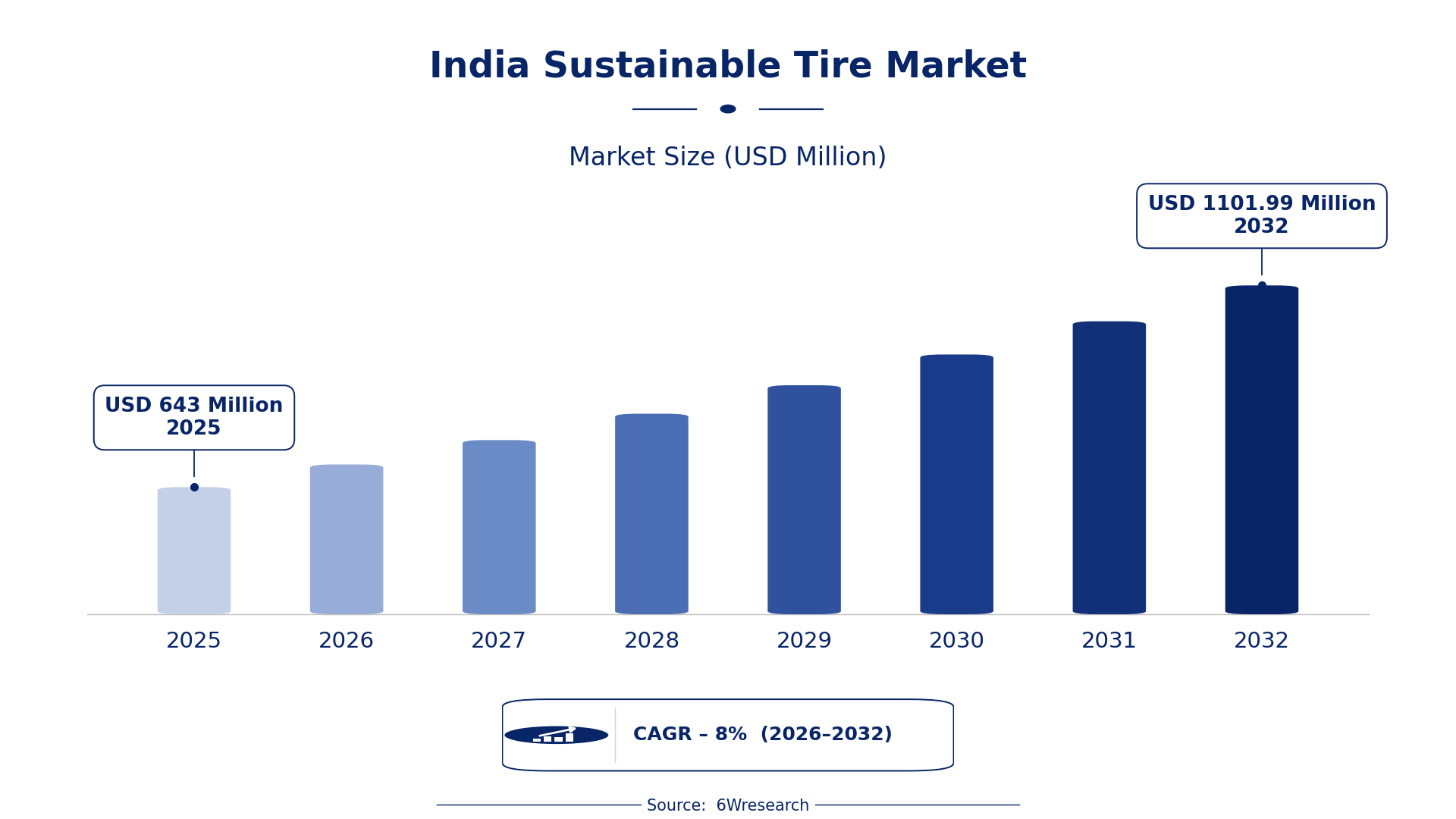
According to 6Wresearch internal database and industry insights, the India Sustainable Tire Market was valued at USD 643.0 million in 2025 and is projected to reach USD 1,101.99 million by 2032, growing at a CAGR of approximately 8% during 2026–2032.
India Sustainable Tire Market Highlights
| Report Metric | Details |
| Report Name | India Sustainable Tire Market |
| Market Size 2025 | USD 643.0 million |
| Market Size 2032 | USD 1,101.99 million |
| Absolute Growth 2025–2032 | USD 458.99 million |
| CAGR 2026–2032 | 8% |
| Peak Annual Growth | 9.9% in 2029 |
| Forecast Period | 2026–2032 |
| Historical Data | 2022–2025 |
| Base Year | 2025 |
| Leading Tire Type, 2025 | Bio-Based Tires (39% share) |
| Leading Sustainable Input, 2025 | Natural Rubber (35% share) |
| Leading Vehicle Segment, 2025 | Passenger Vehicles (44% share) |
| Leading End User, 2025 | Car Manufacturers (50% share) |
| Fastest-Growing Tire Type | Recycled Rubber Tires (9.1% CAGR) |
| Fastest-Growing Sustainable Input | Soy Oil (9.7% CAGR) |
| Fastest-Growing Vehicle Segment | Commercial Fleets (9.7% CAGR) |
| Fastest-Growing End User | Tire Retreading Firms (10.2% CAGR) |
| Growing Sector | Passenger Vehicles |
| Key End Users | Car Manufacturers, Tire Retreading Firms, Commercial Fleets, Transport Operators |
India Sustainable Tire Market Year-wise Growth Rate and Key Drivers (2022–2032)
This graph illustrates the annual growth rates of the market from 2022 to 2032, highlighting a steady upward trajectory and projected market expansion over the forecast period.
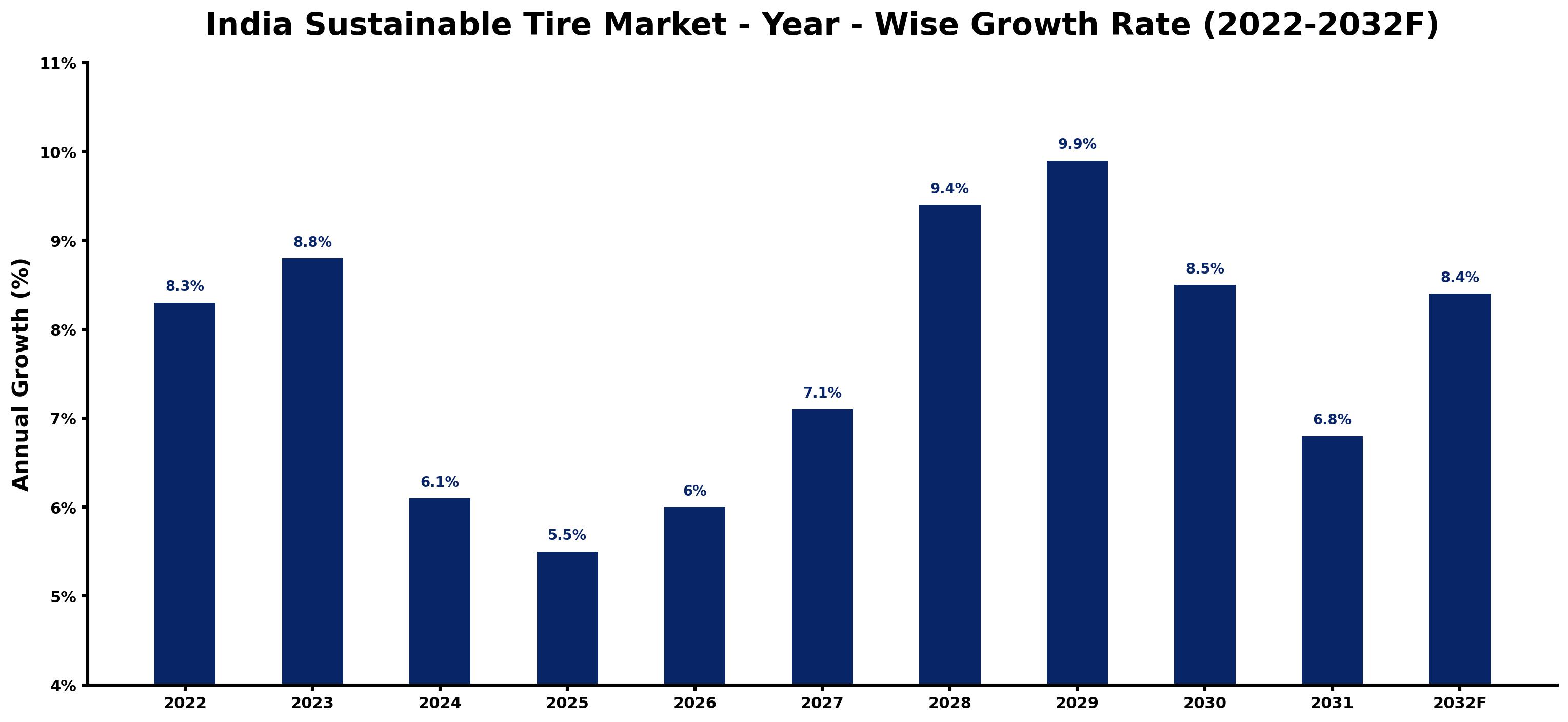
The table below sets out the estimated growth rate for each year and the main factor behind it.
| Year | Estimated Annual Growth (%) | Market Rationale |
| 2022 | 8.3 | The market experienced steady growth due to the implementation of the National Electric Mobility Mission Plan. |
| 2023 | 8.8 | Demand rose as the tire industry produced 190 million units, reflecting higher consumer awareness. |
| 2024 | 6.1 | Growth slowed as the adoption of sustainable materials faced production challenges from regulatory compliance. |
| 2025 | 5.5 | Market expansion continued, driven by the initiatives of the National Electric Mobility Mission Plan. |
| 2026 | 6.0 | Sustainable tire adoption increased as manufacturers complied with the updated IS 15780:2020 eco-friendly standards. |
| 2027 | 7.1 | Growth accelerated due to rising demand from commercial fleets focusing on operational efficiency. |
| 2028 | 9.4 | The market surged as consumer preference shifted towards low rolling resistance tires for better fuel economy. |
| 2029 | 9.9 | Peak growth occurred as the adoption of bio-based materials gained momentum among manufacturers. |
| 2030 | 8.5 | Growth decelerated as the market adjusted to supply chain constraints affecting raw material availability. |
| 2031 | 6.8 | Demand slowed due to increasing production costs impacting manufacturers' pricing strategies. |
| 2032 | 8.4 | The market is expected to grow as new eco-friendly technologies are introduced and adopted. |
Note: Market size estimations and growth projections presented in this report are based on 6Wresearch's proprietary forecasting methodology, utilizing the latest available industry data, government publications, and primary research inputs.
India Sustainable Tire Market Synopsis
The India Sustainable Tire Market includes eco-friendly tires crafted from bio-based and recycled materials, aimed at minimising environmental impact while maintaining performance. The market is set to grow as environmental regulations tighten and consumer awareness rises. Initiatives like the National Electric Mobility Mission Plan are accelerating the shift towards sustainable tire adoption, especially in electric vehicles. With the tire industry producing 190 million units in 2022, a clear movement towards sustainable manufacturing practices is underway. This trend is expected to drive the market to USD 1,101.99 million by 2032.
Market Dynamics Impact Analysis (2026–2032)
| Factor | Type | Impact | Primary Segment Affected |
| Increasing adoption of eco-friendly materials in tire production | Driver | High | Bio-Based Tires |
| Growing demand from commercial fleets for operational efficiency | Driver | High | Commercial Fleets |
| Rising consumer awareness of environmental issues | Opportunity | High | Passenger Vehicles |
| Expansion of tire retreading services using sustainable materials | Opportunity | Medium | Tire Retreading Firms |
| Production challenges in sourcing sustainable materials | Restraint | High | Recycled Rubber Tires |
| High costs associated with eco-friendly tire production | Restraint | Medium | Silica-Enhanced Tires |
| Supply chain disruptions affecting raw material availability | Challenge | High | Natural Rubber |
| Regulatory compliance costs for manufacturers | Challenge | Medium | Eco-Friendly Compounds |
Evaluation of Drivers in India Sustainable Tire Market (2026–2032)
The factors lifting demand, and the evidence behind each, are summarised below.
| Drivers | Primary Segment Affected | Why It Matters (Evidence) |
| Growing production of eco-friendly tires | Bio-Based Tires | Natural rubber accounts for 60% of tire production, driving demand for sustainable alternatives. |
| Increased focus on operational efficiency | Commercial Fleets | The average fuel efficiency improvement from low rolling resistance tires is 5-10%, prompting fleet upgrades. |
| Support from government initiatives | Passenger Vehicles | The National Electric Mobility Mission Plan encourages the adoption of sustainable tires in electric vehicles. |
| Rising consumer demand for eco-friendly products | Recycled Rubber Tires | The use of recycled rubber in tires can reduce waste by 30%, appealing to environmentally conscious buyers. |
| Technological advancements in tire manufacturing | Silica-Enhanced Tires | The Automotive Research Association of India promotes sustainable tire technologies, improving production capabilities. |
Market growth in India for Sustainable Tire rests on rising demand from car manufacturers, commercial fleets, and environmentally conscious consumers. The tire industry produced 190 million units in 2022, reflecting a shift towards sustainability. The average fuel efficiency improvement from low rolling resistance tires is 5-10%, encouraging fleet operators to adopt eco-friendly options. The use of recycled rubber can reduce waste by 30%, appealing to buyers focused on sustainability.
Evaluation of Restraints in India Sustainable Tire Market
The following restraints limit how fast demand can grow.
| Market Restraint | Primary Segment Affected | Why It Matters (Evidence) |
| Challenges in sourcing sustainable raw materials | Recycled Rubber Tires | Natural rubber accounts for 60% of tire production, limiting the availability of alternatives. |
| High production costs for eco-friendly tires | Silica-Enhanced Tires | Manufacturers face increased expenses in sourcing sustainable materials, affecting pricing. |
| Regulatory compliance costs for manufacturers | Eco-Friendly Compounds | The Bureau of Indian Standards has guidelines that add compliance costs for producers. |
| Supply chain disruptions impacting production timelines | Natural Rubber | Global supply chain issues have delayed the availability of necessary materials. |
| Limited awareness among consumers about sustainable options | Bio-Based Tires | Despite growing interest, many consumers remain unaware of the benefits of sustainable tires. |
India Sustainable Tire Market Challenges
Producers in the India Sustainable Tire Market contend with fierce competition from traditional tire manufacturers, which drives prices down and compresses profit margins. This competition arises from the stronghold of conventional tires, compelling producers to invest heavily in differentiation. Supply chain disruptions, particularly in sourcing eco-friendly materials, can extend production timelines by up to 20%, affecting delivery schedules for retailers. Skills shortages in sustainable manufacturing techniques further impede efficiency, potentially increasing production costs by around 15%, which ultimately leads to higher prices for consumers. Regulatory compliance with the Central Pollution Control Board's standards complicates matters, as delays in product approvals can inflate costs for producers and limit market access for newcomers.
Trends in the India Sustainable Tire Market
The trends below show where the India Sustainable Tire Market is heading.
- Update to Eco-Friendly Tire Standards: The Bureau of Indian Standards updated the IS 15780:2020 standard for eco-friendly tire materials, ensuring compliance for manufacturers. This change is projected to boost the adoption of sustainable materials in tire production, with a market share increase of 15%.
- Focus on Low Rolling Resistance Tires: Car manufacturers are increasingly focusing on low rolling resistance tires to improve fuel efficiency. The average fuel efficiency improvement from these tires is 5-10%, making them attractive to consumers seeking cost savings.
- Growth in Tire Retreading Services: Tire retreading firms are adopting sustainable materials to meet rising environmental standards. The tire retreading industry is valued at $1 billion as of 2023, indicating a substantial market opportunity for sustainable practices.
- Adoption of Bio-Based Materials in Manufacturing: The National Policy on Biofuels encourages the use of bio-based materials in tire manufacturing. This initiative aims to increase the share of bio-based inputs in production, targeting a 20% increase by 2025.
Investment Opportunities in the India Sustainable Tire Market
Investors looking at the India Sustainable Tire Market should consider the following areas.
- Car Manufacturers Seeking Sustainable Solutions: Car manufacturers are actively searching for sustainable tire options to satisfy consumer demand. The market for sustainable tires is projected to reach USD 643.0 million by 2025, creating opportunities for suppliers.
- Establishing Partnerships for Sustainable Production: Forming partnerships with local manufacturers can ease entry into the sustainable tire market. The National Automotive Testing and R&D Infrastructure Project encourages collaborations to enhance production capabilities.
- Rising Demand for Eco-Friendly Compounds: The demand for eco-friendly compounds in tires is on the rise, with a projected increase of 25% by 2025. Suppliers can take advantage of this trend by providing materials that comply with regulatory standards.
- Investment in Tire Retreading Technologies: Tire retreading firms are increasingly utilising sustainable materials, generating demand for innovative solutions. The tire retreading industry is valued at $1 billion, presenting a significant opportunity for investment.
Government Initiatives in the India Sustainable Tire Market
The National Electric Mobility Mission Plan 2021 aims to promote electric vehicles and sustainable tire usage, strengthening the regulatory framework for manufacturers. This initiative encourages the adoption of eco-friendly practices, aligning with the Automotive Mission Plan 2026, which emphasises sustainability in the automotive sector. These measures support the transition towards greener tire production and usage, ensuring compliance with environmental standards.
The Automotive Research Association of India oversees the approval of eco-friendly tire materials, ensuring adherence to updated regulations. The Bureau of Indian Standards funds research into sustainable tire technologies, promoting innovation in the sector. Additionally, the Green Skill Development Programme launched in 2022 trains workers in sustainable production techniques, enhancing the workforce's capabilities in this growing market.
Future Insight of the India Sustainable Tire Market
The India Sustainable Tire Market is projected to evolve by 2032, driven by key advancements in technology and policy. The National Electric Mobility Mission Plan will accelerate the transition towards sustainable tires, particularly for electric vehicles, boosting overall market demand. By 2025, tire production is expected to reach 190 million units, reflecting a growing commitment to eco-friendly practices. The Automotive Research Association of India will spearhead innovations in sustainable tire technologies, improving performance and reducing environmental impact. Increased consumer awareness of eco-friendly products will drive demand, prompting producers to refine their offerings.
Market Segmentation Analysis
The analysis below covers each segmentation, its leading category in 2025 and its fastest-growing category through 2032.
By Tire Type – Bio-Based Tires Dominated, Recycled Rubber Tires Expected to Grow Fastest
According to Sumit Sagar, AM at 6Wresearch, Bio-Based Tires took a 39% share of tire type in 2025, more than any other category. Bio-Based Tires hold the largest market share because they are integral to manufacturing processes aimed at reducing carbon footprints. The segment is bolstered by stringent standards set by the Ministry of Environment, which promote the use of eco-friendly materials in tire production. Recycled Rubber Tires are projected to grow fastest, at a CAGR of 9.1% during 2026–2032. Recycled Rubber Tires are experiencing rapid growth due to the increasing demand for sustainable production methods, with the capability to cut waste by 30%. This growth is fuelled by rising consumer awareness and various environmental initiatives throughout India. Suppliers should concentrate on expanding their product lines with bio-based and recycled materials to align with the growing market demands.
By Sustainable Input – Natural Rubber Dominated, Soy Oil Expected to Grow Fastest
Natural Rubber accounted for a 35% market share by sustainable input in 2025. Natural Rubber holds the largest market share as it serves as the primary raw material for tire production, constituting 60% of the industry. Its established supply chain and proven performance characteristics make it the preferred choice for manufacturers. The quickest growth will come from Soy Oil, forecast to expand at a CAGR of 9.7% between 2026 and 2032. Soy Oil is emerging as a rapidly growing input due to its effectiveness as an additive that improves tire performance. This trend reflects a broader movement towards integrating more sustainable materials in tire manufacturing processes. Buyers should seek suppliers that incorporate sustainable inputs like soy oil to ensure compliance with environmental standards.
By Vehicle Segment – Passenger Vehicles Dominated, Commercial Fleets Expected to Grow Fastest
The largest vehicle segment category in 2025 was Passenger Vehicles, with a 44% share of total revenue. Passenger Vehicles dominate the market share, accounting for 70% of tire demand in India, largely driven by consumer preference for sustainable options. This segment's expansion is further supported by increasing environmental regulations and a shift in consumer awareness towards eco-friendly products. Over 2026–2032, Commercial Fleets are expected to post the fastest growth, at a CAGR of 9.7%. Commercial Fleets represent the fastest-growing segment, as there is a heightened focus on operational efficiency and sustainability in fleet management. The transition to sustainable tires in this sector is anticipated to escalate as businesses aim to reduce their carbon footprints. Suppliers should aim to engage with commercial fleet operators to leverage the rising demand for sustainable tire solutions.
By End User – Car Manufacturers Dominated, Tire Retreading Firms Expected to Grow Fastest
With a 50% revenue share in 2025, Car Manufacturers was the largest end user category. Car Manufacturers are the leading buyers of sustainable tires, directly influencing the market share through their commitment to eco-friendly production practices. Their demand for sustainable options is driven by regulatory pressures and consumer preferences. Tire Retreading Firms are set to record the highest CAGR in this split, 10.2% over 2026–2032. Tire Retreading Firms are rapidly adopting sustainable materials for retreading, reflecting a growing trend towards sustainability in the tire lifecycle. This segment's growth is supported by the $1 billion industry value of tire retreading in India. Suppliers should develop partnerships with tire retreading firms to expand their market reach in sustainable tire solutions.
Key Attractiveness of the Report
- 10 Years of Market Numbers
- Historical Data Starting from 2022 to 2025
- Base Year 2025
- Forecast Data until 2032
- Key Performance Indicators Impacting the Market
- Major Upcoming Developments and Projects
Key Highlights of the Report:
- India Sustainable Tire Market Outlook
- Market Size of India Sustainable Tire Market, 2025
- Forecast of India Sustainable Tire Market, 2032
- Historical Data and Forecast of India Sustainable Tire Revenues & Volume for the Period 2022 - 2032F
- India Sustainable Tire Market Trend Evolution
- India Sustainable Tire Market Drivers and Challenges
- India Sustainable Tire Price Trends
- India Sustainable Tire Porter's Five Forces
- India Sustainable Tire Industry Life Cycle
- Historical Data and Forecast of India Sustainable Tire Market Revenues & Volume By Tire Type for the Period 2022 - 2032F
- Historical Data and Forecast of India Sustainable Tire Market Revenues & Volume By Bio-Based Tires for the Period 2022 - 2032F
- Historical Data and Forecast of India Sustainable Tire Market Revenues & Volume By Recycled Rubber Tires for the Period 2022 - 2032F
- Historical Data and Forecast of India Sustainable Tire Market Revenues & Volume By Silica-Enhanced Tires for the Period 2022 - 2032F
- Historical Data and Forecast of India Sustainable Tire Market Revenues & Volume By Low Rolling Resistance for the Period 2022 - 2032F
- Historical Data and Forecast of India Sustainable Tire Market Revenues & Volume By Sustainable Input for the Period 2022 - 2032F
- Historical Data and Forecast of India Sustainable Tire Market Revenues & Volume By Natural Rubber, Soy Oil for the Period 2022 - 2032F
- Historical Data and Forecast of India Sustainable Tire Market Revenues & Volume By Reclaimed Tire Material for the Period 2022 - 2032F
- Historical Data and Forecast of India Sustainable Tire Market Revenues & Volume By Rice Husk Silica for the Period 2022 - 2032F
- Historical Data and Forecast of India Sustainable Tire Market Revenues & Volume By Eco-Friendly Compounds for the Period 2022 - 2032F
- Historical Data and Forecast of India Sustainable Tire Market Revenues & Volume By Vehicle Segment for the Period 2022 - 2032F
- Historical Data and Forecast of India Sustainable Tire Market Revenues & Volume By Passenger Vehicles for the Period 2022 - 2032F
- Historical Data and Forecast of India Sustainable Tire Market Revenues & Volume By Commercial Fleets for the Period 2022 - 2032F
- Historical Data and Forecast of India Sustainable Tire Market Revenues & Volume By High-Performance Cars for the Period 2022 - 2032F
- Historical Data and Forecast of India Sustainable Tire Market Revenues & Volume By Fuel-Efficient Vehicles for the Period 2022 - 2032F
- Historical Data and Forecast of India Sustainable Tire Market Revenues & Volume By End User for the Period 2022 - 2032F
- Historical Data and Forecast of India Sustainable Tire Market Revenues & Volume By Car Manufacturers for the Period 2022 - 2032F
- Historical Data and Forecast of India Sustainable Tire Market Revenues & Volume By Tire Retreading Firms for the Period 2022 - 2032F
- Historical Data and Forecast of India Sustainable Tire Market Revenues & Volume By EV OEMs for the Period 2022 - 2032F
- Historical Data and Forecast of India Sustainable Tire Market Revenues & Volume By Transport Operators for the Period 2022 - 2032F
- India Sustainable Tire Import Export Trade Statistics
- Market Opportunity Assessment By Tire Type
- Market Opportunity Assessment By Sustainable Input
- Market Opportunity Assessment By Vehicle Segment
- Market Opportunity Assessment By End User
- India Sustainable Tire Top Companies Market Share
- India Sustainable Tire Competitive Benchmarking By Technical and Operational Parameters
- India Sustainable Tire Company Profiles
- India Sustainable Tire Key Strategic Recommendations
Market Covered
The report offers an extensive study of the following market segments.
By Tire Type
- Bio-Based Tires
- Recycled Rubber Tires
- Silica-Enhanced Tires
- Low Rolling Resistance
By Sustainable Input
- Natural Rubber
- Soy Oil
- Reclaimed Tire Material
- Rice Husk Silica
- Eco-Friendly Compounds
By Vehicle Segment
- Passenger Vehicles
- Commercial Fleets
- High-Performance Cars
- Fuel-Efficient Vehicles
By End User
- Car Manufacturers
- Tire Retreading Firms
- EV OEMs
- Transport Operators































