India Sustainable Transportation Market Size & Growth Rate
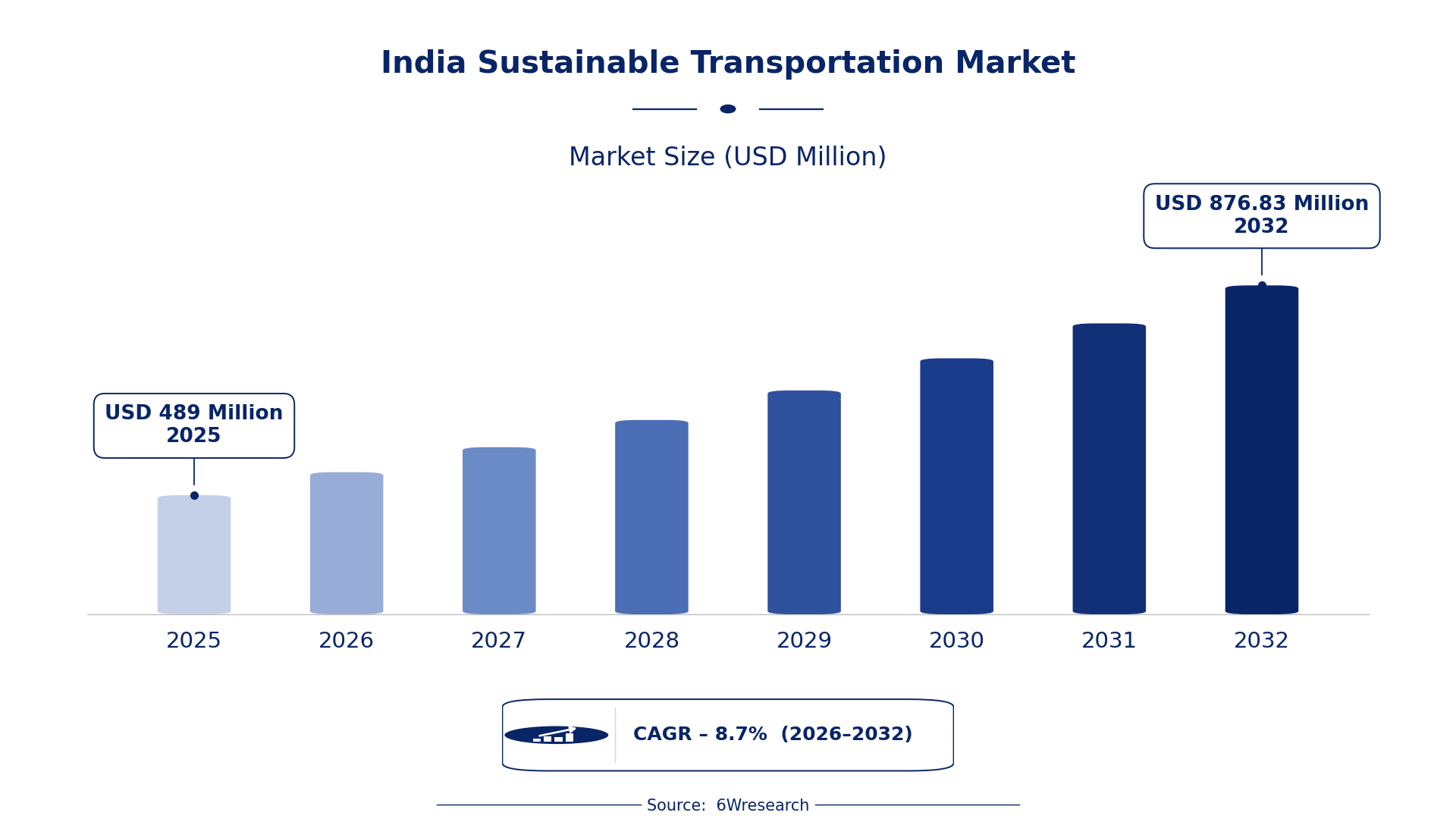
According to 6Wresearch internal database and industry insights, the India Sustainable Transportation Market was valued at USD 489.0 million in 2025 and is projected to reach USD 876.83 million by 2032, growing at a CAGR of approximately 8.7% during 2026–2032.
India Sustainable Transportation Market Highlights
| Report Metric | Details |
| Report Name | India Sustainable Transportation Market |
| Market Size 2025 | USD 489.0 million |
| Market Size 2032 | USD 876.83 million |
| Absolute Growth 2025–2032 | USD 387.83 million |
| CAGR 2026–2032 | 8.7% |
| Peak Annual Growth | 11.3% in 2029 |
| Forecast Period | 2026–2032 |
| Historical Data | 2022–2025 |
| Base Year | 2025 |
| Leading Transport Mode, 2025 | Electric Buses (47% share) |
| Leading Energy Type, 2025 | Battery Electric (39% share) |
| Leading Application Area, 2025 | Intra-city Commute (43% share) |
| Leading End User, 2025 | Public Transit Agencies (52% share) |
| Fastest-Growing Transport Mode | Bike Infrastructure (10.2% CAGR) |
| Fastest-Growing Energy Type | Hydrogen Fuel Cell (11.4% CAGR) |
| Fastest-Growing Application Area | Last-Mile Access (10.2% CAGR) |
| Fastest-Growing End User | Urban Planners (10.4% CAGR) |
| Growing Sector | Public Transit |
| Key End Users | Public Transit Agencies, Municipal Authorities, Urban Planners |
India Sustainable Transportation Market Year-wise Growth Rate and Key Drivers (2022–2032)
This graph illustrates the annual growth rates of the market from 2022 to 2032, highlighting a steady upward trajectory and projected market expansion over the forecast period.
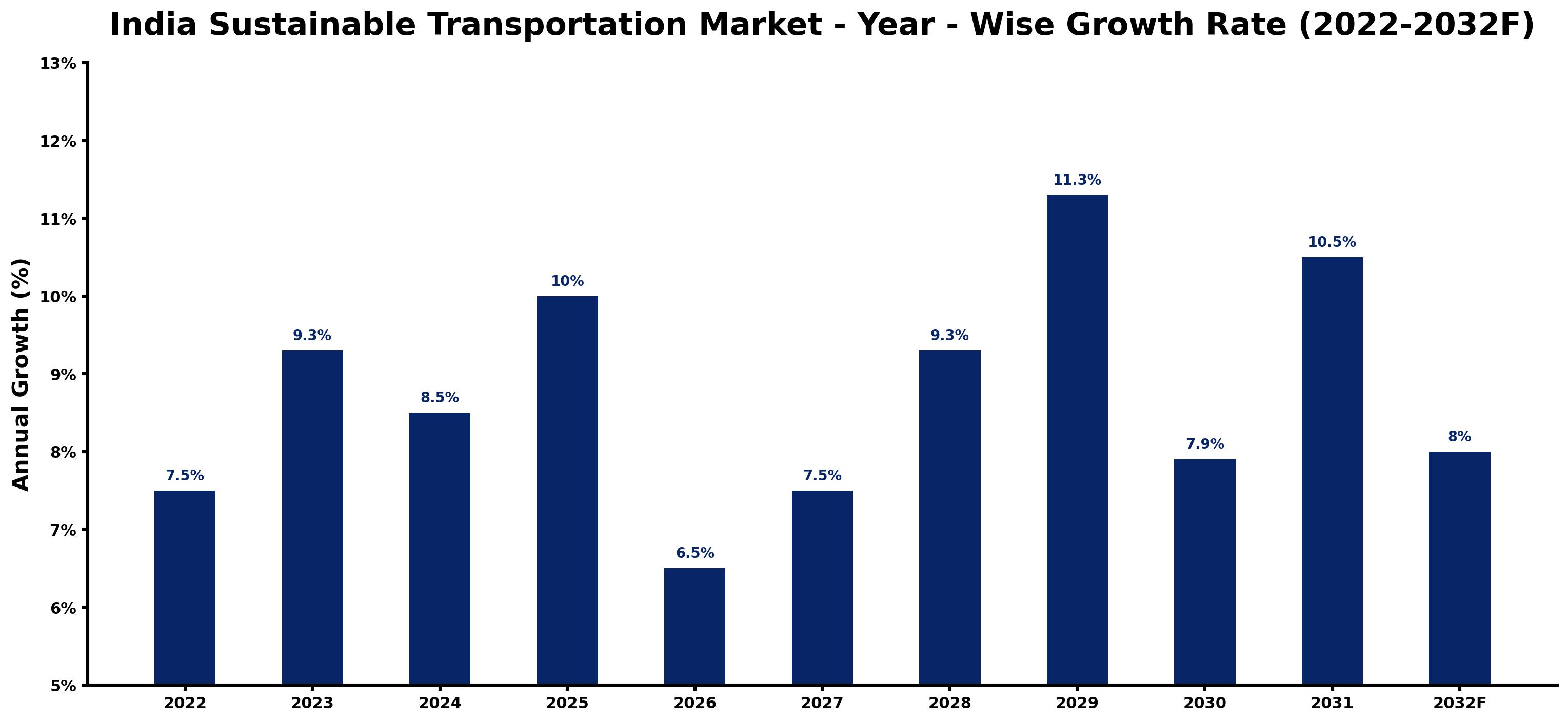
The following table presents the estimated annual growth rate for each year together with the principal factor influencing market performance.
| Year | Estimated Annual Growth (%) | Market Rationale |
| 2022 | 7.5 | The market experienced steady growth due to the National Urban Transport Policy promoting sustainable solutions. |
| 2023 | 9.3 | Demand increased as public transit agencies expanded electric bus fleets, supported by the FAME II scheme. |
| 2024 | 8.5 | Growth slowed as electric vehicle adoption faced challenges from insufficient charging infrastructure. |
| 2025 | 10.0 | A surge in electric bus deployment led to the market's historical peak growth rate, driven by the National Electric Mobility Mission Plan. |
| 2026 | 6.5 | Growth is projected to slow due to the need for more charging stations and infrastructure adjustments. |
| 2027 | 7.5 | Urban planners are increasingly focusing on sustainable transport solutions, boosting demand for electric vehicles. |
| 2028 | 9.3 | Demand is expected to rise as urban planners push for eco-friendly initiatives and infrastructure improvements. |
| 2029 | 11.3 | The market is anticipated to reach its peak growth rate, spurred by significant investments in electric vehicle infrastructure. |
| 2030 | 7.9 | Growth will decelerate as some urban areas experience saturation in electric vehicle adoption. |
| 2031 | 10.5 | Increased government incentives for electric vehicles will stimulate renewed market activity among public transit agencies. |
| 2032 | 8.0 | Growth is projected to decelerate as the market matures and stabilises. |
Note: Market size estimations and growth projections presented in this report are based on 6Wresearch's proprietary forecasting methodology, utilizing the latest available industry data, government publications, and primary research inputs.
India Sustainable Transportation Market Synopsis
Sustainable Transportation in India encompasses eco-friendly transport modes such as electric buses and hydrogen trains, utilising renewable energy sources. This sector is developed through advanced technologies aimed at reducing carbon emissions. The India Sustainable Transportation Market is expanding rapidly, driven by urban planners and public transit agencies seeking cleaner transport solutions. The National Electric Mobility Mission Plan aims for 6-7 million electric vehicles by 2025, highlighting the growing demand for sustainable transport. With over 1,000 electric buses operational in major cities, the market is set for growth in the coming years.
Market Dynamics Impact Analysis (2026–2032)
| Factor | Type | Impact | Primary Segment Affected |
| Increasing investment in electric vehicle infrastructure | Driver | High | Electric Buses |
| Government incentives for electric vehicle adoption | Driver | High | Battery Electric |
| Growing urban population increasing demand for public transit | Opportunity | High | Public Transit Agencies |
| Expansion of bike-sharing programs in urban areas | Opportunity | Medium | Bike Infrastructure |
| Limited charging infrastructure for electric vehicles | Restraint | High | Battery Electric |
| High initial costs of electric buses compared to traditional vehicles | Restraint | Medium | Electric Buses |
| Sustainable Transportation market in India faces regulatory hurdles | Challenge | High | Hydrogen Trains |
| Competition from traditional fuel-based transport modes | Challenge | Medium | Light Rail |
Evaluation of Drivers in India Sustainable Transportation Market (2026–2032)
The table below links each growth driver to the segment it affects and the evidence for it.
| Drivers | Primary Segment Affected | Why It Matters (Evidence) |
| Increased public transit agency investments in electric buses | Electric Buses | Maharashtra leads with 500 electric buses in Mumbai, driving demand for cleaner public transport solutions. |
| Government incentives under the FAME II scheme | Battery Electric | The scheme provides financial support for electric vehicle purchases, encouraging wider adoption among consumers with a target of 6-7 million electric vehicles by 2025. |
| Growing urban population demanding efficient transport solutions | Public Transit Agencies | India's population is projected to reach 1.5 billion by 2030, increasing urban transport demand significantly. |
| Expansion of bike-sharing programs promoting urban mobility | Bike Infrastructure | Delhi's bike-sharing program has over 200,000 registered users, supporting non-motorised transport initiatives and increasing accessibility. |
| Investment in electric vehicle infrastructure by the government | Grid-Tied Electric | The Indian government allocated $1.4 billion for electric vehicle infrastructure in 2022, facilitating the expansion of charging stations and services. |
More than 1,000 electric buses are in operation across major cities, improving public transport options. The FAME II scheme offers financial support for electric vehicle purchases, promoting wider adoption among consumers. With India's population expected to reach 1.5 billion by 2030, urban transport demand will continue to rise, increasing the need for sustainable solutions.
Evaluation of Restraints in India Sustainable Transportation Market
The key brakes on demand, and where they bite hardest, are shown below.
| Market Restraint | Primary Segment Affected | Why It Matters (Evidence) |
| Insufficient charging infrastructure for electric vehicles | Battery Electric | Only a limited number of charging stations exist, hampering electric vehicle adoption across major cities. |
| High upfront costs of electric buses compared to diesel alternatives | Electric Buses | The initial investment required for electric buses deters many public transit agencies from transitioning to cleaner options. |
| Regulatory hurdles in implementing new technologies | Hydrogen Trains | Complex approval processes slow down the introduction of hydrogen trains in the market, limiting deployment opportunities. |
| Competition from traditional fuel-based transport modes | Light Rail | Existing diesel and petrol transport options remain more cost-effective for many operators, hindering electric alternatives. |
| Limited consumer awareness about sustainable transport options | Bike Infrastructure | Many potential users are unaware of the benefits and availability of bike-sharing programs, reducing participation. |
India Sustainable Transportation Market Challenges
The India Sustainable Transportation market encounters strict regulations that can delay project approvals, extending timelines for producers aiming to launch new electric bus routes. Intense competition for government contracts forces suppliers to lower prices, which may compromise quality and service reliability for public transit agencies. Rising raw material costs for electric vehicle components inflate expenses for producers, resulting in higher prices for urban planners seeking sustainable transport solutions. Rapid technological advancements create a knowledge gap for some suppliers, limiting their ability to meet evolving standards and narrowing options for buyers in the market.
Trends in the India Sustainable Transportation Market
Below mentioned are some of the trends shaping the India Sustainable Transportation Market growth.
- Shift towards Electric Buses in Urban Transit: Public Transit Agencies are increasingly adopting electric buses to reduce emissions, with Maharashtra leading by deploying 500 buses in Mumbai. This trend reflects a growing commitment to sustainable urban transport solutions.
- Expansion of Bike-Sharing Initiatives: Delhi's bike-sharing program has registered over 200,000 users, promoting non-motorised transport. The initiative aligns with the Smart Cities Mission, which aims to improve urban mobility through sustainable solutions.
- Increased Focus on Hydrogen Fuel Technologies: The National Hydrogen Mission, launched in 2021, aims to develop hydrogen as a clean fuel source for transportation. This initiative is expected to drive innovation and investment in hydrogen trains by 2025.
- Growth of Intra-city Commute Solutions: Intra-city commute solutions are gaining traction, with a projected share of 43% in 2025. Urban planners are prioritising these solutions to improve connectivity and reduce congestion.
Investment Opportunities in the India Sustainable Transportation Market
Below are the investment opportunities with the strongest case in the India Sustainable Transportation Market.
- Investment in Electric Vehicle Infrastructure: With $1.4 billion allocated for electric vehicle infrastructure, there is a notable opportunity to supply charging stations and related services. Public Transit Agencies are key buyers in this sector.
- Expansion of Cycling Infrastructure: As urban areas focus on sustainable transport, there is a growing need for cycling infrastructure. With Bangalore aiming for 1,000 km of bike lanes by 2025, suppliers can engage with municipal authorities to meet this demand.
- Hydrogen Fuel Cell Development: The National Hydrogen Mission presents an opportunity to invest in hydrogen fuel cell technologies. This initiative aims to promote hydrogen as a clean fuel alternative by 2025, targeting Rail Transport Agencies.
- Growth in Last-Mile Access Solutions: The Last-Mile Access segment is set to grow, driven by urbanisation. Suppliers can partner with Municipal Authorities to develop innovative solutions for connecting commuters to main transport hubs.
Government Initiatives in the India Sustainable Transportation Market
The National Urban Transport Policy, updated in 2020, emphasises sustainable transport solutions in urban planning and development, guiding local authorities in executing eco-friendly transport projects. The National Electric Mobility Mission Plan 2020, initiated by the Ministry of Heavy Industries, aims to promote electric vehicle adoption with a budget of $1.4 billion. This measure encourages manufacturers to invest in electric vehicle production and infrastructure development. The National Hydrogen Mission, launched in 2021, focuses on developing hydrogen as a clean fuel source for transportation, promoting innovation in the sector.
The Ministry of Heavy Industries administers the FAME II scheme, which provides incentives for electric vehicle purchases, assisting buyers in transitioning to cleaner transport options. Additionally, the Smart Cities Mission, launched by the Ministry of Housing and Urban Affairs, funds sustainable transport projects in 100 cities, improving urban mobility and infrastructure. The National Institute of Urban Affairs is conducting research on sustainable transport solutions, offering valuable insights for urban planners and authorities.
Future Insight of the India Sustainable Transportation Market
By 2032, buyers and suppliers in the India Sustainable Transportation market can anticipate a notable shift towards electric and hydrogen-powered vehicles, driven by initiatives like the National Hydrogen Mission. The introduction of 6-7 million electric vehicles by 2025 will improve urban mobility solutions, while the Smart Cities Mission will integrate sustainable transport into 100 cities. As Delhi's bike-sharing program expands, urban planners will advocate for cycling as an important transport option. Investment in electric vehicle infrastructure, projected at $1.4 billion, will further stimulate sector development.
Market Segmentation Analysis
Each segment group is reviewed below, with the leader by share and the fastest grower by CAGR.
By Transport Mode – Electric Buses Dominated, Bike Infrastructure Expected to Grow Fastest
According to Sumit Sagar, AM at 6Wresearch, the largest transport mode category in 2025 was Electric Buses, with a 47% share of total revenue. Electric buses hold the largest market share in India due to their widespread use in public transit systems, significantly contributing to emission reductions in urban areas. For instance, the deployment of 500 electric buses in Mumbai by Maharashtra exemplifies strong governmental support for this transport mode. Over 2026–2032, Bike Infrastructure is expected to post the fastest growth, at a CAGR of 10.2%. The bike infrastructure segment is experiencing rapid growth, with cities like Bangalore aiming to implement 1,000 km of bike lanes by 2025. This initiative highlights the increasing demand for sustainable mobility solutions that enhance non-motorised transport options. Suppliers should focus on expanding bike infrastructure solutions to meet the rising demand for eco-friendly transport alternatives.
By Energy Type – Battery Electric Dominated, Hydrogen Fuel Cell Expected to Grow Fastest
With a 39% revenue share in 2025, Battery Electric was the largest energy type category. Battery electric technology captures the largest market share as the dominant energy source for electric vehicles in urban environments, supported by substantial investments in charging infrastructure. The Indian government's allocation of $1.4 billion for electric vehicle infrastructure in 2022 solidifies its leading position in this sector. Hydrogen Fuel Cell is projected to grow fastest, at a CAGR of 11.4% during 2026–2032. Hydrogen fuel cell technology is poised for rapid growth, driven by the National Hydrogen Mission launched in 2021, which aims to promote hydrogen fuel technologies in transportation. As the market shifts towards cleaner energy alternatives, this segment's potential for expansion is significant. Buyers and suppliers should prepare for an increasing focus on hydrogen fuel cell technologies as the market evolves.
By Application Area – Intra-city Commute Dominated, Last-Mile Access Expected to Grow Fastest
In 2025, Intra-city Commute led the application area split with a 43% share. Intra-city commute accounts for the largest market share as it serves as the primary application area for sustainable transport solutions, addressing the urgent need for efficient urban mobility. This focus aligns with the National Urban Transport Policy's commitment to promoting sustainable development in urban areas. The quickest growth will come from Last-Mile Access, forecast to expand at a CAGR of 10.2% between 2026 and 2032. Last-mile access is the fastest-growing segment, crucial for connecting commuters to major transport hubs, reflecting the rising importance of seamless transit solutions in urban planning. Urban planners are prioritising accessibility, which is driving this segment's growth. Suppliers must innovate in last-mile transport solutions to capitalise on the increasing demand for integrated urban transport networks.
By End User – Public Transit Agencies Dominated, Urban Planners Expected to Grow Fastest
Public Transit Agencies took a 52% share of end user in 2025, more than any other category. Public transit agencies represent the largest market share as key end users of sustainable transport solutions, implementing eco-friendly initiatives across urban areas. Their commitment to reducing emissions is evident through various government-supported programmes that enhance public transit options. Urban Planners are set to record the highest CAGR in this split, 10.4% over 2026–2032. Urban planners are the fastest-growing end user group, actively developing sustainable urban transport strategies to accommodate India's expanding population. Their role in shaping transport policies will significantly influence future market trends and demands. Suppliers should engage with urban planners to align their offerings with the emerging sustainable transport strategies being developed.
Key Attractiveness of the Report
- 10 Years of Market Numbers
- Historical Data Starting from 2022 to 2025
- Base Year 2025
- Forecast Data until 2032
- Key Performance Indicators Impacting the Market
- Major Upcoming Developments and Projects
Key Highlights of the Report:
- India Sustainable Transportation Market Outlook
- Market Size of India Sustainable Transportation Market, 2025
- Forecast of India Sustainable Transportation Market, 2032
- Historical Data and Forecast of India Sustainable Transportation Revenues & Volume for the Period 2022 - 2032F
- India Sustainable Transportation Market Trend Evolution
- India Sustainable Transportation Market Drivers and Challenges
- India Sustainable Transportation Price Trends
- India Sustainable Transportation Porter's Five Forces
- India Sustainable Transportation Industry Life Cycle
- Historical Data and Forecast of India Sustainable Transportation Market Revenues & Volume By Transport Mode for the Period 2022 - 2032F
- Historical Data and Forecast of India Sustainable Transportation Market Revenues & Volume By Electric Buses for the Period 2022 - 2032F
- Historical Data and Forecast of India Sustainable Transportation Market Revenues & Volume By Light Rail for the Period 2022 - 2032F
- Historical Data and Forecast of India Sustainable Transportation Market Revenues & Volume By Bike Infrastructure for the Period 2022 - 2032F
- Historical Data and Forecast of India Sustainable Transportation Market Revenues & Volume By Hydrogen Trains for the Period 2022 - 2032F
- Historical Data and Forecast of India Sustainable Transportation Market Revenues & Volume By Energy Type for the Period 2022 - 2032F
- Historical Data and Forecast of India Sustainable Transportation Market Revenues & Volume By Battery Electric for the Period 2022 - 2032F
- Historical Data and Forecast of India Sustainable Transportation Market Revenues & Volume By Grid-Tied Electric for the Period 2022 - 2032F
- Historical Data and Forecast of India Sustainable Transportation Market Revenues & Volume By Non-Motorized for the Period 2022 - 2032F
- Historical Data and Forecast of India Sustainable Transportation Market Revenues & Volume By Hydrogen Fuel Cell for the Period 2022 - 2032F
- Historical Data and Forecast of India Sustainable Transportation Market Revenues & Volume By Application Area for the Period 2022 - 2032F
- Historical Data and Forecast of India Sustainable Transportation Market Revenues & Volume By Intra-city Commute for the Period 2022 - 2032F
- Historical Data and Forecast of India Sustainable Transportation Market Revenues & Volume By Urban Rail Transit for the Period 2022 - 2032F
- Historical Data and Forecast of India Sustainable Transportation Market Revenues & Volume By Last-Mile Access for the Period 2022 - 2032F
- Historical Data and Forecast of India Sustainable Transportation Market Revenues & Volume By Long Distance Railway for the Period 2022 - 2032F
- Historical Data and Forecast of India Sustainable Transportation Market Revenues & Volume By End User for the Period 2022 - 2032F
- Historical Data and Forecast of India Sustainable Transportation Market Revenues & Volume By Public Transit Agencies for the Period 2022 - 2032F
- Historical Data and Forecast of India Sustainable Transportation Market Revenues & Volume By Municipal Authorities for the Period 2022 - 2032F
- Historical Data and Forecast of India Sustainable Transportation Market Revenues & Volume By Urban Planners for the Period 2022 - 2032F
- Historical Data and Forecast of India Sustainable Transportation Market Revenues & Volume By Rail Transport Agencies for the Period 2022 - 2032F
- India Sustainable Transportation Import Export Trade Statistics
- Market Opportunity Assessment By Transport Mode
- Market Opportunity Assessment By Energy Type
- Market Opportunity Assessment By Application Area
- Market Opportunity Assessment By End User
- India Sustainable Transportation Top Companies Market Share
- India Sustainable Transportation Competitive Benchmarking By Technical and Operational Parameters
- India Sustainable Transportation Company Profiles
- India Sustainable Transportation Key Strategic Recommendations
Market Covered
Segments analysed in this report are listed below.
By Transport Mode
- Electric Buses
- Light Rail
- Bike Infrastructure
- Hydrogen Trains
By Energy Type
- Battery Electric
- Grid-Tied Electric
- Non-Motorized
- Hydrogen Fuel Cell
By Application Area
- Intra-city Commute
- Urban Rail Transit
- Last-Mile Access
- Long Distance Railway
By End User
- Public Transit Agencies
- Municipal Authorities
- Urban Planners
- Rail Transport Agencies































