India Sustainable Waste Management Market Size & Growth Rate
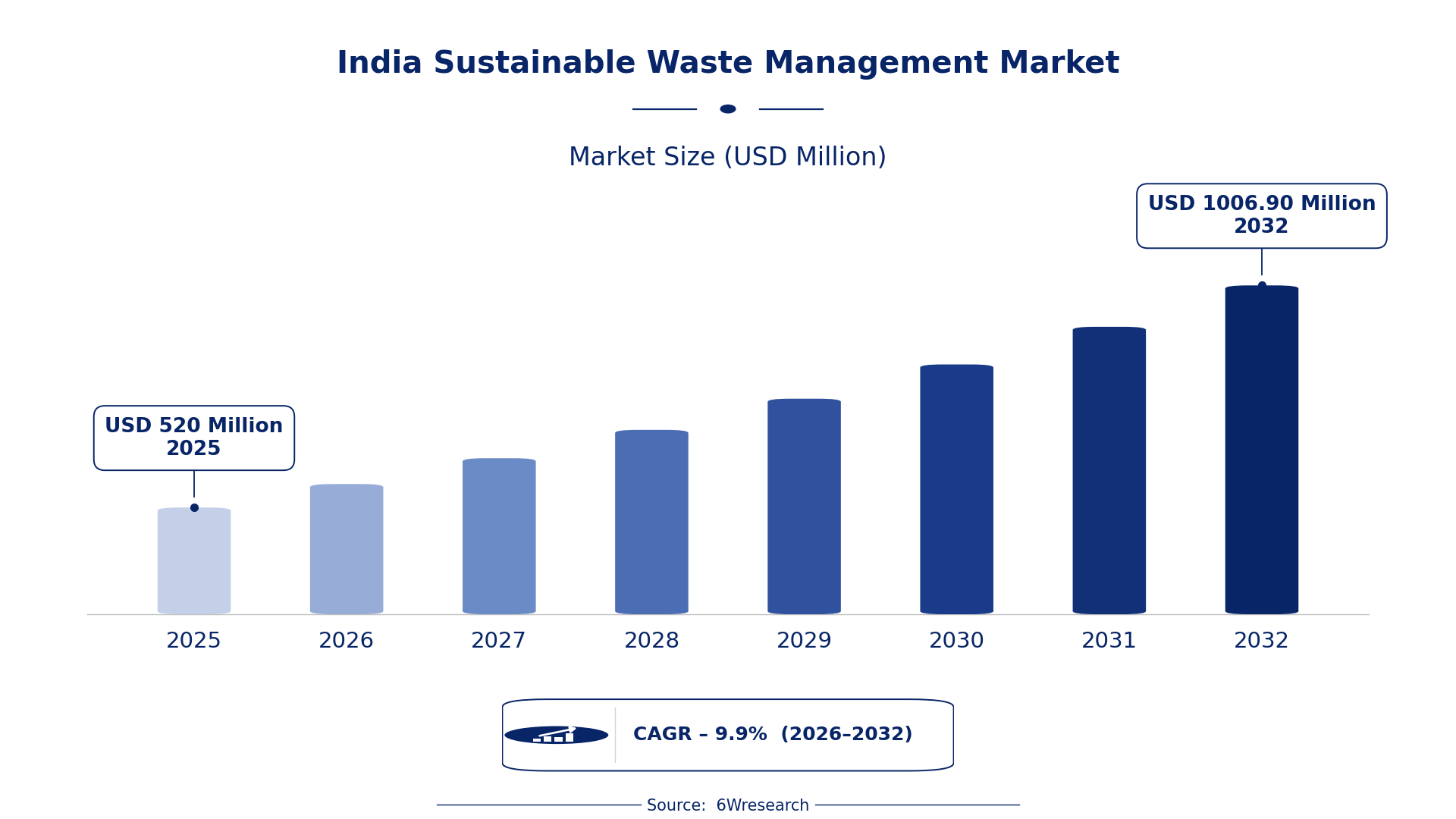
According to 6Wresearch internal database and industry insights, the India Sustainable Waste Management Market was valued at USD 520.0 million in 2025 and is projected to reach USD 1,006.90 million by 2032, growing at a CAGR of approximately 9.9% during 2026–2032.
India Sustainable Waste Management Market Highlights
| Report Metric | Details |
| Report Name | India Sustainable Waste Management Market |
| Market Size 2025 | USD 520.0 million |
| Market Size 2032 | USD 1,006.90 million |
| Absolute Growth 2025–2032 | USD 486.90 million |
| CAGR 2026–2032 | 9.9% |
| Peak Annual Growth | 12.2% in 2030 |
| Forecast Period | 2026–2032 |
| Historical Data | 2022–2025 |
| Base Year | 2025 |
| Leading Waste Type, 2025 | Organic Waste (49% share) |
| Leading Management Solution, 2025 | Composting (45% share) |
| Leading Treatment Process, 2025 | Aerobic Processing (37% share) |
| Leading End User, 2025 | Municipal Corporations (40% share) |
| Fastest-Growing Waste Type | Plastic Waste (10.9% CAGR) |
| Fastest-Growing Management Solution | Mechanical Recycling (12.5% CAGR) |
| Fastest-Growing Treatment Process | Sorting & Shredding (12.2% CAGR) |
| Fastest-Growing End User | Recycling Plants (11.3% CAGR) |
| Growing Sector | Composting |
| Key End Users | Municipal Corporations, Recycling Plants, Electronics Manufacturers |
India Sustainable Waste Management Market Year-wise Growth Rate and Key Drivers (2022–2032)
This graph illustrates the annual growth rates of the market from 2022 to 2032, highlighting a steady upward trajectory and projected market expansion over the forecast period.
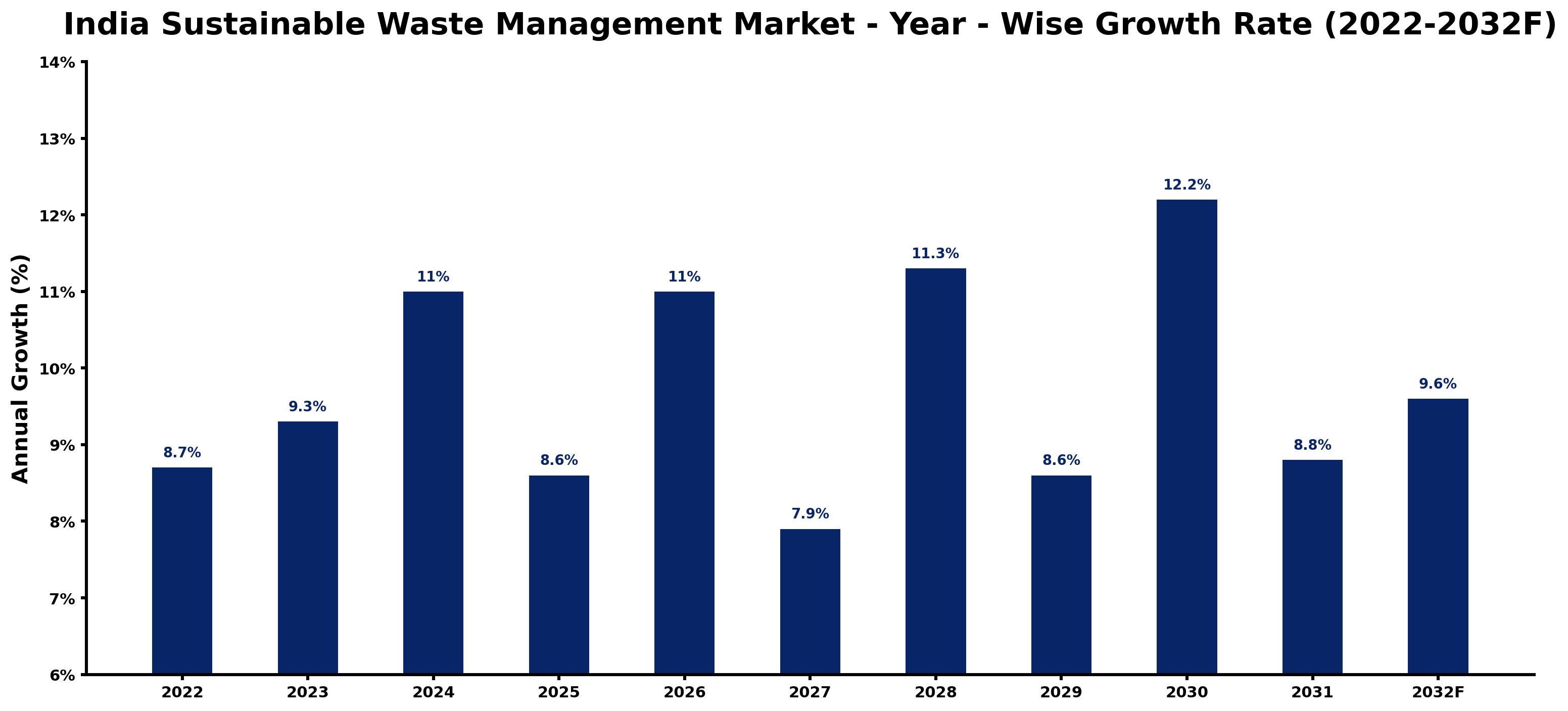
The table below sets out the estimated growth rate for each year and the main factor behind it.
| Year | Estimated Annual Growth (%) | Market Rationale |
| 2022 | 8.7 | The market experienced steady growth due to increasing urban waste generation and regulatory focus. |
| 2023 | 9.3 | Demand accelerated as municipal corporations implemented new waste management initiatives across urban areas. |
| 2024 | 11.0 | Growth continued with the successful rollout of the Swachh Bharat Mission, improving waste processing capabilities. |
| 2025 | 8.6 | A slight slowdown occurred as municipalities adjusted to new waste management standards and practices. |
| 2026 | 11.0 | The market is expected to rebound with renewed investments in recycling facilities and composting initiatives. |
| 2027 | 7.9 | Growth is projected to slow again as some regions face challenges in implementing effective waste management solutions. |
| 2028 | 11.3 | Demand is expected to surge as awareness of environmental issues increases, driving composting and recycling efforts. |
| 2029 | 8.6 | A slowdown is projected as municipalities balance resource allocation for waste management and other services. |
| 2030 | 12.2 | The market is expected to peak with significant advancements in waste-to-energy technologies and municipal investments. |
| 2031 | 8.8 | Growth is projected to decelerate as the market begins to stabilise after rapid expansions in previous years. |
| 2032 | 9.6 | Demand is expected to rise again as new regulations further promote sustainable waste practices. |
Note: Market size estimations and growth projections presented in this report are based on 6Wresearch's proprietary forecasting methodology, utilizing the latest available industry data, government publications, and primary research inputs.
India Sustainable Waste Management Market Synopsis
It employs methods such as recycling and composting to reduce landfill waste and environmental impact. The market is growing due to increasing urbanisation, stringent environmental regulations, and rising demand from municipal corporations. The Swachh Bharat Mission aims for 100% waste management in urban areas by 2024, further driving market expansion.
Market Dynamics Impact Analysis (2026–2032)
| Factor | Type | Impact | Primary Segment Affected |
| Increasing urban waste generation | Driver | High | Municipal Corporations |
| Growing awareness of environmental sustainability | Driver | High | Recycling Plants |
| Investment in composting facilities | Opportunity | High | Composting |
| Expansion of recycling initiatives | Opportunity | High | Mechanical Recycling |
| Limited infrastructure for waste processing | Restraint | High | Organic Waste |
| Regulatory compliance costs for hazardous waste | Restraint | High | Hazardous Waste |
| Inconsistent waste collection services | Challenge | Medium | Municipal Corporations |
| High operational costs for recycling plants | Challenge | Medium | Recycling Plants |
Evaluation of Drivers in India Sustainable Waste Management Market (2026–2032)
The table below links each growth driver to the segment it affects and the evidence for it.
| Drivers | Primary Segment Affected | Why It Matters (Evidence) |
| Urbanisation driving waste generation | Municipal Corporations | India generates approximately 62 million tonnes of waste annually, necessitating effective management solutions. |
| Government initiatives promoting recycling | Recycling Plants | The National Policy on Electronics encourages e-waste recycling, leading to increased demand for recycling facilities. |
| Rising organic waste requiring composting | Composting | Over 50% of urban waste is organic, highlighting the need for composting solutions to manage this waste. |
| Investment in waste-to-energy projects | Hazardous Waste | The National Policy on Waste to Energy aims for a 20% increase in energy recovery from waste by 2025, supporting growth in waste-to-energy projects. |
| Technological advancements in waste processing | Mechanical Recycling | The increasing efficiency of recycling technologies is driving demand for advanced recycling facilities. |
Approximately 62 million tonnes of waste are generated annually, with urban areas making a substantial contribution. The National Policy on Electronics encourages e-waste recycling, boosting demand for recycling facilities. More than 50% of waste produced in cities is organic, creating a need for effective composting solutions. The National Policy on Waste to Energy aims for a 20% increase in energy recovery from waste by 2025, facilitating growth in waste-to-energy projects.
Evaluation of Restraints in India Sustainable Waste Management Market
The main factors holding the market back are set out below.
| Market Restraint | Primary Segment Affected | Why It Matters (Evidence) |
| Limited infrastructure for waste processing | Organic Waste | India lacks adequate facilities for processing organic waste, resulting in increased landfill use and environmental impact. |
| High operational costs for recycling plants | Recycling Plants | The costs associated with setting up and maintaining recycling facilities can deter investment, limiting capacity expansion. |
| Regulatory compliance costs for hazardous waste | Hazardous Waste | Compliance with stringent regulations increases operational costs for hazardous waste management, impacting profitability for facilities. |
| Inconsistent waste collection services | Municipal Corporations | Irregular waste collection hampers effective waste management and recycling efforts in urban areas, leading to increased waste accumulation. |
| Lack of public awareness about waste segregation | E-waste | Insufficient awareness leads to improper disposal of e-waste, complicating recovery efforts and increasing environmental risks. |
India Sustainable Waste Management Market Challenges
Suppliers encounter intense competition among over 1,000 registered recycling facilities, leading to price wars that can reduce profit margins by 20%. Many recycling plants grapple with outdated technology, resulting in inefficiencies that elevate operational costs by 15%. Inconsistent waste collection services disrupt supply chains, causing processing delays that can lead to backlogs of 10,000 tonnes of waste in cities like Delhi.
Trends in the India Sustainable Waste Management Market
The trends below show where the India Sustainable Waste Management Market is heading.
- Shift towards Composting Solutions: In 2022, over 50% of waste generated in urban areas was organic, prompting a shift towards composting solutions. Municipalities are increasingly investing in composting facilities to manage organic waste effectively.
- Emergence of E-waste Recycling Initiatives: The National Policy on Electronics, launched in 2020, has spurred initiatives for e-waste recycling. In 2022, India reported a 30% increase in e-waste processing, reflecting a growing focus on this segment.
- Focus on Waste-to-Energy Projects: The National Policy on Waste to Energy, introduced in 2021, aims for a 20% increase in energy recovery from waste by 2025. This initiative is reshaping how waste is viewed as a resource.
- Expansion of Recycling Facilities: India has over 1,000 registered recycling facilities, indicating a shift towards recycling. The growth of these facilities is essential for managing the increasing waste generated in urban areas.
Investment Opportunities in the India Sustainable Waste Management Market
Several openings in the India Sustainable Waste Management Market merit attention from investors.
- Municipal Corporations seeking composting solutions: Municipal Corporations are actively looking for composting solutions to manage organic waste effectively. With over 50% of urban waste being organic, investment in composting facilities is essential.
- Recycling Plants expanding capacity: Recycling Plants are in need of advanced machinery to improve processing capabilities. With a reported 30% increase in municipal solid waste processing, suppliers can enter through partnerships.
- Investment in waste-to-energy technologies: The National Policy on Waste to Energy targets a 20% increase in energy recovery by 2025. Investors can explore joint ventures with local municipalities to develop waste-to-energy projects.
- Growing demand for e-waste management: With increasing e-waste generation, there is a gap in effective management solutions. Electronics Manufacturers can benefit from partnerships to improve recycling initiatives.
Government Initiatives in the India Sustainable Waste Management Market
The National Policy on Waste to Energy, launched in 2021, promotes energy recovery from waste, targeting a 20% increase in energy generation from waste by 2025. This measure encourages producers to invest in technologies that convert waste into energy, benefiting both the environment and energy supply.
The Swachh Bharat Mission (Gramin) Phase II, initiated in 2021, focuses on improving waste management in rural areas with a budget of ₹1,40,000 crores. The Ministry of Jal Shakti oversees this initiative, funding projects aimed at enhancing waste management infrastructure and practices in rural communities.
Future Insight of the India Sustainable Waste Management Market
The processing of organic materials is projected to rise significantly, creating a demand for innovative composting solutions. Stricter enforcement from the National Green Tribunal will drive improvements in hazardous waste practices. Technological advancements in recycling processes will enhance operational efficiency, enabling suppliers to lower costs and improve waste recovery outcomes.
Market Segmentation Analysis
The analysis below covers each segmentation, its leading category in 2025 and its fastest-growing category through 2032.
By Waste Type – Organic Waste Dominated, Plastic Waste Expected to Grow Fastest
According to Sumit Sagar, AM at 6Wresearch, Organic Waste held a 49% share of the India Sustainable Waste Management Market by waste type in 2025. Organic waste holds the largest market share as it represents over 50% of urban waste, necessitating effective composting solutions. This is particularly evident in cities like Delhi, which generates around 10,000 tonnes of waste daily, underscoring the demand for organic waste management. The quickest growth will come from Plastic Waste, forecast to expand at a CAGR of 10.9% between 2026 and 2032. Plastic waste is growing rapidly due to increased awareness of pollution and the urgent need for recycling initiatives. With a reported 30% rise in municipal solid waste processing in 2022, the demand for plastic recycling solutions is set to escalate. Suppliers should prioritise the development of composting and recycling technologies to meet the rising demand in the sustainable waste management market.
By Management Solution – Composting Dominated, Mechanical Recycling Expected to Grow Fastest
In 2025, Composting led the management solution split with a 45% share. Composting leads the market share as it is the primary method for treating organic waste, essential for reducing landfill use and promoting sustainability. The Swachh Bharat Mission's aim of achieving 100% waste management by 2024 reinforces the importance of composting practices across urban areas. Over 2026–2032, Mechanical Recycling is expected to post the fastest growth, at a CAGR of 12.5%. Mechanical recycling is the fastest-growing solution, propelled by the necessity to recover materials from plastic waste and mitigate environmental impact. The presence of over 1,000 recycling facilities in India underscores the urgent need for effective mechanical recycling processes. Buyers should invest in advanced composting and mechanical recycling technologies to comply with regulatory standards and meet sustainability objectives.
By Treatment Process – Aerobic Processing Dominated, Sorting & Shredding Expected to Grow Fastest
The largest treatment process category in 2025 was Aerobic Processing, with a 37% share of total revenue. Aerobic processing leads the market share due to its extensive use in treating organic waste, essential for effective waste management. This method aligns with regulations from the Central Pollution Control Board, ensuring compliance with national standards for waste treatment. Sorting & Shredding is projected to grow fastest, at a CAGR of 12.2% during 2026–2032. Sorting and shredding processes are rapidly expanding as they are crucial for preparing waste for recycling, especially with the growing emphasis on recycling initiatives. The National Clean Air Programme's focus on enhancing waste management practices further fuels this segment's growth. Suppliers must concentrate on advancing sorting and shredding technologies to optimise recycling processes and address the increasing demand for efficient waste treatment solutions.
By End User – Municipal Corporations Dominated, Recycling Plants Expected to Grow Fastest
Municipal Corporations took a 40% share of end user in 2025, more than any other category. Municipal corporations dominate the market share as they are the primary users of waste management services, responsible for effectively managing urban waste. Their pivotal role is crucial for executing successful waste management strategies, particularly under initiatives like the Swachh Bharat Mission. Recycling Plants are set to record the highest CAGR in this split, 11.3% over 2026–2032. Recycling plants represent the fastest-growing end-user segment, driven by the increasing volume of recyclable materials and the need for efficient processing. The rise in municipal solid waste processing indicates a growing demand for recycling facilities to handle this influx. Suppliers should collaborate with municipal corporations and recycling plants to provide tailored solutions that address their specific waste management challenges.
Key Attractiveness of the Report
- 10 Years of Market Numbers
- Historical Data Starting from 2022 to 2025
- Base Year 2025
- Forecast Data until 2032
- Key Performance Indicators Impacting the Market
- Major Upcoming Developments and Projects
Key Highlights of the Report:
- India Sustainable Waste Management Market Outlook
- Market Size of India Sustainable Waste Management Market, 2025
- Forecast of India Sustainable Waste Management Market, 2032
- Historical Data and Forecast of India Sustainable Waste Management Revenues & Volume for the Period 2022 - 2032F
- India Sustainable Waste Management Market Trend Evolution
- India Sustainable Waste Management Market Drivers and Challenges
- India Sustainable Waste Management Price Trends
- India Sustainable Waste Management Porter's Five Forces
- India Sustainable Waste Management Industry Life Cycle
- Historical Data and Forecast of India Sustainable Waste Management Market Revenues & Volume By Waste Type for the Period 2022 - 2032F
- Historical Data and Forecast of India Sustainable Waste Management Market Revenues & Volume By Organic Waste for the Period 2022 - 2032F
- Historical Data and Forecast of India Sustainable Waste Management Market Revenues & Volume By Plastic Waste for the Period 2022 - 2032F
- Historical Data and Forecast of India Sustainable Waste Management Market Revenues & Volume By Hazardous Waste for the Period 2022 - 2032F
- Historical Data and Forecast of India Sustainable Waste Management Market Revenues & Volume By E-waste for the Period 2022 - 2032F
- Historical Data and Forecast of India Sustainable Waste Management Market Revenues & Volume By Management Solution for the Period 2022 - 2032F
- Historical Data and Forecast of India Sustainable Waste Management Market Revenues & Volume By Composting for the Period 2022 - 2032F
- Historical Data and Forecast of India Sustainable Waste Management Market Revenues & Volume By Mechanical Recycling for the Period 2022 - 2032F
- Historical Data and Forecast of India Sustainable Waste Management Market Revenues & Volume By Incineration for the Period 2022 - 2032F
- Historical Data and Forecast of India Sustainable Waste Management Market Revenues & Volume By Extended Producer Recovery for the Period 2022 - 2032F
- Historical Data and Forecast of India Sustainable Waste Management Market Revenues & Volume By Treatment Process for the Period 2022 - 2032F
- Historical Data and Forecast of India Sustainable Waste Management Market Revenues & Volume By Aerobic Processing for the Period 2022 - 2032F
- Historical Data and Forecast of India Sustainable Waste Management Market Revenues & Volume By Sorting & Shredding for the Period 2022 - 2032F
- Historical Data and Forecast of India Sustainable Waste Management Market Revenues & Volume By High-Temperature Burn for the Period 2022 - 2032F
- Historical Data and Forecast of India Sustainable Waste Management Market Revenues & Volume By Metal Extraction for the Period 2022 - 2032F
- Historical Data and Forecast of India Sustainable Waste Management Market Revenues & Volume By End User for the Period 2022 - 2032F
- Historical Data and Forecast of India Sustainable Waste Management Market Revenues & Volume By Municipal Corporations for the Period 2022 - 2032F
- Historical Data and Forecast of India Sustainable Waste Management Market Revenues & Volume By Recycling Plants for the Period 2022 - 2032F
- Historical Data and Forecast of India Sustainable Waste Management Market Revenues & Volume By Industrial Facilities for the Period 2022 - 2032F
- Historical Data and Forecast of India Sustainable Waste Management Market Revenues & Volume By Electronics Manufacturers for the Period 2022 - 2032F
- India Sustainable Waste Management Import Export Trade Statistics
- Market Opportunity Assessment By Waste Type
- Market Opportunity Assessment By Management Solution
- Market Opportunity Assessment By Treatment Process
- Market Opportunity Assessment By End User
- India Sustainable Waste Management Top Companies Market Share
- India Sustainable Waste Management Competitive Benchmarking By Technical and Operational Parameters
- India Sustainable Waste Management Company Profiles
- India Sustainable Waste Management Key Strategic Recommendations
Market Covered
This report examines the market across the segments below.
By Waste Type
- Organic Waste
- Plastic Waste
- Hazardous Waste
- E-waste
By Management Solution
- Composting
- Mechanical Recycling
- Incineration
- Extended Producer Recovery
By Treatment Process
- Aerobic Processing
- Sorting & Shredding
- High-Temperature Burn
- Metal Extraction
By End User
- Municipal Corporations
- Recycling Plants
- Industrial Facilities
- Electronics Manufacturers































