India Synthetic Building Materials Market Size & Growth Rate
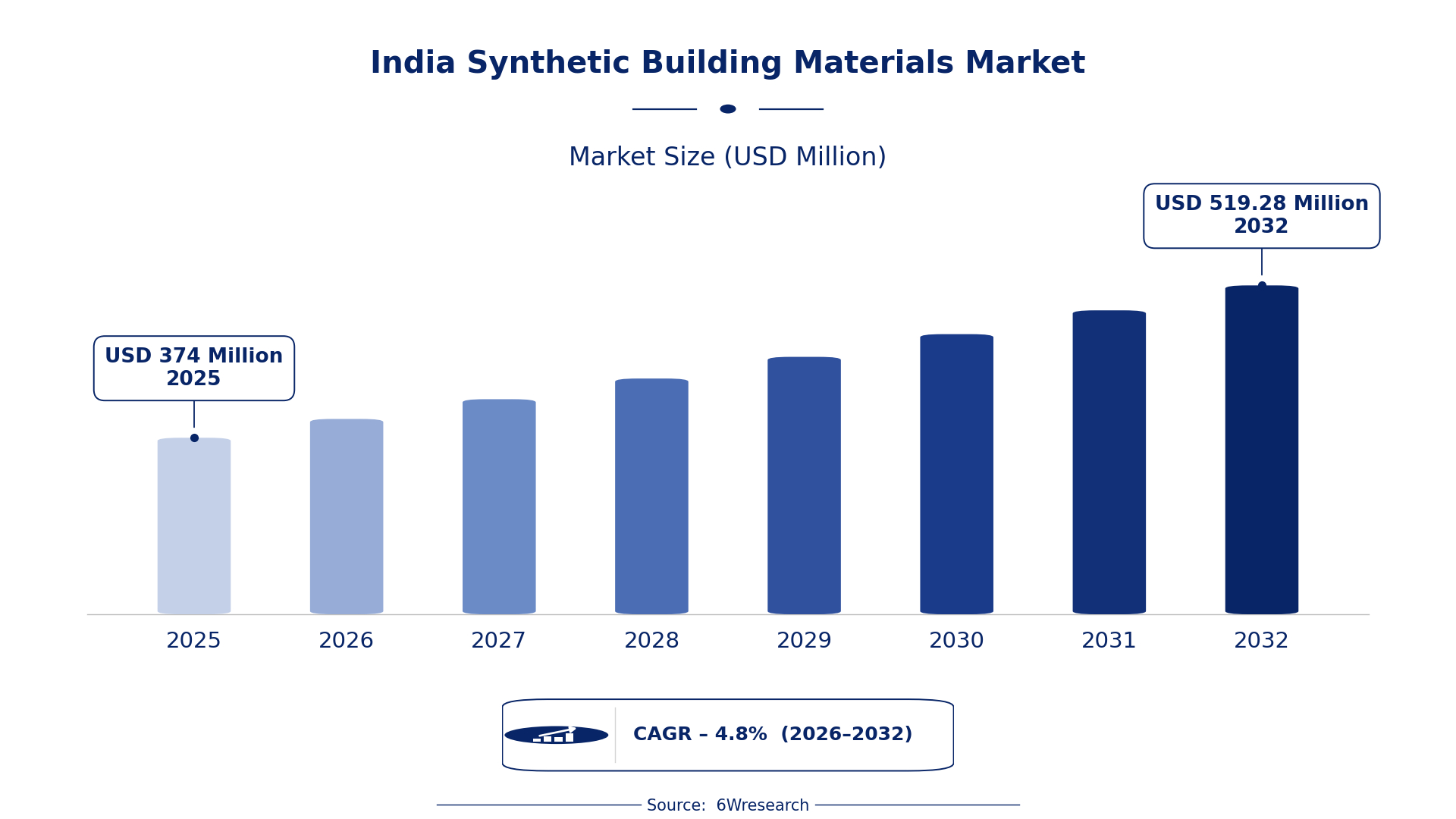
According to 6Wresearch internal database and industry insights, the India Synthetic Building Materials Market was valued at USD 374.0 million in 2025 and is projected to reach USD 519.28 million by 2032, growing at a CAGR of approximately 4.8% during 2026–2032.
India Synthetic Building Materials Market Highlights
| Report Metric | Details |
| Report Name | India Synthetic Building Materials Market |
| Market Size 2025 | USD 374.0 million |
| Market Size 2032 | USD 519.28 million |
| Absolute Growth 2025–2032 | USD 145.28 million |
| CAGR 2026–2032 | 4.8% |
| Peak Annual Growth | 6.8% in 2028 |
| Forecast Period | 2026–2032 |
| Historical Data | 2022–2025 |
| Base Year | 2025 |
| Leading Material Type, 2025 | Synthetic Roofing (49% share) |
| Leading Composition, 2025 | PVC/TPO/EPDM Membranes (39% share) |
| Leading Application Segment, 2025 | Commercial Roofing (48% share) |
| Leading End User, 2025 | Construction Firms (40% share) |
| Fastest-Growing Material Type | Composite Lumber (6.4% CAGR) |
| Fastest-Growing Composition | PU Foam Core (6.4% CAGR) |
| Fastest-Growing Application Segment | Decking/Flooring (6.0% CAGR) |
| Fastest-Growing End User | Prefab Manufacturers (6.0% CAGR) |
| Growing Sector | Construction |
| Key End Users | Construction Firms, Builders, Real Estate Developers, Prefab Manufacturers |
India Synthetic Building Materials Market Year-wise Growth Rate and Key Drivers (2022–2032)
This graph illustrates the annual growth rates of the market from 2022 to 2032, highlighting a steady upward trajectory and projected market expansion over the forecast period.
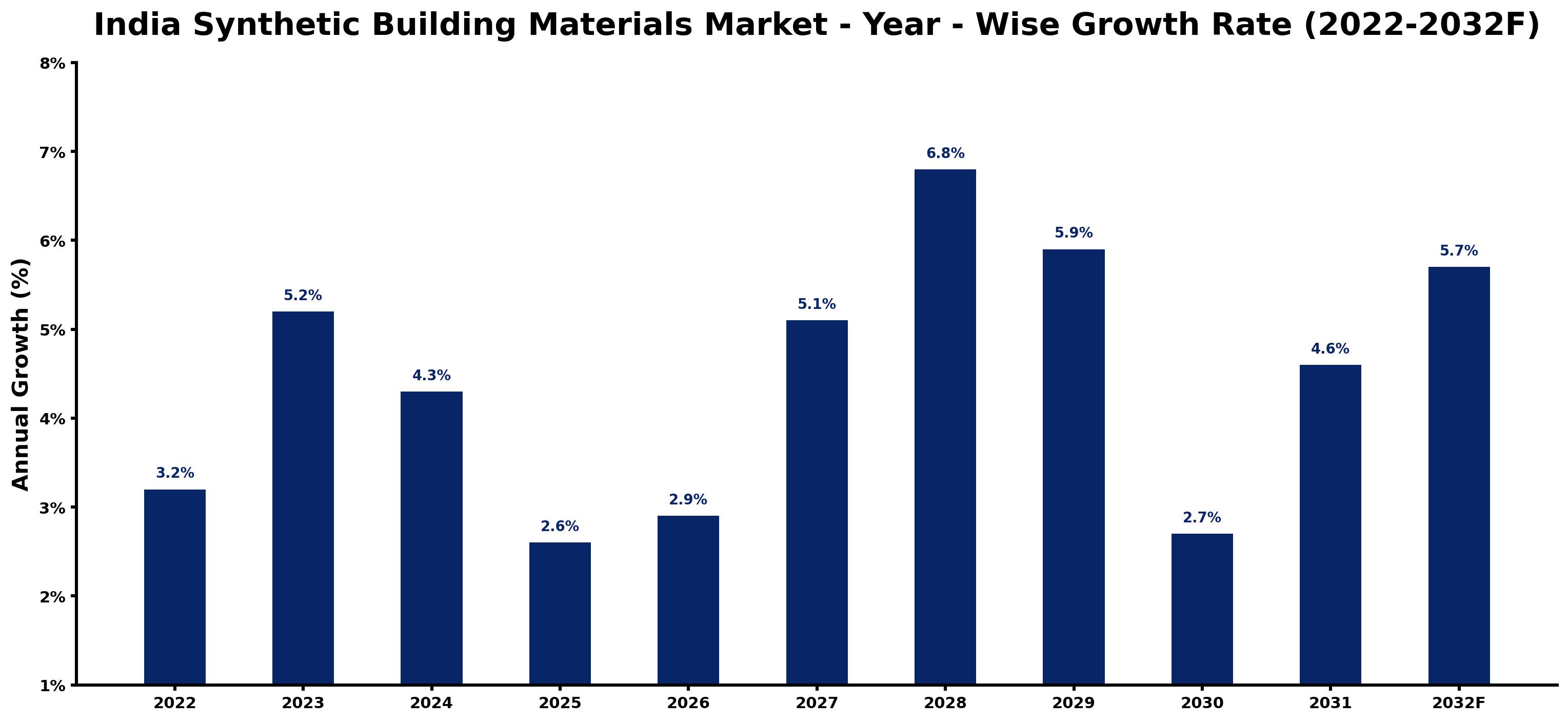
The table below sets out the estimated growth rate for each year and the main factor behind it.
| Year | Estimated Annual Growth (%) | Market Rationale |
| 2022 | 3.2 | The market experienced steady demand due to ongoing construction projects. |
| 2023 | 5.2 | Growth accelerated as urbanisation trends intensified, driving material needs. |
| 2024 | 4.3 | Demand growth slowed as some projects faced delays and budget constraints. |
| 2025 | 2.6 | Market growth continued to decelerate due to economic uncertainties affecting investments. |
| 2026 | 2.9 | A slight recovery occurred as infrastructure projects resumed and gained momentum. |
| 2027 | 5.1 | Demand increased as urban development initiatives expanded across major cities. |
| 2028 | 6.8 | The market peaked with significant investments in commercial roofing applications. |
| 2029 | 5.9 | Growth moderated as market saturation began to affect new project starts. |
| 2030 | 2.7 | A further slowdown was noted as economic conditions stabilised and demand normalised. |
| 2031 | 4.6 | Demand rebounded with renewed focus on sustainable building practices and materials. |
| 2032 | 5.7 | The market grew as urban housing initiatives continued to drive material requirements. |
Note: Market size estimations and growth projections presented in this report are based on 6Wresearch's proprietary forecasting methodology, utilizing the latest available industry data, government publications, and primary research inputs.
India Synthetic Building Materials Market Synopsis
Synthetic Building Materials in India include man-made products utilised in construction, primarily made from polymers and composites. These materials are produced through techniques like extrusion and moulding, playing key roles in roofing, insulation, and structural elements. The India Synthetic Building Materials Market is growing as urbanisation accelerates, with over 500 million people projected to live in urban areas by 2031. Initiatives such as the PMAY are driving demand for affordable housing, further propelling market expansion.
Market Dynamics Impact Analysis (2026–2032)
| Factor | Type | Impact | Primary Segment Affected |
| Urbanisation is increasing the demand for synthetic materials in construction projects. | Driver | High | Synthetic Roofing |
| Rising energy costs are driving the adoption of synthetic insulation for energy efficiency. | Driver | High | Synthetic Insulation |
| The Smart Cities Mission promotes sustainable urban development, creating opportunities for suppliers. | Opportunity | High | Composite Lumber |
| The ongoing PMAY initiative is creating demand for affordable housing solutions. | Opportunity | High | Insulated Panels |
| Economic uncertainties are causing delays in construction projects, affecting material demand. | Restraint | Medium | Synthetic Roofing |
| High initial costs of synthetic materials can deter some buyers from adoption. | Restraint | Medium | Synthetic Insulation |
| The market faces challenges from fluctuating raw material prices impacting production costs. | Challenge | High | Composite Lumber |
| Competition from traditional building materials limits market penetration of synthetics. | Challenge | Medium | Synthetic Roofing |
Evaluation of Drivers in India Synthetic Building Materials Market (2026–2032)
The main growth drivers and the segments they affect most are set out below.
| Drivers | Primary Segment Affected | Why It Matters (Evidence) |
| Urbanisation drives demand for synthetic roofing materials in commercial buildings. | Synthetic Roofing | With over 500 million people expected to live in urban areas by 2031, construction firms are increasingly purchasing synthetic roofing solutions. |
| Rising energy costs are increasing the need for synthetic insulation in buildings. | Synthetic Insulation | As energy prices rise, builders are investing in synthetic insulation to improve energy efficiency in new constructions. |
| The Smart Cities Mission encourages the use of advanced building materials. | Composite Lumber | This initiative promotes advanced materials in urban projects, leading to increased purchases of synthetic options. |
| The PMAY initiative is boosting demand for affordable housing solutions. | Insulated Panels | As the government aims to provide housing for millions, construction firms are sourcing more synthetic materials. |
| The National Building Code sets new standards for building materials. | Synthetic Roofing | Updated regulations ensure that synthetic materials meet safety and sustainability standards, driving demand. |
The construction sector contributes approximately 8% to the GDP, with over 76 million people expected to be employed by 2025. As energy prices rise, builders are investing in synthetic insulation to improve energy efficiency in new constructions. The Smart Cities Mission promotes advanced materials in urban projects, increasing demand for synthetic options. The updated National Building Code ensures compliance with safety and sustainability standards, driving further purchases by construction firms.
Evaluation of Restraints in India Synthetic Building Materials Market
The table below lists the restraints and the evidence behind each.
| Market Restraint | Primary Segment Affected | Why It Matters (Evidence) |
| Economic uncertainties lead to project delays, affecting material demand. | Synthetic Roofing | In 2023, construction delays were reported in several urban projects, reducing the immediate demand for synthetic materials. |
| High initial costs of synthetic materials can deter some buyers from adoption. | Synthetic Insulation | The price of synthetic insulation options is often higher than traditional materials, limiting their uptake by budget-conscious builders. |
| Fluctuating raw material prices impact production costs for synthetic materials. | Composite Lumber | In 2022, rising costs of polymers affected the pricing of composite lumber, deterring some construction firms from switching. |
| Competition from traditional building materials limits market penetration of synthetics. | Synthetic Roofing | Many builders still prefer conventional materials due to established supply chains and lower costs. |
| Regulatory compliance can be complex, hindering market entry for new players. | Synthetic Roofing | Navigating the National Building Code and BIS standards can delay product launches for new manufacturers. |
India Synthetic Building Materials Market Challenges
The India Synthetic Building Materials Market encounters several practical challenges, starting with the overwhelming demand from buyers due to rapid urbanisation. With over 500 million people expected to reside in urban areas by 2031, suppliers find it difficult to keep up, causing project delays for construction firms. A skills gap in the workforce further complicates production, as the construction sector is set to employ over 76 million people by 2025, yet training programmes remain insufficient. The slow uptake of advanced technologies in synthetic materials results in inefficiencies, raising costs for suppliers and affecting pricing for buyers. Fluctuating raw material prices also impact synthetic building materials, compelling buyers to frequently revise budgets and timelines.
Trends in the India Synthetic Building Materials Market
Buyers and suppliers in the India Synthetic Building Materials Market are adjusting to the following trends.
- Construction Firms Embracing Eco-Friendly Solutions: Construction firms are increasingly adopting eco-friendly synthetic materials, indicating a shift towards sustainability. The Indian Green Building Council has reported a 30% rise in certified green buildings since 2020.
- Shift to Composite Lumber for Decking: Composite lumber is becoming a preferred choice for decking, particularly in urban settings, reflecting a move towards durable materials. In 2022, sales of composite lumber surged by 15% in metropolitan areas.
- Rise of Insulated Panels in Cold Storage: Insulated panels are gaining importance in cold storage facilities, improving energy efficiency. In 2023, the market for insulated panels expanded by 20% due to escalating energy costs.
- Increased Use of PVC Roofing Membranes: PVC roofing membranes are commonly utilised in commercial buildings, showcasing a trend towards durable roofing solutions. In 2022, their market share reached 39% in the commercial roofing segment.
Investment Opportunities in the India Synthetic Building Materials Market
Below are the investment opportunities with the strongest case in the India Synthetic Building Materials Market.
- Growing Demand for Affordable Housing: With the PMAY initiative aiming to provide housing for millions, there is an opportunity for suppliers of synthetic building materials. The government allocated ₹48,000 crores for housing and urban development.
- Urban Development Projects Under Smart Cities Mission: The Smart Cities Mission presents an opportunity for partnerships with local construction firms to supply advanced materials. This initiative covers 100 cities, boosting demand for innovative building solutions.
- Investment in Energy-Efficient Insulation: As energy costs rise, there is a growing need for energy-efficient insulation solutions. Suppliers can target construction firms focusing on sustainability and energy savings.
- Expansion of Cold Storage Facilities: The increasing need for cold storage in urban areas creates opportunities for insulated panel manufacturers. Collaborating with real estate developers can facilitate market entry.
Government Initiatives in the India Synthetic Building Materials Market
The National Building Code of India, updated in 2020, establishes new standards for construction materials, including synthetic options, to ensure safety and sustainability. This regulation strengthens the framework for producers, ensuring compliance with quality standards and encouraging the use of synthetic materials in construction projects. In 2022, the government allocated ₹48,000 crores for housing and urban development, further promoting the adoption of synthetic materials.
The Ministry of Housing and Urban Affairs manages various housing schemes, including the PMAY. This agency approves funding for projects that incorporate synthetic materials, ensuring adherence to the National Building Code and advocating for sustainable practices in construction. The PMAY aims to provide affordable housing for 20 million families, significantly boosting demand for synthetic building materials.
Future Insight of the India Synthetic Building Materials Market
The India Synthetic Building Materials Market is set for transformation by 2032, propelled by several strategic initiatives. The PMAY initiative aims to deliver affordable housing, which will increase demand for these products. The Smart Cities Mission will support sustainable urban development, creating opportunities for innovative construction technologies. Rising energy costs are driving the adoption of insulation solutions, enhancing energy efficiency in buildings. The emphasis on eco-friendly practices will further promote the use of sustainable building materials, benefiting both suppliers and buyers.
Market Segmentation Analysis
The analysis below covers each segmentation, its leading category in 2025 and its fastest-growing category through 2032.
By Material Type – Synthetic Roofing Dominated, Composite Lumber Expected to Grow Fastest
According to Sumit Sagar, AM at 6Wresearch, the largest material type category in 2025 was Synthetic Roofing, with a 49% share of total revenue. Synthetic roofing holds the largest share due to its extensive application in both commercial and residential buildings, providing essential weather protection. This segment benefits from the National Building Code of India, which mandates high-quality materials for construction. Composite Lumber is set to record the highest CAGR in this split, 6.4% over 2026–2032. Composite lumber is experiencing rapid growth as it is increasingly preferred for decking and outdoor structures, appealing to urban consumers seeking durable solutions. The rise in urbanisation, with over 500 million people expected to live in urban areas by 2031, fuels this demand. Suppliers should focus on enhancing their offerings in composite lumber to capitalise on its growing popularity in urban settings.
By Composition – PVC/TPO/EPDM Membranes Dominated, PU Foam Core Expected to Grow Fastest
PVC/TPO/EPDM Membranes accounted for a 39% market share by composition in 2025. PVC/TPO/EPDM membranes dominate the market due to their widespread use in flat roofing applications, essential for many commercial buildings. The Bureau of Indian Standards establishes quality standards that reinforce the preference for these materials in construction. Over 2026–2032, PU Foam Core is expected to post the fastest growth, at a CAGR of 6.4%. PU foam core is witnessing the fastest growth as it plays a crucial role in providing insulation for panels and structures, driven by rising energy costs and environmental concerns. This aligns with the government's push for sustainable building practices. Buyers should consider investing in PU foam core solutions to meet energy efficiency standards and reduce operational costs.
By Application Segment – Commercial Roofing Dominated, Decking/Flooring Expected to Grow Fastest
With a 48% revenue share in 2025, Commercial Roofing was the largest application segment category. Commercial roofing captures the largest market share, primarily due to its significant use in large buildings and warehouses that require robust roofing solutions. The ongoing infrastructure projects in India further bolster this segment's dominance. The quickest growth will come from Decking/Flooring, forecast to expand at a CAGR of 6.0% between 2026 and 2032. Decking and flooring are rapidly gaining traction, particularly in residential and commercial outdoor spaces, as consumers increasingly seek durable and aesthetically pleasing options. The Smart Cities Mission promotes sustainable urban development, enhancing demand for these applications. Suppliers must adapt their product lines to include innovative decking and flooring solutions to meet the growing consumer demand.
By End User – Construction Firms Dominated, Prefab Manufacturers Expected to Grow Fastest
Construction Firms held a 40% share of the India Synthetic Building Materials Market by end user in 2025. Construction firms represent the largest share of the market as they are the primary users of synthetic building materials in various building projects. The construction sector's contribution of approximately 8% to the GDP underscores the importance of this segment. Prefab Manufacturers are projected to grow fastest, at a CAGR of 6.0% during 2026–2032. Prefab manufacturers are experiencing the fastest growth as they increasingly utilise synthetic materials for modular construction, aligning with the government's 'Housing for All' initiative. This trend reflects a shift towards more efficient building practices in the industry. Suppliers should target prefab manufacturers to leverage the growing trend of modular construction in the market.
Key Attractiveness of the Report
- 10 Years of Market Numbers
- Historical Data Starting from 2022 to 2025
- Base Year 2025
- Forecast Data until 2032
- Key Performance Indicators Impacting the Market
- Major Upcoming Developments and Projects
Key Highlights of the Report:
- India Synthetic Building Materials Market Outlook
- Market Size of India Synthetic Building Materials Market, 2025
- Forecast of India Synthetic Building Materials Market, 2032
- Historical Data and Forecast of India Synthetic Building Materials Revenues & Volume for the Period 2022 - 2032F
- India Synthetic Building Materials Market Trend Evolution
- India Synthetic Building Materials Market Drivers and Challenges
- India Synthetic Building Materials Price Trends
- India Synthetic Building Materials Porter's Five Forces
- India Synthetic Building Materials Industry Life Cycle
- Historical Data and Forecast of India Synthetic Building Materials Market Revenues & Volume By Material Type for the Period 2022 - 2032F
- Historical Data and Forecast of India Synthetic Building Materials Market Revenues & Volume By Synthetic Roofing for the Period 2022 - 2032F
- Historical Data and Forecast of India Synthetic Building Materials Market Revenues & Volume By Composite Lumber for the Period 2022 - 2032F
- Historical Data and Forecast of India Synthetic Building Materials Market Revenues & Volume By Insulated Panels for the Period 2022 - 2032F
- Historical Data and Forecast of India Synthetic Building Materials Market Revenues & Volume By Synthetic Insulation for the Period 2022 - 2032F
- Historical Data and Forecast of India Synthetic Building Materials Market Revenues & Volume By Composition for the Period 2022 - 2032F
- Historical Data and Forecast of India Synthetic Building Materials Market Revenues & Volume By PVC/TPO/EPDM Membranes for the Period 2022 - 2032F
- Historical Data and Forecast of India Synthetic Building Materials Market Revenues & Volume By Wood-Plastic Blend for the Period 2022 - 2032F
- Historical Data and Forecast of India Synthetic Building Materials Market Revenues & Volume By PU Foam Core for the Period 2022 - 2032F
- Historical Data and Forecast of India Synthetic Building Materials Market Revenues & Volume By Polystyrene/Fiberglass for the Period 2022 - 2032F
- Historical Data and Forecast of India Synthetic Building Materials Market Revenues & Volume By Application Segment for the Period 2022 - 2032F
- Historical Data and Forecast of India Synthetic Building Materials Market Revenues & Volume By Commercial Roofing for the Period 2022 - 2032F
- Historical Data and Forecast of India Synthetic Building Materials Market Revenues & Volume By Decking/Flooring for the Period 2022 - 2032F
- Historical Data and Forecast of India Synthetic Building Materials Market Revenues & Volume By Wall & Ceiling Panels for the Period 2022 - 2032F
- Historical Data and Forecast of India Synthetic Building Materials Market Revenues & Volume By Thermal & Acoustic Barriers for the Period 2022 - 2032F
- Historical Data and Forecast of India Synthetic Building Materials Market Revenues & Volume By End User for the Period 2022 - 2032F
- Historical Data and Forecast of India Synthetic Building Materials Market Revenues & Volume By Construction Firms for the Period 2022 - 2032F
- Historical Data and Forecast of India Synthetic Building Materials Market Revenues & Volume By Builders for the Period 2022 - 2032F
- Historical Data and Forecast of India Synthetic Building Materials Market Revenues & Volume By Prefab Manufacturers for the Period 2022 - 2032F
- Historical Data and Forecast of India Synthetic Building Materials Market Revenues & Volume By Real Estate Developers for the Period 2022 - 2032F
- India Synthetic Building Materials Import Export Trade Statistics
- Market Opportunity Assessment By Material Type
- Market Opportunity Assessment By Composition
- Market Opportunity Assessment By Application Segment
- Market Opportunity Assessment By End User
- India Synthetic Building Materials Top Companies Market Share
- India Synthetic Building Materials Competitive Benchmarking By Technical and Operational Parameters
- India Synthetic Building Materials Company Profiles
- India Synthetic Building Materials Key Strategic Recommendations
Market Covered
The report offers an extensive study of the following market segments.
By Material Type
- Synthetic Roofing
- Composite Lumber
- Insulated Panels
- Synthetic Insulation
By Composition
- PVC/TPO/EPDM Membranes
- Wood-Plastic Blend
- PU Foam Core
- Polystyrene/Fiberglass
By Application Segment
- Commercial Roofing
- Decking/Flooring
- Wall & Ceiling Panels
- Thermal & Acoustic Barriers
By End User
- Construction Firms
- Builders
- Prefab Manufacturers
- Real Estate Developers































