India Tactical Armored Vehicle Market Size & Growth Rate
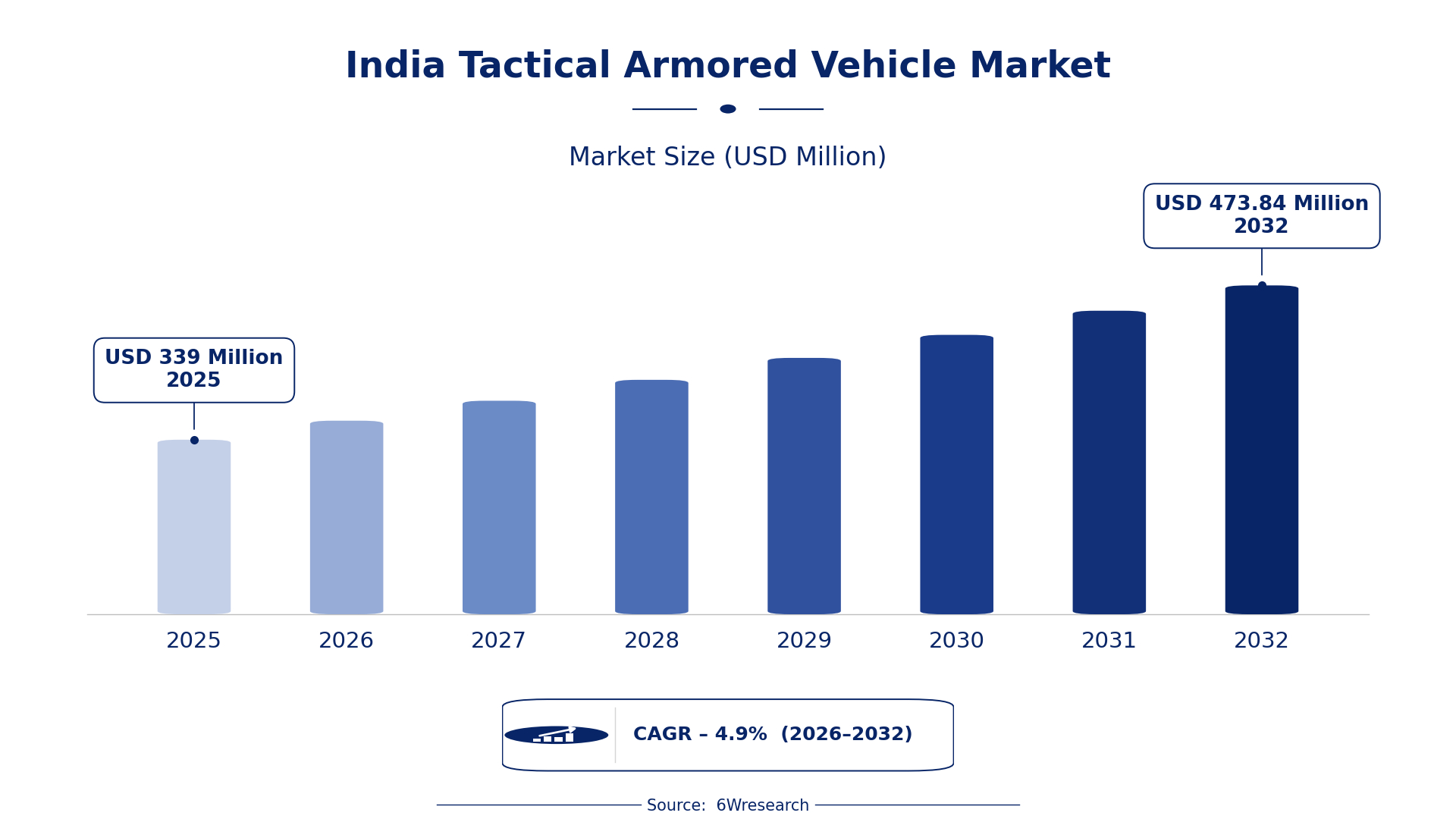
According to 6Wresearch internal database and industry insights, the India Tactical Armored Vehicle Market was valued at USD 339.0 million in 2025 and is projected to reach USD 473.84 million by 2032, growing at a CAGR of approximately 4.9% during 2026–2032.
India Tactical Armored Vehicle Market Highlights
| Report Metric | Details |
| Report Name | India Tactical Armored Vehicle Market |
| Market Size 2025 | USD 339.0 million |
| Market Size 2032 | USD 473.84 million |
| Absolute Growth 2025–2032 | USD 134.84 million |
| CAGR 2026–2032 | 4.9% |
| Peak Annual Growth | 7.5% in 2029 |
| Forecast Period | 2026–2032 |
| Historical Data | 2022–2025 |
| Base Year | 2025 |
| Leading Vehicle Type, 2025 | Light Tactical Vehicles (42% share) |
| Leading Armor Level, 2025 | Blast Resistant Hull (42% share) |
| Leading Mobility Configuration, 2025 | 4x4 Wheeled (47% share) |
| Leading End User, 2025 | Ground Troops (48% share) |
| Fastest-Growing Armor Level | STANAG Level 1–2 (7.5% CAGR) |
| Fastest-Growing Mobility Configuration | 6x6 Wheeled (6.0% CAGR) |
| Fastest-Growing End User | Counter-IED Units (6.6% CAGR) |
| Growing Sector | Military and Defense |
| Key End Users | Ground Troops, Counter-IED Units, Special Task Forces, Marine Battalions |
India Tactical Armored Vehicle Market Year-wise Growth Rate and Key Drivers (2022–2032)
This graph illustrates the annual growth rates of the market from 2022 to 2032, highlighting a steady upward trajectory and projected market expansion over the forecast period.
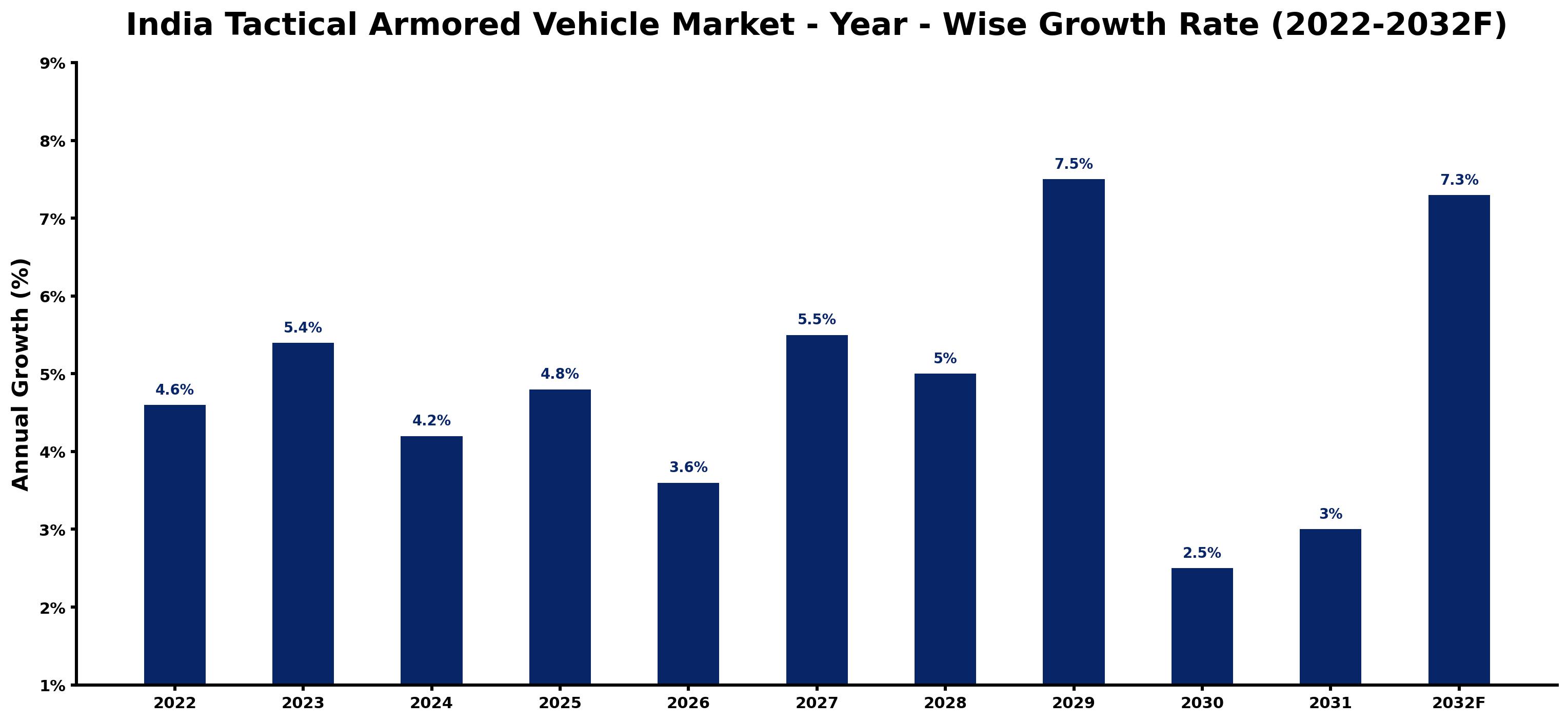
Year by year, the estimates below pair each growth rate with the development that shaped it.
| Year | Estimated Annual Growth (%) | Market Rationale |
| 2022 | 4.6 | The market experienced steady demand from military procurement initiatives. |
| 2023 | 5.4 | Growth was driven by increased defense budget allocations for modernization efforts. |
| 2024 | 4.2 | A slight slowdown occurred as procurement processes adjusted to new regulations. |
| 2025 | 4.8 | Demand rose as the Indian Army targeted new light tactical vehicle acquisitions. |
| 2026 | 3.6 | The market is projected to slow due to challenges in supply chain management and production timelines. |
| 2027 | 5.5 | Growth is expected to accelerate with heightened focus on counter-IED operations and vehicle protection. |
| 2028 | 5.0 | A moderate slowdown is anticipated as procurement strategies are reassessed. |
| 2029 | 7.5 | The market is projected to peak with strong demand for tactical vehicles amid rising security needs. |
| 2030 | 2.5 | Growth is expected to slow as the focus shifts to upgrading existing vehicle fleets. |
| 2031 | 3.0 | Demand is projected to increase again due to renewed investments in defense capabilities. |
| 2032 | 7.3 | The market is expected to grow as local manufacturing initiatives gain momentum. |
Note: Market size estimations and growth projections presented in this report are based on 6Wresearch's proprietary forecasting methodology, utilizing the latest available industry data, government publications, and primary research inputs.
India Tactical Armored Vehicle Market Synopsis
The India Tactical Armored Vehicle Market encompasses specialized military vehicles designed for protection and mobility in combat situations. These vehicles are manufactured using advanced materials to withstand ballistic threats and explosive blasts. The market is expanding due to increased government procurement and modernization efforts, driven by a defense budget of approximately ₹5.25 lakh crore for 2023. Initiatives like 'Make in India' promote local production, while the Indian Armed Forces aim to procure 1,000 light tactical vehicles by 2025 to improve operational capabilities.
Market Dynamics Impact Analysis (2026–2032)
| Factor | Type | Impact | Primary Segment Affected |
| Increased defense budget allocations drive demand for tactical vehicles. | Driver | High | Light Tactical Vehicles |
| The 'Make in India' initiative boosts local manufacturing capabilities. | Driver | High | MRAP Vehicles |
| Growing urbanization creates demand for Urban Patrol vehicles in metropolitan areas. | Opportunity | Medium | Urban Patrol |
| The Indian Navy's focus on amphibious capabilities opens avenues for specialized vehicles. | Opportunity | Medium | Amphibious Tactical |
| Supply chain challenges hinder timely production and delivery of vehicles. | Restraint | High | Light Tactical Vehicles |
| Complex procurement processes can delay acquisitions of tactical vehicles. | Restraint | Medium | MRAP Vehicles |
| The Tactical Armored Vehicle Market in India faces significant supply chain disruptions. | Challenge | High | Armored SUVs |
| Competition from international manufacturers poses a threat to local producers. | Challenge | Medium | Amphibious Tactical |
Evaluation of Drivers in India Tactical Armored Vehicle Market (2026–2032)
The main growth drivers and the segments they affect most are set out below.
| Drivers | Primary Segment Affected | Why It Matters (Evidence) |
| Increased defense budget allocations | Light Tactical Vehicles | The defense budget for 2023, approximately ₹5.25 lakh crore, enables procurement of essential armored vehicles for military operations. |
| Local manufacturing efforts | MRAP Vehicles | The 'Make in India' initiative encourages domestic production, reducing reliance on imports and fostering local supply chains. |
| Rising security needs | Urban Patrol | Urban security concerns are driving demand for Urban Patrol vehicles, particularly in metropolitan areas with a population of around 1.4 billion. |
| Focus on amphibious operations | Amphibious Tactical | The Indian Navy's emphasis on enhancing amphibious capabilities is increasing the demand for specialized tactical vehicles. |
| Counter-IED operations | Counter-IED Units | The establishment of dedicated task forces for counter-IED operations is driving the need for armored vehicles to protect personnel. |
The Tactical Armored Vehicle market in India is expanding as increased defense budget allocations, local manufacturing efforts, and rising security needs drive demand. The defense budget for 2023 is approximately ₹5.25 lakh crore, which supports procurement capabilities for military vehicles. The Indian Armed Forces aim to procure 1,000 light tactical vehicles by 2025, reflecting a commitment to modernization. Urban security concerns are prompting demand for Urban Patrol vehicles, as India's urban population is around 1.4 billion. Additionally, the Indian Navy's focus on enhancing amphibious operations is driving the need for specialized vehicles to protect personnel in coastal environments.
Evaluation of Restraints in India Tactical Armored Vehicle Market
Below mentioned are some major restraints and their influence on market dynamics.
| Market Restraint | Primary Segment Affected | Why It Matters (Evidence) |
| Supply chain disruptions hinder timely production of tactical vehicles. | Light Tactical Vehicles | Challenges in sourcing materials can delay the delivery of essential vehicles. |
| Complex procurement processes can slow down acquisitions of tactical vehicles. | MRAP Vehicles | Bureaucratic hurdles often extend the timeline for securing necessary approvals. |
| Limited availability of skilled labor affects production capacity. | Armored SUVs | A shortage of trained personnel can impact the manufacturing efficiency of armored vehicles. |
| Rising costs of raw materials increase production expenses. | Amphibious Tactical | Fluctuations in material prices can strain budgets for vehicle manufacturers. |
| Regulatory compliance requirements can delay vehicle approvals. | Urban Patrol | Manufacturers must navigate stringent testing and certification processes. |
India Tactical Armored Vehicle Market Challenges
The Tactical Armored Vehicle market in India presents notable challenges for buyers, primarily due to budget limitations. The Indian defence budget for 2023 is approximately ₹5.25 lakh crore, restricting the funds available for acquiring crucial armored vehicles. Technological requirements pose another obstacle, as the demand for STANAG Level 2 armour raises production costs, potentially extending delivery timelines for suppliers. Local manufacturers face stiff competition from foreign firms, resulting in pricing pressures that may erode their market share. Regulatory complexities, especially the Defence Procurement Procedure 2020, complicate the procurement process, causing delays for buyers in securing necessary tactical vehicles.
Trends in the India Tactical Armored Vehicle Market
Below mentioned are some of the trends shaping the India Tactical Armored Vehicle Market growth.
- Shift Towards Enhanced Urban Patrol Capabilities: In 2023, urban patrol vehicles are increasingly utilised in metropolitan areas to tackle rising security concerns. The Indian Armed Forces are expanding their fleet of Urban Patrol vehicles, emphasising rapid response capabilities.
- Growth in Counter-IED Vehicle Demand: The Indian Army's dedicated task force for counter-IED operations is driving the demand for specialised armored vehicles. This initiative aims to procure advanced vehicles, targeting 1,000 light tactical vehicles by 2025.
- Focus on Amphibious Tactical Vehicle Enhancement: The Indian Navy is enhancing its amphibious capabilities, leading to greater procurement of amphibious tactical vehicles. This focus aligns with a broader strategy to strengthen coastal defence operations.
- Rising Demand for Blast Resistant Hull Technology: The adoption of blast resistant hull technology is becoming standard in tactical vehicles. STANAG Level 2 armour is now a requirement for vehicles deployed by Indian ground forces.
Investment Opportunities in the India Tactical Armored Vehicle Market
The following opportunities in the India Tactical Armored Vehicle Market pair current demand with a clear way in.
- Urban Areas Expanding Security Needs: In metropolitan regions, the demand for Urban Patrol vehicles is rising due to increasing security concerns. This creates an opportunity for manufacturers to provide advanced urban patrol solutions.
- Focus on Local Manufacturing Initiatives: The 'Make in India' initiative promotes investment in local production facilities for tactical vehicles. This presents an ideal opportunity for partnerships with local manufacturers to strengthen supply chains.
- Growing Demand for Counter-IED Solutions: With escalating threats from IEDs, there is a considerable opportunity to supply advanced armored vehicles. Counter-IED units are actively seeking new solutions to enhance protection.
- Investment in Amphibious Capabilities: The Indian Navy's emphasis on improving amphibious operations offers opportunities for specialised vehicle manufacturers. Collaboration with defence agencies can facilitate entry into this expanding segment.
Government Initiatives in the India Tactical Armored Vehicle Market
The Ministry of Defence launched the 'Defence Production and Export Promotion Policy' in 2023 to increase defense exports to ₹1.75 lakh crore by 2025. This policy aims to improve the competitiveness of local manufacturers and streamline the export process for tactical vehicles. By encouraging domestic production, it supports buyers in sourcing locally manufactured equipment, reducing lead times and costs. The 'Make in India' initiative was updated in 2021 to provide further incentives for local production of tactical vehicles and components, promoting a self-reliant defense sector.
The 'Make II' scheme encourages private sector participation in defense manufacturing, allowing buyers to collaborate with local firms for tactical vehicle production. This initiative streamlines the approval process for new projects, facilitating quicker market entry for innovative solutions. The Ministry of Defence also funds various projects under this scheme, enhancing the capabilities of local manufacturers. Additionally, the 'Defence Procurement Procedure 2020' was revised in 2022 to simplify procurement processes for tactical vehicles, making it easier for buyers to acquire necessary equipment.
Future Insight of the India Tactical Armored Vehicle Market
The Tactical Armored Vehicle market in India is set for transformation by 2032, driven by several key factors. The 'Make in India' initiative will significantly enhance local production capabilities, allowing manufacturers to meet rising demand. The Indian Army's objective to procure 1,000 light tactical vehicles by 2025 reflects a strong commitment to modernisation. Collaboration with design institutes will lead to improvements in vehicle functionality, while the Indian Navy's focus on expanding amphibious capabilities will create new opportunities for specialised vehicles.
Market Segmentation Analysis
The report offers a comprehensive study of the following market segments and their leading categories in the market.
By Vehicle Type – Light Tactical Vehicles Dominated and Is Expected to Record the Fastest Growth
According to Sumit Sagar, AM at 6Wresearch, Light Tactical Vehicles accounted for a 42% market share by vehicle type in 2025. Light Tactical Vehicles lead the market due to their critical role in troop mobility across varied terrains, essential for the operational capabilities of the Indian Army. Their significance is highlighted by the target to procure 1,000 units by 2025, supported by government procurement initiatives. Its lead should widen, with a projected CAGR of 6.7% during 2026–2032, the highest in this split. The growth of Light Tactical Vehicles is driven by the Indian Army's ongoing modernization efforts, which include upgrading existing fleets to improve operational effectiveness. This continuous demand is likely to further strengthen their market share as procurement goals are achieved. Suppliers must align their strategies with the increasing demand for Light Tactical Vehicles to secure a larger market share.
By Armor Level – Blast Resistant Hull Dominated, STANAG Level 1–2 Expected to Grow Fastest
In 2025, Blast Resistant Hull led the armor level split with a 42% share. The Blast Resistant Hull holds the largest market share due to its essential role in protecting personnel from explosive threats, a critical aspect for the Indian Armed Forces. This focus on survivability is particularly relevant in the context of counter-IED operations, which are a priority for military procurement. STANAG Level 1–2 is projected to grow fastest, at a CAGR of 7.5% during 2026–2032. STANAG Level 1–2 armor is experiencing rapid growth as it sets a benchmark for basic ballistic protection in military vehicles, reflecting the increasing focus on safety. As operational demands evolve, this segment is likely to see continued expansion. Buyers should prioritise armor levels that align with military standards to ensure maximum protection in tactical operations.
By Mobility Configuration – 4x4 Wheeled Dominated, 6x6 Wheeled Expected to Grow Fastest
4x4 Wheeled held a 47% share of the India Tactical Armored Vehicle Market by mobility configuration in 2025. The 4x4 Wheeled configuration dominates the market as it is the preferred choice for light tactical operations, providing an effective balance of mobility and versatility for ground forces. Its extensive use across various military applications solidifies its leading market share. 6x6 Wheeled is set to record the highest CAGR in this split, 6.0% over 2026–2032. The 6x6 Wheeled configuration is witnessing rapid growth, offering enhanced mobility for transporting heavier loads and troops, which aligns with the evolving needs of modern warfare. This trend suggests a shift towards more capable vehicles in the tactical armored vehicle market. Suppliers should expand their product lines to include 6x6 configurations to meet the rising demand for improved mobility.
By End User – Ground Troops Dominated, Counter-IED Units Expected to Grow Fastest
The largest end user category in 2025 was Ground Troops, with a 48% share of total revenue. Ground Troops represent the largest user group for tactical armored vehicles, as they rely heavily on these vehicles for effective combat operations in various environments. Their substantial presence in the market drives demand for specific vehicle types tailored to their needs. Over 2026–2032, Counter-IED Units are expected to post the fastest growth, at a CAGR of 6.6%. Counter-IED Units are the fastest-growing segment, as their operations increasingly depend on armored vehicles for protection against improvised explosive devices. This focus on safety and operational effectiveness will likely expand their market share further. Manufacturers should tailor their offerings to meet the specific requirements of Counter-IED Units to capitalise on this growing segment.
Key Attractiveness of the Report
- 10 Years of Market Numbers
- Historical Data Starting from 2022 to 2025
- Base Year 2025
- Forecast Data until 2032
- Key Performance Indicators Impacting the Market
- Major Upcoming Developments and Projects
Key Highlights of the Report:
- India Tactical Armored Vehicle Market Outlook
- Market Size of India Tactical Armored Vehicle Market, 2025
- Forecast of India Tactical Armored Vehicle Market, 2032
- Historical Data and Forecast of India Tactical Armored Vehicle Revenues & Volume for the Period 2022 - 2032F
- India Tactical Armored Vehicle Market Trend Evolution
- India Tactical Armored Vehicle Market Drivers and Challenges
- India Tactical Armored Vehicle Price Trends
- India Tactical Armored Vehicle Porter's Five Forces
- India Tactical Armored Vehicle Industry Life Cycle
- Historical Data and Forecast of India Tactical Armored Vehicle Market Revenues & Volume By Vehicle Type for the Period 2022 - 2032F
- Historical Data and Forecast of India Tactical Armored Vehicle Market Revenues & Volume By Light Tactical Vehicles for the Period 2022 - 2032F
- Historical Data and Forecast of India Tactical Armored Vehicle Market Revenues & Volume By MRAP Vehicles for the Period 2022 - 2032F
- Historical Data and Forecast of India Tactical Armored Vehicle Market Revenues & Volume By Armored SUVs for the Period 2022 - 2032F
- Historical Data and Forecast of India Tactical Armored Vehicle Market Revenues & Volume By Amphibious Tactical for the Period 2022 - 2032F
- Historical Data and Forecast of India Tactical Armored Vehicle Market Revenues & Volume By Armor Level for the Period 2022 - 2032F
- Historical Data and Forecast of India Tactical Armored Vehicle Market Revenues & Volume By STANAG Level 1 2 for the Period 2022 - 2032F
- Historical Data and Forecast of India Tactical Armored Vehicle Market Revenues & Volume By Blast Resistant Hull for the Period 2022 - 2032F
- Historical Data and Forecast of India Tactical Armored Vehicle Market Revenues & Volume By Bulletproof Glass/Plates for the Period 2022 - 2032F
- Historical Data and Forecast of India Tactical Armored Vehicle Market Revenues & Volume By Waterproof Hull for the Period 2022 - 2032F
- Historical Data and Forecast of India Tactical Armored Vehicle Market Revenues & Volume By Mobility Configuration for the Period 2022 - 2032F
- Historical Data and Forecast of India Tactical Armored Vehicle Market Revenues & Volume By 4x4 Wheeled for the Period 2022 - 2032F
- Historical Data and Forecast of India Tactical Armored Vehicle Market Revenues & Volume By 6x6 Wheeled for the Period 2022 - 2032F
- Historical Data and Forecast of India Tactical Armored Vehicle Market Revenues & Volume By Urban Patrol for the Period 2022 - 2032F
- Historical Data and Forecast of India Tactical Armored Vehicle Market Revenues & Volume By Land-Water Navigation for the Period 2022 - 2032F
- Historical Data and Forecast of India Tactical Armored Vehicle Market Revenues & Volume By End User for the Period 2022 - 2032F
- Historical Data and Forecast of India Tactical Armored Vehicle Market Revenues & Volume By Ground Troops for the Period 2022 - 2032F
- Historical Data and Forecast of India Tactical Armored Vehicle Market Revenues & Volume By Counter-IED Units for the Period 2022 - 2032F
- Historical Data and Forecast of India Tactical Armored Vehicle Market Revenues & Volume By Special Task Forces for the Period 2022 - 2032F
- Historical Data and Forecast of India Tactical Armored Vehicle Market Revenues & Volume By Marine Battalions for the Period 2022 - 2032F
- India Tactical Armored Vehicle Import Export Trade Statistics
- Market Opportunity Assessment By Vehicle Type
- Market Opportunity Assessment By Armor Level
- Market Opportunity Assessment By Mobility Configuration
- Market Opportunity Assessment By End User
- India Tactical Armored Vehicle Top Companies Market Share
- India Tactical Armored Vehicle Competitive Benchmarking By Technical and Operational Parameters
- India Tactical Armored Vehicle Company Profiles
- India Tactical Armored Vehicle Key Strategic Recommendations
Market Covered
Segments analysed in this report are listed below.
By Vehicle Type
- Light Tactical Vehicles
- MRAP Vehicles
- Armored SUVs
- Amphibious Tactical
By Armor Level
- STANAG Level 1–2
- Blast Resistant Hull
- Bulletproof Glass/Plates
- Waterproof Hull
By Mobility Configuration
- 4x4 Wheeled
- 6x6 Wheeled
- Urban Patrol
- Land-Water Navigation
By End User
- Ground Troops
- Counter-IED Units
- Special Task Forces
- Marine Battalions































