India Tactical Communication Radar Market Size & Growth Rate
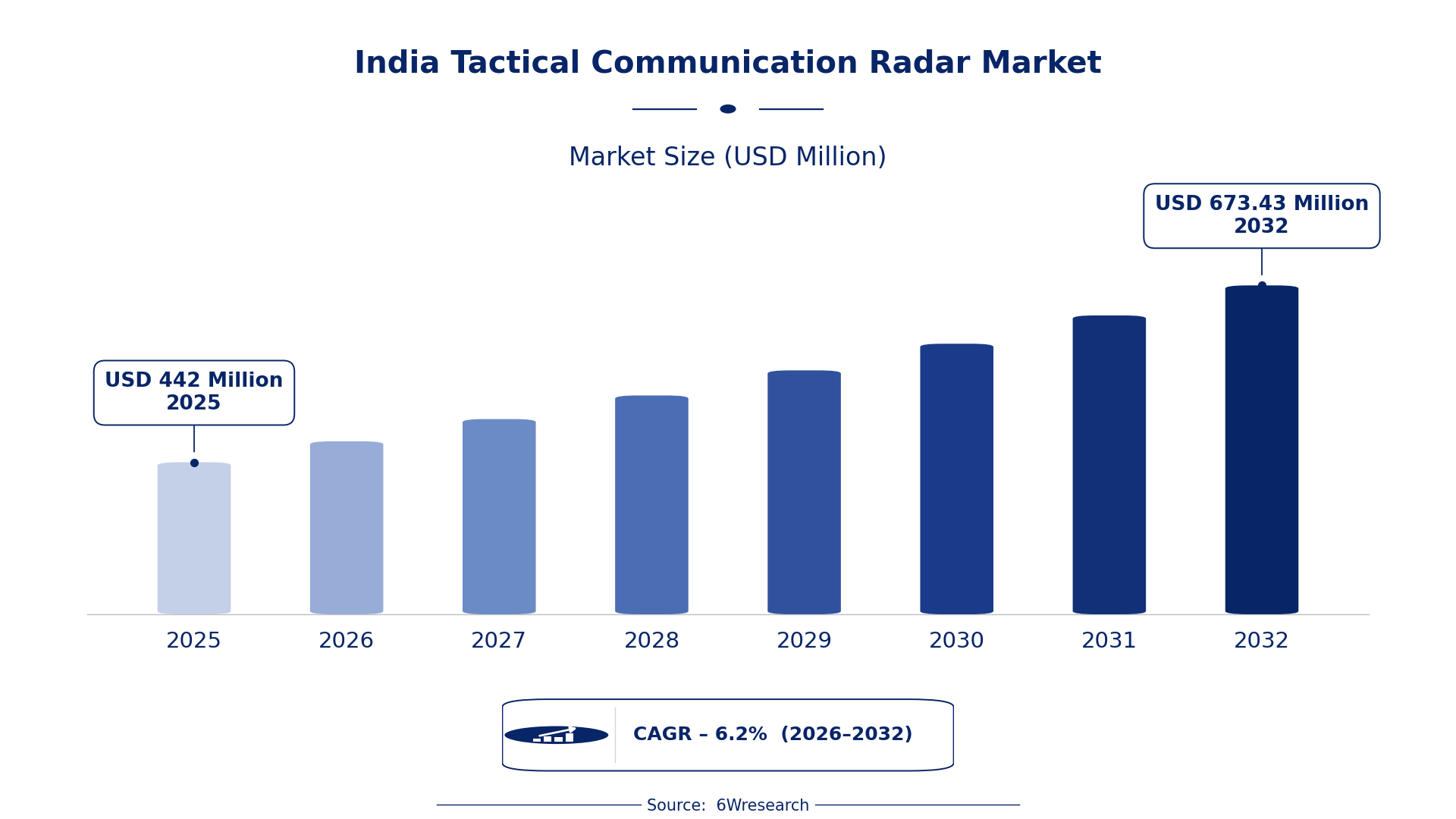
According to 6Wresearch internal database and industry insights, the India Tactical Communication Radar Market was valued at USD 442.0 million in 2025 and is projected to reach USD 673.43 million by 2032, growing at a CAGR of approximately 6.2% during 2026–2032.
India Tactical Communication Radar Market Highlights
| Report Metric | Details |
| Report Name | India Tactical Communication Radar Market |
| Market Size 2025 | USD 442.0 million |
| Market Size 2032 | USD 673.43 million |
| Absolute Growth 2025–2032 | USD 231.43 million |
| CAGR 2026–2032 | 6.2% |
| Peak Annual Growth | 8.2% in 2030 |
| Forecast Period | 2026–2032 |
| Historical Data | 2022–2025 |
| Base Year | 2025 |
| Leading Radar Type, 2025 | Ground Surveillance (36% share) |
| Leading Frequency Band, 2025 | X-Band (41% share) |
| Leading Deployment Mode, 2025 | Mobile (40% share) |
| Leading End User, 2025 | Military Bases (38% share) |
| Fastest-Growing Radar Type | Man-Portable Radar (7.5% CAGR) |
| Fastest-Growing Deployment Mode | Handheld (7.4% CAGR) |
| Fastest-Growing End User | Infantry Units (8.8% CAGR) |
| Growing Sector | Military Operations |
| Key End Users | Military Bases, Infantry Units, ISR Operators, Military Vehicles |
India Tactical Communication Radar Market Year-wise Growth Rate and Key Drivers (2022–2032)
This graph illustrates the annual growth rates of the market from 2022 to 2032, highlighting a steady upward trajectory and projected market expansion over the forecast period.
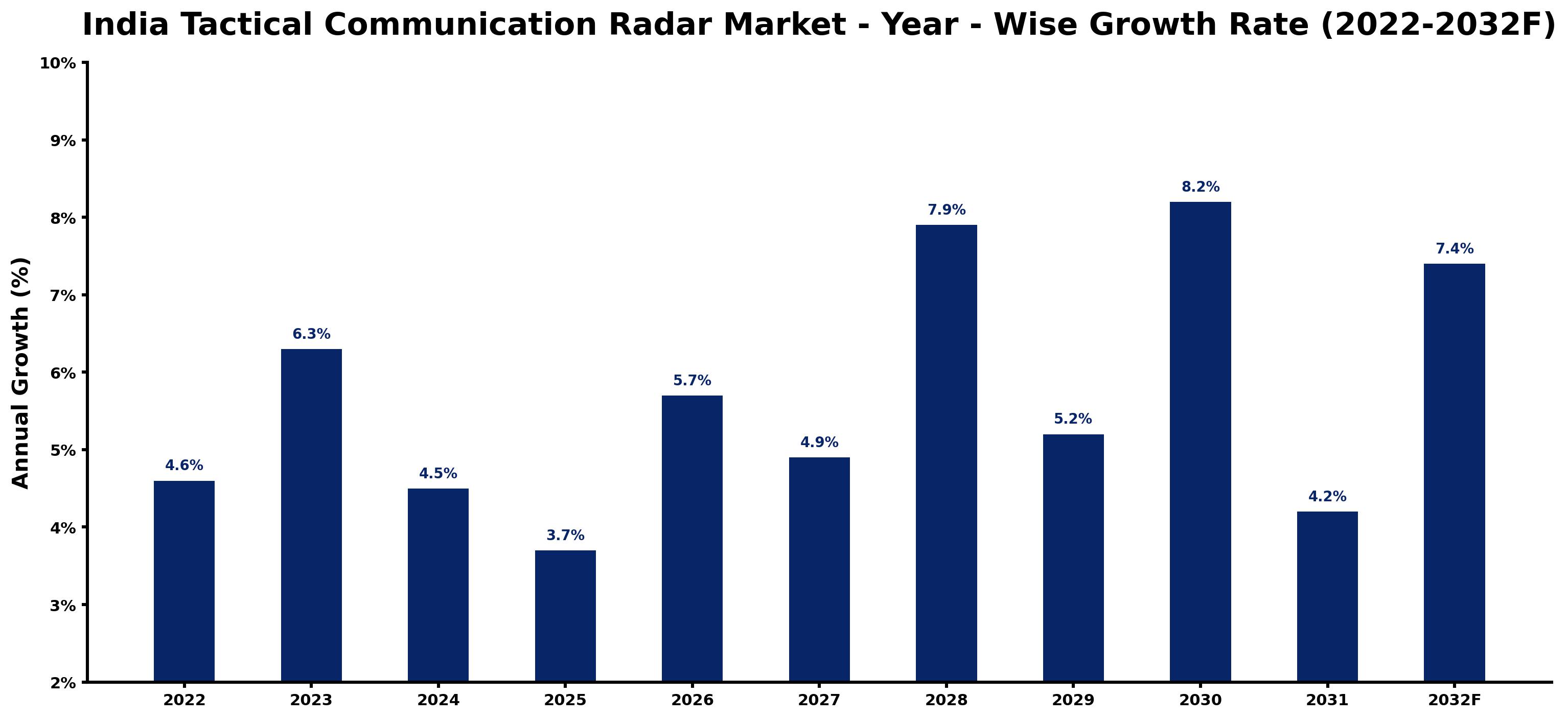
Each row of the following table gives one year's estimated growth and the event or demand shift that explains it.
| Year | Estimated Annual Growth (%) | Market Rationale |
| 2022 | 4.6 | The market experienced steady demand from military bases and ongoing procurement efforts. |
| 2023 | 6.3 | Growth accelerated due to increased investment in indigenous radar technologies. |
| 2024 | 4.5 | Demand slowed slightly as procurement processes faced delays in approvals. |
| 2025 | 3.7 | The market continued to grow, albeit at a slower pace, amid ongoing modernization efforts. |
| 2026 | 5.7 | The Indian Army focuses on upgrading tactical systems under the 'Make in India' initiative. |
| 2027 | 4.9 | Growth will decelerate as the market adjusts to new procurement regulations and standards. |
| 2028 | 7.9 | An increase in demand is projected due to heightened military operations and border security needs. |
| 2029 | 5.2 | The market is expected to experience a slowdown as procurement processes become more stringent and competitive. |
| 2030 | 8.2 | Growth is projected to peak as the Indian military expands its tactical communication capabilities. |
| 2031 | 4.2 | A slowdown will occur following the peak, as the market adjusts to previous expansions. |
| 2032 | 7.4 | Demand is expected to rise again as modernization plans continue to unfold. |
Note: Market size estimations and growth projections presented in this report are based on 6Wresearch's proprietary forecasting methodology, utilizing the latest available industry data, government publications, and primary research inputs.
India Tactical Communication Radar Market Synopsis
The Tactical Communication Radar Market in India encompasses advanced technologies used for secure military communication and surveillance. This sophisticated technology is essential for ground surveillance, target tracking, and situational awareness. The India Tactical Communication Radar Market is growing due to substantial investments in indigenous radar manufacturing and the ongoing modernization of armed forces. The Indian military, with over 1.4 million active personnel, drives demand through initiatives like 'Make in India' and the allocation of ₹70,000 crore for modernization in 2023. Military bases and infantry units are key buyer groups contributing to this growth.
Market Dynamics Impact Analysis (2026–2032)
| Factor | Type | Impact | Primary Segment Affected |
| Increased investment in indigenous radar manufacturing | Driver | High | Ground Surveillance |
| Growing military operations and border security needs | Driver | High | UAV-Based Radar |
| Rising demand for mobile tactical solutions | Opportunity | High | Mobile |
| Expansion of military bases in border regions | Opportunity | High | Military Bases |
| Challenges in procurement processes and approvals | Restraint | Medium | Vehicle-Mounted Radar |
| Dependence on advanced electronic components from abroad | Restraint | Medium | Multi-Band |
| Limited local expertise in advanced radar technologies | Challenge | High | Man-Portable Radar |
| Competition from foreign radar manufacturers | Challenge | High | X-Band |
Evaluation of Drivers in India Tactical Communication Radar Market (2026–2032)
Key forces behind demand, with the segment each one moves most, are listed below.
| Drivers | Primary Segment Affected | Why It Matters (Evidence) |
| Increased funding for indigenous radar projects | Ground Surveillance | This funding supports the development of advanced radar systems, enhancing military capabilities and driving procurement from military bases. |
| Expansion of military operations along borders | UAV-Based Radar | Heightened surveillance needs lead to increased demand for UAV-Based Radars, particularly in border areas, improving reconnaissance efforts. |
| Rising demand for mobile tactical solutions | Mobile | The need for flexibility in military operations boosts demand for Mobile radars, essential for dynamic deployment in various terrains. |
| Investment in indigenous manufacturing capabilities | Vehicle-Mounted Radar | Local production initiatives reduce reliance on imports, encouraging military units to procure Vehicle-Mounted Radars for enhanced operational efficiency. |
| Implementation of the Tactical Communication System project | Man-Portable Radar | This project aims to improve communication capabilities, increasing the demand for Man-Portable Radars among infantry units. |
Growth in the Tactical Communication Radar market in India comes from increased funding for indigenous radar projects, expansion of military operations along borders, and rising demand for mobile tactical solutions. The Indian Air Force employs UAV-Based Radars for reconnaissance missions in border areas, improving surveillance capabilities. The Tactical Communication System project aims to improve communication capabilities for infantry units, leading to increased procurement. The Indian Army's modernization plan includes upgrading Vehicle-Mounted Radar systems by 2025, further driving demand.
Evaluation of Restraints in India Tactical Communication Radar Market
The main factors holding the market back are set out below.
| Market Restraint | Primary Segment Affected | Why It Matters (Evidence) |
| Challenges in procurement processes and approvals | Vehicle-Mounted Radar | Delays in approvals slow down the acquisition of advanced radar systems, affecting military readiness. |
| Dependence on advanced electronic components from abroad | Multi-Band | A leading supplier on imports can lead to supply chain vulnerabilities, impacting production timelines. |
| Limited local expertise in advanced radar technologies | Man-Portable Radar | A shortage of skilled personnel hampers the development and maintenance of sophisticated radar systems. |
| High competition from foreign radar manufacturers | X-Band | Foreign companies often offer advanced technologies at competitive prices, challenging local producers. |
| Budget constraints affecting procurement cycles | Ground Surveillance | Budget limitations can delay the acquisition of essential radar systems for military operations. |
India Tactical Communication Radar Market Challenges
Producers in the India Tactical Communication Radar market encounter a skills shortage, as the current workforce lacks expertise in advanced electronic components and software algorithms, which delays radar development timelines by up to 12 months. Buyers face high costs due to limited local manufacturing capabilities, inflating procurement budgets by 30% compared to imported systems. Increased competition from foreign suppliers pressures local producers to lower prices, potentially compromising the quality and reliability of communication systems for military operations. Supply chain disruptions affect the availability of critical components, leading to project delays that can extend timelines by 6 months for military procurement.
Trends in the India Tactical Communication Radar Market
Buyers and suppliers in the India Tactical Communication Radar Market are adjusting to the following trends.
- Shift Towards Indigenous Manufacturing: The Indian government has set a target of achieving 70% indigenization in defense procurement by 2025. This initiative encourages local manufacturers to produce tactical communication radars, reducing reliance on imports.
- Increase in Mobile Tactical Solutions: Military bases in Jammu and Kashmir are increasingly adopting Mobile radar systems for operational flexibility. This shift is vital for adapting to dynamic military environments and improving situational awareness.
- Focus on Multi-Band Communication Systems: The Indian Navy is investing in Multi-Band communication systems for naval operations, improving interoperability with other forces. This trend reflects a growing need for versatile communication technologies in diverse operational scenarios.
- Expansion of UAV-Based Radar Usage: The Indian Air Force is expanding its use of UAV-Based Radars for reconnaissance missions in border areas, improving surveillance capabilities. This trend aligns with the increasing importance of aerial surveillance in modern military operations.
Investment Opportunities in the India Tactical Communication Radar Market
Below are the investment opportunities with the strongest case in the India Tactical Communication Radar Market.
- Development of Indigenous Radar Manufacturing Facilities: The National Defence Industrial Corridor in Uttar Pradesh is promoting radar technology development, with a target of ₹70,000 crore funding. Local partnerships can improve production capabilities and reduce import dependency.
- Investment in Mobile Tactical Solutions: Military bases require advanced Mobile radar systems to support dynamic operations. Suppliers can enter this market through joint ventures with local manufacturers to meet growing demand.
- Expansion of Handheld Radar Technologies: Infantry units are increasingly seeking Handheld radar solutions for mobility. Investing in this segment can meet the needs of ground troops, particularly in challenging terrains.
- Enhancement of Ground Surveillance Capabilities: The Indian Army's focus on upgrading Ground Surveillance Radars presents opportunities for suppliers. Collaborating with local defence agencies can facilitate market entry and align with modernisation goals.
Government Initiatives in the India Tactical Communication Radar Market
The Defence Acquisition Procedure 2020, implemented by the Ministry of Defence, aims to streamline procurement processes for tactical communication systems. This measure builds on previous frameworks by promoting transparency and reducing delays in acquisitions, which is essential for timely modernization efforts. The 'Digital India' initiative, launched in 2020, supports the integration of advanced communication technologies in military operations, improving operational efficiency. The National Policy on Electronics 2019 encourages domestic production of electronic components used in radar systems, fostering local manufacturing capabilities.
The Defence Production and Export Promotion Policy 2020 aims to increase defense exports, including tactical communication technologies, by 2025. The Defence Research and Development Organisation (DRDO) is actively involved in developing indigenous radar technologies, supporting the initiative's goals. This agency funds various projects to enhance local manufacturing and reduce import dependency, enabling military buyers to procure advanced systems more efficiently.
Future Insight of the India Tactical Communication Radar Market
The India Tactical Communication Radar market is set to evolve by 2032, primarily driven by the 'Make in India' initiative which aims to boost local manufacturing capabilities. The Defence Research and Development Organisation will focus on developing indigenous radar technologies, facilitating quicker deployment of advanced systems. The Indian Army's modernisation plan includes upgrading communication systems, which will improve operational efficiency. With a government target of achieving 70% indigenisation in defence procurement, local suppliers will be motivated to innovate and better meet military demands.
Market Segmentation Analysis
The analysis below covers each segmentation, its leading category in 2025 and its fastest-growing category through 2032.
By Radar Type – Ground Surveillance Dominated, Man-Portable Radar Expected to Grow Fastest
According to Sumit Sagar, AM at 6Wresearch, Ground Surveillance took a 36% share of radar type in 2025, more than any other category. Ground Surveillance radars hold the largest market share because they are essential for monitoring and detecting threats in military operations. Their extensive use in high-security regions, particularly in military bases, ensures a robust installed base that supports ongoing demand. Man-Portable Radar is set to record the highest CAGR in this split, 7.5% over 2026–2032. Man-Portable Radar is witnessing rapid growth due to its mobility and flexibility, which are critical for infantry units in dynamic combat situations. This segment's expansion is fuelled by the increasing necessity for adaptable surveillance solutions on the battlefield. Suppliers should focus on developing versatile radar technologies to meet the specific needs of military operations.
By Frequency Band – X-Band Dominated and Is Expected to Record the Fastest Growth
X-Band accounted for a 41% market share by frequency band in 2025. X-Band radars dominate the market share as they are widely recognised for their high-resolution imaging and tracking capabilities, making them indispensable for military applications. Their established use in various defence operations solidifies their leading position. Its lead should widen, with a projected CAGR of 7.4% during 2026–2032, the highest in this split. X-Band is also the fastest-growing segment due to its versatility and effectiveness in modern warfare, ensuring that its lead will continue to widen as military strategies evolve. The increasing reliance on high-resolution data for operational success fuels this growth. Suppliers must prioritise advancements in X-Band technology to capitalise on the growing demand for high-resolution surveillance capabilities.
By Deployment Mode – Mobile Dominated, Handheld Expected to Grow Fastest
The largest deployment mode category in 2025 was Mobile, with a 40% share of total revenue. Mobile deployment modes command the largest market share as they are crucial for dynamic military operations, enabling forces to effectively respond to changing battlefield conditions. The flexibility offered by mobile systems is vital for successful military engagement. Over 2026–2032, Handheld is expected to post the fastest growth, at a CAGR of 7.4%. Handheld systems are growing swiftly as they provide soldiers with portable surveillance capabilities, addressing the demand for lightweight and efficient solutions in the field. This growth complements the mobile segment, enhancing overall operational effectiveness. Suppliers should prioritise advancements in handheld technologies to meet the increasing demand for portable military communication systems.
By End User – Military Bases Dominated, Infantry Units Expected to Grow Fastest
In 2025, Military Bases led the end user split with a 38% share. Military Bases account for the largest share of the market due to their extensive use for security and surveillance in critical areas. The significant concentration of military personnel and equipment at these bases drives a consistent demand for advanced radar systems. Infantry Units are projected to grow fastest, at a CAGR of 8.8% during 2026–2032. Infantry Units are the fastest-growing segment, relying heavily on tactical communication radars for ground operations, reflecting a heightened focus on enhancing troop capabilities. This trend indicates a shift towards more integrated military strategies. Suppliers should tailor their offerings to meet the specific operational needs of infantry units, ensuring their technologies align with frontline requirements.
Key Attractiveness of the Report
- 10 Years of Market Numbers
- Historical Data Starting from 2022 to 2025
- Base Year 2025
- Forecast Data until 2032
- Key Performance Indicators Impacting the Market
- Major Upcoming Developments and Projects
Key Highlights of the Report:
- India Tactical Communication Radar Market Outlook
- Market Size of India Tactical Communication Radar Market, 2025
- Forecast of India Tactical Communication Radar Market, 2032
- Historical Data and Forecast of India Tactical Communication Radar Revenues & Volume for the Period 2022 - 2032F
- India Tactical Communication Radar Market Trend Evolution
- India Tactical Communication Radar Market Drivers and Challenges
- India Tactical Communication Radar Price Trends
- India Tactical Communication Radar Porter's Five Forces
- India Tactical Communication Radar Industry Life Cycle
- Historical Data and Forecast of India Tactical Communication Radar Market Revenues & Volume By Radar Type for the Period 2022 - 2032F
- Historical Data and Forecast of India Tactical Communication Radar Market Revenues & Volume By Ground Surveillance for the Period 2022 - 2032F
- Historical Data and Forecast of India Tactical Communication Radar Market Revenues & Volume By Man-Portable Radar for the Period 2022 - 2032F
- Historical Data and Forecast of India Tactical Communication Radar Market Revenues & Volume By Vehicle-Mounted Radar for the Period 2022 - 2032F
- Historical Data and Forecast of India Tactical Communication Radar Market Revenues & Volume By UAV-Based Radar for the Period 2022 - 2032F
- Historical Data and Forecast of India Tactical Communication Radar Market Revenues & Volume By Frequency Band for the Period 2022 - 2032F
- Historical Data and Forecast of India Tactical Communication Radar Market Revenues & Volume By X-Band for the Period 2022 - 2032F
- Historical Data and Forecast of India Tactical Communication Radar Market Revenues & Volume By L-Band for the Period 2022 - 2032F
- Historical Data and Forecast of India Tactical Communication Radar Market Revenues & Volume By Ku-Band for the Period 2022 - 2032F
- Historical Data and Forecast of India Tactical Communication Radar Market Revenues & Volume By Multi-Band for the Period 2022 - 2032F
- Historical Data and Forecast of India Tactical Communication Radar Market Revenues & Volume By Deployment Mode for the Period 2022 - 2032F
- Historical Data and Forecast of India Tactical Communication Radar Market Revenues & Volume By Mobile for the Period 2022 - 2032F
- Historical Data and Forecast of India Tactical Communication Radar Market Revenues & Volume By Handheld for the Period 2022 - 2032F
- Historical Data and Forecast of India Tactical Communication Radar Market Revenues & Volume By Tactical Convoy Support for the Period 2022 - 2032F
- Historical Data and Forecast of India Tactical Communication Radar Market Revenues & Volume By Airborne Tactical Comms for the Period 2022 - 2032F
- Historical Data and Forecast of India Tactical Communication Radar Market Revenues & Volume By End User for the Period 2022 - 2032F
- Historical Data and Forecast of India Tactical Communication Radar Market Revenues & Volume By Military Bases for the Period 2022 - 2032F
- Historical Data and Forecast of India Tactical Communication Radar Market Revenues & Volume By Infantry Units for the Period 2022 - 2032F
- Historical Data and Forecast of India Tactical Communication Radar Market Revenues & Volume By Military Vehicles for the Period 2022 - 2032F
- Historical Data and Forecast of India Tactical Communication Radar Market Revenues & Volume By ISR Operators for the Period 2022 - 2032F
- India Tactical Communication Radar Import Export Trade Statistics
- Market Opportunity Assessment By Radar Type
- Market Opportunity Assessment By Frequency Band
- Market Opportunity Assessment By Deployment Mode
- Market Opportunity Assessment By End User
- India Tactical Communication Radar Top Companies Market Share
- India Tactical Communication Radar Competitive Benchmarking By Technical and Operational Parameters
- India Tactical Communication Radar Company Profiles
- India Tactical Communication Radar Key Strategic Recommendations
Market Covered
This report examines the market across the segments below.
By Radar Type
- Ground Surveillance
- Man-Portable Radar
- Vehicle-Mounted Radar
- UAV-Based Radar
By Frequency Band
- X-Band
- L-Band
- Ku-Band
- Multi-Band
By Deployment Mode
- Mobile
- Handheld
- Tactical Convoy Support
- Airborne Tactical Comms
By End User
- Military Bases
- Infantry Units
- Military Vehicles
- ISR Operators































