India Tank Defeat Systems Market Size & Growth Rate
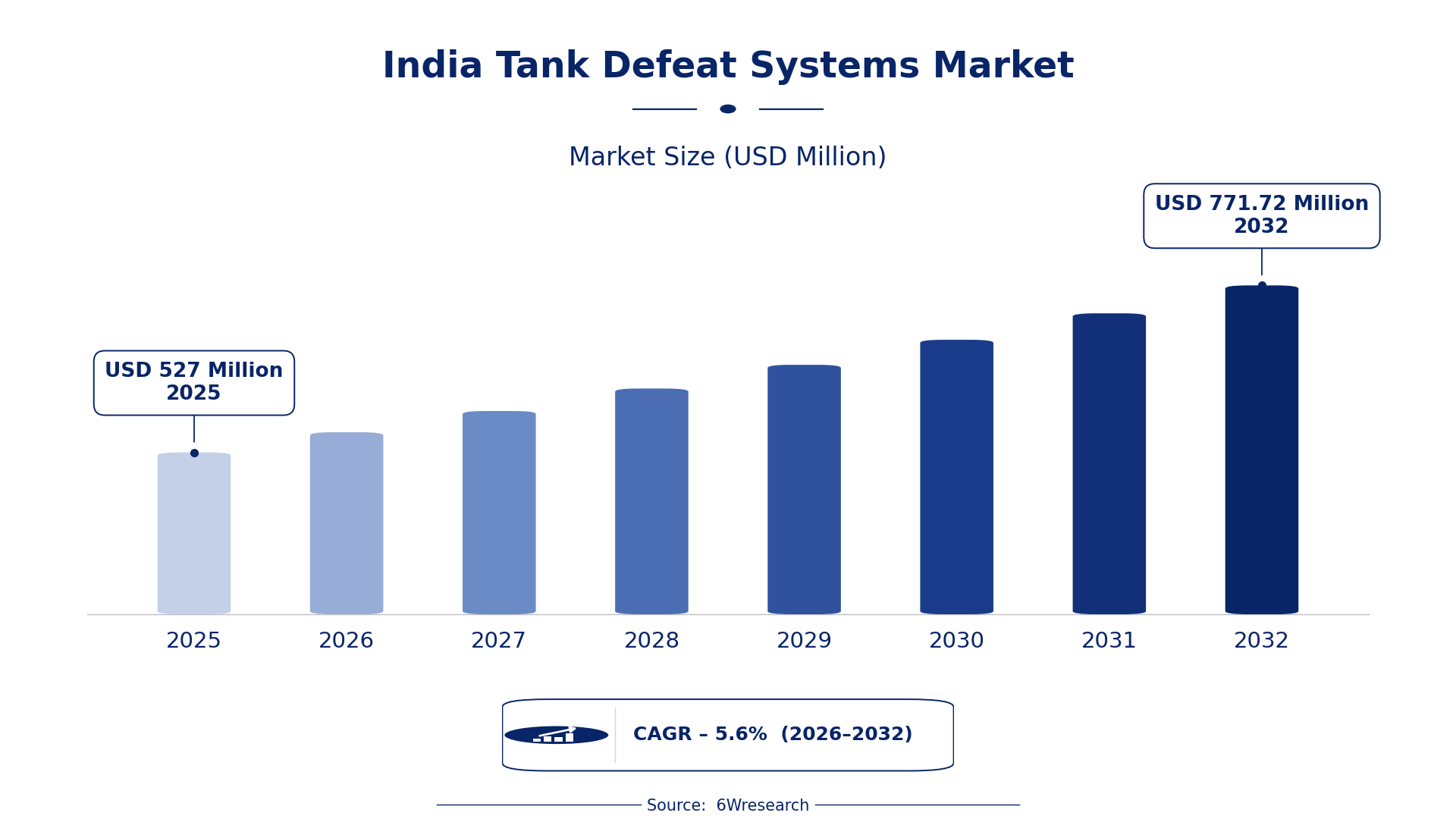
According to 6Wresearch internal database and industry insights, the India Tank Defeat Systems Market was valued at USD 527.0 million in 2025 and is projected to reach USD 771.72 million by 2032, growing at a CAGR of approximately 5.6% during 2026–2032.
India Tank Defeat Systems Market Highlights
| Report Metric | Details |
| Report Name | India Tank Defeat Systems Market |
| Market Size 2025 | USD 527.0 million |
| Market Size 2032 | USD 771.72 million |
| Absolute Growth 2025–2032 | USD 244.72 million |
| CAGR 2026–2032 | 5.6% |
| Peak Annual Growth | 8.1% in 2027 |
| Forecast Period | 2026–2032 |
| Historical Data | 2022–2025 |
| Base Year | 2025 |
| Leading Tank Defeat Systems, 2025 | Anti-Tank Missiles (45% share) |
| Leading Product Type, 2025 | Guided Systems (42% share) |
| Leading Mechanism Type, 2025 | Top-Attack Missiles (39% share) |
| Leading Distribution Channel, 2025 | Government Contracts (46% share) |
| Leading End User Industry, 2025 | Infantry Divisions (47% share) |
| Fastest-Growing Tank Defeat Systems | Loitering Munitions (8.3% CAGR) |
| Fastest-Growing Product Type | Kamikaze Drones (7.2% CAGR) |
| Fastest-Growing Mechanism Type | AI-Targeting (7.8% CAGR) |
| Fastest-Growing Distribution Channel | OEM Procurement (7.2% CAGR) |
| Fastest-Growing End User Industry | Special Forces (7.3% CAGR) |
| Growing Sector | Infantry Divisions |
| Key End Users | Infantry Divisions, Armored Brigades, Special Forces, Defense Suppliers |
India Tank Defeat Systems Market Year-wise Growth Rate and Key Drivers (2022–2032)
This graph illustrates the annual growth rates of the market from 2022 to 2032, highlighting a steady upward trajectory and projected market expansion over the forecast period.
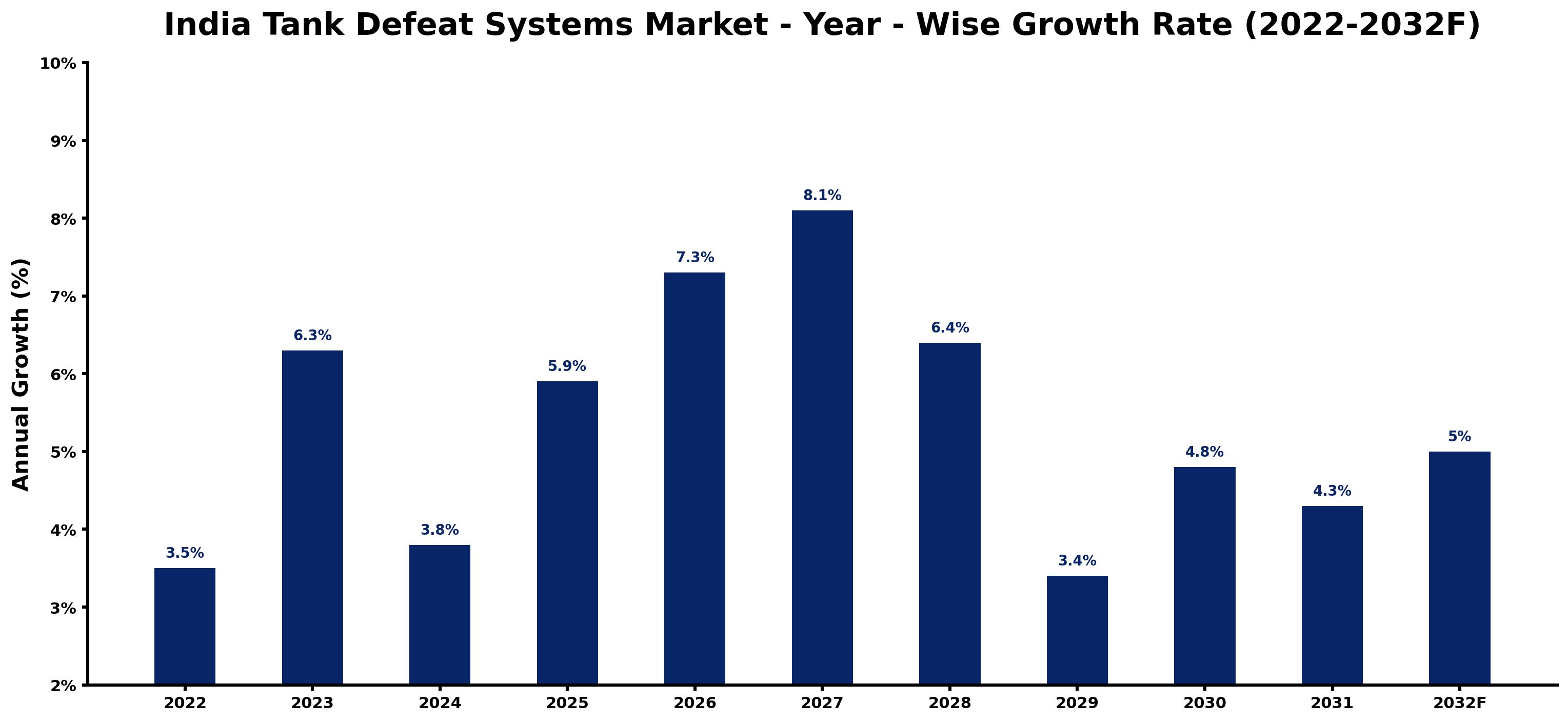
Year by year, the estimates below pair each growth rate with the development that shaped it.
| Year | Estimated Annual Growth (%) | Market Rationale |
| 2022 | 3.5 | The market experienced steady activity due to existing military needs. |
| 2023 | 6.3 | Growth accelerated as the Indian Army focused on modernizing its tank defeat capabilities. |
| 2024 | 3.8 | A slowdown occurred as procurement processes faced delays in approvals and funding. |
| 2025 | 5.9 | Demand surged as the government increased defense spending and contracts for modernization. |
| 2026 | 7.3 | The market expanded further with the introduction of new technologies in defense systems. |
| 2027 | 8.1 | Peak growth was driven by the successful rollout of advanced anti-tank guided missiles. |
| 2028 | 6.4 | A slowdown followed as the market adjusted to the previous year's high growth. |
| 2029 | 3.4 | The market continued to grow, albeit at a slower pace due to procurement challenges. |
| 2030 | 4.8 | Growth picked up again as demand for loitering munitions increased significantly. |
| 2031 | 4.3 | A slight slowdown occurred as the market stabilised after rapid expansion. |
| 2032 | 5.0 | Growth is expected as the modernization plans of the Indian Army continue to unfold. |
Note: Market size estimations and growth projections presented in this report are based on 6Wresearch's proprietary forecasting methodology, utilizing the latest available industry data, government publications, and primary research inputs.
India Tank Defeat Systems Market Synopsis
Tank Defeat Systems in India include technologies aimed at neutralising armoured vehicles, particularly tanks, through advanced engineering and military research. These systems are crucial for gaining an edge on the battlefield and defending against armoured threats. The India Tank Defeat Systems Market is expanding due to rising military expenditure and ongoing modernisation efforts. The Indian defence budget for 2023 stands at approximately ₹5.25 lakh crore, which supports domestic production initiatives. The 'Make in India' initiative is driving local manufacturing, further increasing demand for these systems.
Market Dynamics Impact Analysis (2026–2032)
| Factor | Type | Impact | Primary Segment Affected |
| Increased defense spending and modernization efforts drive demand for advanced systems. | Driver | High | Anti-Tank Missiles |
| The focus on indigenous production creates opportunities for local suppliers. | Driver | High | Loitering Munitions |
| The growing need for advanced weaponry presents significant investment opportunities. | Opportunity | High | Kinetic Energy Weapons |
| The modernization of the Indian Army creates demand for innovative technologies. | Opportunity | High | Directed Energy Systems |
| Procurement delays can slow down the acquisition of necessary technologies. | Restraint | High | Guided Systems |
| Limited funding for R&D can hinder the development of new technologies. | Restraint | Medium | Kamikaze Drones |
| High costs associated with advanced systems can limit procurement budgets. | Challenge | High | APFSDS Rounds |
| Complex approval processes can delay the introduction of new technologies. | Challenge | Medium | DEW Weapons |
Evaluation of Drivers in India Tank Defeat Systems Market (2026–2032)
The main growth drivers and the segments they affect most are set out below.
| Drivers | Primary Segment Affected | Why It Matters (Evidence) |
| Increased defense budget allocation for modernization programs. | Anti-Tank Missiles | The defense budget for 2023 is approximately ₹5.25 lakh crore, leading to more contracts for advanced systems. |
| Growing domestic production capabilities boost supply. | Loitering Munitions | The 'Make in India' initiative supports local manufacturing, increasing the availability of loitering munitions. |
| Rising threats from armored vehicles necessitate advanced systems. | Kinetic Energy Weapons | The modernization plan includes upgrading tank defeat capabilities, driving demand for kinetic energy solutions. |
| Technological advancements in defense systems stimulate market growth. | Directed Energy Systems | The Indian Air Force is exploring directed energy systems for aerial defense, increasing interest in these technologies. |
| Government contracts remain the primary procurement method. | Guided Systems | Government Contracts accounted for 46% of the market in 2025, ensuring steady demand for guided systems. |
Expansion of the Tank Defeat Systems market in India is backed by increased defense spending, modernization efforts, and growing domestic production capabilities. The defense budget for 2023 is approximately ₹5.25 lakh crore, leading to more contracts for advanced systems. The Indian Army's focus on upgrading tank defeat capabilities is driving demand for kinetic energy solutions. Furthermore, advancements in directed energy technologies are expected to stimulate interest in these systems, expanding overall market potential.
Evaluation of Restraints in India Tank Defeat Systems Market
Below mentioned are some major restraints and their influence on market dynamics.
| Market Restraint | Primary Segment Affected | Why It Matters (Evidence) |
| Procurement delays can hinder timely acquisition of systems. | Guided Systems | Complex approval processes can slow down the acquisition of necessary technologies, affecting supply timelines. |
| Limited funding for R&D restricts innovation in defense technologies. | Kamikaze Drones | Budget constraints on research and development can hinder the advancement of new technologies, impacting market growth. |
| High costs associated with advanced systems limit procurement budgets. | APFSDS Rounds | The rising costs of advanced systems can restrict the purchasing power of military buyers. |
| Regulatory hurdles can slow down the introduction of new technologies. | DEW Weapons | Complex approval processes can delay the deployment of new directed energy systems, affecting market growth. |
| Competition from international suppliers can affect local manufacturers. | Loitering Munitions | Increased competition from foreign defense suppliers can pressure local manufacturers to innovate and reduce costs. |
India Tank Defeat Systems Market Challenges
The India Tank Defeat Systems market encounters supply chain disruptions that increase costs for producers, as the current defence budget of approximately ₹5.25 lakh crore restricts procurement flexibility. Competition from international suppliers pressures local manufacturers to reduce prices, which can compromise the quality of systems provided to the Indian Army. Skills shortages in advanced engineering hinder the development of new technologies, delaying necessary upgrades for over 4,000 tanks in active service. Technology gaps in local production capabilities obstruct the timely integration of advanced systems, potentially affecting the armed forces' readiness in modern combat scenarios.
Trends in the India Tank Defeat Systems Market
Buyers and suppliers in the India Tank Defeat Systems Market are adjusting to the following trends.
- Shift towards Indigenous Production: India is placing greater emphasis on indigenous production of defence systems. The 'Make in India' initiative has resulted in a 20% increase in local contracts for tank defeat systems.
- Emergence of Directed Energy Systems: The Indian Armed Forces are investigating directed energy systems to enhance battlefield capabilities. The Indian Air Force is researching these technologies, aiming for deployment by 2025.
- Growth of Loitering Munitions: The demand for loitering munitions is increasing, with the Indian Army expected to procure 200 units by 2025. This reflects a strategic shift in combat tactics.
- Increased Focus on R&D: The Indian government is prioritising research and development in defence technologies. The defence R&D expenditure is approximately 6% of the total defence budget, promoting innovation.
Investment Opportunities in the India Tank Defeat Systems Market
Several openings in the India Tank Defeat Systems Market merit attention from investors.
- Timing for Investment in Local Manufacturing: With the defense budget increasing, there is an opportunity to invest in local manufacturing. The 'Defence Production Policy 2020' aims for ₹1.75 lakh crore in defense manufacturing by 2025.
- Gap in Advanced Technology Supply: The Indian Army's modernization creates a gap in advanced technology supply. Investing in directed energy systems can meet this demand, particularly for the Indian Navy's research initiatives.
- Focus on Infantry Divisions: Infantry divisions represent a key buyer group for tank defeat systems. With a 47% share in 2025, suppliers should target this segment for strategic partnerships.
- Entry through Joint Ventures: Forming joint ventures with local manufacturers can facilitate market entry. Collaborating with firms in the Defence Industrial Corridor in Uttar Pradesh can boost local production capabilities.
Government Initiatives in the India Tank Defeat Systems Market
The 'Defence Production Policy 2020' aims to achieve ₹1.75 lakh crore in defence manufacturing by 2025, promoting indigenous production. This policy encourages local manufacturers to invest in advanced technologies, ensuring a steady supply of tank defeat systems. The 'Atmanirbhar Bharat' initiative launched in 2020 further supports self-reliance in defence manufacturing, focusing on local procurement and production. These measures have led to increased collaboration between government and private sectors, improving overall capabilities in the defence industry.
The 'Defence Acquisition Procedure 2020' was updated to streamline the procurement process, enhancing the efficiency of acquiring defence technologies. The Ministry of Defence oversees these procedures, ensuring that procurement aligns with modernisation goals. Additionally, the 'National Policy on Electronics 2019' aims to strengthen the electronics manufacturing ecosystem, including defence-related technologies. Agencies like the Defence Research and Development Organisation (DRDO) play a significant role in funding and approving new technologies, ensuring that advancements are integrated into the military effectively.
Future Insight of the India Tank Defeat Systems Market
The India Tank Defeat Systems market will undergo substantial changes by 2032, driven by the 'Make in India' initiative, which aims to boost local manufacturing capabilities. The Indian Army's modernisation plan is set to lead to the procurement of 200 loitering munitions by 2025, enhancing operational effectiveness. The 'Defence Production Policy 2020' aims to achieve ₹1.75 lakh crore in defence manufacturing by 2025, promoting innovation and self-reliance. Buyers can expect improved quality and availability of indigenous systems, while suppliers will benefit from increased opportunities through government contracts.
Market Segmentation Analysis
Each segment group is reviewed below, with the leader by share and the fastest grower by CAGR.
By Tank Defeat Systems – Anti-Tank Missiles Dominated, Loitering Munitions Expected to Grow Fastest
According to Sumit Sagar, AM at 6Wresearch, Anti-Tank Missiles accounted for a 45% market share by tank defeat systems in 2025. Anti-Tank Missiles dominate the market due to their critical role in neutralising threats posed by the Indian Army's extensive fleet of over 4,000 tanks. Their effectiveness in engaging armoured vehicles makes them indispensable for ensuring battlefield superiority. The quickest growth will come from Loitering Munitions, forecast to expand at a CAGR of 8.3% between 2026 and 2032. Loitering Munitions are experiencing rapid growth as they offer precision strikes on tanks, with the Indian Armed Forces planning to procure 200 of these systems by 2025. This demand reflects a shift towards more advanced, adaptable technologies in combat scenarios. Suppliers should focus on developing advanced anti-tank solutions to meet the evolving needs of the Indian military.
By Product Type – Guided Systems Dominated, Kamikaze Drones Expected to Grow Fastest
Guided Systems took a 42% share of product type in 2025, more than any other category. Guided Systems command the largest market share due to their essential role in accurately targeting armoured vehicles. Their effectiveness is particularly evident in military operations, where precision is critical for success in combat scenarios. Over 2026–2032, Kamikaze Drones are expected to post the fastest growth, at a CAGR of 7.2%. Kamikaze Drones are witnessing rapid growth as they are increasingly employed for direct attacks on tanks, reflecting a shift towards unmanned systems in modern warfare. This trend highlights the military's evolving strategies that prioritise precision and efficiency. Suppliers should focus on developing guided technologies to meet the increasing demand for effective combat solutions.
By Mechanism Type – Top-Attack Missiles Dominated, AI-Targeting Expected to Grow Fastest
The largest mechanism type category in 2025 was Top-Attack Missiles, with a 39% share of total revenue. Top-Attack Missiles lead the market share as they provide a strategic advantage in targeting tanks from above, crucial for overcoming heavily armoured threats. Their design allows for effective engagements, making them a staple in military arsenals. AI-Targeting is set to record the highest CAGR in this split, 7.8% over 2026–2032. AI-Targeting is growing swiftly as it enhances targeting efficiency, allowing for more accurate engagements with armoured threats. This technology is becoming vital as military operations demand higher accuracy in targeting. Suppliers must invest in advanced targeting technologies to remain competitive in the tank defeat systems market.
By Distribution Channel – Government Contracts Dominated, OEM Procurement Expected to Grow Fastest
Government Contracts held a 46% share of the India Tank Defeat Systems Market by distribution channel in 2025. Government Contracts dominate the procurement landscape for military tank defeat systems, ensuring a steady revenue share for suppliers. This channel is critical for fulfilling the defence requirements of the Indian Armed Forces, providing consistent contract opportunities. OEM Procurement is projected to grow fastest, at a CAGR of 7.2% during 2026–2032. OEM Procurement is rapidly gaining momentum as original equipment manufacturers play a crucial role in supplying advanced systems to the military. This trend highlights the importance of collaboration between manufacturers and the defence sector to address evolving needs. Building strong partnerships with OEMs will enhance distribution capabilities for suppliers in the market.
By End User Industry – Infantry Divisions Dominated, Special Forces Expected to Grow Fastest
With a 47% revenue share in 2025, Infantry Divisions was the largest end user industry category. Infantry Divisions represent the largest consumer group for tank defeat systems, relying on these technologies for frontline operations against armoured threats. Their operational needs significantly drive market demand for effective solutions. The quickest growth will come from Special Forces, forecast to expand at a CAGR of 7.3% between 2026 and 2032. Special Forces are the fastest-growing segment, as they require advanced systems tailored for unique missions involving armoured threats. Their specific operational requirements are leading to increased investments in cutting-edge technologies. Military buyers should prioritise acquiring advanced systems that specifically address the operational needs of Special Forces.
Key Attractiveness of the Report
- 10 Years of Market Numbers
- Historical Data Starting from 2022 to 2025
- Base Year 2025
- Forecast Data until 2032
- Key Performance Indicators Impacting the Market
- Major Upcoming Developments and Projects
Key Highlights of the Report:
- India Tank Defeat Systems Market Outlook
- Market Size of India Tank Defeat Systems Market, 2025
- Forecast of India Tank Defeat Systems Market, 2032
- Historical Data and Forecast of India Tank Defeat Systems Revenues & Volume for the Period 2022 - 2032F
- India Tank Defeat Systems Market Trend Evolution
- India Tank Defeat Systems Market Drivers and Challenges
- India Tank Defeat Systems Price Trends
- India Tank Defeat Systems Porter's Five Forces
- India Tank Defeat Systems Industry Life Cycle
- Historical Data and Forecast of India Tank Defeat Systems Market Revenues & Volume By Tank Defeat Systems for the Period 2022 - 2032F
- Historical Data and Forecast of India Tank Defeat Systems Market Revenues & Volume By Anti-Tank Missiles for the Period 2022 - 2032F
- Historical Data and Forecast of India Tank Defeat Systems Market Revenues & Volume By Loitering Munitions for the Period 2022 - 2032F
- Historical Data and Forecast of India Tank Defeat Systems Market Revenues & Volume By Kinetic Energy Weapons for the Period 2022 - 2032F
- Historical Data and Forecast of India Tank Defeat Systems Market Revenues & Volume By Directed Energy Systems for the Period 2022 - 2032F
- Historical Data and Forecast of India Tank Defeat Systems Market Revenues & Volume By Product Type for the Period 2022 - 2032F
- Historical Data and Forecast of India Tank Defeat Systems Market Revenues & Volume By Guided Systems for the Period 2022 - 2032F
- Historical Data and Forecast of India Tank Defeat Systems Market Revenues & Volume By Kamikaze Drones for the Period 2022 - 2032F
- Historical Data and Forecast of India Tank Defeat Systems Market Revenues & Volume By APFSDS Rounds for the Period 2022 - 2032F
- Historical Data and Forecast of India Tank Defeat Systems Market Revenues & Volume By DEW Weapons for the Period 2022 - 2032F
- Historical Data and Forecast of India Tank Defeat Systems Market Revenues & Volume By Mechanism Type for the Period 2022 - 2032F
- Historical Data and Forecast of India Tank Defeat Systems Market Revenues & Volume By Top-Attack Missiles for the Period 2022 - 2032F
- Historical Data and Forecast of India Tank Defeat Systems Market Revenues & Volume By AI-Targeting for the Period 2022 - 2032F
- Historical Data and Forecast of India Tank Defeat Systems Market Revenues & Volume By Tank-Mounted for the Period 2022 - 2032F
- Historical Data and Forecast of India Tank Defeat Systems Market Revenues & Volume By Laser-Guided for the Period 2022 - 2032F
- Historical Data and Forecast of India Tank Defeat Systems Market Revenues & Volume By Distribution Channel for the Period 2022 - 2032F
- Historical Data and Forecast of India Tank Defeat Systems Market Revenues & Volume By Government Contracts for the Period 2022 - 2032F
- Historical Data and Forecast of India Tank Defeat Systems Market Revenues & Volume By Defense Suppliers for the Period 2022 - 2032F
- Historical Data and Forecast of India Tank Defeat Systems Market Revenues & Volume By OEM Procurement for the Period 2022 - 2032F
- Historical Data and Forecast of India Tank Defeat Systems Market Revenues & Volume By Specialty Vendors for the Period 2022 - 2032F
- Historical Data and Forecast of India Tank Defeat Systems Market Revenues & Volume By End User Industry for the Period 2022 - 2032F
- Historical Data and Forecast of India Tank Defeat Systems Market Revenues & Volume By Infantry Divisions for the Period 2022 - 2032F
- Historical Data and Forecast of India Tank Defeat Systems Market Revenues & Volume By Special Forces for the Period 2022 - 2032F
- Historical Data and Forecast of India Tank Defeat Systems Market Revenues & Volume By Armored Brigades for the Period 2022 - 2032F
- Historical Data and Forecast of India Tank Defeat Systems Market Revenues & Volume By Research Facilities for the Period 2022 - 2032F
- India Tank Defeat Systems Import Export Trade Statistics
- Market Opportunity Assessment By Tank Defeat Systems
- Market Opportunity Assessment By Product Type
- Market Opportunity Assessment By Mechanism Type
- Market Opportunity Assessment By Distribution Channel
- Market Opportunity Assessment By End User Industry
- India Tank Defeat Systems Top Companies Market Share
- India Tank Defeat Systems Competitive Benchmarking By Technical and Operational Parameters
- India Tank Defeat Systems Company Profiles
- India Tank Defeat Systems Key Strategic Recommendations
Market Covered
The report offers an extensive study of the following market segments.
By Tank Defeat Systems
- Anti-Tank Missiles
- Loitering Munitions
- Kinetic Energy Weapons
- Directed Energy Systems
By Product Type
- Guided Systems
- Kamikaze Drones
- APFSDS Rounds
- DEW Weapons
By Mechanism Type
- Top-Attack Missiles
- AI-Targeting
- Tank-Mounted
- Laser-Guided
By Distribution Channel
- Government Contracts
- Defense Suppliers
- OEM Procurement
- Specialty Vendors
By End User Industry
- Infantry Divisions
- Special Forces
- Armored Brigades
- Research Facilities































