India Targeted Cancer Drugs Market Size & Growth Rate
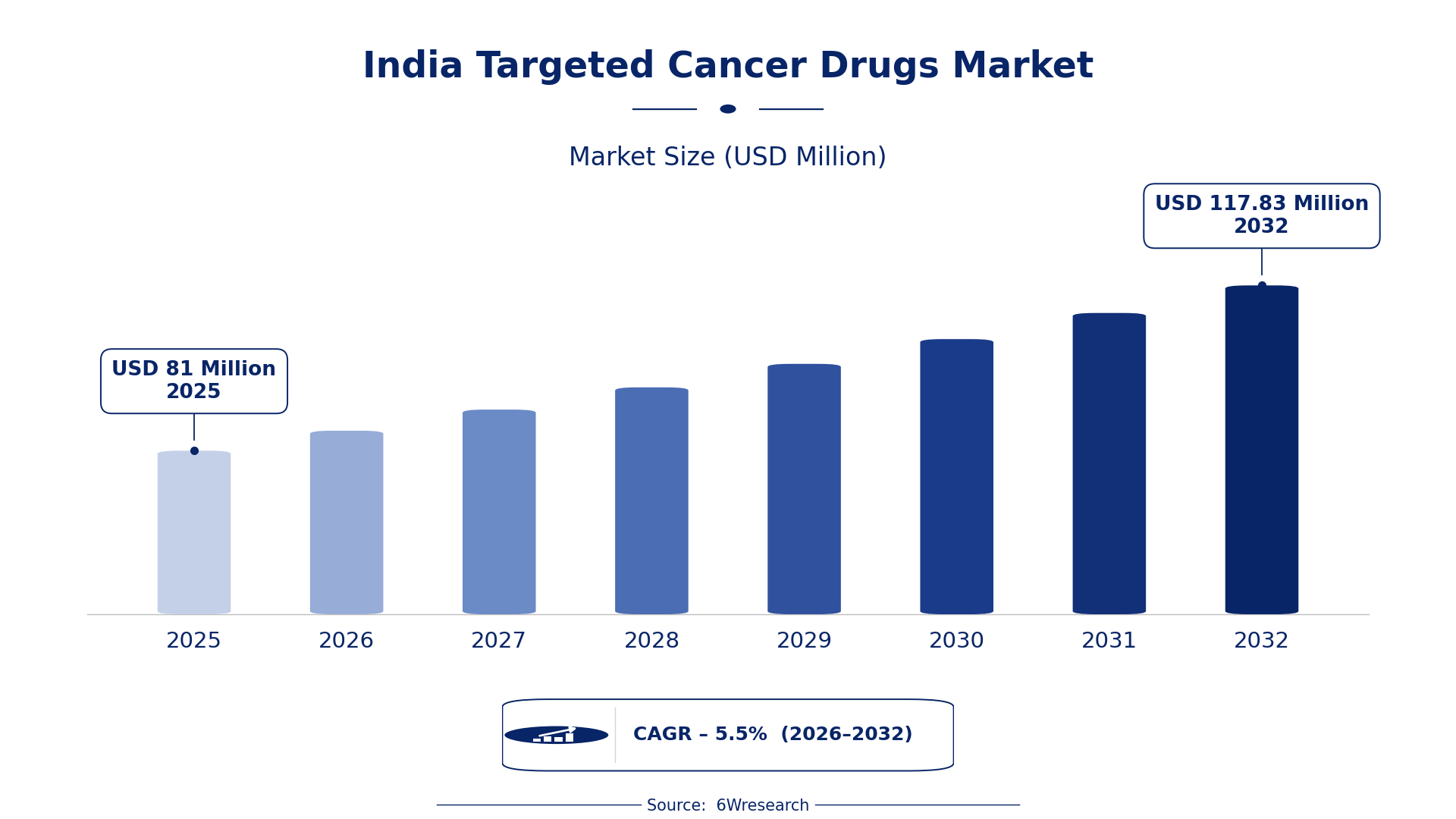
According to 6Wresearch internal database and industry insights, the India Targeted Cancer Drugs Market was valued at USD 81.0 million in 2025 and is projected to reach USD 117.83 million by 2032, growing at a CAGR of approximately 5.5% during 2026–2032.
India Targeted Cancer Drugs Market Highlights
| Report Metric | Details |
| Report Name | India Targeted Cancer Drugs Market |
| Market Size 2025 | USD 81.0 million |
| Market Size 2032 | USD 117.83 million |
| Absolute Growth 2025–2032 | USD 36.83 million |
| CAGR 2026–2032 | 5.5% |
| Peak Annual Growth | 7.6% in 2026 |
| Forecast Period | 2026–2032 |
| Historical Data | 2022–2025 |
| Base Year | 2025 |
| Leading Targeted Cancer Drugs, 2025 | Monoclonal Antibodies (44% share) |
| Leading Drug Type, 2025 | Anti-HER2 (41% share) |
| Leading Mechanism, 2025 | Immune Modulators (43% share) |
| Leading Distribution Channel, 2025 | Oncology Clinics (44% share) |
| Leading End User Industry, 2025 | Breast/Lung Cancer (40% share) |
| Fastest-Growing Targeted Cancer Drugs | PARP Inhibitors (7.5% CAGR) |
| Fastest-Growing Drug Type | PD-1/PD-L1 Inhibitors (7.6% CAGR) |
| Fastest-Growing Mechanism | Synthetic Lethality (8.2% CAGR) |
| Fastest-Growing End User Industry | Ovarian/Prostate Cancers (7.6% CAGR) |
| Growing Sector | Oncology |
| Key End Users | Oncology Clinics, Hospitals, Healthcare Providers |
India Targeted Cancer Drugs Market Year-wise Growth Rate and Key Drivers (2022–2032)
This graph illustrates the annual growth rates of the market from 2022 to 2032, highlighting a steady upward trajectory and projected market expansion over the forecast period.
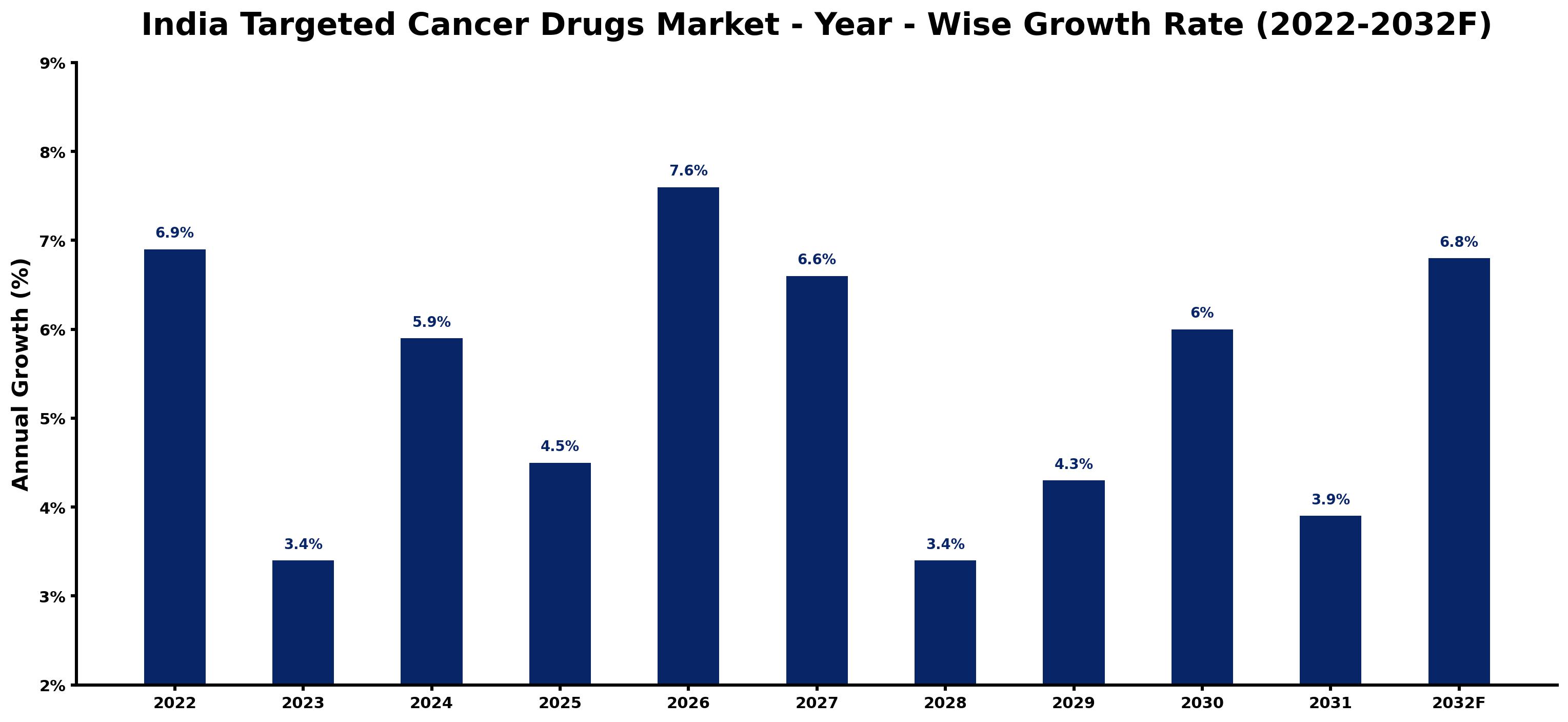
Year by year, the estimates below pair each growth rate with the development that shaped it.
| Year | Estimated Annual Growth (%) | Market Rationale |
| 2022 | 6.9 | The market experienced strong demand due to rising cancer cases and treatment advancements. |
| 2023 | 3.4 | Growth slowed as the market adjusted to new regulations and supply chain challenges. |
| 2024 | 5.9 | A recovery in growth was noted as healthcare investments increased and patient awareness rose. |
| 2025 | 4.5 | The market continued to grow, albeit at a slower pace, due to ongoing treatment accessibility issues. |
| 2026 | 7.6 | Demand surged with the introduction of new therapies and increased government support for cancer care. |
| 2027 | 6.6 | Growth slowed as market conditions stabilised and competition intensified among drug providers. |
| 2028 | 3.4 | The market saw further slowdown as healthcare budgets faced constraints amid economic pressures. |
| 2029 | 4.3 | Growth picked up again as new treatment options became available and patient numbers increased. |
| 2030 | 6.0 | Demand strengthened with advancements in targeted therapies and expanded healthcare initiatives. |
| 2031 | 3.9 | Growth slowed slightly due to market saturation and the need for continuous innovation. |
| 2032 | 6.8 | The market is expected to grow as new drugs enter the market and treatment options expand. |
Note: Market size estimations and growth projections presented in this report are based on 6Wresearch's proprietary forecasting methodology, utilizing the latest available industry data, government publications, and primary research inputs.
India Targeted Cancer Drugs Market Synopsis
Targeted cancer drugs are medications specifically designed to target cancer cells while minimising damage to normal cells. These drugs are produced through advanced biotechnological methods and are primarily used for treating breast, lung, and blood cancers. The increasing number of oncology clinics and growing patient awareness further contribute to this demand.
Market Dynamics Impact Analysis (2026–2032)
| Factor | Type | Impact | Primary Segment Affected |
| Increasing investment in healthcare infrastructure and research initiatives | Driver | High | Monoclonal Antibodies |
| Growing prevalence of cancer cases, particularly breast and lung cancers | Driver | High | Monoclonal Antibodies |
| Rising demand for advanced therapies in urban healthcare facilities | Opportunity | High | Oncology Clinics |
| Expansion of oncology clinics in major cities to meet patient needs | Opportunity | High | Oncology Clinics |
| Regulatory hurdles in drug approval processes delaying market entry | Restraint | High | Monoclonal Antibodies |
| High costs associated with advanced cancer treatments limiting accessibility | Restraint | High | Monoclonal Antibodies |
| Limited availability of skilled professionals for cancer treatment | Challenge | Medium | Monoclonal Antibodies |
| Inconsistent supply of raw materials for drug production affecting availability | Challenge | Medium | Monoclonal Antibodies |
Evaluation of Drivers in India Targeted Cancer Drugs Market (2026–2032)
Key forces behind demand, with the segment each one moves most, are listed below.
| Drivers | Primary Segment Affected | Why It Matters (Evidence) |
| Increased healthcare funding for cancer research and treatment | Monoclonal Antibodies | The Indian government allocated ₹1,000 crores for cancer research in 2023, boosting drug development. |
| Growing patient awareness about targeted therapies | Oncology Clinics | The National Cancer Control Program has raised awareness, leading to more patients seeking treatment. |
| Advancements in biotechnological methods for drug production | Monoclonal Antibodies | Innovations in monoclonal antibody technology improve drug efficacy, attracting more patients. |
| Rising number of oncology clinics across urban areas | Oncology Clinics | With over 200 clinics in major cities, access to targeted therapies has improved significantly. |
| Collaboration between research institutions and pharmaceutical companies | Monoclonal Antibodies | Joint ventures are increasing the development of new therapies, meeting rising demand. |
Market growth in India for Targeted Cancer Drugs relies on increased healthcare funding, heightened patient awareness, and advancements in biotechnological methods. With over 200 oncology clinics in major cities, access to targeted therapies has improved, driving demand. Collaborations between research institutions and pharmaceutical companies are also accelerating the development of new therapies, addressing the need for fresh solutions.
Evaluation of Restraints in India Targeted Cancer Drugs Market
The following restraints limit how fast demand can grow.
| Market Restraint | Primary Segment Affected | Why It Matters (Evidence) |
| Regulatory hurdles in drug approval processes delaying market entry | Monoclonal Antibodies | The Drugs and Cosmetics Act adds complexity to the approval process, causing delays for new therapies. |
| High costs associated with advanced cancer treatments limiting accessibility | Monoclonal Antibodies | Patients often face financial barriers, reducing the number of individuals seeking treatment. |
| Limited availability of skilled professionals for cancer treatment | Monoclonal Antibodies | The shortage of trained oncologists affects patient access to necessary therapies. |
| Inconsistent supply of raw materials for drug production affecting availability | Monoclonal Antibodies | Supply chain disruptions can lead to shortages of essential components for drug manufacturing. |
| Market saturation with existing therapies reducing new drug uptake | Monoclonal Antibodies | As more therapies enter the market, competition increases, making it harder for new entrants. |
India Targeted Cancer Drugs Market Challenges
The India Targeted Cancer Drugs Market still has to solve a few problems, starting with supply chain disruptions. Many oncology clinics face delays in receiving targeted cancer drugs due to import restrictions, which can postpone treatments for patients by several weeks. Technological limitations persist; advanced biotechnological methods for drug synthesis are not widely adopted, forcing suppliers to rely on foreign innovations that can increase costs. Regulatory hurdles complicate access, as the lengthy approval process under the Drugs and Cosmetics Act can delay new drug availability, impacting patient care. Buyers also encounter high prices for these treatments, with some costing up to ₹1.5 lakhs per month, limiting access for many patients in need.
Trends in the India Targeted Cancer Drugs Market
Buyers and suppliers in the India Targeted Cancer Drugs Market are adjusting to the following trends.
- Shift from Traditional to Targeted Therapies: Since 2022, there has been a notable shift towards targeted therapies in cancer treatment, particularly in breast cancer. The National Cancer Control Program has driven this change, with a projected increase in targeted therapy usage by 30% by 2025.
- Emergence of Immunotherapy as a Key Treatment: In 2023, immunotherapy has gained traction, especially among lung cancer patients. The establishment of Immunotherapy Centers has contributed to a 25% rise in treatment adoption, showcasing its effectiveness.
- Increased Focus on Genetic Testing for Treatment Personalisation: From 2022, healthcare providers have started prioritising genetic testing to tailor cancer treatments. This shift is evident in the growing number of patients opting for personalised therapies, with a 20% increase reported.
- Expansion of Oncology Clinics in Urban Areas: Since 2021, the number of oncology clinics has surged, particularly in metropolitan regions. With over 200 clinics now operational, patient access to targeted therapies has improved significantly.
Investment Opportunities in the India Targeted Cancer Drugs Market
The following opportunities in the India Targeted Cancer Drugs Market pair current demand with a clear way in.
- Joint Ventures with Local Healthcare Providers: Establishing partnerships with local healthcare providers can facilitate market entry. With the Indian pharmaceutical market expected to grow to $65 billion by 2024, collaboration is essential for success.
- Investment in Research for Advanced Therapies: With the Indian government allocating ₹1,000 crores for cancer research in 2023, there is a significant opportunity for investment in innovative therapies. Targeted cancer drug developers can benefit from this funding.
- Expansion into Tier 2 and Tier 3 Cities: There is a growing need for targeted cancer therapies in smaller cities. As urban healthcare expands, suppliers can enter these markets to meet increasing demand, especially in oncology clinics.
- Supply of Genetic Testing Kits for Personalised Medicine: The demand for genetic testing kits is rising as healthcare providers focus on personalised medicine. Suppliers can capitalise on this trend by offering advanced testing solutions.
Government Initiatives in the India Targeted Cancer Drugs Market
The National Cancer Control Program, launched by the Ministry of Health and Family Welfare in 2022, aims to reduce cancer mortality by 30% by 2025. This initiative focuses on improving access to cancer treatments and raising awareness among the population. The program also allocates resources for training healthcare professionals, ensuring that patients receive timely and effective care. Additionally, it promotes the establishment of more oncology clinics across the country to meet the growing demand for targeted therapies.
The National Health Mission, updated in 2020, includes provisions for cancer treatment and prevention at the primary healthcare level. This scheme supports the establishment of healthcare facilities equipped to provide targeted cancer therapies. The Ministry of Health oversees funding for cancer research initiatives, ensuring that advancements in treatment options are accessible to patients. Through these efforts, the government aims to improve overall cancer care and reduce mortality rates.
Future Insight of the India Targeted Cancer Drugs Market
The India Targeted Cancer Drugs Market is set to evolve by 2032, driven by several key factors. The National Cancer Control Program will improve treatment accessibility, while the allocation of ₹1,000 crores for cancer research will support innovation in drug development. The 'Pharma Vision 2025' initiative aims to improve drug accessibility, ensuring that more patients can receive timely treatments. The expansion of over 200 oncology clinics across major cities will facilitate better patient access to targeted therapies, ultimately improving overall cancer care outcomes.
Market Segmentation Analysis
The analysis below covers each segmentation, its leading category in 2025 and its fastest-growing category through 2032.
By Targeted Cancer Drugs – Monoclonal Antibodies Dominated, PARP Inhibitors Expected to Grow Fastest
According to Sumit Sagar, AM at 6Wresearch, Monoclonal Antibodies took a 44% share of targeted cancer drugs in 2025, more than any other category. Monoclonal antibodies hold the largest share due to their extensive applications in treating various cancers, particularly breast cancer, which is the most prevalent in India. With over 200 oncology clinics across major cities, the installed base for these therapies continues to expand. PARP Inhibitors are projected to grow fastest, at a CAGR of 7.5% during 2026–2032. The rapid growth of PARP inhibitors is propelled by their effectiveness in treating cancers with specific genetic mutations, aligning with the increasing focus on personalised medicine. As awareness and testing for genetic markers rise, demand for these inhibitors is expected to surge. This trend indicates that suppliers should prioritise the development and distribution of monoclonal antibodies and PARP inhibitors to meet the growing demand.
By Drug Type – Anti-HER2 Dominated, PD-1/PD-L1 Inhibitors Expected to Grow Fastest
In 2025, Anti-HER2 led the drug type split with a 41% share. Anti-HER2 drugs dominate the market due to their targeted action against HER2-positive breast cancer, which is the most prevalent cancer type in India. The significant patient population seeking these therapies ensures a robust demand for Anti-HER2 medications. Over 2026–2032, PD-1/PD-L1 Inhibitors are expected to post the fastest growth, at a CAGR of 7.6%. PD-1/PD-L1 inhibitors are rapidly growing in popularity as they play a crucial role in immunotherapy for various cancers, particularly lung cancer, which accounts for 6.9% of all cases in India. The increasing recognition of immunotherapy's effectiveness is driving this segment's growth. Suppliers should focus on expanding their portfolio of PD-1/PD-L1 inhibitors to capitalise on the rising demand for immunotherapy in cancer treatment.
By Mechanism – Immune Modulators Dominated, Synthetic Lethality Expected to Grow Fastest
Immune Modulators accounted for a 43% market share by mechanism in 2025. Immune modulators lead the market by enhancing the body's immune response against cancer, which is vital for treating common cancers such as breast and lung cancer. Their established role in oncology clinics solidifies their market position as a preferred treatment option. The quickest growth will come from Synthetic Lethality, forecast to expand at a CAGR of 8.2% between 2026 and 2032. Synthetic lethality is emerging as a key growth area as it targets specific vulnerabilities in cancer cells, offering new therapeutic possibilities. As research progresses, this mechanism is likely to gain traction in the treatment of difficult-to-treat cancers. Suppliers should prioritise the development of synthetic lethality strategies to remain competitive in the evolving cancer treatment landscape.
By Distribution Channel – Oncology Clinics Dominated and Is Expected to Record the Fastest Growth
With a 44% revenue share in 2025, Oncology Clinics was the largest distribution channel category. Oncology clinics are the primary distribution channel for targeted therapies, serving as the main point of care for patients undergoing treatment. Their extensive presence in major cities ensures that patients have timely access to essential targeted cancer drugs. Oncology Clinics are also forecast to expand faster than any other category, at a CAGR of 7.3% over 2026–2032. The growth of oncology clinics as a distribution channel is set to continue as they adapt to increasing patient needs and advancements in treatment options. Their dual role as both leader and fastest segment underscores their critical importance in the targeted cancer drugs market. Suppliers should strengthen partnerships with oncology clinics to improve distribution efficiency and enhance patient access to targeted therapies.
By End User Industry – Breast/Lung Cancer Dominated, Ovarian/Prostate Cancers Expected to Grow Fastest
The largest end user industry category in 2025 was Breast/Lung Cancer, with a 40% share of total revenue. Breast and lung cancers are the main focus areas for targeted therapies, representing a significant share of the cancer burden in India. The ongoing initiatives to enhance cancer care further drive the demand for treatments in these prevalent areas. Ovarian/Prostate Cancers are projected to grow fastest, at a CAGR of 7.6% during 2026–2032. The rising focus on ovarian and prostate cancers is propelling rapid growth in this segment, as awareness and screening efforts for these cancers improve. This trend reflects a broader acceptance of targeted therapies across various cancer types. Suppliers should broaden their product lines to include therapies for ovarian and prostate cancers to capture emerging market opportunities.
Key Attractiveness of the Report
- 10 Years of Market Numbers
- Historical Data Starting from 2022 to 2025
- Base Year 2025
- Forecast Data until 2032
- Key Performance Indicators Impacting the Market
- Major Upcoming Developments and Projects
Key Highlights of the Report:
- India Targeted Cancer Drugs Market Outlook
- Market Size of India Targeted Cancer Drugs Market, 2025
- Forecast of India Targeted Cancer Drugs Market, 2032
- Historical Data and Forecast of India Targeted Cancer Drugs Revenues & Volume for the Period 2022 - 2032F
- India Targeted Cancer Drugs Market Trend Evolution
- India Targeted Cancer Drugs Market Drivers and Challenges
- India Targeted Cancer Drugs Price Trends
- India Targeted Cancer Drugs Porter's Five Forces
- India Targeted Cancer Drugs Industry Life Cycle
- Historical Data and Forecast of India Targeted Cancer Drugs Market Revenues & Volume By Targeted Cancer Drugs for the Period 2022 - 2032F
- Historical Data and Forecast of India Targeted Cancer Drugs Market Revenues & Volume By Monoclonal Antibodies for the Period 2022 - 2032F
- Historical Data and Forecast of India Targeted Cancer Drugs Market Revenues & Volume By Tyrosine Kinase Inhibitors for the Period 2022 - 2032F
- Historical Data and Forecast of India Targeted Cancer Drugs Market Revenues & Volume By PARP Inhibitors for the Period 2022 - 2032F
- Historical Data and Forecast of India Targeted Cancer Drugs Market Revenues & Volume By Immune Checkpoint Inhibitors for the Period 2022 - 2032F
- Historical Data and Forecast of India Targeted Cancer Drugs Market Revenues & Volume By Drug Type for the Period 2022 - 2032F
- Historical Data and Forecast of India Targeted Cancer Drugs Market Revenues & Volume By Anti-HER2, EGFR for the Period 2022 - 2032F
- Historical Data and Forecast of India Targeted Cancer Drugs Market Revenues & Volume By Oral Drugs for the Period 2022 - 2032F
- Historical Data and Forecast of India Targeted Cancer Drugs Market Revenues & Volume By DNA Repair Blockers for the Period 2022 - 2032F
- Historical Data and Forecast of India Targeted Cancer Drugs Market Revenues & Volume By PD-1/PD-L1 Inhibitors for the Period 2022 - 2032F
- Historical Data and Forecast of India Targeted Cancer Drugs Market Revenues & Volume By Mechanism for the Period 2022 - 2032F
- Historical Data and Forecast of India Targeted Cancer Drugs Market Revenues & Volume By Receptor Blockers for the Period 2022 - 2032F
- Historical Data and Forecast of India Targeted Cancer Drugs Market Revenues & Volume By Signal Blockers for the Period 2022 - 2032F
- Historical Data and Forecast of India Targeted Cancer Drugs Market Revenues & Volume By Synthetic Lethality for the Period 2022 - 2032F
- Historical Data and Forecast of India Targeted Cancer Drugs Market Revenues & Volume By Immune Modulators for the Period 2022 - 2032F
- Historical Data and Forecast of India Targeted Cancer Drugs Market Revenues & Volume By Distribution Channel for the Period 2022 - 2032F
- Historical Data and Forecast of India Targeted Cancer Drugs Market Revenues & Volume By Oncology Clinics for the Period 2022 - 2032F
- Historical Data and Forecast of India Targeted Cancer Drugs Market Revenues & Volume By Pharma Wholesalers for the Period 2022 - 2032F
- Historical Data and Forecast of India Targeted Cancer Drugs Market Revenues & Volume By Hospital Pharmacies for the Period 2022 - 2032F
- Historical Data and Forecast of India Targeted Cancer Drugs Market Revenues & Volume By Online Pharmacies for the Period 2022 - 2032F
- Historical Data and Forecast of India Targeted Cancer Drugs Market Revenues & Volume By End User Industry for the Period 2022 - 2032F
- Historical Data and Forecast of India Targeted Cancer Drugs Market Revenues & Volume By Breast/Lung Cancer for the Period 2022 - 2032F
- Historical Data and Forecast of India Targeted Cancer Drugs Market Revenues & Volume By Blood Cancers for the Period 2022 - 2032F
- Historical Data and Forecast of India Targeted Cancer Drugs Market Revenues & Volume By Ovarian/Prostate Cancers for the Period 2022 - 2032F
- Historical Data and Forecast of India Targeted Cancer Drugs Market Revenues & Volume By Immunotherapy Centers for the Period 2022 - 2032F
- India Targeted Cancer Drugs Import Export Trade Statistics
- Market Opportunity Assessment By Targeted Cancer Drugs
- Market Opportunity Assessment By Drug Type
- Market Opportunity Assessment By Mechanism
- Market Opportunity Assessment By Distribution Channel
- Market Opportunity Assessment By End User Industry
- India Targeted Cancer Drugs Top Companies Market Share
- India Targeted Cancer Drugs Competitive Benchmarking By Technical and Operational Parameters
- India Targeted Cancer Drugs Company Profiles
- India Targeted Cancer Drugs Key Strategic Recommendations
Market Covered
This report examines the market across the segments below.
By Targeted Cancer Drugs
- Monoclonal Antibodies
- Tyrosine Kinase Inhibitors
- PARP Inhibitors
- Immune Checkpoint Inhibitors
By Drug Type
- Anti-HER2
- EGFR
- Oral Drugs
- DNA Repair Blockers
- PD-1/PD-L1 Inhibitors
By Mechanism
- Receptor Blockers
- Signal Blockers
- Synthetic Lethality
- Immune Modulators
By Distribution Channel
- Oncology Clinics
- Pharma Wholesalers
- Hospital Pharmacies
- Online Pharmacies
By End User Industry
- Breast/Lung Cancer
- Blood Cancers
- Ovarian/Prostate Cancers
- Immunotherapy Centers































