India Tax-Free Goods Market Size & Growth Rate
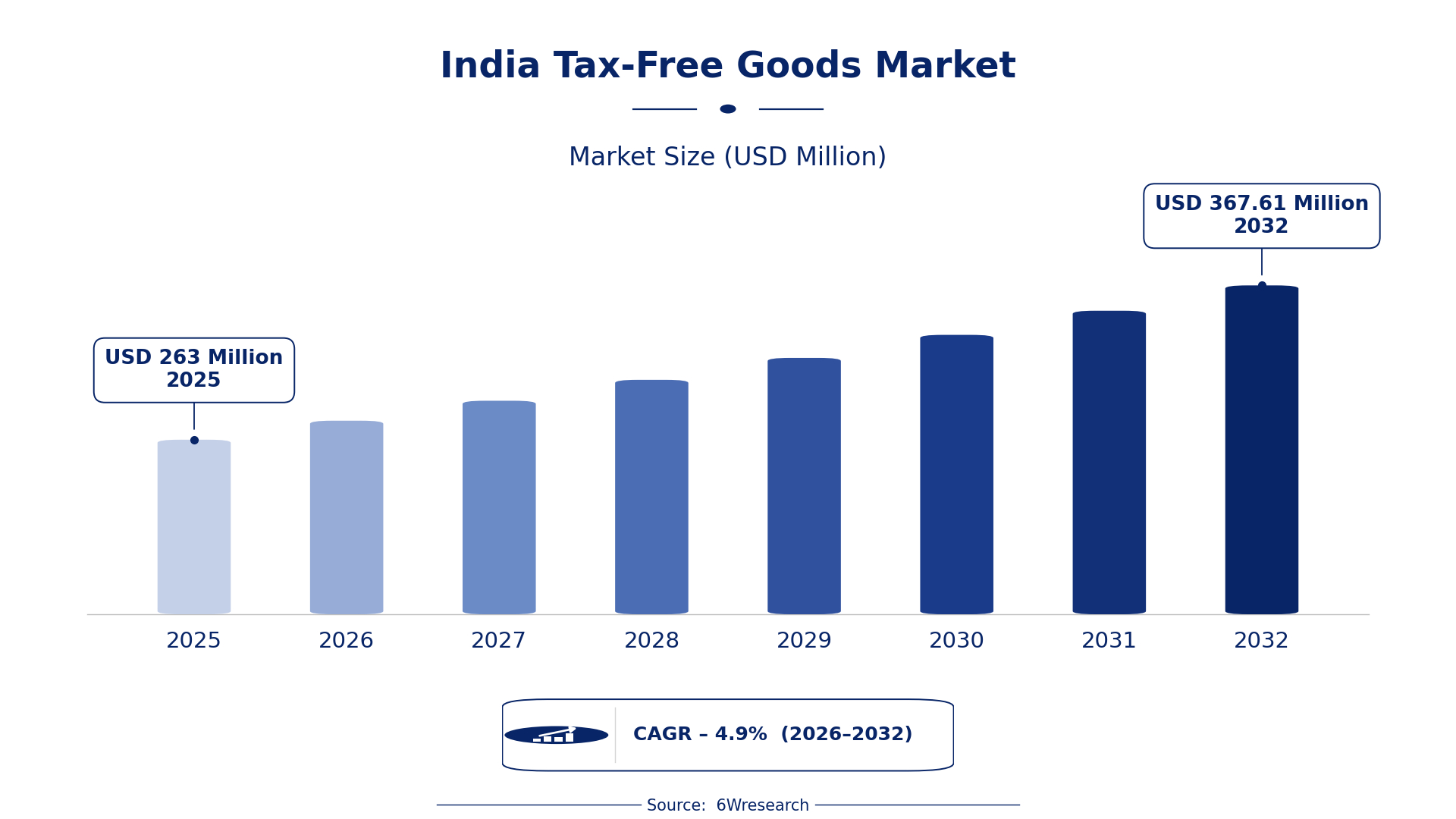
According to 6Wresearch internal database and industry insights, the India Tax-Free Goods Market was valued at USD 263.0 million in 2025 and is projected to reach USD 367.61 million by 2032, growing at a CAGR of approximately 4.9% during 2026–2032.
India Tax-Free Goods Market Highlights
| Report Metric | Details |
| Report Name | India Tax-Free Goods Market |
| Market Size 2025 | USD 263.0 million |
| Market Size 2032 | USD 367.61 million |
| Absolute Growth 2025–2032 | USD 104.61 million |
| CAGR 2026–2032 | 4.9% |
| Peak Annual Growth | 6.6% in 2030 |
| Forecast Period | 2026–2032 |
| Historical Data | 2022–2025 |
| Base Year | 2025 |
| Leading Product Type, 2025 | Duty-Free Alcohol (49% share) |
| Leading Selling Channel, 2025 | Airport Retail (42% share) |
| Leading Buyer Type, 2025 | International Travelers (53% share) |
| Leading End User, 2025 | Travel Retail Chains (51% share) |
| Fastest-Growing Product Type | Luxury Cosmetics (6.3% CAGR) |
| Fastest-Growing Selling Channel | Seaport Shops (6.5% CAGR) |
| Fastest-Growing Buyer Type | Tourists (6.3% CAGR) |
| Growing Sector | Duty-Free Retail Chains |
| Key End Users | International Travelers, Tourists, Cruise Passengers |
India Tax-Free Goods Market Year-wise Growth Rate and Key Drivers (2022–2032)
This graph illustrates the annual growth rates of the market from 2022 to 2032, highlighting a steady upward trajectory and projected market expansion over the forecast period.
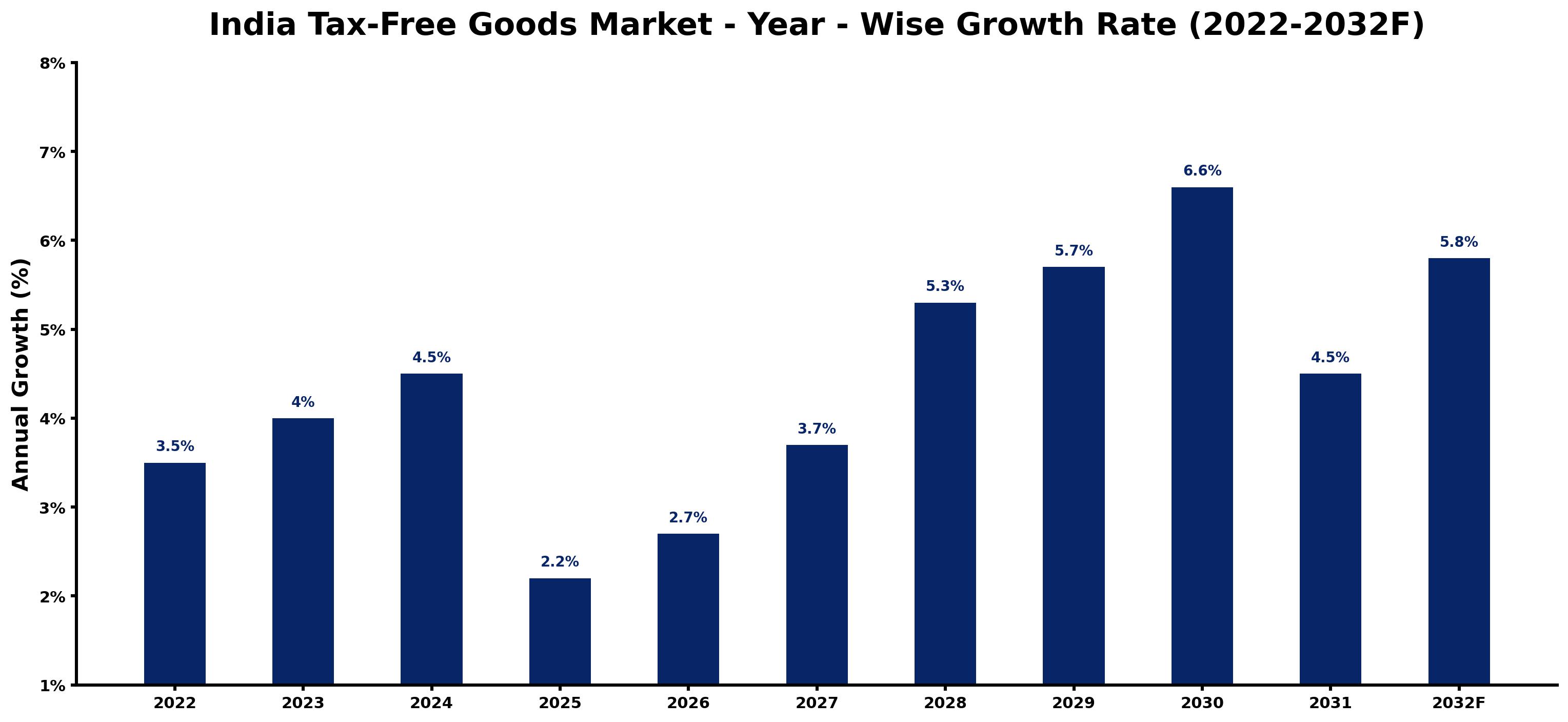
Below, each year's estimated growth is shown next to the factor that most influenced it.
| Year | Estimated Annual Growth (%) | Market Rationale |
| 2022 | 3.5 | The market showed steady growth due to increased international travel following the National Tourism Policy. |
| 2023 | 4.0 | Demand surged as tourism numbers rose, with 10 million international arrivals boosting sales. |
| 2024 | 4.5 | The growth continued as duty-free alcohol remained a top-selling category in airports, attracting more travelers. |
| 2025 | 2.2 | Growth slowed slightly as the market adjusted after peak tourist seasons, impacting overall sales. |
| 2026 | 2.7 | An increase in international travelers is expected to rejuvenate market growth through tourism initiatives. |
| 2027 | 3.7 | Tourist spending is anticipated to rise, further driving demand for tax-free goods as travel packages promote shopping. |
| 2028 | 5.3 | The market is projected to gain momentum as luxury cosmetics see higher sales, appealing to discerning travelers. |
| 2029 | 5.7 | Increased international arrivals will likely boost overall tax-free sales significantly, driven by promotional efforts. |
| 2030 | 6.6 | The market is expected to peak with a surge in luxury goods purchases, supported by rising disposable incomes. |
| 2031 | 4.5 | Growth will moderate as the market stabilises after reaching peak levels due to changing consumer preferences. |
| 2032 | 5.8 | A continued rise in international travel will support ongoing market expansion, driven by government tourism initiatives. |
Note: Market size estimations and growth projections presented in this report are based on 6Wresearch's proprietary forecasting methodology, utilizing the latest available industry data, government publications, and primary research inputs.
India Tax-Free Goods Market Synopsis
The India Tax-Free Goods Market includes products such as duty-free alcohol, luxury cosmetics, and fashion accessories, primarily available at airports and seaports. These items cater to international travellers, with luxury cosmetics representing about 25% of tax-free sales. The market is growing due to a rise in tourism, with 10 million international arrivals recorded in 2022. This expansion is fuelled by increased traveller spending and the promotion of duty-free shopping as a key attraction, supported by the National Tourism Policy.
Market Dynamics Impact Analysis (2026–2032)
| Factor | Type | Impact | Primary Segment Affected |
| Rising international travel numbers drive demand for tax-free goods. | Driver | High | Duty-Free Alcohol |
| Growing interest in luxury products among travelers boosts sales. | Driver | High | Luxury Cosmetics |
| The average spend per traveler is around ₹5000, indicating a lucrative market. | Opportunity | High | Fashion Accessories |
| Seaport shops cater to over 1 million cruise passengers annually, expanding market reach. | Opportunity | Medium | Seaport Shops |
| Regulatory compliance can be challenging for new retailers entering the market. | Restraint | High | Duty-Free Retailers |
| Limited product selection in onboard sales restricts consumer choice. | Restraint | Medium | Onboard Sales |
| High competition among duty-free retailers can pressure pricing strategies. | Challenge | High | Duty-Free Retailers |
| Dependence on tourism trends makes the market vulnerable to fluctuations. | Challenge | Medium | International Travelers |
Evaluation of Drivers in India Tax-Free Goods Market (2026–2032)
Below mentioned are some major drivers and their influence on market dynamics.
| Drivers | Primary Segment Affected | Why It Matters (Evidence) |
| Increased international arrivals fuel demand for duty-free products. | Duty-Free Alcohol | With 10 million arrivals in 2022, international travelers are significant buyers. |
| Luxury cosmetics are increasingly popular among travelers seeking premium products. | Luxury Cosmetics | Approximately 25% of tax-free sales are attributed to luxury cosmetics. |
| Growing tourism enhances spending in duty-free shops. | Fashion Accessories | The average spend per international traveler is around ₹5000. |
| Seaport shops attract cruise passengers, expanding the customer base. | Seaport Shops | Over 1 million cruise passengers visit seaport shops annually. |
| Airport retail remains the primary channel for tax-free goods sales. | Airport Retail | Major airports like Delhi and Mumbai have dedicated duty-free zones. |
The Tax-Free Goods market in India is expanding as international travel numbers rise, spending increases, and interest in luxury products grows. In 2022, the tourism sector welcomed 10 million international arrivals, positively impacting sales. Duty-free alcohol remains a top-selling category, while luxury cosmetics account for around 25% of tax-free sales. The average spend per traveler is approximately ₹5000, indicating a growing market. Seaport shops cater to over 1 million cruise passengers annually, further broadening market reach. Airport retail continues to dominate, with major airports establishing dedicated duty-free zones to improve shopping experiences.
Evaluation of Restraints in India Tax-Free Goods Market
The main factors holding the market back are set out below.
| Market Restraint | Primary Segment Affected | Why It Matters (Evidence) |
| Regulatory compliance can be challenging for new retailers entering the market. | Duty-Free Retailers | The Customs (Amendment) Act, 2020, imposes strict compliance measures on retailers. |
| Limited product selection in onboard sales restricts consumer choice. | Onboard Sales | Onboard sales offer a narrower range of products compared to airport retail. |
| Dependence on tourism trends makes the market vulnerable to fluctuations. | International Travelers | Economic downturns can lead to reduced travel and spending in duty-free shops. |
| Regulatory changes can impact the operational framework for retailers. | Duty-Free Retailers | Changes in the GST framework may alter the tax-free goods sales structure. |
| High competition among duty-free retailers can pressure pricing strategies. | Duty-Free Retailers | Intense competition may lead to price wars, affecting profit margins. |
India Tax-Free Goods Market Challenges
The India Tax-Free Goods Market encounters several practical issues, starting with outdated technology in duty-free operations. Many retailers depend on legacy systems that slow down transactions, leading to delays for customers and diminishing sales efficiency, which can result in a 20% decline in customer satisfaction. A shortage of skilled staff is a concern, as there is a lack of trained personnel familiar with luxury cosmetics and electronics, leading to lost sales opportunities worth approximately ₹1,000 per traveller. Supply chain disruptions arise from regulatory changes, such as the Customs Act of 1962, which can impose unexpected compliance costs on suppliers, increasing operational expenses by up to 15%.
Trends in the India Tax-Free Goods Market
Four trends stand out in the India Tax-Free Goods Market.
- Shift towards Luxury Cosmetics in Duty-Free Shopping: The Incredible India campaign has led to a marked increase in luxury cosmetics sales, making up 25% of tax-free sales. This trend reflects changing consumer preferences among travellers.
- Growth of Seaport Shops for Cruise Passengers: Seaport shops are experiencing growth as they cater to over 1 million cruise passengers annually. This shift broadens the market's reach beyond traditional airport retail.
- Increase in Average Spend per International Traveler: The average spend per international traveller in duty-free shops is around ₹5000, indicating a growing willingness to purchase premium products during travel, enhancing the overall market appeal.
- Expansion of Duty-Free Zones in Major Airports: Major airports like Delhi and Mumbai are improving duty-free shopping experiences with dedicated zones, attracting more international travellers and boosting sales.
Investment Opportunities in the India Tax-Free Goods Market
Investors looking at the India Tax-Free Goods Market should consider the following areas.
- Gap in Onboard Sales for Luxury Products: With onboard sales offering limited luxury product selections, there is a gap for suppliers to fill. Airlines could benefit from partnerships to improve their duty-free offerings, capturing more traveller interest.
- Growing Demand from Tourists for Unique Products: Tourists are increasingly seeking unique tax-free products, providing opportunities for retailers to expand their offerings. The National Tourism Policy aims to boost this segment, encouraging innovative retail strategies.
- Opportune Moment for Investment in Duty-Free Retail Expansion: The projected growth in duty-free sales, with an 8% annual increase, presents a timely opportunity for investment in retail spaces at airports and seaports, attracting more international travellers.
- Entry into Seaport Market for Retailers: With seaport shops growing at a rate of 6.5%, retailers can enter this market through joint ventures with existing operators to capture cruise passenger spending effectively.
Government Initiatives in the India Tax-Free Goods Market
The Customs (Amendment) Act, 2020, introduced by the Ministry of Finance, updated regulations for duty-free goods, improving compliance measures for retailers. This act ensures that all duty-free products meet national standards, enhancing accountability and transparency in the market. Additionally, the GST framework revised in 2021 provides clarity on tax-free goods sales, aiding retailers in understanding their obligations and rights. These measures support the growth of the tax-free goods market by ensuring a level playing field for all participants.
The Incredible India campaign, led by the Ministry of Tourism, promotes duty-free shopping as part of travel experiences, aiming to increase international tourist arrivals. This initiative encourages travellers to explore duty-free options, improving their shopping experiences. The Airports Authority of India oversees the management of duty-free operations at various airports, ensuring compliance with regulations and improving customer experiences. Furthermore, the Central Board of Indirect Taxes and Customs regulates duty-free sales, ensuring that all transactions adhere to national standards, benefiting both retailers and buyers.
Future Insight of the India Tax-Free Goods Market
The India Tax-Free Goods Market is expected to evolve significantly by 2032, driven by a surge in international tourism and technological advancements. The Indian government aims to attract 15 million international arrivals by 2025, which will substantially increase demand for tax-free goods. Enhanced digital payment systems will streamline transactions, improving the shopping experience for buyers. The introduction of new luxury brands in duty-free shops will cater to diverse consumer preferences, expanding the market's appeal and increasing average spend per traveller to around ₹8,000.
Market Segmentation Analysis
Each segment group is reviewed below, with the leader by share and the fastest grower by CAGR.
By Product Type – Duty-Free Alcohol Dominated, Luxury Cosmetics Expected to Grow Fastest
According to Sumit Sagar, AM at 6Wresearch, with a 49% revenue share in 2025, Duty-Free Alcohol was the largest product type category. Duty-free alcohol holds the largest share in the Indian tax-free goods market due to its widespread consumption among international travelers at major airports like Delhi and Mumbai. This category thrives on high demand, with international travelers averaging a spend of around ₹5000 in duty-free shops. Over 2026–2032, Luxury Cosmetics are expected to post the fastest growth, at a CAGR of 6.3%. Luxury cosmetics are experiencing rapid growth as they attract travelers seeking premium products, accounting for approximately 25% of tax-free sales in India. The surge in international arrivals, which reached 10 million in 2022, significantly boosts this segment's expansion. Suppliers should enhance their luxury cosmetics offerings to capitalise on the growing consumer interest in premium products.
By Selling Channel – Airport Retail Dominated, Seaport Shops Expected to Grow Fastest
Airport Retail accounted for a 42% market share by selling channel in 2025. Airport retail commands the largest share in the Indian tax-free goods market, serving as the primary sales channel due to the high footfall of international travelers. Major airports like Delhi and Mumbai feature dedicated duty-free zones that facilitate substantial transactions. Seaport Shops are set to record the highest CAGR in this split, 6.5% over 2026–2032. Seaport shops are rapidly growing as they cater to the increasing number of cruise passengers, with over 1 million visiting annually. The segment's growth is supported by initiatives from the Indian Ministry of Tourism promoting travel packages that include duty-free shopping. Retailers should consider expanding their presence in seaport shops to tap into the rising cruise passenger market.
By Buyer Type – International Travelers Dominated, Tourists Expected to Grow Fastest
International Travelers held a 53% share of the India Tax-Free Goods Market by buyer type in 2025. International travelers represent the largest buyer group in the Indian tax-free goods market, primarily due to their purchasing power and enthusiasm for tax-free shopping. Their significant presence is vital for driving sales, especially in airport retail environments. Tourists are projected to grow fastest, at a CAGR of 6.3% during 2026–2032. Tourists are the fastest-growing buyer group, making a notable impact on sales in tax-free markets as they seek souvenirs and luxury items during their travels. The anticipated growth in tourism, aiming for $50 billion by 2025, supports this upward trend. Suppliers should tailor their marketing strategies to attract tourists, enhancing product visibility and accessibility.
By End User – Travel Retail Chains Dominated and Is Expected to Record the Fastest Growth
In 2025, Travel Retail Chains led the end user split with a 51% share. Travel retail chains dominate the end-user segment, playing a crucial role in distributing tax-free goods across various channels. Their established networks and expertise in catering to travelers make them indispensable for market penetration. Travel Retail Chains are also forecast to expand faster than any other category, at a CAGR of 6.1% over 2026–2032. Travel retail chains are also the fastest-growing end-user segment, benefiting from their adaptability to consumer preferences and the expansion of their offerings. Their lead will continue to widen as they leverage increased tourism and spending in duty-free shopping. Suppliers should strengthen partnerships with travel retail chains to maximise their reach and sales potential.
Key Attractiveness of the Report
- 10 Years of Market Numbers
- Historical Data Starting from 2022 to 2025
- Base Year 2025
- Forecast Data until 2032
- Key Performance Indicators Impacting the Market
- Major Upcoming Developments and Projects
Key Highlights of the Report:
- India Tax-Free Goods Market Outlook
- Market Size of India Tax-Free Goods Market, 2025
- Forecast of India Tax-Free Goods Market, 2032
- Historical Data and Forecast of India Tax-Free Goods Revenues & Volume for the Period 2022 - 2032F
- India Tax-Free Goods Market Trend Evolution
- India Tax-Free Goods Market Drivers and Challenges
- India Tax-Free Goods Price Trends
- India Tax-Free Goods Porter's Five Forces
- India Tax-Free Goods Industry Life Cycle
- Historical Data and Forecast of India Tax-Free Goods Market Revenues & Volume By Product Type for the Period 2022 - 2032F
- Historical Data and Forecast of India Tax-Free Goods Market Revenues & Volume By Duty-Free Alcohol for the Period 2022 - 2032F
- Historical Data and Forecast of India Tax-Free Goods Market Revenues & Volume By Luxury Cosmetics for the Period 2022 - 2032F
- Historical Data and Forecast of India Tax-Free Goods Market Revenues & Volume By Fashion Accessories for the Period 2022 - 2032F
- Historical Data and Forecast of India Tax-Free Goods Market Revenues & Volume By Electronics for the Period 2022 - 2032F
- Historical Data and Forecast of India Tax-Free Goods Market Revenues & Volume By Selling Channel for the Period 2022 - 2032F
- Historical Data and Forecast of India Tax-Free Goods Market Revenues & Volume By Airport Retail for the Period 2022 - 2032F
- Historical Data and Forecast of India Tax-Free Goods Market Revenues & Volume By Onboard Sales for the Period 2022 - 2032F
- Historical Data and Forecast of India Tax-Free Goods Market Revenues & Volume By Seaport Shops for the Period 2022 - 2032F
- Historical Data and Forecast of India Tax-Free Goods Market Revenues & Volume By Border Zone Markets for the Period 2022 - 2032F
- Historical Data and Forecast of India Tax-Free Goods Market Revenues & Volume By Buyer Type for the Period 2022 - 2032F
- Historical Data and Forecast of India Tax-Free Goods Market Revenues & Volume By International Travelers for the Period 2022 - 2032F
- Historical Data and Forecast of India Tax-Free Goods Market Revenues & Volume By Tourists for the Period 2022 - 2032F
- Historical Data and Forecast of India Tax-Free Goods Market Revenues & Volume By Cruise Passengers for the Period 2022 - 2032F
- Historical Data and Forecast of India Tax-Free Goods Market Revenues & Volume By Cross-Border Shoppers for the Period 2022 - 2032F
- Historical Data and Forecast of India Tax-Free Goods Market Revenues & Volume By End User for the Period 2022 - 2032F
- Historical Data and Forecast of India Tax-Free Goods Market Revenues & Volume By Travel Retail Chains for the Period 2022 - 2032F
- Historical Data and Forecast of India Tax-Free Goods Market Revenues & Volume By Airlines for the Period 2022 - 2032F
- Historical Data and Forecast of India Tax-Free Goods Market Revenues & Volume By Duty-Free Retailers for the Period 2022 - 2032F
- Historical Data and Forecast of India Tax-Free Goods Market Revenues & Volume By Tech Goods Suppliers for the Period 2022 - 2032F
- India Tax-Free Goods Import Export Trade Statistics
- Market Opportunity Assessment By Product Type
- Market Opportunity Assessment By Selling Channel
- Market Opportunity Assessment By Buyer Type
- Market Opportunity Assessment By End User
- India Tax-Free Goods Top Companies Market Share
- India Tax-Free Goods Competitive Benchmarking By Technical and Operational Parameters
- India Tax-Free Goods Company Profiles
- India Tax-Free Goods Key Strategic Recommendations
Market Covered
Segments analysed in this report are listed below.
By Product Type
- Duty-Free Alcohol
- Luxury Cosmetics
- Fashion Accessories
- Electronics
By Selling Channel
- Airport Retail
- Onboard Sales
- Seaport Shops
- Border Zone Markets
By Buyer Type
- International Travelers
- Tourists
- Cruise Passengers
- Cross-Border Shoppers
By End User
- Travel Retail Chains
- Airlines
- Duty-Free Retailers
- Tech Goods Suppliers































