India TCAS Avionics Market Size & Growth Rate
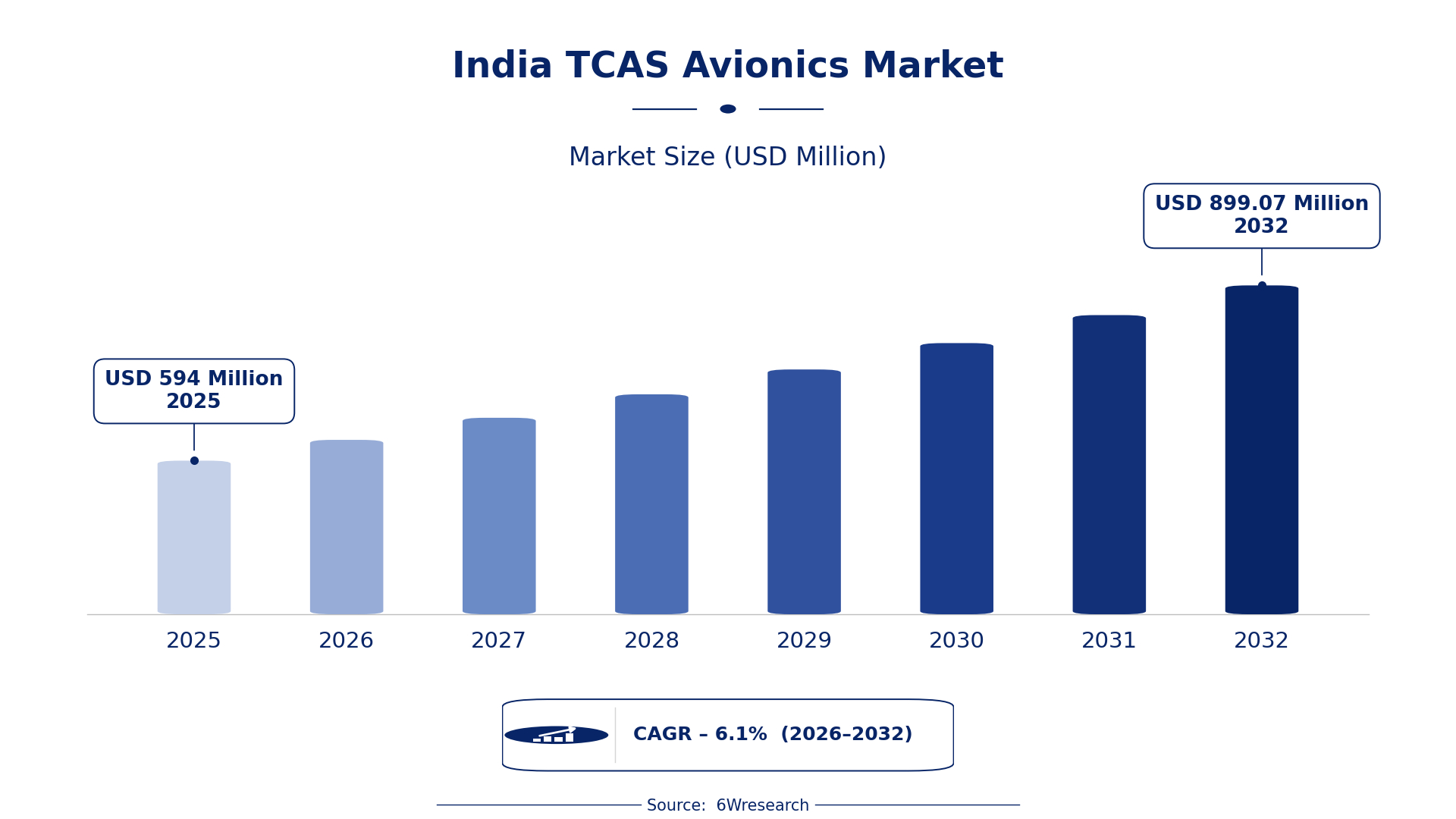
According to 6Wresearch internal database and industry insights, the India TCAS Avionics Market was valued at USD 594.0 million in 2025 and is projected to reach USD 899.07 million by 2032, growing at a CAGR of approximately 6.1% during 2026–2032.
India TCAS Avionics Market Highlights
| Report Metric | Details |
| Report Name | India TCAS Avionics Market |
| Market Size 2025 | USD 594.0 million |
| Market Size 2032 | USD 899.07 million |
| Absolute Growth 2025–2032 | USD 305.07 million |
| CAGR 2026–2032 | 6.1% |
| Peak Annual Growth | 8.1% in 2026 |
| Forecast Period | 2026–2032 |
| Historical Data | 2022–2025 |
| Base Year | 2025 |
| Leading TCAS Type, 2025 | TCAS II (45% share) |
| Leading Alert Mode, 2025 | Resolution Advisory (43% share) |
| Leading Aircraft Compatibility, 2025 | Commercial Jets (44% share) |
| Leading End User, 2025 | Airline Operators (45% share) |
| Fastest-Growing TCAS Type | Integrated TCAS (7.4% CAGR) |
| Fastest-Growing Aircraft Compatibility | Business Jets (8.5% CAGR) |
| Fastest-Growing End User | Avionics Manufacturers (8.1% CAGR) |
| Growing Sector | Commercial Aviation |
| Key End Users | Airline Operators, Avionics Manufacturers, General Aviation Users |
India TCAS Avionics Market Year-wise Growth Rate and Key Drivers (2022–2032)
This graph illustrates the annual growth rates of the market from 2022 to 2032, highlighting a steady upward trajectory and projected market expansion over the forecast period.
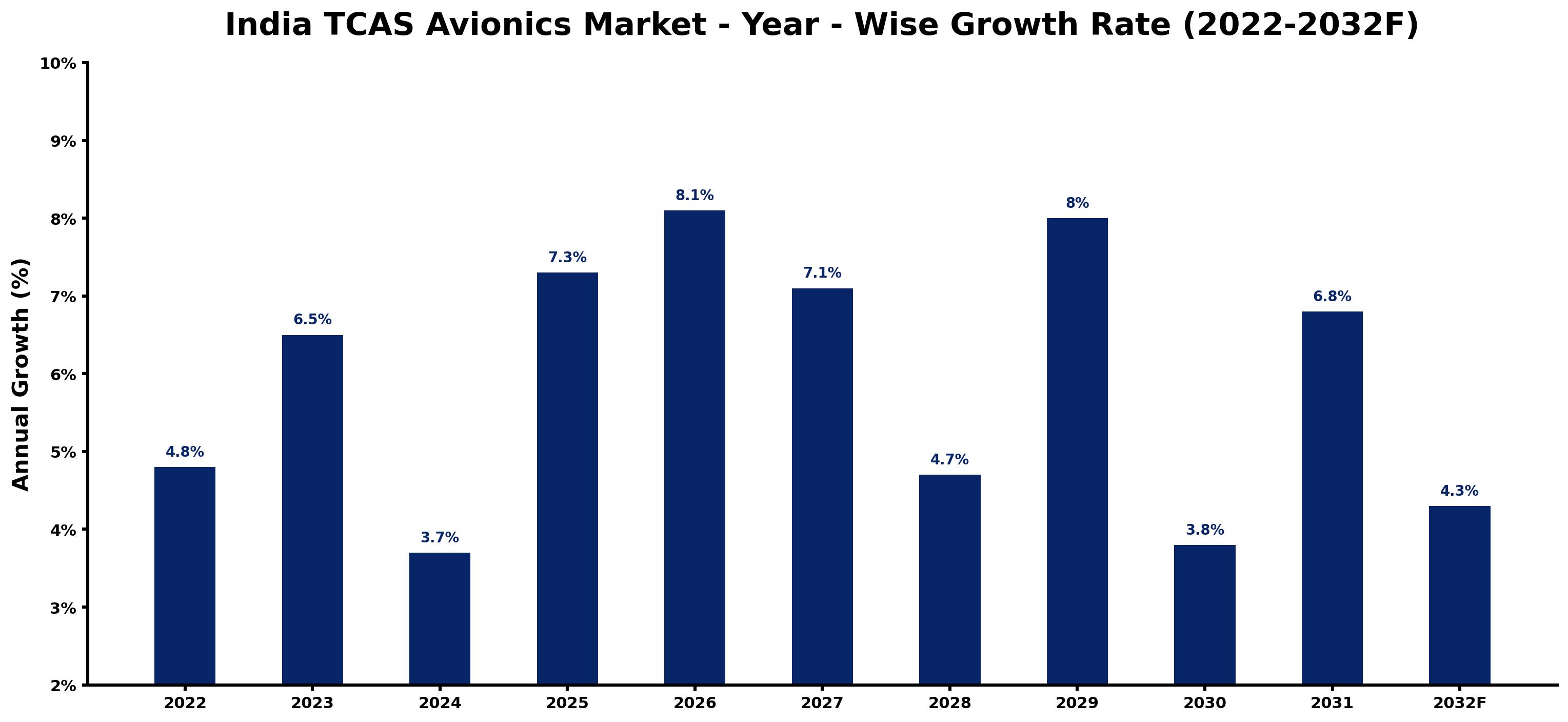
Each row of the following table gives one year's estimated growth and the event or demand shift that explains it.
| Year | Estimated Annual Growth (%) | Market Rationale |
| 2022 | 4.8 | The aviation sector was operational with steady demand from airline operators. |
| 2023 | 6.5 | The Directorate General of Civil Aviation mandated TCAS II for all commercial aircraft, boosting demand. |
| 2024 | 3.7 | A slight slowdown occurred as growth moderated after the previous year's surge. |
| 2025 | 7.3 | Demand surged as the aviation market expanded, driven by increased passenger numbers. |
| 2026 | 8.1 | The peak growth is anticipated as the market responds to rising safety regulations. |
| 2027 | 7.1 | A slowdown will follow as the market adjusts to the previous year's rapid growth. |
| 2028 | 4.7 | Continued growth is projected, although at a slower pace compared to prior years. |
| 2029 | 8.0 | The market is expected to rebound with renewed demand from airline operators for safety compliance. |
| 2030 | 3.8 | Growth will slow again as the National Civil Aviation Policy stabilises after the previous year's surge. |
| 2031 | 6.8 | Demand is projected to increase as the aviation sector continues to expand and modernise. |
| 2032 | 4.3 | The market growth rate will decrease as it approaches maturity in the aviation sector. |
Note: Market size estimations and growth projections presented in this report are based on 6Wresearch's proprietary forecasting methodology, utilizing the latest available industry data, government publications, and primary research inputs.
India TCAS Avionics Market Synopsis
The TCAS Avionics Market in India includes sophisticated electronic systems aimed at preventing mid-air collisions. These systems equip pilots with alerts and guidance, thereby ensuring flight safety in commercial aviation. The market is growing alongside rising passenger numbers, with the aviation sector expected to accommodate 1.1 billion passengers by 2036. Regulatory requirements, such as TCAS II mandates for commercial aircraft, are propelling demand. Investments in modernising air traffic management systems are also driving market expansion, improving overall safety protocols.
Market Dynamics Impact Analysis (2026–2032)
| Factor | Type | Impact | Primary Segment Affected |
| Regulatory mandates for TCAS II systems in commercial aircraft enhance safety compliance. | Driver | High | TCAS II |
| The increase in passenger traffic leads to higher demand for safety systems in aviation. | Driver | High | Commercial Jets |
| Investment in air traffic management modernization creates opportunities for TCAS system suppliers. | Opportunity | High | Integrated TCAS |
| The growing number of airline operators in India presents a significant market opportunity. | Opportunity | High | Airline Operators |
| High costs associated with TCAS system upgrades can deter smaller operators from compliance. | Restraint | Medium | General Aviation |
| Limited awareness of advanced TCAS systems among smaller operators restricts market growth. | Restraint | Medium | Business Jets |
| The TCAS Avionics Market in India faces challenges related to high implementation costs. | Challenge | High | Commercial Jets |
| Technological integration issues can delay the adoption of TCAS systems in new aircraft. | Challenge | Medium | Integrated TCAS |
Evaluation of Drivers in India TCAS Avionics Market (2026–2032)
The main growth drivers and the segments they affect most are set out below.
| Drivers | Primary Segment Affected | Why It Matters (Evidence) |
| Regulatory compliance for TCAS II systems increases demand from commercial operators. | TCAS II | The Directorate General of Civil Aviation mandates TCAS II for all commercial aircraft. |
| Rising passenger numbers drive demand for safety features in aviation. | Commercial Jets | India's aviation sector is projected to reach 1.1 billion passengers by 2036. |
| Investment in air traffic management systems boosts demand for TCAS integration. | Integrated TCAS | The Airports Authority of India is investing in modernising air traffic management systems. |
| Increased flights in general aviation create demand for collision avoidance systems. | General Aviation | India has seen a 10% increase in general aviation flights in the past year. |
| The focus on safety compliance among airline operators drives TCAS adoption. | Airline Operators | The National Civil Aviation Policy 2016 emphasises safety and technology upgrades. |
Growth across the TCAS Avionics market in India is anchored in rising passenger numbers, compliance requirements, and increased investment in air traffic management. The aviation sector is projected to reach 1.1 billion passengers by 2036, prompting airline operators to adopt more safety features. Investment in modernising air traffic management systems integrates TCAS technology, which improves operational safety. This growing focus on compliance leads to increased purchases of TCAS systems by airline operators.
Evaluation of Restraints in India TCAS Avionics Market
Below mentioned are some major restraints and their influence on market dynamics.
| Market Restraint | Primary Segment Affected | Why It Matters (Evidence) |
| High costs of TCAS system upgrades deter smaller operators from compliance. | General Aviation | The investment required for TCAS II systems can be prohibitive for smaller operators. |
| Limited awareness of advanced TCAS systems restricts market growth among smaller operators. | Business Jets | Many smaller operators are not fully informed about the benefits of TCAS technology. |
| The complexity of integrating TCAS systems into existing aircraft can delay adoption. | Integrated TCAS | Technical challenges in retrofitting older aircraft with new TCAS systems hinder progress. |
| Regulatory compliance can be burdensome for smaller airline operators. | Commercial Jets | Smaller operators may struggle to meet the stringent requirements set by aviation authorities. |
| Market consolidation among larger operators can limit opportunities for smaller suppliers. | Airline Operators | As larger airlines dominate, smaller suppliers may find it difficult to compete. |
India TCAS Avionics Market Challenges
Domestic airline operators in the India TCAS avionics market are grappling with rising costs linked to the mandatory implementation of TCAS II systems for all commercial aircraft, which can increase production expenses by up to 15%. Competition among manufacturers is intensifying as the market grows, potentially squeezing profit margins for suppliers. The limited availability of advanced TCAS systems can lead to delays in fleet upgrades, posing safety risks for airlines. Regulatory compliance enforced by the Bureau of Civil Aviation Security may result in fines of up to 5 million rupees for non-compliance, straining operational budgets for airlines.
Trends in the India TCAS Avionics Market
Below mentioned are some of the trends shaping the India TCAS Avionics Market growth.
- Shift towards Enhanced Safety Protocols: Airline operators are increasingly prioritising safety protocols, driven by regulatory requirements. The Directorate General of Civil Aviation's mandate for TCAS II systems in commercial aircraft exemplifies this commitment, ensuring overall aviation safety.
- Transition from Basic to Advanced TCAS Systems: The aviation sector is transitioning towards advanced TCAS systems, with Integrated TCAS gaining popularity. The demand for safety features is clear, with a projected CAGR of 7.4% for Integrated TCAS systems.
- Growing Focus on Air Traffic Management Integration: The Airports Authority of India is investing in modernising air traffic management systems, which will incorporate TCAS technology. This initiative aligns with the anticipated growth of the aviation sector, expected to reach 1.1 billion passengers by 2036.
- Emergence of Business Jets Market: The Business Jets segment is emerging as a notable market within TCAS avionics. With a projected CAGR of 8.5% from 2026 to 2032, this segment is drawing interest from suppliers eager to broaden their offerings.
Investment Opportunities in the India TCAS Avionics Market
Some of the investment opportunities in the India TCAS Avionics Market are mentioned below.
- Partnerships with Regional Airlines: Now is an ideal time for partnerships with regional airlines to supply TCAS systems. As the aviation sector is set to expand, regional operators are in search of compliance solutions.
- Supplying Integrated TCAS Systems: Investing in Integrated TCAS systems is timely, as demand continues to rise. Airline operators are increasingly seeking advanced solutions to fulfil safety and regulatory requirements.
- Engaging with Government Initiatives: The current emphasis on safety and technological upgrades presents a unique opportunity. Suppliers can collaborate with the Ministry of Civil Aviation to align with initiatives such as the National Air Transport Policy.
- Targeting Airline Operators: Airline operators require TCAS solutions to comply with regulatory standards. Suppliers can enter this market by forming local partnerships to facilitate compliance.
Government Initiatives in the India TCAS Avionics Market
The National Air Transport Policy, launched in 2020 by the Ministry of Civil Aviation, aims to improve safety measures in aviation. This policy promotes the adoption of advanced avionics like TCAS systems, ensuring alignment with international standards. Additionally, the updated Civil Aviation Requirements (CAR) in 2021 mandated TCAS II systems for all commercial aircraft operations, further reinforcing safety protocols. These measures have impacted producers, as they must invest in compliant technologies to meet regulatory standards.
The 'Digital Sky' framework, initiated in 2022, is designed to integrate advanced technologies in air traffic management, including TCAS systems. The Ministry of Civil Aviation oversees this initiative, which aims to modernise the aviation sector. Moreover, the Bureau of Civil Aviation Security issued new guidelines in 2023 for the implementation of TCAS systems in all commercial operations. This framework offers a structured approach for producers to ensure compliance and improve safety in aviation.
Future Insight of the India TCAS Avionics Market
The India TCAS avionics market will undergo notable changes by 2032, propelled by the Airports Authority of India's investment in modernising air traffic management systems that integrate TCAS technology. The aviation sector is expected to grow at a CAGR of 9% from 2023 to 2030, increasing the demand for safety systems. The National Civil Aviation Policy's focus on technological upgrades will encourage TCAS adoption across various aircraft types. Enhancements to the Indian Air Traffic Control system will improve operational efficiency and safety in controlled airspace.
Market Segmentation Analysis
The analysis below covers each segmentation, its leading category in 2025 and its fastest-growing category through 2032.
By TCAS Type – TCAS II Dominated, Integrated TCAS Expected to Grow Fastest
According to Sumit Sagar, AM at 6Wresearch, TCAS II held a 45% share of the India TCAS Avionics Market by tcas type in 2025. TCAS II holds the largest share in the Indian market as it is mandated for all commercial aircraft by the Directorate General of Civil Aviation. This regulation ensures widespread adoption among airline operators who prioritise compliance and safety in their operations. Integrated TCAS is projected to grow fastest, at a CAGR of 7.4% during 2026–2032. Integrated TCAS is rapidly gaining traction as it becomes the preferred choice for new aircraft designs, reflecting a broader industry trend towards advanced safety measures. The ongoing upgrades in India's aviation infrastructure further support the integration of such sophisticated systems. Suppliers must focus on developing Integrated TCAS solutions to meet the growing demand from aircraft manufacturers.
By Alert Mode – Resolution Advisory Dominated and Is Expected to Record the Fastest Growth
With a 43% revenue share in 2025, Resolution Advisory was the largest alert mode category. Resolution Advisory is the leading alert mode because it provides pilots with critical actionable avoidance instructions, essential for maintaining safety in busy airspaces. Its effectiveness in preventing mid-air collisions makes it indispensable for commercial aviation. Resolution Advisory is also forecast to expand faster than any other category, at a CAGR of 8.3% over 2026–2032. Resolution Advisory is also the fastest-growing alert mode as its importance continues to increase with rising air traffic and stringent safety regulations. The ongoing upgrades in India's air traffic management systems further reinforce its relevance. Suppliers must prioritise the development of advanced Resolution Advisory systems to align with the increasing safety requirements in aviation.
By Aircraft Compatibility – Commercial Jets Dominated, Business Jets Expected to Grow Fastest
In 2025, Commercial Jets led the aircraft compatibility split with a 44% share. Commercial Jets dominate this segment as they represent the primary market for TCAS systems in India, driven by a large number of domestic airline operators. The regulatory requirement for TCAS II in commercial aircraft solidifies this segment's strong market share. Business Jets are set to record the highest CAGR in this split, 8.5% over 2026–2032. Business Jets are the fastest-growing category, reflecting a rising demand for personalised aviation solutions among affluent users. The recent increase in aviation activity indicates a growing interest in business aviation, contributing to this segment's rapid expansion. Suppliers should consider diversifying their offerings to tap into the emerging business jet market.
By End User – Airline Operators Dominated, Avionics Manufacturers Expected to Grow Fastest
Airline Operators accounted for a 45% market share by end user in 2025. Airline Operators account for the largest share of TCAS system users, primarily due to their need for compliance with safety regulations set by the Directorate General of Civil Aviation. This segment significantly influences the overall TCAS avionics market in India. The quickest growth will come from Avionics Manufacturers, forecast to expand at a CAGR of 8.1% between 2026 and 2032. Avionics Manufacturers are experiencing the fastest growth as they play a crucial role in developing and supplying TCAS technology to meet increasing market demand. The expansion of the aviation sector positions these manufacturers to benefit from heightened orders for advanced avionics systems. Suppliers should strengthen partnerships with avionics manufacturers to leverage growth opportunities in the TCAS avionics market.
Key Attractiveness of the Report
- 10 Years of Market Numbers
- Historical Data Starting from 2022 to 2025
- Base Year 2025
- Forecast Data until 2032
- Key Performance Indicators Impacting the Market
- Major Upcoming Developments and Projects
Key Highlights of the Report:
- India TCAS Avionics Market Outlook
- Market Size of India TCAS Avionics Market, 2025
- Forecast of India TCAS Avionics Market, 2032
- Historical Data and Forecast of India TCAS Avionics Revenues & Volume for the Period 2022 - 2032F
- India TCAS Avionics Market Trend Evolution
- India TCAS Avionics Market Drivers and Challenges
- India TCAS Avionics Price Trends
- India TCAS Avionics Porter's Five Forces
- India TCAS Avionics Industry Life Cycle
- Historical Data and Forecast of India TCAS Avionics Market Revenues & Volume By TCAS Type for the Period 2022 - 2032F
- Historical Data and Forecast of India TCAS Avionics Market Revenues & Volume By TCAS I for the Period 2022 - 2032F
- Historical Data and Forecast of India TCAS Avionics Market Revenues & Volume By TCAS II for the Period 2022 - 2032F
- Historical Data and Forecast of India TCAS Avionics Market Revenues & Volume By TCAS III (Next-Gen) for the Period 2022 - 2032F
- Historical Data and Forecast of India TCAS Avionics Market Revenues & Volume By Integrated TCAS for the Period 2022 - 2032F
- Historical Data and Forecast of India TCAS Avionics Market Revenues & Volume By Alert Mode for the Period 2022 - 2032F
- Historical Data and Forecast of India TCAS Avionics Market Revenues & Volume By Proximity Warning for the Period 2022 - 2032F
- Historical Data and Forecast of India TCAS Avionics Market Revenues & Volume By Resolution Advisory for the Period 2022 - 2032F
- Historical Data and Forecast of India TCAS Avionics Market Revenues & Volume By Vertical & Horizontal Guidance for the Period 2022 - 2032F
- Historical Data and Forecast of India TCAS Avionics Market Revenues & Volume By With ADS-B In/Out for the Period 2022 - 2032F
- Historical Data and Forecast of India TCAS Avionics Market Revenues & Volume By Aircraft Compatibility for the Period 2022 - 2032F
- Historical Data and Forecast of India TCAS Avionics Market Revenues & Volume By General Aviation for the Period 2022 - 2032F
- Historical Data and Forecast of India TCAS Avionics Market Revenues & Volume By Commercial Jets for the Period 2022 - 2032F
- Historical Data and Forecast of India TCAS Avionics Market Revenues & Volume By Business Jets for the Period 2022 - 2032F
- Historical Data and Forecast of India TCAS Avionics Market Revenues & Volume By All Classes for the Period 2022 - 2032F
- Historical Data and Forecast of India TCAS Avionics Market Revenues & Volume By End User for the Period 2022 - 2032F
- Historical Data and Forecast of India TCAS Avionics Market Revenues & Volume By Light Aircraft OEMs for the Period 2022 - 2032F
- Historical Data and Forecast of India TCAS Avionics Market Revenues & Volume By Airline Operators for the Period 2022 - 2032F
- Historical Data and Forecast of India TCAS Avionics Market Revenues & Volume By Avionics Manufacturers for the Period 2022 - 2032F
- Historical Data and Forecast of India TCAS Avionics Market Revenues & Volume By Air Traffic Management for the Period 2022 - 2032F
- India TCAS Avionics Import Export Trade Statistics
- Market Opportunity Assessment By TCAS Type
- Market Opportunity Assessment By Alert Mode
- Market Opportunity Assessment By Aircraft Compatibility
- Market Opportunity Assessment By End User
- India TCAS Avionics Top Companies Market Share
- India TCAS Avionics Competitive Benchmarking By Technical and Operational Parameters
- India TCAS Avionics Company Profiles
- India TCAS Avionics Key Strategic Recommendations
Market Covered
The report offers an extensive study of the following market segments.
By TCAS Type
- TCAS I
- TCAS II
- TCAS III (Next-Gen)
- Integrated TCAS
By Alert Mode
- Proximity Warning
- Resolution Advisory
- Vertical & Horizontal Guidance
- With ADS-B In/Out
By Aircraft Compatibility
- General Aviation
- Commercial Jets
- Business Jets
- All Classes
By End User
- Light Aircraft OEMs
- Airline Operators
- Avionics Manufacturers
- Air Traffic Management































