India Telecom Hardware Market Size & Growth Rate
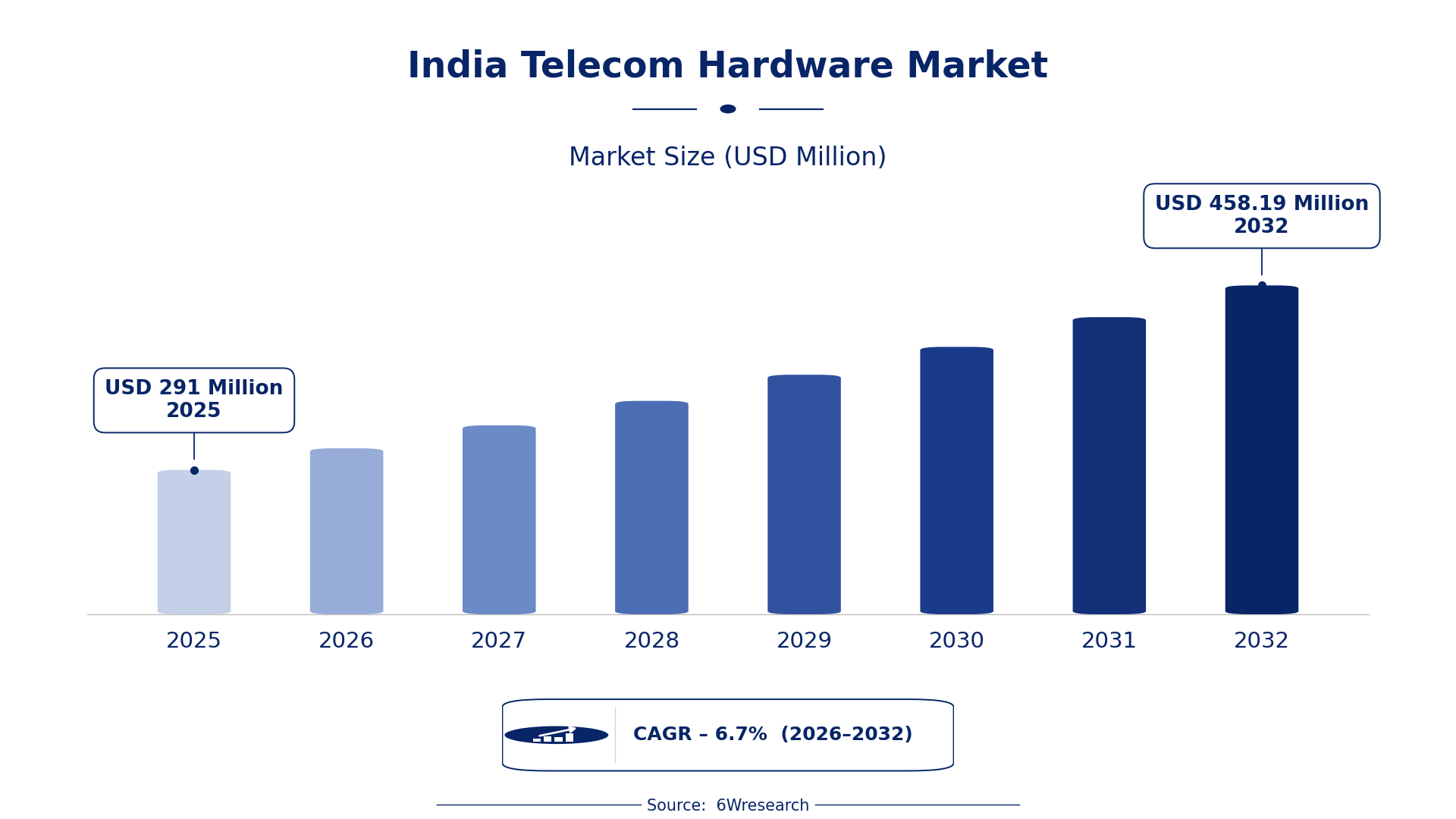
According to 6Wresearch internal database and industry insights, the India Telecom Hardware Market was valued at USD 291.0 million in 2025 and is projected to reach USD 458.19 million by 2032, growing at a CAGR of approximately 6.7% during 2026–2032.
India Telecom Hardware Market Highlights
| Report Metric | Details |
| Report Name | India Telecom Hardware Market |
| Market Size 2025 | USD 291.0 million |
| Market Size 2032 | USD 458.19 million |
| Absolute Growth 2025–2032 | USD 167.19 million |
| CAGR 2026–2032 | 6.7% |
| Peak Annual Growth | 9.0% in 2029 |
| Forecast Period | 2026–2032 |
| Historical Data | 2022–2025 |
| Base Year | 2025 |
| Leading Telecom Hardware Type, 2025 | Access Equipment (45% share) |
| Leading Product Type, 2025 | Routers & Switches (45% share) |
| Leading Hardware Category, 2025 | Wireless/Wired (45% share) |
| Leading Distribution Channel, 2025 | OEM Sales (39% share) |
| Leading End User Industry, 2025 | Mobile Networks (41% share) |
| Fastest-Growing Telecom Hardware Type | Base Station Equipment (8.0% CAGR) |
| Fastest-Growing Hardware Category | Broadband Access (8.5% CAGR) |
| Fastest-Growing Distribution Channel | Distributors (8.4% CAGR) |
| Fastest-Growing End User Industry | ISPs (9.1% CAGR) |
| Growing Sector | Mobile Networks |
| Key End Users | Network Providers, ISPs, Mobile Networks, Telecom Partners |
India Telecom Hardware Market Year-wise Growth Rate and Key Drivers (2022–2032)
This graph illustrates the annual growth rates of the market from 2022 to 2032, highlighting a steady upward trajectory and projected market expansion over the forecast period.
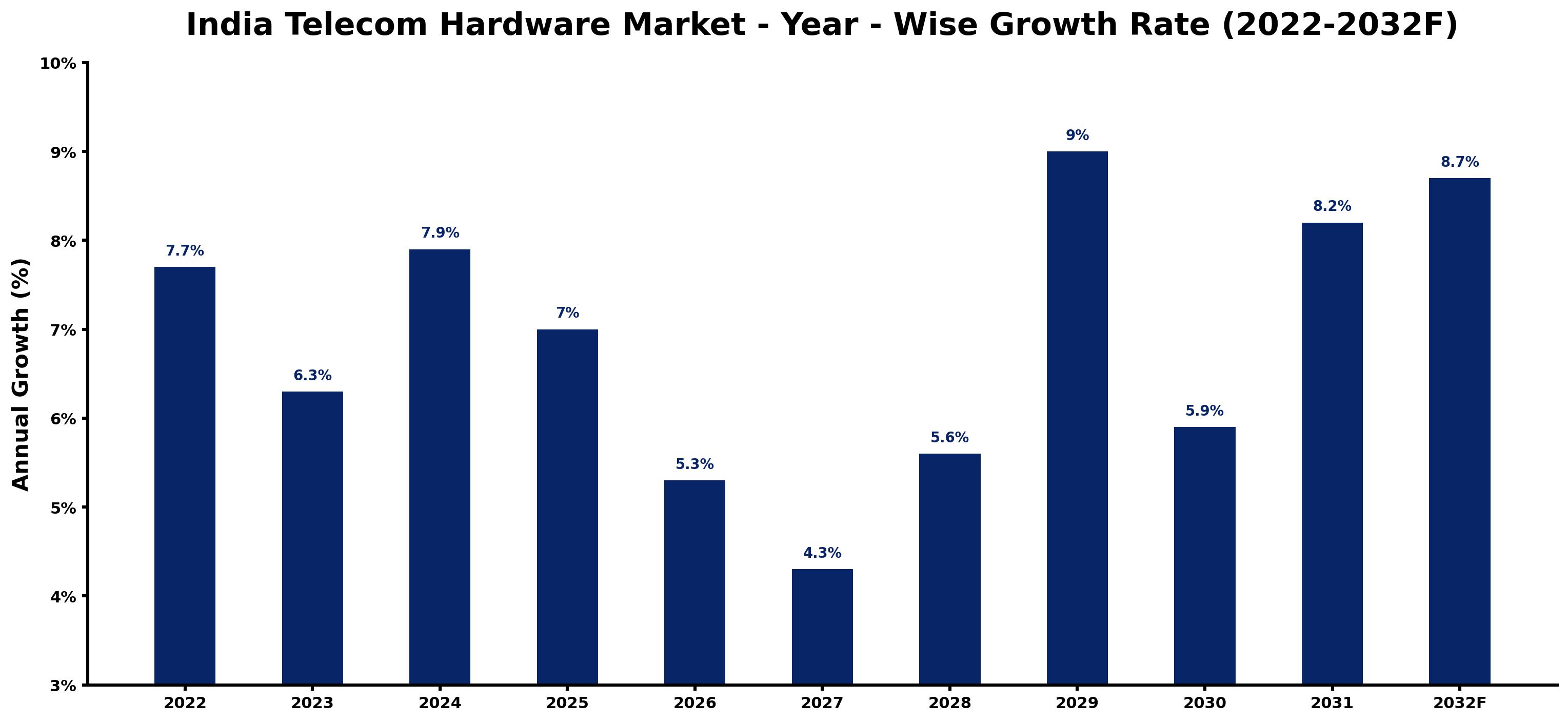
Annual growth estimates for each year appear below with the principal reason behind them, explaining the shifts that set the pace of the market.
| Year | Estimated Annual Growth (%) | Market Rationale |
| 2022 | 7.7 | The market experienced steady demand due to ongoing infrastructure investments. |
| 2023 | 6.3 | Growth slowed as the market adjusted to the previous year's high activity levels. |
| 2024 | 7.9 | Increased mobile subscriber numbers drove faster growth in telecom hardware. |
| 2025 | 7.0 | Demand moderated as infrastructure projects reached completion, impacting growth rates. |
| 2026 | 5.3 | Investment in 5G infrastructure began to slow, affecting overall market growth. |
| 2027 | 4.3 | Market growth continued to decelerate as investment levels normalised. |
| 2028 | 5.6 | A resurgence in broadband demand began to boost growth rates once again. |
| 2029 | 9.0 | The peak growth year saw significant demand from 5G base station equipment. |
| 2030 | 5.9 | Growth slowed slightly as market conditions stabilised after peak demand. |
| 2031 | 8.2 | A rebound in mobile network investments led to faster growth rates. |
| 2032 | 8.7 | Continued infrastructure development and digital initiatives supported strong market growth. |
Note: Market size estimations and growth projections presented in this report are based on 6Wresearch's proprietary forecasting methodology, utilizing the latest available industry data, government publications, and primary research inputs.
India Telecom Hardware Market Synopsis
Telecom Hardware in India includes devices and equipment crucial for telecommunications networks. These products enable communication, data transfer, and internet access, developed using advanced technologies. The India Telecom Hardware Market is expanding due to strong domestic demand, substantial investments in infrastructure, and a growing number of mobile subscribers. With over 1.2 billion mobile subscribers and a telecom sector contributing around 6% to GDP, demand is expected to stay robust. The National Digital Communications Policy targets broadband access for all by 2025, further propelling growth.
Market Dynamics Impact Analysis (2026–2032)
| Factor | Type | Impact | Primary Segment Affected |
| Increasing mobile subscriber base drives demand for routers and switches. | Driver | High | Routers & Switches |
| Investment in 5G infrastructure enhances demand for base station equipment. | Driver | High | Base Station Equipment |
| The gap in broadband access presents opportunities for infrastructure development. | Opportunity | High | Broadband Access |
| The Production Linked Incentive Scheme encourages local manufacturing of telecom hardware. | Opportunity | High | Access Equipment |
| High import dependency on certain telecom components restricts market growth. | Restraint | Medium | CPE Devices |
| Regulatory compliance costs can hinder smaller manufacturers' market entry. | Restraint | Medium | Access Equipment |
| Supply chain disruptions can delay project timelines for telecom infrastructure. | Challenge | High | Base Station Equipment |
| Competition from international manufacturers pressures local pricing strategies. | Challenge | Medium | Routers & Switches |
Evaluation of Drivers in India Telecom Hardware Market (2026–2032)
Below mentioned are some major drivers and their influence on market dynamics.
| Drivers | Primary Segment Affected | Why It Matters (Evidence) |
| Growing mobile subscriber base increases demand for routers and switches. | Routers & Switches | India has over 1.2 billion mobile subscribers, leading to higher purchases of networking equipment. |
| Investment in 5G infrastructure boosts demand for base station equipment. | Base Station Equipment | 5G deployment will increase the need for base station installations. |
| Rising internet user numbers drive demand for broadband access equipment. | Broadband Access | With more than 700 million internet users, demand for high-speed connectivity is surging. |
| Government initiatives support local manufacturing capabilities. | Access Equipment | The Production Linked Incentive Scheme aims to reduce reliance on imports and boost domestic production. |
| Increased focus on network reliability drives demand for access equipment. | Access Equipment | The Telecom Regulatory Authority of India sets standards that necessitate reliable access solutions. |
The Telecom Hardware market in India is growing on the back of rising mobile subscriber numbers, increased investment in 5G infrastructure, and expanding internet access. With over 1.2 billion mobile subscribers, demand for routers and switches is surging, prompting higher purchases. The Production Linked Incentive Scheme encourages local manufacturing, reducing reliance on imports and improving supply capabilities. This combination of factors creates a strong growth environment for telecom hardware in India.
Evaluation of Restraints in India Telecom Hardware Market
The table below lists the restraints and the evidence behind each.
| Market Restraint | Primary Segment Affected | Why It Matters (Evidence) |
| High import dependency on telecom components limits local production. | CPE Devices | Approximately 30% of telecom hardware is imported, affecting local manufacturers' competitiveness. |
| Regulatory compliance costs can hinder smaller manufacturers' market entry. | Access Equipment | Compliance with standards set by the Bureau of Indian Standards increases operational costs for new entrants. |
| Supply chain disruptions can delay project timelines for telecom infrastructure. | Base Station Equipment | Global supply chain issues have led to delays in equipment delivery, impacting project schedules. |
| Intense competition from international manufacturers pressures pricing strategies. | Routers & Switches | Local manufacturers face pricing pressures from established international players, affecting margins. |
| Limited access to financing for small telecom hardware producers. | Access Equipment | Many small manufacturers struggle to secure funding for expansion due to stringent lending criteria. |
India Telecom Hardware Market Challenges
India's telecom hardware market faces challenges, beginning with buyers navigating complex regulatory standards set by the Department of Telecommunications, which can delay project approvals by up to six months. High costs from the ₹1.5 trillion telecom infrastructure investment compel smaller players to limit their product lines, restricting competition. The push for 5G deployment significantly raises demand for base station equipment, causing supply chain strains that may delay production timelines for manufacturers. Inconsistent frequency allocation from the Wireless Planning and Coordination Wing disrupts essential equipment availability for service providers, complicating their ability to deliver reliable services.
Trends in the India Telecom Hardware Market
Below mentioned are some of the trends shaping the India Telecom Hardware Market growth.
- Digital India Initiative Driving Connectivity: The 'Digital India' initiative is mobilising ₹3 trillion in investments to enhance broadband access across urban and rural areas by 2025. This funding will improve infrastructure and connectivity, benefiting telecom hardware suppliers.
- Transition Towards 5G Infrastructure Development: India is rapidly transitioning towards 5G infrastructure, with substantial investments in base station equipment. The anticipated demand for this equipment is projected to increase by 9% annually as the country prepares for widespread 5G deployment.
- Growing Demand for Broadband Access Equipment: The increasing number of internet users is driving demand for broadband access equipment. With over 700 million internet users, the market for DSLAM and FTTH gear is expected to grow significantly, improving connectivity solutions.
- Focus on Local Manufacturing through PLI Scheme: The Production Linked Incentive Scheme is encouraging local manufacturing of telecom hardware. With a budget of ₹12,195 crore, this scheme aims to boost domestic production and reduce reliance on imports.
Investment Opportunities in the India Telecom Hardware Market
Several openings in the India Telecom Hardware Market merit attention from investors.
- Supply of Broadband Access Equipment: With over 700 million internet users, the demand for broadband access equipment is surging. Suppliers can target ISPs looking to expand their infrastructure, capitalising on the growing need for connectivity.
- Investment in 5G Base Station Equipment: The anticipated growth in 5G infrastructure presents a promising opportunity for manufacturers. With a projected increase in demand for base station equipment, suppliers can engage with network providers to meet this need.
- Local Manufacturing of Telecom Hardware: The Production Linked Incentive Scheme offers a ₹12,195 crore budget to boost local manufacturing. Companies can invest in production facilities to cater to the growing domestic market and reduce import reliance.
- Enhancing Network Reliability Solutions: As network reliability becomes paramount, suppliers can focus on providing access equipment that meets regulatory standards. Engaging with telecom operators can facilitate entry into this growing segment.
Government Initiatives in the India Telecom Hardware Market
The National Digital Communications Policy 2020 aims to attract ₹3 trillion investment in the telecom sector by 2025, improving infrastructure and connectivity. This policy builds upon previous measures, ensuring a comprehensive approach to enhancing telecom services across India. The Telecom Infrastructure Policy 2022 further supports this by encouraging the deployment of telecom towers and small cells, facilitating better coverage and service quality in both urban and rural areas. These measures aim to strengthen India's telecom infrastructure and ensure widespread access to services.
Network providers benefit from the Telecom Infrastructure Policy 2022, which streamlines the approval process for new telecom tower installations. The Department of Telecommunications oversees this policy, ensuring that projects meet regulatory standards. The Production Linked Incentive Scheme also supports buyers by incentivising local manufacturing, allowing them to source equipment domestically. This reduces lead times and improves service delivery for end-users, ultimately enhancing connectivity across the country.
Future Insight of the India Telecom Hardware Market
The India telecom hardware market is poised for transformation by 2032, driven by multiple forward-looking factors. The National Digital Communications Policy aims for universal broadband access, broadening the customer base for telecom hardware. With over 700 million internet users, demand for advanced connectivity solutions will rise, encouraging suppliers to enhance their offerings. The government's 'Digital India' initiative will catalyse investments in cutting-edge technologies, ensuring the market adapts to evolving consumer needs and remains competitive.
Market Segmentation Analysis
Each segment group is reviewed below, with the leader by share and the fastest grower by CAGR.
By Telecom Hardware Type – Access Equipment Dominated, Base Station Equipment Expected to Grow Fastest
According to Sumit Sagar, AM at 6Wresearch, Access Equipment took a 45% share of telecom hardware type in 2025, more than any other category. Access Equipment holds the largest share due to its crucial role in connecting over 1.2 billion mobile subscribers in India. This segment is vital for ensuring reliable communication and data transfer across diverse regions, meeting the needs of both urban and rural users. Base Station Equipment is projected to grow fastest, at a CAGR of 8.0% during 2026–2032. Base Station Equipment is experiencing rapid growth as the demand for 5G deployment increases, with expectations of significant surges in the coming years. The ongoing investments in telecom infrastructure, which reached ₹1.5 trillion in 2022, will further accelerate this segment's expansion. Suppliers should enhance their Access and Base Station Equipment offerings to align with the growing demand driven by 5G and expanding mobile networks.
By Product Type – Routers & Switches Dominated and Is Expected to Record the Fastest Growth
Routers & Switches accounted for a 45% market share by product type in 2025. Routers & Switches dominate the market share as they are integral for data routing and switching, essential for supporting India's vast internet user base of over 700 million. Their reliability and performance are critical for maintaining seamless connectivity across various networks. Its lead should widen, with a projected CAGR of 8.2% during 2026–2032, the highest in this split. The growth rate of Routers & Switches will continue to accelerate as the demand for high-speed internet access rises, spurred by initiatives like the National Digital Communications Policy. This policy aims to provide broadband access to all by 2025, significantly boosting the need for these products. Buyers should prioritise investing in advanced Routers & Switches to ensure robust network performance as the digital landscape evolves.
By Hardware Category – Wireless/Wired Dominated, Broadband Access Expected to Grow Fastest
The largest hardware category category in 2025 was Wireless/Wired, with a 45% share of total revenue. Wireless/Wired equipment captures the largest share as both types are fundamental for connectivity across diverse telecommunications networks. Their versatility in supporting various applications makes them essential for both urban and rural communication infrastructures. Broadband Access is set to record the highest CAGR in this split, 8.5% over 2026–2032. Broadband Access is projected to grow rapidly due to the increasing demand for high-speed internet, particularly as the government pushes for universal broadband access by 2025. This focus on connectivity will drive investments in broadband technologies and infrastructure. Suppliers must adapt their strategies to cater to the growing demand for Broadband Access solutions to remain competitive in the market.
By Distribution Channel – OEM Sales Dominated, Distributors Expected to Grow Fastest
OEM Sales held a 39% share of the India Telecom Hardware Market by distribution channel in 2025. OEM Sales leads the market share as it serves as the primary channel for distributing telecom hardware directly to manufacturers and service providers. This well-established channel ensures that high-quality products reach end-users efficiently and effectively. Over 2026–2032, Distributors are expected to post the fastest growth, at a CAGR of 8.4%. Distributors are experiencing the fastest growth due to their significant role in product distribution, especially as the telecom market expands. Their ability to quickly reach various customer segments is essential for meeting the increasing demand for telecom hardware. Suppliers should strengthen relationships with distributors to enhance market penetration and ensure timely delivery of products.
By End User Industry – Mobile Networks Dominated, ISPs Expected to Grow Fastest
In 2025, Mobile Networks led the end user industry split with a 41% share. Mobile Networks hold the largest market share as they are foundational for mobile communication services, supporting India's extensive subscriber base. The growth of mobile data consumption continues to drive demand for telecom hardware in this sector. ISPs are projected to grow fastest, at a CAGR of 9.1% during 2026–2032. ISPs are the fastest-growing segment, driven by the increasing need for internet services among consumers and businesses alike. The government's push for broadband access is further propelling ISPs to expand their infrastructure and service offerings. Suppliers should align their product development with the needs of ISPs to capitalise on the growing demand for internet services.
Key Attractiveness of the Report
- 10 Years of Market Numbers
- Historical Data Starting from 2022 to 2025
- Base Year 2025
- Forecast Data until 2032
- Key Performance Indicators Impacting the Market
- Major Upcoming Developments and Projects
Key Highlights of the Report:
- India Telecom Hardware Market Outlook
- Market Size of India Telecom Hardware Market, 2025
- Forecast of India Telecom Hardware Market, 2032
- Historical Data and Forecast of India Telecom Hardware Revenues & Volume for the Period 2022 - 2032F
- India Telecom Hardware Market Trend Evolution
- India Telecom Hardware Market Drivers and Challenges
- India Telecom Hardware Price Trends
- India Telecom Hardware Porter's Five Forces
- India Telecom Hardware Industry Life Cycle
- Historical Data and Forecast of India Telecom Hardware Market Revenues & Volume By Telecom Hardware Type for the Period 2022 - 2032F
- Historical Data and Forecast of India Telecom Hardware Market Revenues & Volume By Transmission Equipment for the Period 2022 - 2032F
- Historical Data and Forecast of India Telecom Hardware Market Revenues & Volume By Access Equipment for the Period 2022 - 2032F
- Historical Data and Forecast of India Telecom Hardware Market Revenues & Volume By CPE Devices for the Period 2022 - 2032F
- Historical Data and Forecast of India Telecom Hardware Market Revenues & Volume By Base Station Equipment for the Period 2022 - 2032F
- Historical Data and Forecast of India Telecom Hardware Market Revenues & Volume By Product Type for the Period 2022 - 2032F
- Historical Data and Forecast of India Telecom Hardware Market Revenues & Volume By Routers & Switches for the Period 2022 - 2032F
- Historical Data and Forecast of India Telecom Hardware Market Revenues & Volume By DSLAM/FTTH Gear for the Period 2022 - 2032F
- Historical Data and Forecast of India Telecom Hardware Market Revenues & Volume By Modems/Routers for the Period 2022 - 2032F
- Historical Data and Forecast of India Telecom Hardware Market Revenues & Volume By Radio Units for the Period 2022 - 2032F
- Historical Data and Forecast of India Telecom Hardware Market Revenues & Volume By Hardware Category for the Period 2022 - 2032F
- Historical Data and Forecast of India Telecom Hardware Market Revenues & Volume By IP/MPLS for the Period 2022 - 2032F
- Historical Data and Forecast of India Telecom Hardware Market Revenues & Volume By Broadband Access for the Period 2022 - 2032F
- Historical Data and Forecast of India Telecom Hardware Market Revenues & Volume By Wireless/Wired for the Period 2022 - 2032F
- Historical Data and Forecast of India Telecom Hardware Market Revenues & Volume By Macro/Small Cells for the Period 2022 - 2032F
- Historical Data and Forecast of India Telecom Hardware Market Revenues & Volume By Distribution Channel for the Period 2022 - 2032F
- Historical Data and Forecast of India Telecom Hardware Market Revenues & Volume By OEM Sales for the Period 2022 - 2032F
- Historical Data and Forecast of India Telecom Hardware Market Revenues & Volume By Distributors for the Period 2022 - 2032F
- Historical Data and Forecast of India Telecom Hardware Market Revenues & Volume By Retail Chains for the Period 2022 - 2032F
- Historical Data and Forecast of India Telecom Hardware Market Revenues & Volume By Telecom Partners for the Period 2022 - 2032F
- Historical Data and Forecast of India Telecom Hardware Market Revenues & Volume By End User Industry for the Period 2022 - 2032F
- Historical Data and Forecast of India Telecom Hardware Market Revenues & Volume By Network Providers for the Period 2022 - 2032F
- Historical Data and Forecast of India Telecom Hardware Market Revenues & Volume By ISPs for the Period 2022 - 2032F
- Historical Data and Forecast of India Telecom Hardware Market Revenues & Volume By Consumer Telecom for the Period 2022 - 2032F
- Historical Data and Forecast of India Telecom Hardware Market Revenues & Volume By Mobile Networks for the Period 2022 - 2032F
- India Telecom Hardware Import Export Trade Statistics
- Market Opportunity Assessment By Telecom Hardware Type
- Market Opportunity Assessment By Product Type
- Market Opportunity Assessment By Hardware Category
- Market Opportunity Assessment By Distribution Channel
- Market Opportunity Assessment By End User Industry
- India Telecom Hardware Top Companies Market Share
- India Telecom Hardware Competitive Benchmarking By Technical and Operational Parameters
- India Telecom Hardware Company Profiles
- India Telecom Hardware Key Strategic Recommendations
Market Covered
The report offers an extensive study of the following market segments.
By Telecom Hardware Type
- Transmission Equipment
- Access Equipment
- CPE Devices
- Base Station Equipment
By Product Type
- Routers & Switches
- DSLAM/FTTH Gear
- Modems/Routers
- Radio Units
By Hardware Category
- IP/MPLS
- Broadband Access
- Wireless/Wired
- Macro/Small Cells
By Distribution Channel
- OEM Sales
- Distributors
- Retail Chains
- Telecom Partners
By End User Industry
- Network Providers
- ISPs
- Consumer Telecom
- Mobile Networks































