Indonesia Advertising Market Size, Share & Growth Rate
The Indonesia Advertising Market was estimated at USD 198 Million in 2025 and is projected to reach USD 263 Million by 2032, growing at a CAGR of 4.1% from 2026 to 2032. This growth trajectory is primarily driven by the expanding middle class and the rapid digital transformation within the country. As businesses increasingly recognize the value of digital platforms, particularly in mobile and social media, advertising budgets are being reallocated to engage a more tech-savvy consumer base effectively.
Indonesia Advertising Market Year-wise Growth Rate and Key Drivers
This graph highlights how the Indonesia Advertising Market has steadily grown over the years, supported by major growth factors.
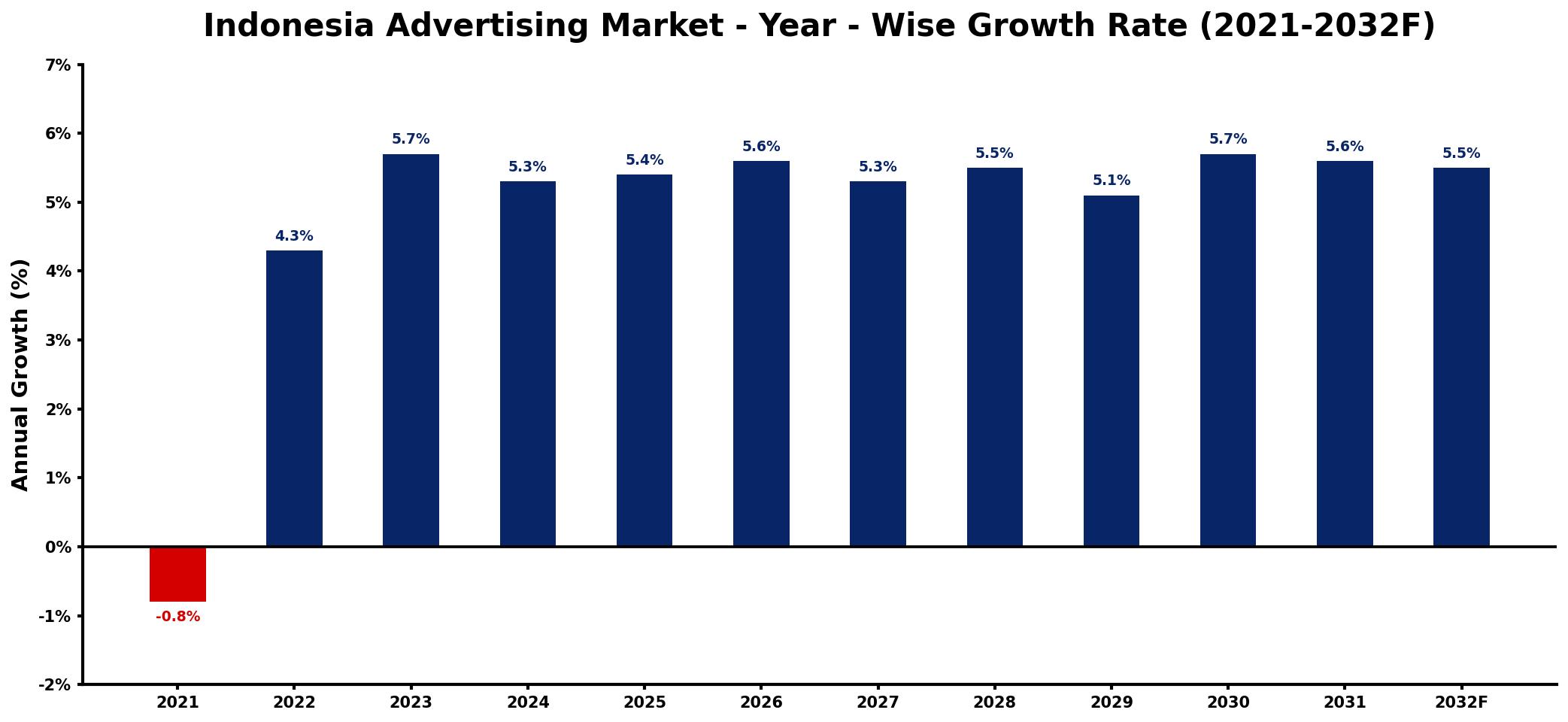
The table below presents the year‑wise growth rates along with the key drivers influencing the market
| Year | Growth Rate | Major Drivers |
| 2021 | -0.8% | decrease in marketing budgets |
| 2022 | 4.3% | rising digital media consumption |
| 2023 | 5.7% | increased mobile internet accessibility |
| 2024 | 5.3% | growth in e-commerce platforms |
| 2025 | 5.4% | expansion of social media influencers |
| 2026 | 5.6% | higher investment in technology |
| 2027 | 5.3% | emergence of new startups |
| 2028 | 5.5% | growing interest in sustainability |
| 2029 | 5.1% | enhanced customer engagement strategies |
| 2030 | 5.7% | adoption of innovative formats |
| 2031 | 5.6% | broader audience targeting capabilities |
| 2032 | 5.5% | strengthened brand loyalty programs |
Note: Market size estimations and growth projections presented in this report are based on 6Wresearch's proprietary forecasting methodology, utilizing the latest available industry data, government publications, and primary research inputs.
Indonesia Advertising Market Synopsis
The rise of the digital economy has significantly altered the advertising landscape in Indonesia. With a burgeoning internet penetration rate, businesses are shifting their focus to online advertising strategies that harness the power of social media and mobile platforms. This adaptation is crucial for connecting with the diverse and urbanizing consumer demographic.
Moreover, the competitive nature of the e-commerce sector has intensified the need for impactful advertising. As companies strive to stand out amidst fierce competition, effective branding and innovative marketing strategies have become essential for capturing consumer attention and loyalty.
Indonesia Advertising Market Key Takeaways
- The market is experiencing a significant shift from traditional to digital advertising methodologies.
- Increased internet and smartphone penetration are pivotal drivers of advertising growth.
- Economic recovery post-COVID-19 is expected to foster a rebound in advertising spending.
- Urbanization and a growing middle class present expansive consumer opportunities.
- The competitive landscape in e-commerce heightens the demand for strategic advertising investments.
Evaluation of Restraints in Indonesia Advertising Market
Despite its growth potential, the Indonesia Advertising Market faces certain restraints that could hinder expansion. Economic fluctuations, often exacerbated by global market trends, can prompt businesses to tighten their advertising budgets during downturns. Furthermore, the increasing prevalence of ad-blockers poses a significant challenge, complicating the task of effectively reaching target audiences. Additionally, the fragmentation of media channels can dilute advertising impact, making it imperative for companies to navigate these complexities thoughtfully.
Indonesia Advertising Market Trends
Several key trends are shaping the Indonesia Advertising Market. Firstly, there is a noticeable shift towards influencer marketing, driven by the rising influence of social media personalities on consumer behavior. Brands are leveraging these influencers to establish trust and authenticity. Secondly, mobile advertising is gaining traction, as more consumers engage with brands through their smartphones. This necessitates advertisers to optimize their strategies for mobile-first experiences. Lastly, the integration of data analytics into advertising strategies is becoming crucial, enabling businesses to personalize their campaigns and enhance return on investment.
Indonesia Advertising Market Opportunities
The landscape of the Indonesia Advertising Market presents numerous opportunities for growth and investment. As digital advertising continues to evolve, businesses can capitalize on the increasing demand for video content and interactive advertising formats. Furthermore, the expansion of e-commerce provides a fertile ground for targeted advertising campaigns that directly engage consumers at critical buying moments. This convergence of digital innovation and consumer engagement offers a ripe environment for advertisers looking to differentiate themselves in a crowded marketplace.
Government Initiatives in the Indonesia Advertising Market
The Indonesian government has been actively supporting the digital economy through various initiatives aimed at enhancing internet infrastructure and fostering entrepreneurship. Programs designed to promote digital literacy are critical in ensuring that both consumers and businesses can effectively navigate the evolving advertising landscape. Furthermore, public spending on technology and telecommunications continues to bolster the advertising sector, enabling improved access to digital platforms for a broader population.
Future Insights of the Indonesia Advertising Market
Looking ahead to the 2026-2032 period, the Indonesia Advertising Market is poised for robust growth. As digital innovation accelerates, advertisers will increasingly rely on sophisticated technologies like artificial intelligence and machine learning to optimize their campaigns. The continued urbanization and digital engagement of the populace will likely lead to greater competition among brands, driving higher advertising investments. Overall, the synergy between evolving consumer preferences and technological advancements is set to redefine the advertising landscape in Indonesia.
Indonesia Advertising Market Latest Developments (2025 - 2026)
Recent developments in the Indonesia Advertising Market indicate a pronounced pivot towards digital and mobile advertising strategies. Agencies are exploring innovative campaign formats to engage younger audiences more effectively. The ongoing evolution of social media platforms is driving advertisers to adapt their messaging and creative approaches, reflecting changing consumer dynamics. Moreover, an emphasis on data-driven decision-making is becoming prevalent, enabling more targeted and efficient advertising efforts across various channels.
Indonesia Advertising Market - Key Attractiveness of the Report
- 10 Years of Market Numbers
- Historical Data Starting from 2022 to 2025
- Base Year: 2025
- Forecast Data until 2032
- Key Performance Indicators Impacting the Market
- Major Upcoming Developments and Projects
Key Highlights of the Report:
- Indonesia Advertising Market Outlook
- Market Size of Indonesia Advertising Market, 2025
- Forecast of Indonesia Advertising Market, 2032
- Historical Data and Forecast of Indonesia Advertising Revenues & Volume for the Period 2022-2032F
- Indonesia Advertising Market Trend Evolution
- Indonesia Advertising Market Drivers and Challenges
- Indonesia Advertising Price Trends
- Indonesia Advertising Porter's Five Forces
- Indonesia Advertising Industry Life Cycle
- Historical Data and Forecast of Indonesia Advertising Market Revenues & Volume By Type for the Period 2022-2032F
- Historical Data and Forecast of Indonesia Advertising Market Revenues & Volume By Television for the Period 2022-2032F
- Historical Data and Forecast of Indonesia Advertising Market Revenues & Volume By Print (Newspaper and Magazine) for the Period 2022-2032F
- Historical Data and Forecast of Indonesia Advertising Market Revenues & Volume By Radio for the Period 2022-2032F
- Historical Data and Forecast of Indonesia Advertising Market Revenues & Volume By Outdoor for the Period 2022-2032F
- Historical Data and Forecast of Indonesia Advertising Market Revenues & Volume By Internet (Search, Display, Classified, Video) for the Period 2022-2032F
- Historical Data and Forecast of Indonesia Advertising Market Revenues & Volume By Mobile for the Period 2022-2032F
- Historical Data and Forecast of Indonesia Advertising Market Revenues & Volume By Cinema for the Period 2022-2032F
- Indonesia Advertising Import Export Trade Statistics
- Market Opportunity Assessment By Type
- Indonesia Advertising Top Companies Market Share
- Indonesia Advertising Competitive Benchmarking By Technical and Operational Parameters
- Indonesia Advertising Company Profiles
- Indonesia Advertising Key Strategic Recommendations






































