Indonesia Conveyors System Market Summary
The indonesia conveyors system market was estimated at USD 477 Million in 2025 and is projected to reach USD 633 Million by 2032, growing at a CAGR of 5.5% from 2026 to 2032.
Indonesia Conveyors System Market Year-wise Growth Rate and Key Drivers
This graph highlights how the Indonesia Conveyors System Market has steadily grown over the past five years, supported by major growth factors.
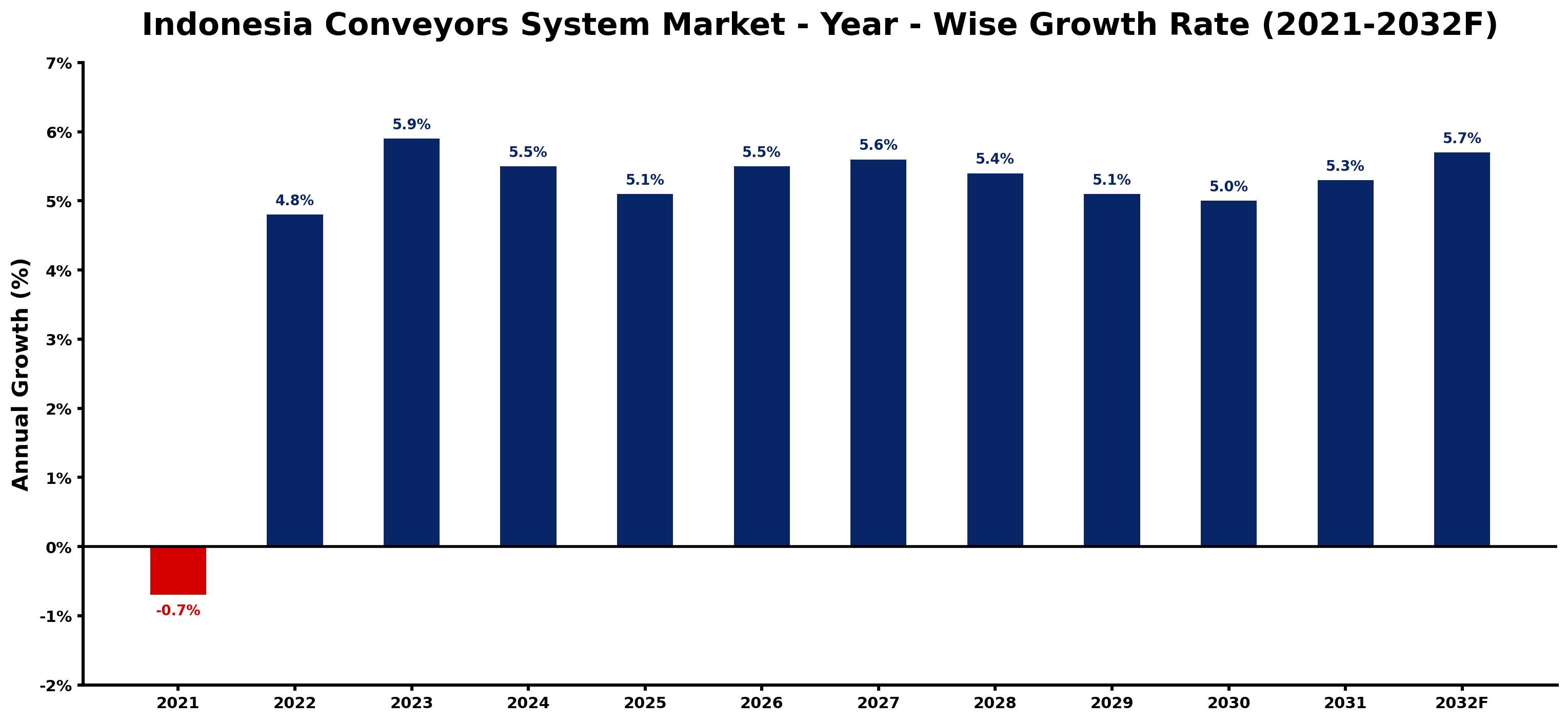
The table below presents the year wise growth rates along with the key drivers influencing the market
| Year | Growth Rate | Major Drivers |
| 2021 | -0.7% | Supply chain disruptions due to pandemic restrictions hindered project completions and delayed equipment installations. |
| 2022 | 4.8% | Manufacturing sector recovery prompted investments in automation technologies throughout the region. |
| 2023 | 5.9% | E-commerce expansion necessitated advanced conveyor solutions for faster logistics and distribution. |
| 2024 | 5.5% | Infrastructure developments, including transportation networks, increased demand for bulk material handling. |
| 2025 | 5.1% | Local manufacturers began prioritizing conveyor system upgrades to enhance production efficiency. |
| 2026 | 5.5% | Emerging industries, such as food processing, required specialized conveyor solutions for safety. |
| 2027 | 5.6% | Sustainability goals pushed organizations to adopt energy-efficient conveyor technologies in factories. |
| 2028 | 5.4% | Increased foreign direct investment fueled competition, driving innovation in conveyor system designs. |
| 2029 | 5.1% | Technological convergence led to smart conveyor systems integrating IoT for real-time monitoring. |
| 2030 | 5.0% | Workforce shifts towards automation urged companies to streamline processes with conveyor solutions. |
| 2031 | 5.3% | Growing urbanization in Indonesia expanded logistical needs, emphasizing reliable conveyor systems. |
| 2032 | 5.7% | Shift towards circular economy principles inspired innovative recycling conveyors in various industries. |
Note - Market size estimations and growth projections presented in this report are based on 6Wresearch's advanced forecasting approach, validated with industry datasets as of June 2026.
Indonesia Conveyors System Market Synopsis
The Indonesia Conveyors System Market is projected to reach 5.5% and witness significant growth during the forecast period (2026-2032). This growth is largely driven by the rising demand for automated solutions across various sectors, particularly in material handling, automotive, food and beverage processing, and pharmaceutical manufacturing. With the increasing focus on efficiency and productivity, industries are increasingly turning to conveyor systems as integral components of their operations.
Indonesia Conveyors System Market Growth Drivers
Several key factors are fueling the expansion of the Indonesia Conveyors System Market. First, the booming mining sector, propelled by heightened demand for minerals from neighboring countries such as China and India, is driving investments in automation technologies. These conveyor systems help streamline production processes while reducing labor costs and increasing operational accuracy.
- Rising mineral demand has led to increased mining activities, enhancing the necessity for automated conveyor systems that facilitate quicker production cycles.
- Conveyor technologies enable companies to optimize their supply chains, ensuring that products reach consumers in a timely manner, thus meeting evolving market demands.
- The growth of e-commerce in Indonesia, spurred by the digital revolution, necessitates advanced logistics solutions, including efficient warehousing apparatus that incorporates conveyor systems.
- Manufacturers are increasingly adopting robotics along with conveyors to improve sorting and packing capabilities, further optimizing the speed of their operations.
- In an effort to enhance profitability, businesses are investing in conveyor systems to minimize workforce costs while maximizing output quality and efficiency.
Indonesia Conveyors System Market Challenges and Restraints
Despite the positive growth trajectory, the Indonesia Conveyors System Market faces notable challenges. High installation costs associated with advanced automated conveyor technologies inhibit adoption among small- and medium-sized enterprises that lack the necessary capital.
- Initial capital investment requirements can be prohibitively expensive for smaller firms, creating a barrier to entry into the automation space.
- Maintenance challenges often arise from the complexities of modern conveyor systems, coupled with inadequate training for personnel, leading to operational inefficiencies.
- The reliance on sophisticated technologies can lead to operational disruptions when there is a lack of skilled personnel to handle system management.
- Market players must navigate fluctuating raw material costs, which can impact the pricing and profitability of conveyor installation projects.
- Competition from alternative material handling solutions may pressure conveyor system providers to continually innovate and reduce prices.
Indonesia Conveyors System Market Trends and Opportunities
Emerging trends indicate a shift towards smart conveyor systems integrated with advanced technologies such as the Internet of Things (IoT) and artificial intelligence (AI). These systems allow for real-time monitoring and data analytics, improving decision-making and operational efficiency.
- Automation technology adoption is set to rise, especially in sectors like e-commerce, where speed and accuracy are paramount.
- Companies are seeking eco-friendly conveyor solutions that minimize energy consumption and reduce environmental impact.
- Collaborative robotics (cobots) are gaining traction, allowing human workers to collaborate with machines to enhance productivity without replacing the workforce.
- There is a growing emphasis on retrofitting existing conveyor systems with updated technologies to improve performance without the need for complete replacements.
- As businesses increasingly prioritize supply chain resilience, flexible conveyor systems that can be reconfigured for various applications are becoming more desirable.
Indonesia Conveyors System Market Government Investment and Initiatives
The Indonesian government has identified the need for advanced infrastructure in its development plans, emphasizing support for automation in manufacturing sectors, including conveyor systems. Initiatives focus on enhancing industrial productivity and competitiveness through public investments and incentives aimed at modernizing facilities.
- Government policies are fostering an environment conducive to foreign investments in automation technologies, including conveyor systems.
- Public spending on infrastructure projects aims to boost economic growth and efficiency within logistics and manufacturing sectors.
- Incentives for companies adopting green technologies are encouraging investment in energy-efficient conveyor solutions.
- Development programs are facilitating partnerships between government bodies and private enterprises to promote innovation in automation technologies.
- Investment in workforce training initiatives is crucial, ensuring that personnel are equipped with the necessary skills to operate advanced conveyor systems effectively.
Indonesia Conveyors System Market Latest Developments (May 2025 - June 2026)
Recent industry developments indicate a strengthening trend towards innovation in conveyor technology. Companies are increasingly focusing on integrating AI and IoT capabilities within their systems, enhancing monitoring and maintenance functions. This shift helps businesses achieve higher operational efficiency and adaptability in rapidly changing market conditions.
- Industry collaborations are becoming more common, with firms joining forces to develop cutting-edge conveyor technologies that meet evolving customer needs.
- Investments in research and development are on the rise, particularly in creating smart conveyor systems that optimize workflows and reduce downtime.
- Different sectors are exploring automation solutions tailored to their specific needs, indicating a growing recognition of the potential benefits of conveyor systems.
- Significant strides are being made towards sustainability in conveyor design, aligning with global trends focused on reducing environmental impact.
- Conveyor manufacturers are enhancing their service offerings by providing comprehensive maintenance and support packages to ensure operational continuity for clients.
Indonesia Conveyors System Market - Key Attractiveness of the Report
- 10 Years of Market Numbers
- Historical Data Starting from 2022 to 2025
- Base Year: 2025
- Forecast Data until 2032
- Key Performance Indicators Impacting the Market
- Major Upcoming Developments and Projects
Key Highlights of the Report:
- Indonesia Conveyors System Market Outlook
- Market Size of Indonesia Conveyors System Market, 2025
- Forecast of Indonesia Conveyors System Market, 2032F
- Historical Data and Forecast of Indonesia Conveyors System Revenues & Volume for the Period 2022-2032F
- Indonesia Conveyors System Market Trend Evolution
- Indonesia Conveyors System Market Drivers and Challenges
- Indonesia Conveyors System Price Trends
- Indonesia Conveyors System Porter's Five Forces
- Indonesia Conveyors System Industry Life Cycle
- Historical Data and Forecast of Indonesia Conveyors System Market Revenues & Volume By Type for the Period 2022-2032F
- Historical Data and Forecast of Indonesia Conveyors System Market Revenues & Volume By Belt for the Period 2022-2032F
- Historical Data and Forecast of Indonesia Conveyors System Market Revenues & Volume By Roller for the Period 2022-2032F
- Historical Data and Forecast of Indonesia Conveyors System Market Revenues & Volume By Pallet for the Period 2022-2032F
- Historical Data and Forecast of Indonesia Conveyors System Market Revenues & Volume By Overhead for the Period 2022-2032F
- Historical Data and Forecast of Indonesia Conveyors System Market Revenues & Volume By Floor for the Period 2022-2032F
- Historical Data and Forecast of Indonesia Conveyors System Market Revenues & Volume By Crescent for the Period 2022-2032F
- Historical Data and Forecast of Indonesia Conveyors System Market Revenues & Volume By Tri-planar for the Period 2022-2032F
- Historical Data and Forecast of Indonesia Belt Conveyors System Market Revenues & Volume By Others for the Period 2022-2032F
- Historical Data and Forecast of Indonesia Conveyors System Market Revenues & Volume By End-Use Industry for the Period 2022-2032F
- Historical Data and Forecast of Indonesia Conveyors System Market Revenues & Volume By Warehouse & Distribution for the Period 2022-2032F
- Historical Data and Forecast of Indonesia Conveyors System Market Revenues & Volume By Food & Beverage for the Period 2022-2032F
- Historical Data and Forecast of Indonesia Conveyors System Market Revenues & Volume By Automotive for the Period 2022-2032F
- Historical Data and Forecast of Indonesia Conveyors System Market Revenues & Volume By Electronics for the Period 2022-2032F
- Historical Data and Forecast of Indonesia Conveyors System Market Revenues & Volume By Mining for the Period 2022-2032F
- Historical Data and Forecast of Indonesia Conveyors System Market Revenues & Volume By Airport for the Period 2022-2032F
- Indonesia Conveyors System Import Export Trade Statistics
- Market Opportunity Assessment By Type
- Market Opportunity Assessment By End-Use Industry
- Indonesia Conveyors System Top Companies Market Share
- Indonesia Conveyors System Competitive Benchmarking By Technical and Operational Parameters
- Indonesia Conveyors System Company Profiles
- Indonesia Conveyors System Key Strategic Recommendations






































