Indonesia Customer Relationship Management CRM Market Size & Growth Rate (2026-2032)
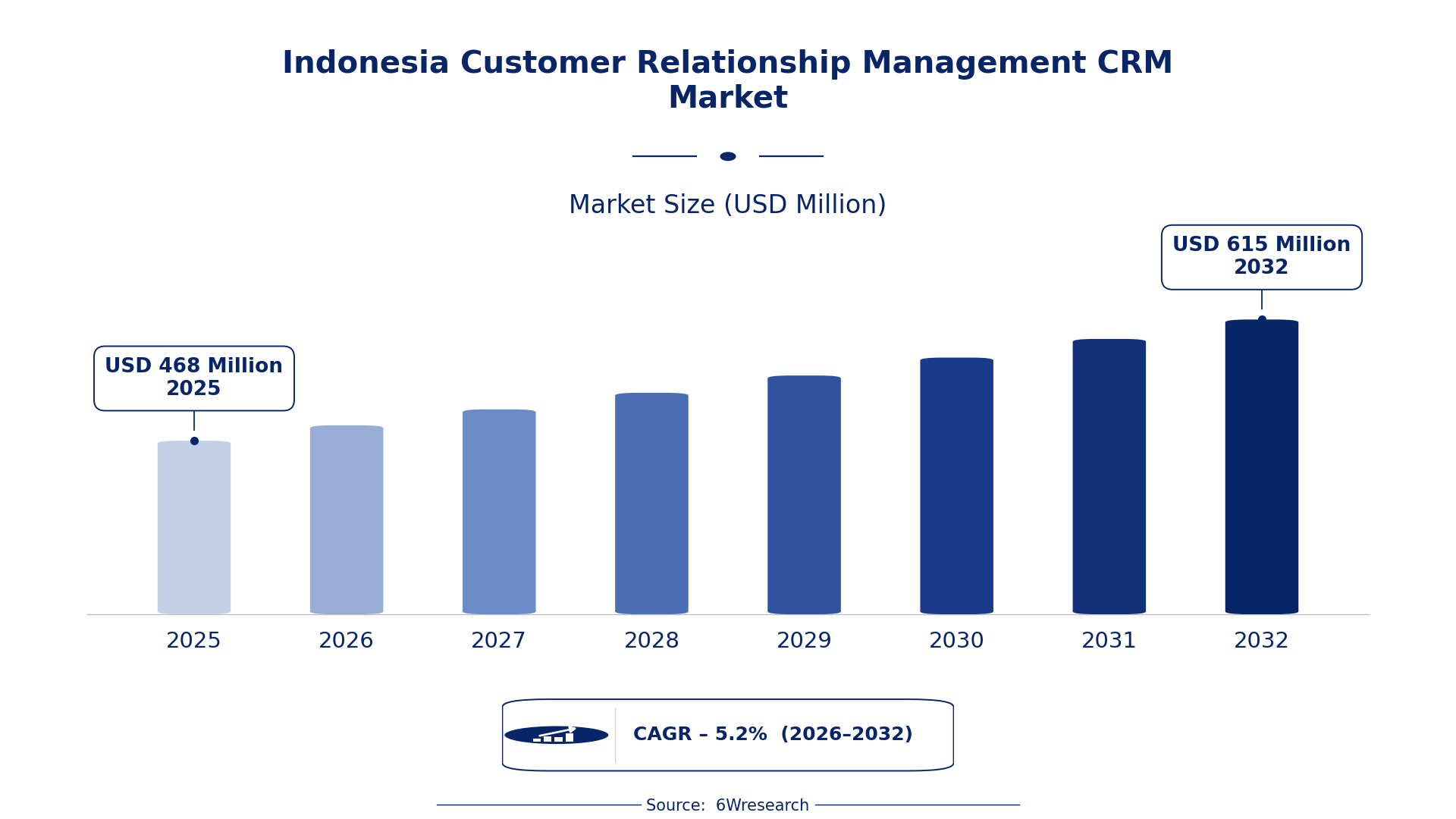
The Indonesia Customer Relationship Management CRM Market was estimated at USD 468 Million in 2025 and is projected to reach USD 615 Million by 2032, growing at a CAGR of 5.2% from 2026 to 2032.
Indonesia Customer Relationship Management CRM Market Synopsis
The CRM market in Indonesia is on an upward trajectory as businesses increasingly prioritize customer relationships. Companies are leveraging CRM solutions not just to manage interactions but to gain a deeper understanding of customer behavior, ultimately driving loyalty and long-term profitability.
The surge in e-commerce and mobile technology adoption has further accelerated the need for effective CRM systems. Organizations are recognizing that personalized customer engagement is essential in a competitive marketplace, making CRM an indispensable tool for success.
Indonesia Customer Relationship Management CRM Market Year-wise Growth Rate and Key Drivers
This graph illustrates the annual growth rates of the Indonesia Customer Relationship Management CRM Market from 2021 to 2032, highlighting a steady upward trajectory and projected expansion over the forecast period.
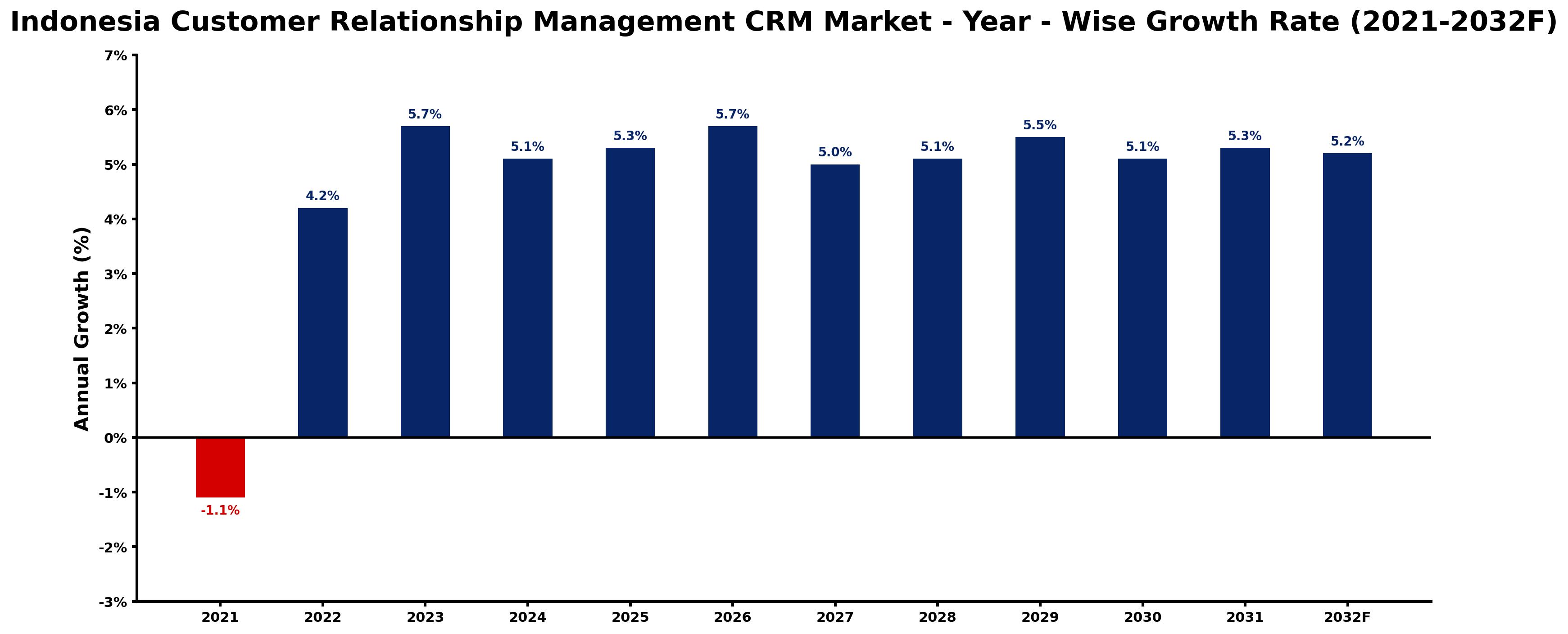
The table below presents the year‑wise growth rates along with the key drivers influencing the market
| Year | Growth Rate | Major Drivers |
| 2021 | -1.1% | Regulatory hurdles from Indonesian Personal Data Protection Law |
| 2022 | 4.2% | Government digital transformation initiatives enhancing customer engagement. |
| 2023 | 5.7% | Surge in e-commerce driving CRM adoption among retailers. |
| 2024 | 5.1% | Growing mobile internet penetration improving customer interaction. |
| 2025 | 5.3% | Rise in SMEs implementing digital marketing strategies. |
| 2026 | 5.7% | Increased focus on customer experience by Indonesian businesses. |
| 2027 | 5.0% | Emerging AI technologies enhancing CRM capabilities locally. |
| 2028 | 5.1% | Adoption of cloud solutions by Indonesian organizations increasing. |
| 2029 | 5.5% | Strengthened data privacy laws fostering CRM system upgrades. |
| 2030 | 5.1% | Growing consumer data security concerns driving CRM investments. |
| 2031 | 5.3% | Demand for personalized services boosting CRM market growth. |
| 2032 | 5.2% | Government support for tech startups enhancing CRM solutions. |
Note: Market size estimations and growth projections presented in this report are based on 6Wresearch's proprietary forecasting methodology, utilizing the latest available industry data, government publications, and primary research inputs.
Indonesia Customer Relationship Management CRM Market Key Takeaways
Below are some of the specific key takeaways from the market, including:
- The market is witnessing steady growth driven by the increasing focus on customer loyalty.
- E-commerce expansion is significantly boosting the demand for CRM solutions.
- Mobile technology and internet access have simplified CRM implementation.
- Data-driven strategies are helping businesses enhance marketing efforts.
- Companies face challenges related to data privacy and evolving customer expectations.
Evaluation of Restraints in Indonesia Customer Relationship Management CRM Market
Despite its growth, the CRM market in Indonesia grapples with several challenges. Managing customer data responsibly is paramount, as any breach can lead to significant repercussions. Trust is fragile, and businesses must work diligently to maintain it in an era where data breaches are prevalent. on top of that, adapting to changing customer preferences requires agility and continuous innovation, which can strain resources and capabilities.
Indonesia Customer Relationship Management CRM Market Trends
Several trends are shaping the CRM market in Indonesia. The integration of artificial intelligence into CRM systems is enhancing customer insights, allowing for more personalized interactions. Additionally, the focus on omnichannel communication is growing, as businesses strive to engage customers across multiple platforms. As companies adopt these technologies, the demand for user-friendly interfaces and real-time analytics is also increasing.
Indonesia Customer Relationship Management CRM Market Opportunities
Opportunities abound for businesses willing to invest in CRM technologies. The continued rise of e-commerce presents a fertile ground for CRM applications aimed at enhancing customer experiences. on top of that, companies that can harness data analytics effectively stand to gain a competitive edge. There's also potential for expansion into underserved markets, particularly in rural areas where digital engagement is on the rise.
Government Initiatives in the Indonesia Customer Relationship Management CRM Market
Government initiatives are increasingly shaping the CRM market in Indonesia. With a push towards digital transformation, public policy is prioritizing the enhancement of digital infrastructure, which directly impacts CRM capabilities. Regulatory frameworks are being established to support data privacy and security, ensuring that companies can build trust with their customers while complying with local regulations.
- A national digital infrastructure upgrade programme recently completed in early 2025 aims to improve internet accessibility across urban and rural areas.
- Current initiatives focus on developing a regulatory framework that mandates compliance with data privacy standards, enhancing consumer trust.
- Planned public-private partnerships are expected to launch by 2026 to facilitate the deployment of CRM solutions among small and medium enterprises.
- Ongoing government training programs aim to enhance the digital skills of the workforce, thereby improving CRM implementation capabilities.
Future Insights of the Indonesia Customer Relationship Management CRM Market
Looking ahead to 2026-2032, the CRM market in Indonesia is set for continued growth. Businesses will increasingly rely on sophisticated CRM tools to navigate the complexities of customer engagement. The integration of advanced analytics and AI will become commonplace, enabling companies to predict customer needs and tailor their offerings accordingly. As digital transformation accelerates, those who invest in CRM technologies will likely emerge as leaders in their respective sectors.
Indonesia Customer Relationship Management CRM Market Latest Developments
Recent developments in the CRM market reflect a dynamic environment characterized by innovation and adaptation. Companies are actively enhancing their CRM offerings to meet the growing demands of consumers and businesses alike. This ongoing activity signals a vibrant market ready for transformation.
- A leading regional operator launched a new AI-powered CRM solution in Q2 2025 to better analyze customer interactions and improve service delivery.
- In early 2025, a major technology vendor completed a comprehensive upgrade of its CRM platform, focusing on user experience and mobile accessibility.
- Ongoing collaborations between CRM providers and local businesses aim to tailor solutions that meet specific market needs, with initiatives expected to conclude by late 2025.
- A rollout of a cloud-based CRM solution targeting SMEs is planned for the second half of 2026, aiming to democratize access to advanced CRM functionalities.
Indonesia Customer Relationship Management CRM Market - Key Attractiveness of the Report
- 10 Years of Market Numbers
- Historical Data Starting from 2022 to 2025
- Base Year: 2025
- Forecast Data until 2032
- Key Performance Indicators Impacting the Market
- Major Upcoming Developments and Projects
Key Highlights of the Report:
- Indonesia Customer Relationship Management CRM Market Outlook
- Market Size of Indonesia Customer Relationship Management CRM Market, 2025
- Forecast of Indonesia Customer Relationship Management CRM Market, 2032
- Historical Data and Forecast of Indonesia Customer Relationship Management CRM Revenues & Volume for the Period 2022-2032F
- Indonesia Customer Relationship Management CRM Market Trend Evolution
- Indonesia Customer Relationship Management CRM Market Drivers and Challenges
- Indonesia Customer Relationship Management CRM Price Trends
- Indonesia Customer Relationship Management CRM Porter's Five Forces
- Indonesia Customer Relationship Management CRM Industry Life Cycle
- Historical Data and Forecast of Indonesia Customer Relationship Management CRM Market Revenues & Volume By Applications for the Period 2022-2032F
- Historical Data and Forecast of Indonesia Customer Relationship Management CRM Market Revenues & Volume By Marketing for the Period 2022-2032F
- Historical Data and Forecast of Indonesia Customer Relationship Management CRM Market Revenues & Volume By Sales for the Period 2022-2032F
- Historical Data and Forecast of Indonesia Customer Relationship Management CRM Market Revenues & Volume By Customer support & service for the Period 2022-2032F
- Historical Data and Forecast of Indonesia Customer Relationship Management CRM Market Revenues & Volume By Others for the Period 2022-2032F
- Historical Data and Forecast of Indonesia Customer Relationship Management CRM Market Revenues & Volume By Deployment Type for the Period 2022-2032F
- Historical Data and Forecast of Indonesia Customer Relationship Management CRM Market Revenues & Volume By On Demand (SaaS and PaaS) for the Period 2022-2032F
- Historical Data and Forecast of Indonesia Customer Relationship Management CRM Market Revenues & Volume By On Premise for the Period 2022-2032F
- Historical Data and Forecast of Indonesia Customer Relationship Management CRM Market Revenues & Volume By Hybrid for the Period 2022-2032F
- Historical Data and Forecast of Indonesia Customer Relationship Management CRM Market Revenues & Volume By Solutions for the Period 2022-2032F
- Historical Data and Forecast of Indonesia Customer Relationship Management CRM Market Revenues & Volume By Social Monitoring for the Period 2022-2032F
- Historical Data and Forecast of Indonesia Customer Relationship Management CRM Market Revenues & Volume By Social Mapping for the Period 2022-2032F
- Historical Data and Forecast of Indonesia Customer Relationship Management CRM Market Revenues & Volume By Social Middleware for the Period 2022-2032F
- Historical Data and Forecast of Indonesia Customer Relationship Management CRM Market Revenues & Volume By Social Management for the Period 2022-2032F
- Historical Data and Forecast of Indonesia Customer Relationship Management CRM Market Revenues & Volume By Social Measurement for the Period 2022-2032F
- Historical Data and Forecast of Indonesia Customer Relationship Management CRM Market Revenues & Volume By Users for the Period 2022-2032F
- Historical Data and Forecast of Indonesia Customer Relationship Management CRM Market Revenues & Volume By Small & Medium Businesses (SMB) for the Period 2022-2032F
- Historical Data and Forecast of Indonesia Customer Relationship Management CRM Market Revenues & Volume By Enterprises for the Period 2022-2032F
- Historical Data and Forecast of Indonesia Customer Relationship Management CRM Market Revenues & Volume By Verticals for the Period 2022-2032F
- Historical Data and Forecast of Indonesia Customer Relationship Management CRM Market Revenues & Volume By Academia & Government for the Period 2022-2032F
- Historical Data and Forecast of Indonesia Customer Relationship Management CRM Market Revenues & Volume By Automotive, Transportation and Logistics for the Period 2022-2032F
- Historical Data and Forecast of Indonesia Customer Relationship Management CRM Market Revenues & Volume By BFSI for the Period 2022-2032F
- Historical Data and Forecast of Indonesia Customer Relationship Management CRM Market Revenues & Volume By Consumer Goods and Retail for the Period 2022-2032F
- Historical Data and Forecast of Indonesia Customer Relationship Management CRM Market Revenues & Volume By Energy, Power and Utilities for the Period 2022-2032F
- Historical Data and Forecast of Indonesia Customer Relationship Management CRM Market Revenues & Volume By Healthcare for the Period 2022-2032F
- Indonesia Customer Relationship Management CRM Import Export Trade Statistics
- Market Opportunity Assessment By Applications
- Market Opportunity Assessment By Deployment Type
- Market Opportunity Assessment By Solutions
- Market Opportunity Assessment By Users
- Market Opportunity Assessment By Verticals
- Indonesia Customer Relationship Management CRM Top Companies Market Share
- Indonesia Customer Relationship Management CRM Competitive Benchmarking By Technical and Operational Parameters
- Indonesia Customer Relationship Management CRM Company Profiles
- Indonesia Customer Relationship Management CRM Key Strategic Recommendations






































