Indonesia Electrical Equipment Market Summary
The indonesia electrical equipment market was estimated at USD 311 Million in 2025 and is projected to reach USD 411 Million by 2032, growing at a CAGR of 5.7% from 2026 to 2032.
Indonesia Electrical Equipment Market Year-wise Growth Rate and Key Drivers
This graph highlights how the Indonesia Electrical Equipment Market has steadily grown over the years, supported by major growth factors.
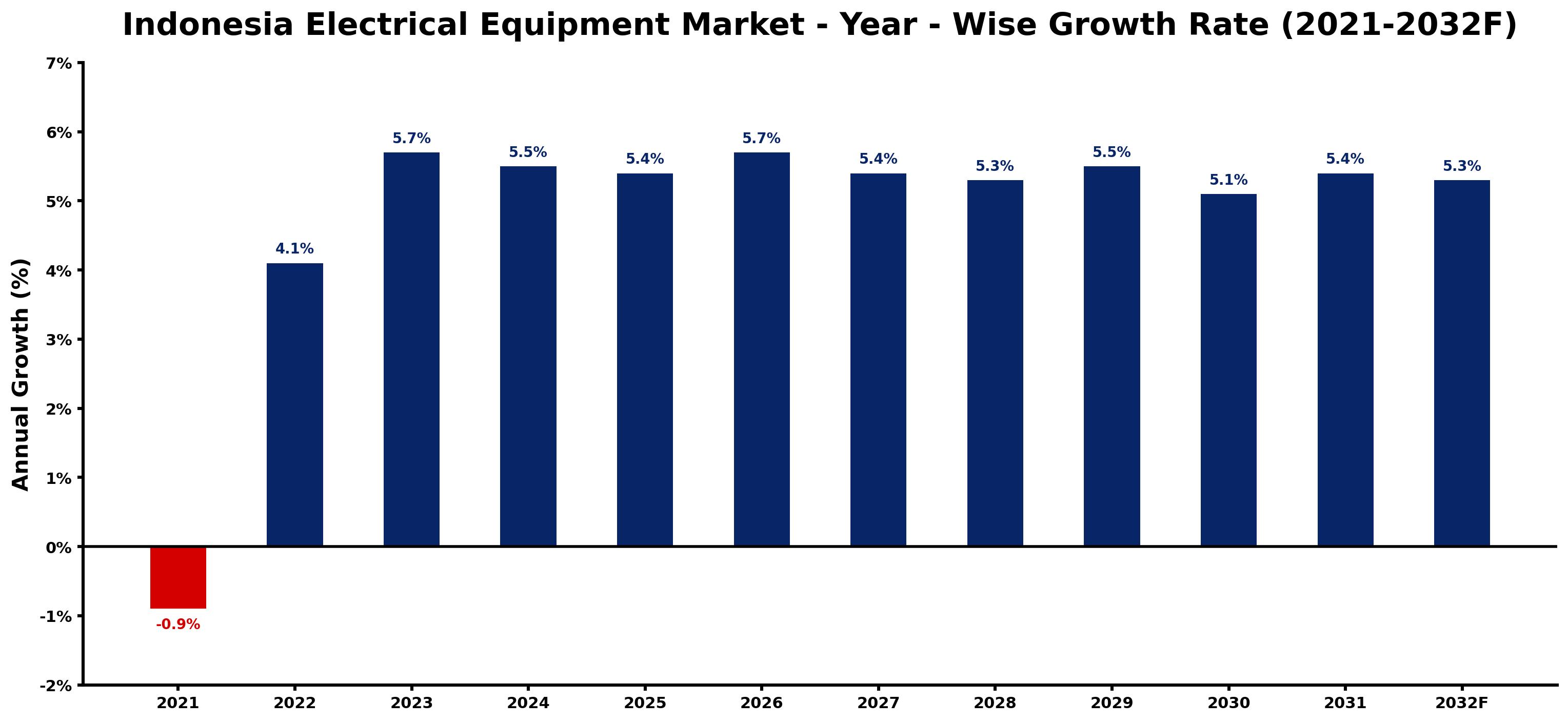
The table below presents the year wise growth rates along with the key drivers influencing the market
| Year | Growth Rate | Major Drivers |
| 2021 | -0.9% | Supply chain disruptions caused by global shipping delays hindered availability of essential electrical components. |
| 2022 | 4.1% | Legacy copper grid failures highlighted the urgent need for modern electrical solutions. |
| 2023 | 5.7% | Enterprise budgets prioritizing energy efficiency have spurred investment in advanced technologies. |
| 2024 | 5.5% | Urban expansion has driven the requirement for reliable electrical infrastructure in cities. |
| 2025 | 5.4% | Rising middle-class incomes are influencing consumer preferences for smart home technologies. |
| 2026 | 5.7% | Significant construction projects in Jakarta are boosting demand for electrical installations. |
| 2027 | 5.4% | Growing interest in renewable energy sources is reshaping electrical equipment market dynamics. |
| 2028 | 5.3% | Increased focus on sustainability urges manufacturers to innovate in energy-efficient solutions. |
| 2029 | 5.5% | The shift towards electric vehicles necessitates extensive charging infrastructure development. |
| 2030 | 5.1% | Investment in digital infrastructure is transforming power distribution and management systems. |
| 2031 | 5.4% | Technological integration in homes promotes comprehensive smart electrical networks and appliances. |
| 2032 | 5.3% | Collaboration between local and foreign companies enhances market competitiveness and innovation. |
Note - Market size estimations and growth projections presented in this report are based on 6Wresearch's advanced forecasting approach, validated with industry datasets as of June 2026.
Indonesia Electrical Equipment Market Synopsis
The Indonesia Electrical Equipment Market is projected to reach 5.7% and witness significant growth during the forecast period (2026-2032). This promising trajectory can be attributed to a multitude of factors, including substantial government investments in infrastructure projects, an escalating demand for electricity fueled by a growing population, and a wave of industrialization sweeping across the nation. Furthermore, advancements in technology and the development of smart grid solutions are playing pivotal roles in shaping the market landscape.
Indonesia Electrical Equipment Market Growth Drivers
Several key factors are driving the growth of the Indonesia Electrical Equipment Market. The government's commitment to improving national infrastructure is a primary catalyst. For instance, extensive public spending on roads, airports, and railways necessitates an increased demand for electrical equipment essential for these projects. As global players establish manufacturing units in Indonesia, the local supply chain benefits, further enhancing market growth.
- The substantial investments in infrastructure are not limited to transportation; the energy sector is also witnessing significant upgrades. This includes the expansion of power generation facilities aimed at meeting the surging electricity demand from both residential and commercial sectors.
- Urbanization is another critical factor. With a rapidly increasing population and mass migration to cities, the demand for electricity in urban centers has skyrocketed, leading to higher sales of electrical equipment such as transformers and circuit breakers.
- With the ongoing industrialization, there is a marked increase in the number of manufacturing units and factories, amplifying the demand for reliable electrical equipment to support operations.
- Technological innovation, including the development of smart grids, is reshaping how electricity is produced, distributed, and consumed. This encourages investment in advanced electrical equipment capable of supporting modern energy demands.
- Rising consumer awareness regarding energy efficiency and sustainability is driving demand for innovative electrical solutions that adhere to modern standards, thus supporting market growth.
Indonesia Electrical Equipment Market Challenges and Restraints
Despite its growth potential, the Indonesia Electrical Equipment Market faces several challenges. One of the most pressing issues is the lack of a skilled labor force. This workforce gap raises concerns for companies seeking to establish and maintain operations in the country, as the absence of trained professionals can affect production quality and operational efficiency.
- Foreign companies, in particular, may struggle to recruit localized talent capable of operating specialized equipment or adhering to advanced quality standards, thereby hindering overall performance.
- High tariffs imposed on imported electrical goods present another significant barrier for foreign entrants into the market. These tariffs can often lead to prohibitive costs, affecting profitability and making it challenging to establish a competitive foothold.
- Regulatory compliance can also be cumbersome, as companies navigate a complex array of local laws and standards that govern electrical equipment manufacturing and distribution.
- Economic fluctuations may pose risks as well, impacting consumer purchasing power and altering the dynamics of supply and demand in the electrical equipment market.
- Lastly, environmental concerns and sustainability pressures may compel manufacturers to invest in greener technologies, leading to potential increases in operational costs.
Indonesia Electrical Equipment Market Government Investment and Initiatives
Government investment plays a crucial role in shaping the Indonesia Electrical Equipment Market. The Indonesian government has prioritized infrastructure development as a core component of its national strategy, aiming to enhance connectivity and improve living standards across the archipelago. This includes substantial funding allocations for public sector projects that necessitate a wide array of electrical equipment.
In addition to direct investments, various initiatives are being implemented to incentivize private sector involvement. These can range from tax breaks for foreign investment to simplified licensing processes for companies entering the market. By fostering a conducive environment for investment in the electrical sector, the government is bolstering domestic production capabilities.
Moreover, the government has launched programs aimed at modernizing the country's energy infrastructure, including transitioning to renewable energy sources. This shift not only promises sustainability but also creates new opportunities for electrical equipment procurement and deployment.
As part of its long-term development planning, the government is also focusing on enhancing educational and vocational training programs to bridge the skills gap in the labor market. By investing in human capital, Indonesia is working towards ensuring that its electrical equipment market has access to a qualified workforce.
Indonesia Electrical Equipment Market Latest Developments (May 2025 - June 2026)
Between May 2025 and June 2026, the Indonesia Electrical Equipment Market witnessed several significant developments that underscore the evolving landscape. The government announced new infrastructure projects aimed at expanding the national electricity grid, which are expected to create further demand for a variety of electrical equipment.
Technological advancements were also prominent during this period, with several companies investing in research and development to innovate smarter equipment and solutions. This push towards intelligent electrical systems reflects a growing market trend emphasizing efficiency and reliability.
In light of the challenges surrounding labor availability, partnerships between industry leaders and vocational training institutions have become increasingly common. These collaborations are designed to enhance workforce capabilities in the electrical equipment sector.
Additionally, the push for sustainability has seen an uptick in demand for renewable energy solutions, prompting companies to adapt their offerings to meet both regulatory standards and consumer preferences.
Indonesia Electrical Equipment Market - Key Attractiveness of the Report
- 10 Years of Market Numbers
- Historical Data Starting from 2022 to 2025
- Base Year: 2025
- Forecast Data until 2032
- Key Performance Indicators Impacting the Market
- Major Upcoming Developments and Projects
Key Highlights of the Report:
- Indonesia Electrical Equipment Market Outlook
- Market Size of Indonesia Electrical Equipment Market, 2025
- Forecast of Indonesia Electrical Equipment Market, 2032F
- Historical Data and Forecast of Indonesia Electrical Equipment Revenues & Volume for the Period 2022-2032F
- Indonesia Electrical Equipment Market Trend Evolution
- Indonesia Electrical Equipment Market Drivers and Challenges
- Indonesia Electrical Equipment Price Trends
- Indonesia Electrical Equipment Porter's Five Forces
- Indonesia Electrical Equipment Industry Life Cycle
- Historical Data and Forecast of Indonesia Electrical Equipment Market Revenues & Volume By Types for the Period 2022-2032F
- Historical Data and Forecast of Indonesia Electrical Equipment Market Revenues & Volume By Electronic and electrical wires and cables for the Period 2022-2032F
- Historical Data and Forecast of Indonesia Electrical Equipment Market Revenues & Volume By Batteries and accumulators for the Period 2022-2032F
- Historical Data and Forecast of Indonesia Electrical Equipment Market Revenues & Volume By Wiring devices for the Period 2022-2032F
- Historical Data and Forecast of Indonesia Electrical Equipment Market Revenues & Volume By Electric lighting equipment for the Period 2022-2032F
- Historical Data and Forecast of Indonesia Electrical Equipment Market Revenues & Volume By Others for the Period 2022-2032F
- Historical Data and Forecast of Indonesia Electrical Equipment Market Revenues & Volume By Applications for the Period 2022-2032F
- Historical Data and Forecast of Indonesia Electrical Equipment Market Revenues & Volume By Residential end-users for the Period 2022-2032F
- Historical Data and Forecast of Indonesia Electrical Equipment Market Revenues & Volume By Non-residential end-users for the Period 2022-2032F
- Indonesia Electrical Equipment Import Export Trade Statistics
- Market Opportunity Assessment By Types
- Market Opportunity Assessment By Applications
- Indonesia Electrical Equipment Top Companies Market Share
- Indonesia Electrical Equipment Competitive Benchmarking By Technical and Operational Parameters
- Indonesia Electrical Equipment Company Profiles
- Indonesia Electrical Equipment Key Strategic Recommendations






































