Indonesia Electrical Testing Market Summary
The indonesia electrical testing market was estimated at USD 225 Million in 2025 and is projected to reach USD 297 Million by 2032, growing at a CAGR of 5.3% from 2026 to 2032.
Indonesia Electrical Testing Market Year-wise Growth Rate and Key Drivers
This graph highlights how the Indonesia Electrical Testing Market has steadily grown over the past five years, supported by major growth factors.
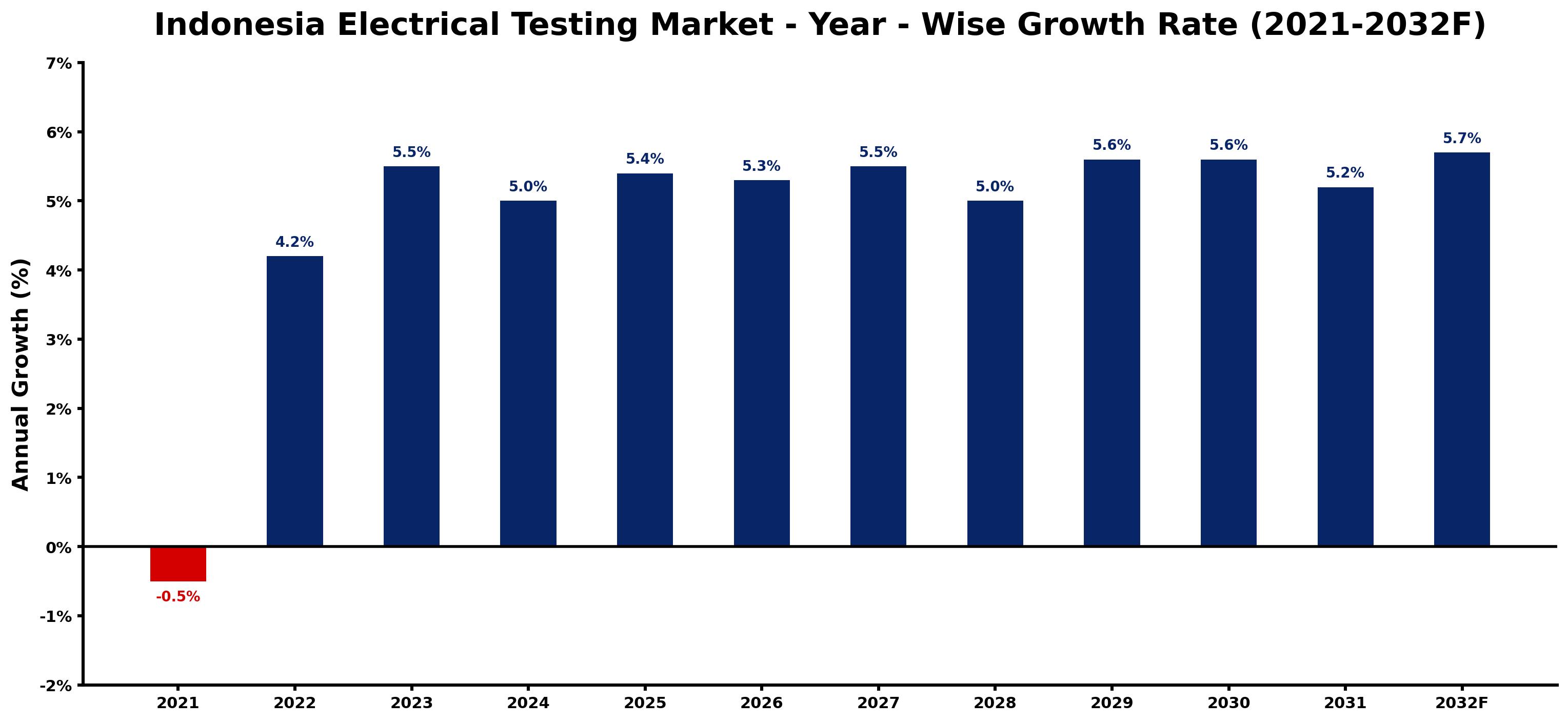
The table below presents the year wise growth rates along with the key drivers influencing the market
| Year | Growth Rate | Major Drivers |
| 2021 | -0.5% | Pandemicinduced supply chain disruptions hindered timely delivery of essential electrical testing equipment. |
| 2022 | 4.2% | Companies began prioritizing smart grid technologies to enhance energy efficiency and reliability. |
| 2023 | 5.5% | Urbanization trends prompted investments in infrastructure, boosting demand for electrical testing services. |
| 2024 | 5.0% | Increased focus on renewable energy sources necessitated advanced electrical testing methodologies. |
| 2025 | 5.4% | Telecommunication expansions led to more intricate electrical networks requiring comprehensive testing solutions. |
| 2026 | 5.3% | Corporate sustainability goals encouraged firms to adopt cutting-edge electrical testing technologies. |
| 2027 | 5.5% | Growing industrialization within Indonesia further stimulated the need for robust electrical testing frameworks. |
| 2028 | 5.0% | Partnerships between local and international firms aimed to elevate testing service standards significantly. |
| 2029 | 5.6% | Technological innovations in equipment allowed for more efficient and accurate testing processes. |
| 2030 | 5.6% | Diverse sectors began to recognize the critical role of electrical testing in safety compliance. |
| 2031 | 5.2% | Increased foreign investments aimed at infrastructure projects created new opportunities in electrical testing. |
| 2032 | 5.7% | Advances in digital technologies ultimately transformed traditional testing approaches into data-driven solutions. |
Note - Market size estimations and growth projections presented in this report are based on 6Wresearch's advanced forecasting approach, validated with industry datasets as of June 2026.
Indonesia Electrical Testing Market Synopsis
The Indonesia Electrical Testing Market is projected to reach 5.3% and witness significant growth during the forecast period (2026-2032). In 2020, the market was valued at USD 4.3 billion, and continued investments in the country's expanding infrastructure are anticipated to drive this upward trajectory. A compounded annual growth rate (CAGR) of 7.06% is expected, reflecting the increasing demand for electrical testing services across various sectors.
Indonesia Electrical Testing Market Growth Drivers
Several key factors are contributing to the growth of the Indonesia Electrical Testing Market. Firstly, government initiatives aimed at enhancing electricity generation capabilities and expanding the electricity transmission network are crucial. These measures are expected to increase the demand for comprehensive electrical testing services to ensure safety and efficiency.
- The expansion of power plants is a strategic priority for the Indonesian government, helping to accommodate rising energy needs.
- With more manufacturing industries emerging, there is an escalating requirement for reliable electricity, which increases the need for electrical testing services.
- As substations are installed to support increased generation and distribution, the demand for efficient testing solutions is on the rise.
- Stringent safety regulations in various sectors, including residential, commercial, and especially the oil and gas industry, necessitate regular electrical testing to prevent risks associated with faulty wiring.
- Technological advancements in testing methodologies are making these services more cost-effective and accessible, further driving market growth.
Indonesia Electrical Testing Market Challenges and Restraints
Despite the optimistic growth outlook, the Indonesia Electrical Testing Market faces certain challenges that could impact its progress. A primary concern is the shortage of skilled labor needed for the accurate installation and maintenance of electrical systems.
- The lack of trained professionals can lead to subpar testing results, undermining the effectiveness of safety measures.
- Economic slowdowns, particularly those induced by the pandemic, have strained resources available for infrastructure upgrades.
- In rural regions, disparities in access to quality electrical testing services persist, resulting in inconsistent safety standards.
- The evolving nature of technology requires continuous training and adaptation, which can be resource-intensive for service providers.
- Competition within the market is intensifying, requiring companies to differentiate their offerings while managing operational costs effectively.
Indonesia Electrical Testing Market Government Investment and Initiatives
The Indonesian government has undertaken several initiatives aimed at boosting the electrical testing market, reflecting its commitment to improving energy infrastructure and safety standards. Significant investments are expected in new power generation facilities and the modernization of transmission systems.
- Government policies designed to stimulate public-private partnerships are facilitating infrastructure development, creating opportunities for electrical testing services.
- Incentives for technology adoption are promoting modern testing techniques and equipment, thereby enhancing service delivery.
- Enhanced regulations are being introduced to ensure compliance with safety standards across all sectors, compelling companies to engage professional electrical testing services.
- Ongoing investment in human capital through training programs aims to address the skills gap in the technical workforce.
- Long-term energy planning strategies emphasize reliability and safety, further cementing the role of electrical testing in the national energy framework.
Indonesia Electrical Testing Market Latest Developments (May 2025 - June 2026)
Recent developments in the Indonesia Electrical Testing Market indicate a shift towards more sophisticated testing solutions, driven by both technological advancements and regulatory changes. Companies are adapting to new requirements and innovations, resulting in improved service offerings.
- Increased adoption of digital testing instruments is enhancing accuracy and efficiency in electrical assessments.
- There has been a rise in collaborations between technology providers and testing service companies, fostering innovation in electrical testing methodologies.
- Regulatory adjustments have prompted businesses to upgrade their compliance strategies, leading to new partnerships within the sector.
- The emphasis on renewable energy sources is creating additional testing requirements, further driving demand for professional services.
- Investments in automation and smart grid technology are empowering electrical testing firms to offer predictive maintenance solutions.
Indonesia Electrical Testing Market - Key Attractiveness of the Report
- 10 Years of Market Numbers
- Historical Data Starting from 2022 to 2025
- Base Year: 2025
- Forecast Data until 2032
- Key Performance Indicators Impacting the Market
- Major Upcoming Developments and Projects
Key Highlights of the Report:
- Indonesia Electrical Testing Market Outlook
- Market Size of Indonesia Electrical Testing Market, 2025
- Forecast of Indonesia Electrical Testing Market, 2032F
- Historical Data and Forecast of Indonesia Electrical Testing Revenues & Volume for the Period 2022-2032F
- Indonesia Electrical Testing Market Trend Evolution
- Indonesia Electrical Testing Market Drivers and Challenges
- Indonesia Electrical Testing Price Trends
- Indonesia Electrical Testing Porter's Five Forces
- Indonesia Electrical Testing Industry Life Cycle
- Historical Data and Forecast of Indonesia Electrical Testing Market Revenues & Volume By Testing Application for the Period 2022-2032F
- Historical Data and Forecast of Indonesia Electrical Testing Market Revenues & Volume By Voltage Testing for the Period 2022-2032F
- Historical Data and Forecast of Indonesia Electrical Testing Market Revenues & Volume By Functionality Testing for the Period 2022-2032F
- Historical Data and Forecast of Indonesia Electrical Testing Market Revenues & Volume By Other for the Period 2022-2032F
- Historical Data and Forecast of Indonesia Electrical Testing Market Revenues & Volume By Industry Application for the Period 2022-2032F
- Historical Data and Forecast of Indonesia Electrical Testing Market Revenues & Volume By Energy & Power for the Period 2022-2032F
- Historical Data and Forecast of Indonesia Electrical Testing Market Revenues & Volume By Aerospace & Defense for the Period 2022-2032F
- Historical Data and Forecast of Indonesia Electrical Testing Market Revenues & Volume By Manufacturing for the Period 2022-2032F
- Historical Data and Forecast of Indonesia Electrical Testing Market Revenues & Volume By Consumer Electronics for the Period 2022-2032F
- Historical Data and Forecast of Indonesia Electrical Testing Market Revenues & Volume By Oil and Gas for the Period 2022-2032F
- Historical Data and Forecast of Indonesia Electrical Testing Market Revenues & Volume By Other? for the Period 2022-2032F
- Indonesia Electrical Testing Import Export Trade Statistics
- Market Opportunity Assessment By Testing Application
- Market Opportunity Assessment By Industry Application
- Indonesia Electrical Testing Top Companies Market Share
- Indonesia Electrical Testing Competitive Benchmarking By Technical and Operational Parameters
- Indonesia Electrical Testing Company Profiles
- Indonesia Electrical Testing Key Strategic Recommendations






































