Indonesia Fennel Seeds Market Size, Share & Growth Rate
The Indonesia Fennel Seeds Market was estimated at USD 467 Million in 2025 and is projected to reach USD 618 Million by 2032, growing at a CAGR of 4.1% from 2026 to 2032. This growth trajectory is fueled by increasing consumer preference for natural ingredients, notably among health-conscious individuals looking to enhance their culinary experiences at home. Additionally, government initiatives supporting local farmers and rising disposable incomes are contributing to a broader acceptance and consumption of fennel seeds across various demographic segments.
Indonesia Fennel Seeds Market Growth Rate Analysis (2021-2032)
The Indonesian fennel seeds market experienced a notable rebound following a decline of 0.5% in 2021. By 2022, the market showed resilience with a growth of 4.3%, driven primarily by increasing consumer demand for health supplements and natural flavoring agents. This upward trend accelerated to 5.2% in 2023 and is projected to reach 5.6% in 2024, reflecting heightened investments in agricultural technology and improved supply chain infrastructure. Over the subsequent years, growth rates are expected to stabilize around 5%, supported by favorable policies promoting sustainable farming practices and integrating digital solutions for market outreach. By 2032, the market is anticipated to flourish with a growth rate of 5.8%, underscoring a strong shift towards organic and health-conscious consumption.
Indonesia Fennel Seeds Market Year-wise Growth Rate and Key Drivers
This graph highlights how the Indonesia Fennel Seeds Market has steadily grown over the past five years, supported by major growth factors.
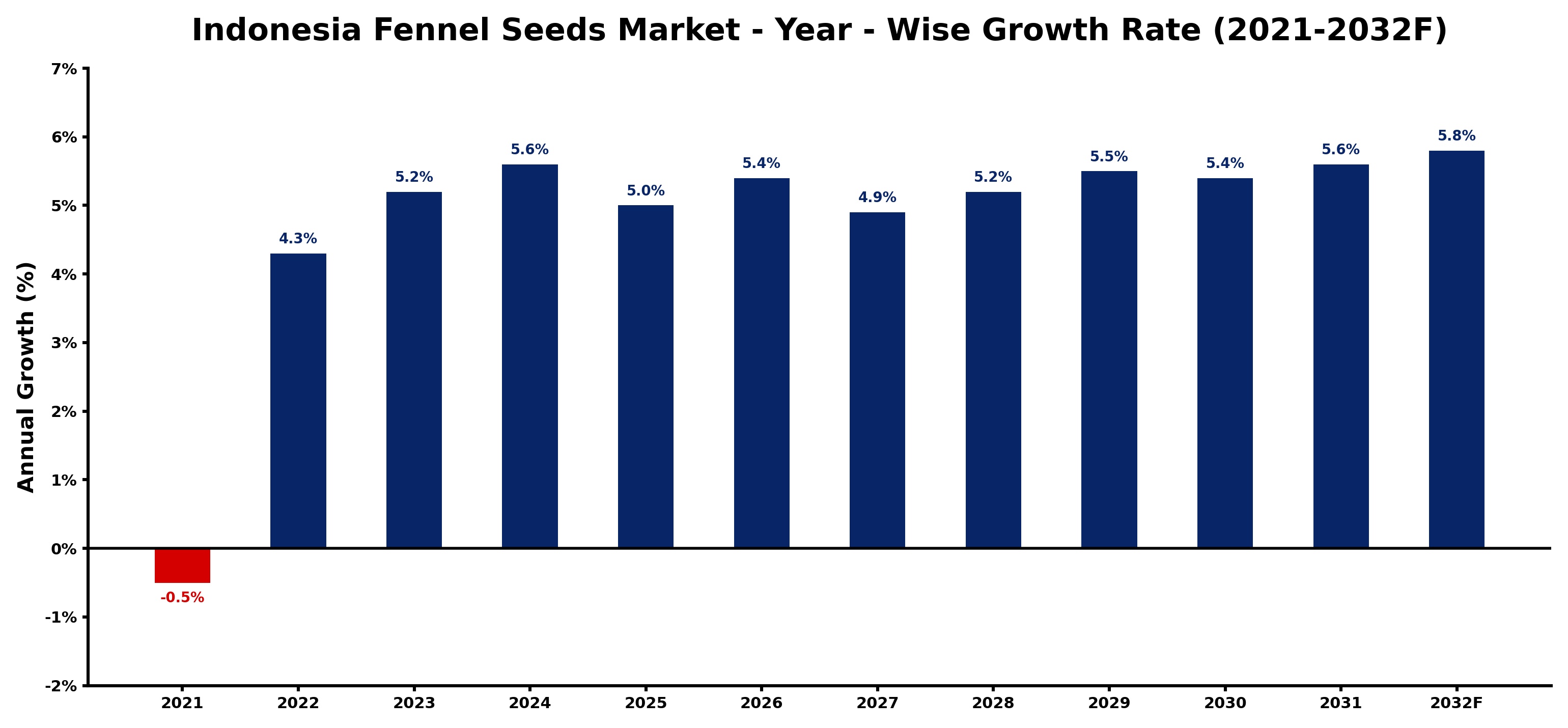
The table below presents the year‑wise growth rates along with the key drivers influencing the market
| Year | Growth Rate | Major Drivers |
| 2021 | -0.5% | Supply chain disruptions affected availability |
| 2022 | 4.3% | Health benefits awareness increased demand |
| 2023 | 5.2% | Culinary trends embraced fennel seeds |
| 2024 | 5.6% | E-commerce growth expanded market reach |
| 2025 | 5.0% | Organic product offerings attracted consumers |
| 2026 | 5.4% | Culinary tourism boosted local consumption |
| 2027 | 4.9% | New product innovations enhanced appeal |
| 2028 | 5.2% | Sustainable farming practices gained traction |
| 2029 | 5.5% | Export opportunities opened new markets |
| 2030 | 5.4% | Consumer education improved product knowledge |
| 2031 | 5.6% | Partnerships with chefs increased visibility |
| 2032 | 5.8% | Cultural cuisine integration drove popularity |
Note - Market size estimations and growth projections presented in this report are based on 6Wresearch’s advanced forecasting approach, validated with industry datasets as of June 2026.
Indonesia Fennel Seeds Market Synopsis
In Indonesia, fennel seeds have been a culinary staple, adding distinctive flavor to traditional dishes such as rice and curry. Over the years, their significance has only intensified, supported by a growing consumer base that values authentic and natural flavors in their cooking.
The market for fennel seeds has seen significant expansion due to heightened awareness surrounding health and wellness. Local farmers' markets are thriving, providing fresh produce, including fennel seeds, while encouraging a shift towards home cooking and culinary exploration during recent global disruptions.
Indonesia Fennel Seeds Market Key Takeaways
- Increasing consumer interest in natural and organic ingredients is driving the demand for fennel seeds.
- Local farmers' markets are enhancing accessibility and promoting indigenous crop consumption.
- Government support for smallholder farmers is enabling more competitive pricing and availability.
- The ongoing pandemic has elevated home cooking trends, further boosting herb and spice usage.
- Export dependencies present potential vulnerabilities within the local fennel seeds market.
Evaluation of Restraints in Indonesia Fennel Seeds Market
Despite the positive market dynamics, the Indonesia fennel seeds sector is facing notable restraints. A heavy reliance on export markets such as Europe, North America, and the Asia Pacific means that fluctuations in demand from these regions can lead to instability in local market performance. Furthermore, the rising competition from other exporting countries, particularly India, poses challenges in maintaining market share. High transportation costs also complicate export activities, making local products less competitive in international markets. Moreover, adherence to stringent food safety regulations is mandatory for local producers seeking to expand beyond domestic borders.
Indonesia Fennel Seeds Market Trends
The Indonesia fennel seeds market is witnessing several emerging trends. The surge in online shopping platforms has broadened distribution channels, making fennel seeds more accessible to rural consumers who may have had limited options previously. Additionally, there is a growing emphasis on sustainable farming practices and organic certifications, appealing to environmentally conscious consumers. As culinary interests continue to evolve, more individuals are seeking diverse flavor profiles, with fennel seeds gaining traction among those looking to explore unique culinary avenues.
Indonesia Fennel Seeds Market Opportunities
Significant growth opportunities exist within the Indonesia fennel seeds market, particularly in the realm of product diversification. Innovative applications of fennel seeds in health supplements, organic teas, and gourmet food products can attract a broader customer base. Additionally, expanding local production capabilities, leveraging technology for improved farming practices, and exploring export potential to emerging markets could yield substantial benefits. Engaging in partnerships with culinary schools and food influencers can also pave the way for higher brand visibility and consumer awareness.
Government Initiatives in the Indonesia Fennel Seeds Market
The Indonesian government has introduced various initiatives aimed at supporting agricultural sectors, including fennel seed production. Programs focused on providing subsidies to smallholder farmers enhance their capacity to deliver fresh, high-quality produce at local markets. Additionally, investments in agricultural infrastructure and training programs for farmers are helping to improve productivity and sustainability, thereby facilitating the growth of indigenous crops like fennel seeds. Such governmental support plays a crucial role in boosting overall market performance.
Future Insights of the Indonesia Fennel Seeds Market
Looking ahead to 2026-2032, the Indonesia fennel seeds market is poised for sustained growth. The fusion of traditional and modern culinary practices will likely drive increased demand, supported by continuous innovations in product offerings. As consumers increasingly gravitate towards healthier lifestyles, the focus on naturally sourced ingredients will remain a significant factor. Furthermore, advancements in e-commerce will improve market reach, creating new avenues for local producers to tap into both domestic and international markets.
Indonesia Fennel Seeds Market Latest Developments (May 2025 - June 2026)
In recent months, the Indonesia fennel seeds market has seen positive developments, particularly in terms of expanding distribution channels. E-commerce platforms have ramped up their offerings, enhancing the visibility of fennel seeds to a broader audience. Additionally, local farmers are increasingly participating in training programs aimed at improving agricultural practices, leading to better quality produce. Collaborative efforts with culinary institutions to promote the unique flavors and health benefits of fennel seeds are also gaining momentum, reinforcing its status as a valued ingredient in Indonesian kitchens.
Indonesia Fennel Seeds Market - Key Attractiveness of the Report
- 10 Years of Market Numbers
- Historical Data Starting from 2022 to 2025
- Base Year: 2025
- Forecast Data until 2032
- Key Performance Indicators Impacting the Market
- Major Upcoming Developments and Projects
Key Highlights of the Report:
- Indonesia Fennel Seeds Market Outlook
- Market Size of Indonesia Fennel Seeds Market, 2025
- Forecast of Indonesia Fennel Seeds Market, 2032F
- Historical Data and Forecast of Indonesia Fennel Seeds Revenues & Volume for the Period 2022-2032F
- Indonesia Fennel Seeds Market Trend Evolution
- Indonesia Fennel Seeds Market Drivers and Challenges
- Indonesia Fennel Seeds Price Trends
- Indonesia Fennel Seeds Porter's Five Forces
- Indonesia Fennel Seeds Industry Life Cycle
- Historical Data and Forecast of Indonesia Fennel Seeds Market Revenues & Volume By Types for the Period 2022-2032F
- Historical Data and Forecast of Indonesia Fennel Seeds Market Revenues & Volume By Organic for the Period 2022-2032F
- Historical Data and Forecast of Indonesia Fennel Seeds Market Revenues & Volume By Conventional for the Period 2022-2032F
- Historical Data and Forecast of Indonesia Fennel Seeds Market Revenues & Volume By Application for the Period 2022-2032F
- Historical Data and Forecast of Indonesia Fennel Seeds Market Revenues & Volume By Essential for the Period 2022-2032F
- Historical Data and Forecast of Indonesia Fennel Seeds Market Revenues & Volume By Flavors for the Period 2022-2032F
- Historical Data and Forecast of Indonesia Fennel Seeds Market Revenues & Volume By Seasoning Ingredient for the Period 2022-2032F
- Historical Data and Forecast of Indonesia Fennel Seeds Market Revenues & Volume By Beverages for the Period 2022-2032F
- Historical Data and Forecast of Indonesia Fennel Seeds Market Revenues & Volume By End-user for the Period 2022-2032F
- Historical Data and Forecast of Indonesia Fennel Seeds Market Revenues & Volume By Households for the Period 2022-2032F
- Historical Data and Forecast of Indonesia Fennel Seeds Market Revenues & Volume By Food Industry for the Period 2022-2032F
- Historical Data and Forecast of Indonesia Fennel Seeds Market Revenues & Volume By Personal Care Industry for the Period 2022-2032F
- Indonesia Fennel Seeds Import Export Trade Statistics
- Market Opportunity Assessment By Types
- Market Opportunity Assessment By Application
- Market Opportunity Assessment By End-user
- Indonesia Fennel Seeds Top Companies Market Share
- Indonesia Fennel Seeds Competitive Benchmarking By Technical and Operational Parameters
- Indonesia Fennel Seeds Company Profiles
- Indonesia Fennel Seeds Key Strategic Recommendations






































