Indonesia Groceries Market Summary
The indonesia groceries market was estimated at USD 239 Million in 2025 and is projected to reach USD 316 Million by 2032, growing at a CAGR of 5.6% from 2026 to 2032.
Indonesia Groceries Market Year-wise Growth Rate and Key Drivers
This graph highlights how the Indonesia Groceries Market has steadily grown over the past five years, supported by major growth factors.
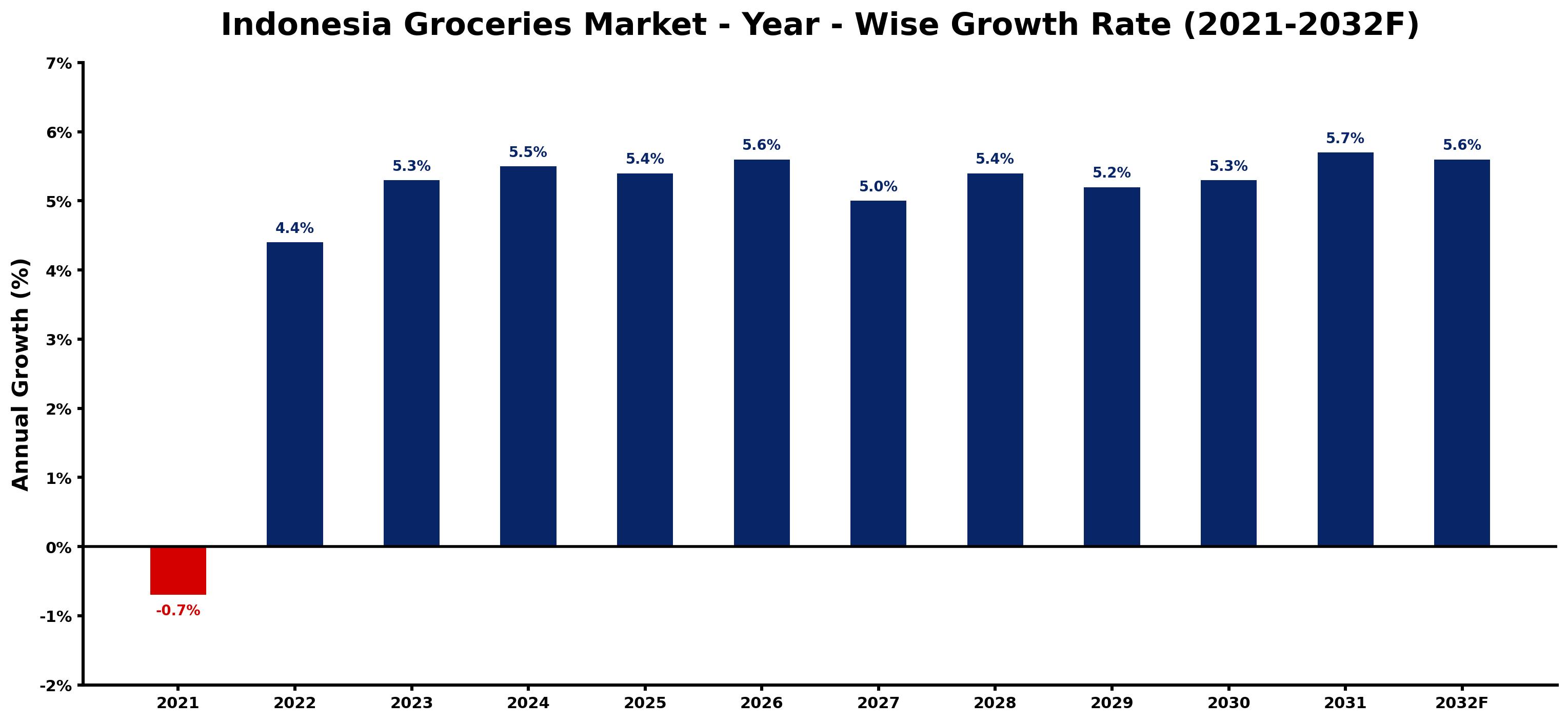
The table below presents the year wise growth rates along with the key drivers influencing the market
| Year | Growth Rate | Major Drivers |
| 2021 | -0.7% | Supply chain disruptions during the pandemic led to limited product availability, negatively impacting grocery sales in Indonesia. |
| 2022 | 4.4% | Consumer preferences shifted towards health-focused products, prompting new product launches. |
| 2023 | 5.3% | Infrastructure improvements enhanced distribution networks, facilitating faster deliveries to remote areas. |
| 2024 | 5.5% | Local sourcing initiatives gained popularity, boosting demand for regional agricultural products. |
| 2025 | 5.4% | Innovative payment solutions emerged, enabling seamless transactions for online grocery purchases. |
| 2026 | 5.6% | Sustainability trends prompted brands to adopt eco-friendly packaging and practices. |
| 2027 | 5.0% | Increasing urbanization led to more convenience store openings in densely populated neighborhoods. |
| 2028 | 5.4% | Technological advancements in inventory management improved supply chain efficiency across retailers. |
| 2029 | 5.2% | Emerging middle-class consumers prioritized quality over cost in their grocery shopping. |
| 2030 | 5.3% | Partnerships between local farms and supermarkets flourished, enhancing fresh produce availability. |
| 2031 | 5.7% | Digital marketing strategies became essential for grocery brands to engage younger consumers. |
| 2032 | 5.6% | Healthy meal kits gained traction, reflecting changing lifestyles and cooking habits. |
Note - Market size estimations and growth projections presented in this report are based on 6Wresearch's advanced forecasting approach, validated with industry datasets as of June 2026.
Indonesia Groceries Market Synopsis
The Indonesia Groceries Market is projected to reach 5.6% and witness significant growth during the forecast period (2026-2032). This growth trajectory is largely attributed to a rising population, increased urbanization, and growing disposable incomes among consumers. As purchasing power escalates, the shift towards convenience via online grocery stores and modern retail outlets also plays a pivotal role in driving market dynamics.
Indonesia Groceries Market Growth Drivers
A combination of several factors is propelling the Indonesia Groceries Market forward. Key growth drivers include:
- The rising population in Indonesia has reached around 270 million as of 2019, significantly influencing demand for groceries. As more consumers turn to supermarkets or online platforms for their grocery needs, this demographic shift has proven to be beneficial for market growth.
- Urbanization in Indonesia has accelerated, resulting in a greater demand for grocery purchases from both traditional retailers and modern formats. The urban lifestyle encourages a shift in consumer preferences, favoring convenient shopping experiences.
- Growing disposable incomes across different societal segments enable more consumers to invest in a wider range of grocery products. As employment levels improve, spending on both essential and non-essential food items rises, further boosting the market.
- The increasing popularity of online grocery shopping has revolutionized the shopping experience for Indonesian consumers. This trend not only offers convenience but also expands access to diverse grocery options, influencing purchasing behaviors.
- Rising health consciousness among consumers has led to increased demand for healthier grocery options, including organic and whole foods. This change in consumer behavior creates new opportunities for retailers to cater to evolving preferences.
Indonesia Groceries Market Challenges and Restraints
Despite the promising growth prospects, the Indonesia Groceries Market faces several challenges that could impede its expansion:
- Infrastructure development in certain regions remains inadequate, affecting distribution and accessibility of grocery products. This limits the potential reach for retailers in more remote areas.
- The increasing competition among grocery retailers can lead to price wars, negatively impacting profit margins. Both traditional and online retailers must navigate this competitive landscape wisely.
- Consumer preferences are rapidly changing, and failing to adapt to these shifts could lead to declining sales. Retailers must stay attuned to emerging trends to maintain their market position.
- Economic fluctuations and potential political instability could hinder market growth. Economic policies may influence disposable incomes and purchasing behaviors adversely.
- Regulatory challenges, including compliance with food safety standards and labeling requirements, can pose operational difficulties for grocery retailers. Maintaining adherence to these regulations is crucial for business success.
Indonesia Groceries Market Regional Analysis
Indonesia's vast geographical diversity creates distinct regional dynamics in the groceries market. Urban centers such as Jakarta and Surabaya exhibit higher demand for modern retail formats and online shopping platforms. In contrast, rural areas tend to rely more on traditional markets and local grocery stores.
- In urban areas, rapid development has encouraged the establishment of supermarkets and specialty grocery stores, contributing to the convenience factor that urban consumers seek.
- E-commerce is gaining traction, especially in metropolitan regions, where consumers are increasingly inclined to adopt online grocery shopping due to its time-saving benefits.
- Rural regions, while traditionally less reliant on modern retail channels, are gradually integrating more digital solutions. This shift opens new avenues for growth in these areas.
- Inter-island logistics remain a challenge, affecting supply chain efficiency. Overcoming these logistical hurdles is essential for retailers looking to expand their footprint across different regions.
- Market players focusing on regional adaptations and tailored product offerings are likely to gain a competitive advantage as they cater to the unique needs of local consumers.
Indonesia Groceries Market Government Investment and Initiatives
The Indonesian government has recognized the importance of the groceries market in bolstering the economy and has initiated several programs aimed at enhancing the sector:
- Government infrastructure projects are underway to improve logistics and transportation systems, aimed at facilitating smoother supply chains for grocery distribution across the archipelago.
- Initiatives promoting local agricultural production support the fresh grocery supply chain, ultimately benefiting consumers with a wider range of local products.
- Regulatory frameworks are being reviewed to ensure that e-commerce platforms can operate smoothly, encouraging the integration of traditional grocery channels with modern digital solutions.
- Public campaigns aimed at improving food safety standards and consumer awareness are helping build trust in the grocery sector, which is essential for growth.
- Investment incentives for retailers looking to expand in underserved areas reflect government efforts to balance economic growth across rural and urban locales.
Indonesia Groceries Market Latest Developments (May 2025 - June 2026)
Recent developments in the Indonesia Groceries Market reflect a dynamic and evolving landscape:
- The expansion of online grocery services has accelerated, with more regional and national players entering the market, enhancing competition and variety for consumers.
- Sustainability initiatives have gained traction, with retailers increasingly adopting eco-friendly practices and offering organic product lines in response to consumer demand.
- Technological advancements, including AI and big data analytics, are being utilized to optimize inventory management and improve customer experience in grocery shopping.
- A notable increase in partnerships between local producers and retailers has become prominent, allowing retailers to augment their fresh offerings while supporting the local economy.
- Consumer interest in health and wellness continues to shape product offerings, with a noticeable rise in demand for functional foods that promote healthier lifestyles.
Indonesia Groceries Market - Key Attractiveness of the Report
- 10 Years of Market Numbers
- Historical Data Starting from 2022 to 2025
- Base Year: 2025
- Forecast Data until 2032
- Key Performance Indicators Impacting the Market
- Major Upcoming Developments and Projects
Key Highlights of the Report:
- Indonesia Groceries Market Outlook
- Market Size of Indonesia Groceries Market, 2025
- Forecast of Indonesia Groceries Market, 2032F
- Historical Data and Forecast of Indonesia Groceries Revenues & Volume for the Period 2022-2032F
- Indonesia Groceries Market Trend Evolution
- Indonesia Groceries Market Drivers and Challenges
- Indonesia Groceries Price Trends
- Indonesia Groceries Porter's Five Forces
- Indonesia Groceries Industry Life Cycle
- Historical Data and Forecast of Indonesia Groceries Market Revenues & Volume By Product Types for the Period 2022-2032F
- Historical Data and Forecast of Indonesia Groceries Market Revenues & Volume By Packaged Food for the Period 2022-2032F
- Historical Data and Forecast of Indonesia Groceries Market Revenues & Volume By Unpackaged Food for the Period 2022-2032F
- Historical Data and Forecast of Indonesia Groceries Market Revenues & Volume By Drinks for the Period 2022-2032F
- Historical Data and Forecast of Indonesia Groceries Market Revenues & Volume By Tobacco for the Period 2022-2032F
- Historical Data and Forecast of Indonesia Groceries Market Revenues & Volume By Household Products for the Period 2022-2032F
- Historical Data and Forecast of Indonesia Groceries Market Revenues & Volume By Others for the Period 2022-2032F
- Historical Data and Forecast of Indonesia Groceries Market Revenues & Volume By Distribution Channel for the Period 2022-2032F
- Historical Data and Forecast of Indonesia Groceries Market Revenues & Volume By Supermarkets & Hypermarkets for the Period 2022-2032F
- Historical Data and Forecast of Indonesia Groceries Market Revenues & Volume By Convenience Store for the Period 2022-2032F
- Historical Data and Forecast of Indonesia Groceries Market Revenues & Volume By Online for the Period 2022-2032F
- Indonesia Groceries Import Export Trade Statistics
- Market Opportunity Assessment By Product Types
- Market Opportunity Assessment By Distribution Channel
- Indonesia Groceries Top Companies Market Share
- Indonesia Groceries Competitive Benchmarking By Technical and Operational Parameters
- Indonesia Groceries Company Profiles
- Indonesia Groceries Key Strategic Recommendations






































