Indonesia Household Appliances Manufacturing Market (2026-2032) | Outlook, Value, Forecast, Companies, Revenue, Trends, Size, Share, Industry, Growth & Analysis
Market Forecast By Type Of Appliance (Small Electrical Appliances, Household Cooking Appliances, Household Refrigerators And Home Freezers, Household Laundry Equipment, Other Major Household Appliances) And Competitive Landscape
| Product Code: ETC328408 | Publication Date: Aug 2022 | Updated Date: Mar 2026 | Product Type: Report | |
| Publisher: 6Wresearch | Author: Ravi Bhandari | No. of Pages: 70 | No. of Figures: 35 | No. of Tables: 5 |
Indonesia Household Appliances Manufacturing Market: Import Trend Analysis
In the Indonesia household appliances manufacturing market, the import trend showed a notable growth rate from 2023 to 2024 at 9.34%, with a compound annual growth rate (CAGR) of 8.55% for the period of 2020-2024. This upward import momentum can be attributed to increasing consumer demand for innovative and energy-efficient appliances, reflecting a positive market stability and consumer preference for imported products in the industry.
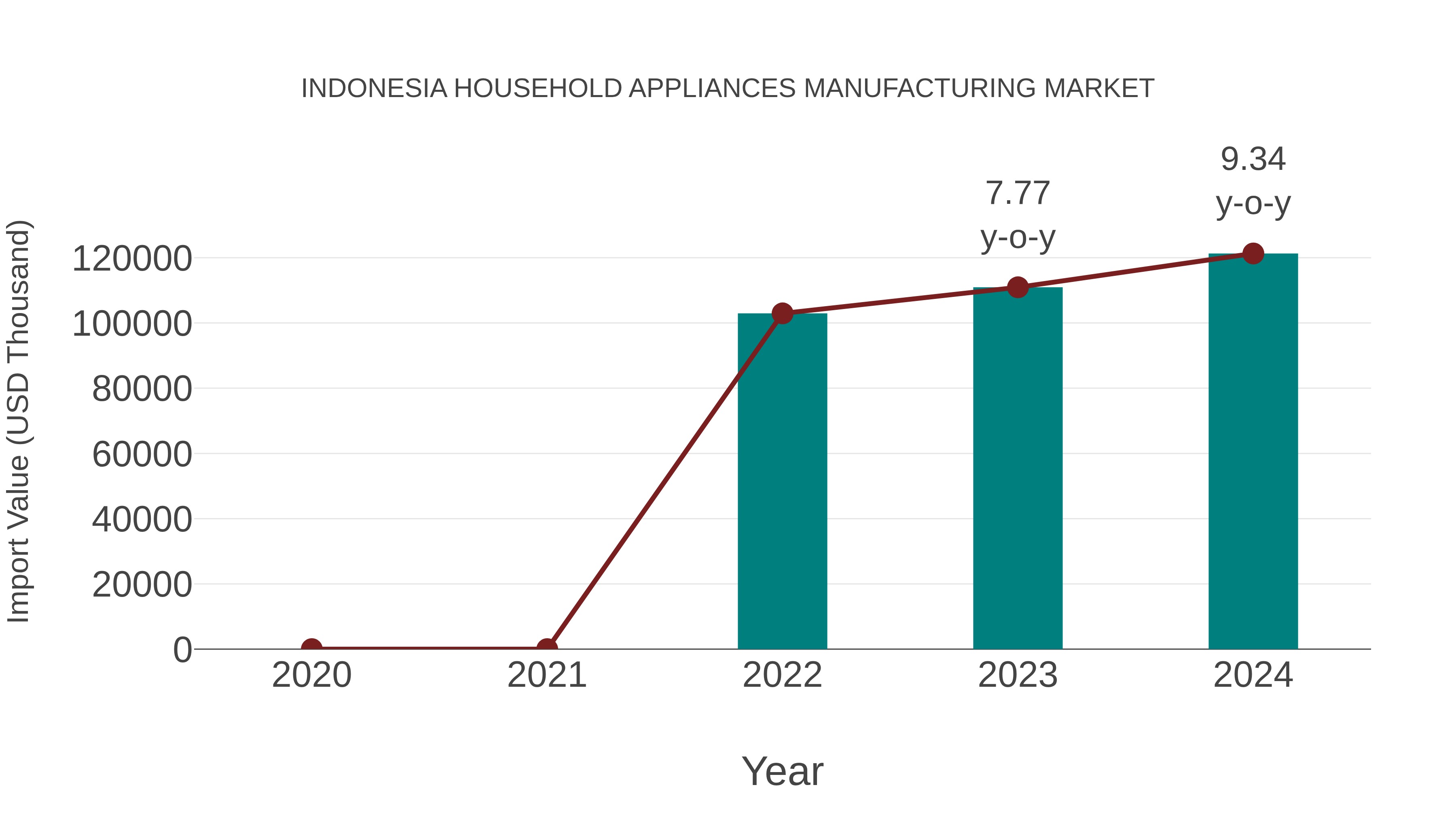
Indonesia Household Appliances Manufacturing Market Growth Rate
According to 6Wresearch internal database and industry insights, the Indonesia Household Appliances Manufacturing Market is projected to grow at a compound annual growth rate (CAGR) of 6.8% during the forecast period (2026-2032).
Topics Covered in the Indonesia Household Appliances Manufacturing Market Report
The Indonesia Household Appliances Manufacturing Market report thoroughly covers the market by type of appliance. The report provides a detailed analysis of ongoing market trends, opportunities/high-growth areas, and market drivers that will help stakeholders align strategies based on current and future market dynamics.
Indonesia Household Appliances Manufacturing Market Highlights
| Report Name | Indonesia Household Appliances Manufacturing Market |
| Forecast Period | 2026–2032 |
| CAGR | 6.8% |
| Growing Sector | Smart Kitchen and Energy-Efficient Cooling |
Indonesia Household Appliances Manufacturing Market Synopsis
Indonesia Household Appliances Manufacturing Market is projected to attain enormous expansion in the coming years on the back of the government’s "Making Indonesia 4.0" roadmap, which identifies the electronics industry as a priority sector for digital transformation. Apart from this, the Indonesia Household Appliances Manufacturing Market growth is further attributed to rapidly expanding middle class and the country’s demographic dividend, which has increased the number of new households requiring essential appliances.
Evaluation of Growth Drivers in Indonesia Household Appliances Manufacturing Market
Below are some prominent drivers and their influence on the market dynamics:
| Drivers | Primary Segments Affected | Why It Matters |
| Middle-Class Expansion | All Major Appliances | Rising disposable income allows for upgrades from basic to premium models. |
| Industry 4.0 Incentives | Manufacturing Operations | Government tax breaks for automated production lines reduce unit costs. |
| Urbanization | Small Electrical Appliances | Compact living in apartments drives demand for multi-functional, space-saving gadgets. |
| Energy Labeling Rules | Refrigerators & Air Conditioners | Mandatory energy ratings push consumers toward high-margin, eco-friendly models. |
| E-commerce Proliferation | Small Kitchen Appliances | Digital platforms like Tokopedia enable wider reach into Tier-2 and Tier-3 cities. |
Indonesia Household Appliances Manufacturing Market is expected to grow steadily, growing at a CAGR of 6.8% during the forecast period (2026-2032). This is mainly due to people moving to cities, rising incomes, and the growing middle class, which means that more people will require refrigerators, washing machines, air conditioners, and cooking appliances. The Indonesia Household Appliances Manufacturing Industry is also benefiting from the growing interest in energy-efficient appliances. This is in line with global trends toward sustainability and what Indonesian consumers want.
Evaluation of Restraints in Indonesia Household Appliances Manufacturing Market
Below are some prominent restraints and their influence on the market dynamics:
| Restraints | Primary Segments Affected | What This Means |
| Raw Material Costs | Major Household Appliances | Instable global prices for steel and copper impact manufacturing margins. |
| Inconsistent Power Grid | Smart/IoT Appliances | Power surges in remote islands can damage sensitive electronic components. |
| Logistical Complexity | Distribution (All Segments) | Increased shipping costs across the archipelago make appliances expensive in Eastern Indonesia. |
| Component Shortages | Laundry & Cooking Equipment | High reliance on imported semiconductors can lead to production delays for high-tech models. |
| Counterfeit Parts | Small Electrical Appliances | The occurrence of low-quality, non-SNI certified parts affects brand reputation and safety. |
Indonesia Household Appliances Manufacturing Market Challenges
The Indonesia Household Appliances Manufacturing Market is expected to continue its upward momentum during the forecast period. However, the competitive landscape is intensely price-driven, making it difficult for premium players to capture market share outside of metropolitan areas. Also, there is a shortage of specialized technical labor for "Industry 4.0" manufacturing, which necessitates high investments in employee training and automation technology.
Indonesia Household Appliances Manufacturing Market Trends
There are various emerging trends influencing the landscape of the Indonesia Household Appliances Manufacturing Industry:
- Adoption of AI and IoT: Using AI (Artificial Intelligence) & IoT (Internet of Things) will be a big part of how appliances work; manufacturers are including AI technology in machines to ensure that the use of energy is as efficient as possible.
- Focus on Health and Hygiene: There is heightened awareness regarding health & hygiene; as a result, consumers are now more inclined to purchase appliances with built-in sterilization features.
- Sustainable and Green Manufacturing: Manufacturers are increasingly using environmentally-friendly refrigerants and recyclable plastics to differentiate themselves from their competitors.
Investment Opportunities in the Indonesia Household Appliances Manufacturing Market
There are several investment opportunities available to investors in the Indonesia Household Appliances Manufacturing Market which include:
- Localized Components — There is a substantial gap in the production of high-quality compressors and motors which are used to produce these appliances. The vast majority of these components will be imported and therefore pose a unique opportunity for local manufacturers to enter the market.
- Expansion into Tier-2 Cities: By establishing Experience Centres in Tier 2 cities (Makassar, Medan) investors can obtain first mover advantage in these region as these cities urbanize.
- Smart Home Ecosystems — Tech firms can partner with appliance manufacturers to establish a unified software platform for the purpose of creating a Smart Home Ecosystem.
Top 5 Leading Players in the Indonesia Household Appliances Manufacturing Market
Below is a list of prominent companies leading the Indonesia Household Appliances Manufacturing Market:
1. PT. Sharp Electronics Indonesia
| Company Name | PT. Sharp Electronics Indonesia |
|---|---|
| Established Year | 1970 (Indonesia Operations) |
| Headquarters | Karawang, West Java |
| Official Website | - |
A market leader in the refrigerator and washing machine segments, Sharp operates one of the largest manufacturing facilities in the country and is known for products tailored to local voltage fluctuations.
2. PT. Panasonic Manufacturing Indonesia
| Company Name | PT. Panasonic Manufacturing Indonesia |
|---|---|
| Established Year | 1970 |
| Headquarters | East Jakarta |
| Official Website | Click Here |
A diversified giant that produces a wide range of appliances including air conditioners and water pumps; the company has a strong focus on "Japan Quality" and energy-saving "Econavi" technology.
3. PT. LG Electronics Indonesia
| Company Name | PT. LG Electronics Indonesia |
|---|---|
| Established Year | 1990 |
| Headquarters | Tangerang, Banten |
| Official Website | Click Here |
A pioneer in the premium and smart appliance category, LG is a dominant force in the OLED TV and "Smart Inverter" refrigerator markets, emphasizing IoT connectivity.
4. PT. Modena Indonesia
| Company Name | PT. Modena Indonesia |
|---|---|
| Established Year | 1981 |
| Headquarters | Jakarta |
| Official Website | Click Here |
A leader in the cooking appliance segment, Modena specializes in built-in hobs, ovens, and professional-grade kitchen equipment, catering to the growing luxury residential market.
5. PT. Polytron (Hartono Istana Teknologi)
| Company Name | PT. Polytron (Hartono Istana Teknologi) |
|---|---|
| Established Year | 1975 |
| Headquarters | Kudus, Central Java |
| Official Website | Click Here |
A prominent homegrown Indonesian brand that successfully competes with global giants by offering high-durability electronics and appliances specifically designed for the Indonesian consumer's lifestyle.
Government Initiatives in the Indonesia Household Appliances Manufacturing Market
According to Indonesian Government Data, they have played a major role through initiatives like the National Industrial Development Master Plan (RIPIN), which provides fiscal incentives for companies that achieve high Domestic Component Level (TKDN) scores. Apart from this, the Ministry of Industry’s Circular Economy Roadmap is a prime example of support aiming to encourage the "Right to Repair" and the use of recycled materials in small appliances. Besides this, the Smart City Indonesia initiative also encourages the adoption of smart meters and energy-efficient home devices to manage the national power load more effectively.
Future Insights of the Indonesia Household Appliances Manufacturing Market
The Indonesia Household Appliances Manufacturing Market is anticipated to grow, spurred by the expansion of 5G connectivity, which will act as the backbone for fully integrated smart home ecosystems. There will be major convergence of retail and fintech, where appliances may be sold under "Appliance-as-a-Service" models, particularly for high-end laundry and kitchen equipment. Apart from this, as the government continues to push for carbon neutrality, the market will likely adopt standardized "Blue Label" energy certifications, rewarding manufacturers who achieve zero-waste production.
Market Segmentation Analysis
The report offers a comprehensive study of the following market segments and their leading categories:
By Type Of Appliance – Household Refrigerators and Home Freezers to Lead the Market
According to Parth, Senior Research Analyst, 6Wresearch, the household refrigerators and home freezers segment is anticipated to lead the Indonesia Household Appliances Manufacturing Market share as country’s tropical climate and growing food-preservation needs make these products essential. Furthermore, the rising trend of "Halal" certified storage and the introduction of large-capacity, multi-door refrigerators in urban areas are significantly contributing to this segment’s revenue dominance.
Key Attractiveness of the Report
- 10 Years of Market Numbers
- Historical Data Starting from 2022 to 2025
- Base Year: 2025
- Forecast Data until 2032
- Key Performance Indicators Impacting the Market
- Major Upcoming Developments and Projects
Key Highlights of the Report:
- Indonesia Household Appliances Manufacturing Market Outlook
- Market Size of Indonesia Household Appliances Manufacturing Market, 2025
- Forecast of Indonesia Household Appliances Manufacturing Market, 2032
- Historical Data and Forecast of Indonesia Household Appliances Manufacturing Revenues & Volume for the Period 2022-2032F
- Indonesia Household Appliances Manufacturing Market Trend Evolution
- Indonesia Household Appliances Manufacturing Market Drivers and Challenges
- Indonesia Household Appliances Manufacturing Price Trends
- Indonesia Household Appliances Manufacturing Porter's Five Forces
- Indonesia Household Appliances Manufacturing Industry Life Cycle
- Historical Data and Forecast of Indonesia Household Appliances Manufacturing Market Revenues & Volume By Type Of Appliance for the Period 2022-2032F
- Historical Data and Forecast of Indonesia Household Appliances ManufacturingMarket Revenues & Volume By Small Electrical Appliances for the Period 2022-2032F
- Historical Data and Forecast of Indonesia Household Appliances Manufacturing Market Revenues & Volume By Household Cooking Appliances for the Period 2022-2032F
- Historical Data and Forecast of Indonesia Household Appliances Manufacturing Market Revenues & Volume By Household Refrigerators And Home Freezers for the Period 2022-2032F
- Historical Data and Forecast of Indonesia Household Appliances Manufacturing Market Revenues & Volume By Household Laundry Equipment for the Period 2022-2032F
- Historical Data and Forecast of Indonesia Household Appliances Manufacturing Market Revenues & Volume By Other Major Household Appliances for the Period 2022-2032F
- Indonesia Household Appliances Manufacturing Import Export Trade Statistics
- Market Opportunity Assessment By Type Of Appliance
- Indonesia Household Appliances Manufacturing Top Companies Market Share
- Indonesia Household Appliances Manufacturing Competitive Benchmarking By Technical and Operational Parameters
- Indonesia Household Appliances Manufacturing Company Profiles
- Indonesia Household Appliances Manufacturing Key Strategic Recommendations
Markets Covered
The report provides a detailed analysis of the following market segments and their leading segments
By Type Of Appliance
- Small Electrical Appliances
- Household Cooking Appliances
- Household Refrigerators and Home Freezers
- Household Laundry Equipment
- Other Major Household Appliances
Indonesia Household Appliances Manufacturing Market (2026-2032): FAQs
Key hindrances faced by the market include high raw material costs, supply chain disruptions, and intense competition from low-cost imports.
The Indonesia Household Appliances Manufacturing Market is projected to grow at a CAGR of 6.8% during the forecast period 2026–2032.
Key players include Polytron, Maspion Group, and various international brands with local manufacturing facilities.
Increasing disposable income, urbanization, and government support for domestic production are the major factors for the household appliances market.
6Wresearch actively monitors the Indonesia Household Appliances Manufacturing Market and publishes its comprehensive annual report, highlighting emerging trends, growth drivers, revenue analysis, and forecast outlook. Our insights help businesses to make data-backed strategic decisions with ongoing market dynamics. Our analysts track relevent industries related to the Indonesia Household Appliances Manufacturing Market, allowing our clients with actionable intelligence and reliable forecasts tailored to emerging regional needs.
Yes, we provide customisation as per your requirements. To learn more, feel free to contact us on sales@6wresearch.com
| 1 Executive Summary |
| 2 Introduction |
| 2.1 Key Highlights of the Report |
| 2.2 Report Description |
| 2.3 Market Scope & Segmentation |
| 2.4 Research Methodology |
| 2.5 Assumptions |
| 3 Indonesia Household Appliances Manufacturing Market Overview |
| 3.1 Indonesia Country Macro Economic Indicators |
| 3.2 Indonesia Household Appliances Manufacturing Market Revenues & Volume, 2022 & 2032F |
| 3.3 Indonesia Household Appliances Manufacturing Market - Industry Life Cycle |
| 3.4 Indonesia Household Appliances Manufacturing Market - Porter's Five Forces |
| 3.5 Indonesia Household Appliances Manufacturing Market Revenues & Volume Share, By Type Of Appliance, 2022 & 2032F |
| 4 Indonesia Household Appliances Manufacturing Market Dynamics |
| 4.1 Impact Analysis |
| 4.2 Market Drivers |
| 4.2.1 Increasing disposable income in Indonesia leading to higher purchasing power for household appliances. |
| 4.2.2 Technological advancements driving demand for innovative and energy-efficient appliances. |
| 4.2.3 Growing urbanization and population creating a need for more household appliances. |
| 4.3 Market Restraints |
| 4.3.1 Fluctuating raw material prices impacting manufacturing costs. |
| 4.3.2 Intense competition from both domestic and international appliance manufacturers. |
| 4.3.3 Regulatory challenges and compliance requirements affecting production processes. |
| 5 Indonesia Household Appliances Manufacturing Market Trends |
| 6 Indonesia Household Appliances Manufacturing Market, By Types |
| 6.1 Indonesia Household Appliances Manufacturing Market, By Type Of Appliance |
| 6.1.1 Overview and Analysis |
| 6.1.2 Indonesia Household Appliances Manufacturing Market Revenues & Volume, By Type Of Appliance, 2022-2032F |
| 6.1.3 Indonesia Household Appliances Manufacturing Market Revenues & Volume, By Small Electrical Appliances, 2022-2032F |
| 6.1.4 Indonesia Household Appliances Manufacturing Market Revenues & Volume, By Household Cooking Appliances, 2022-2032F |
| 6.1.5 Indonesia Household Appliances Manufacturing Market Revenues & Volume, By Household Refrigerators And Home Freezers, 2022-2032F |
| 6.1.6 Indonesia Household Appliances Manufacturing Market Revenues & Volume, By Household Laundry Equipment, 2022-2032F |
| 6.1.7 Indonesia Household Appliances Manufacturing Market Revenues & Volume, By Other Major Household Appliances, 2022-2032F |
| 7 Indonesia Household Appliances Manufacturing Market Import-Export Trade Statistics |
| 7.1 Indonesia Household Appliances Manufacturing Market Export to Major Countries |
| 7.2 Indonesia Household Appliances Manufacturing Market Imports from Major Countries |
| 8 Indonesia Household Appliances Manufacturing Market Key Performance Indicators |
| 8.1 Adoption rate of smart appliances in Indonesian households. |
| 8.2 Percentage of households with multiple appliances. |
| 8.3 Investment in research and development for new appliance technologies. |
| 8.4 Energy efficiency ratings of appliances manufactured in Indonesia. |
| 8.5 Number of new product launches in the household appliances sector. |
| 9 Indonesia Household Appliances Manufacturing Market - Opportunity Assessment |
| 9.1 Indonesia Household Appliances Manufacturing Market Opportunity Assessment, By Type Of Appliance, 2022 & 2032F |
| 10 Indonesia Household Appliances Manufacturing Market - Competitive Landscape |
| 10.1 Indonesia Household Appliances Manufacturing Market Revenue Share, By Companies, 2025 |
| 10.2 Indonesia Household Appliances Manufacturing Market Competitive Benchmarking, By Operating and Technical Parameters |
| 11 Company Profiles |
| 12 Recommendations |
| 13 Disclaimer |
Global Go To Market Strategy - 2030
Export potential enables firms to identify high-growth global markets with greater confidence by combining advanced trade intelligence with a structured quantitative methodology. The framework analyzes emerging demand trends and country-level import patterns while integrating macroeconomic and trade datasets such as GDP and population forecasts, bilateral import–export flows, tariff structures, elasticity differentials between developed and developing economies, geographic distance, and import demand projections. Using weighted trade values from 2020–2024 as the base period to project country-to-country export potential for 2030, these inputs are operationalized through calculated drivers such as gravity model parameters, tariff impact factors, and projected GDP per-capita growth. Through an analysis of hidden potentials, demand hotspots, and market conditions that are most favorable to success, this method enables firms to focus on target countries, maximize returns, and global expansion with data, backed by accuracy.
By factoring in the projected importer demand gap that is currently unmet and could be potential opportunity, it identifies the potential for the Exporter (Country) among 190 countries, against the general trade analysis, which identifies the biggest importer or exporter.
To discover high-growth global markets and optimize your business strategy:
Click Here
Pricing
- Single User License$ 1,995
- Department License$ 2,400
- Site License$ 3,120
- Global License$ 3,795

Leadership Perspectives from Industry Events
Search
Thought Leadership and Analyst Meet





Our Clients








6WResearch In News
- India Export Attractiveness Tracker 2026
- India Air Conditioner Market Set for Strong Rebound in 2026 After Weather-Led Correction and GST-Driven Recovery: 6Wresearch
- ADAS in India: How Automatic Emergency Braking, Blind Spot Detection & Driver Monitoring are Transforming Road Safety
- Doha a strategic location for EV manufacturing hub: IPA Qatar
- Demand for luxury TVs surging in the GCC, says Samsung
- Empowering Growth: The Thriving Journey of Bangladesh’s Cable Industry
Latest Reports
- Nicaragua RPG Gaming Market (2026-2032)
- New Zealand RPG Gaming Market (2026-2032)
- Netherlands RPG Gaming Market (2026-2032)
- Nauru RPG Gaming Market (2026-2032)
- Namibia RPG Gaming Market (2026-2032)
- Mozambique RPG Gaming Market (2026-2032)
- Montenegro RPG Gaming Market (2026-2032)
- Mongolia RPG Gaming Market (2026-2032)
- Monaco RPG Gaming Market (2026-2032)
- Micronesia RPG Gaming Market (2026-2032)
Industry Events and Analyst Meet

EV India Expo 2026

HIMTEX 2026

India Refining Summit 2026

India EV Show 2026

EV tech India Expo 2026
Whitepaper
- Middle East & Africa Commercial Security Market Click here to view more.
- Middle East & Africa Fire Safety Systems & Equipment Market Click here to view more.
- GCC Drone Market Click here to view more.
- Middle East Lighting Fixture Market Click here to view more.
- GCC Physical & Perimeter Security Market Click here to view more.


