Indonesia Household furniture Market Summary
The indonesia household furniture market was estimated at USD 406 Million in 2025 and is projected to reach USD 535 Million by 2032, growing at a CAGR of 5.1% from 2026 to 2032.
Indonesia Household furniture Market Year-wise Growth Rate and Key Drivers
This graph highlights how the Indonesia Household furniture Market has steadily grown over the past five years, supported by major growth factors.
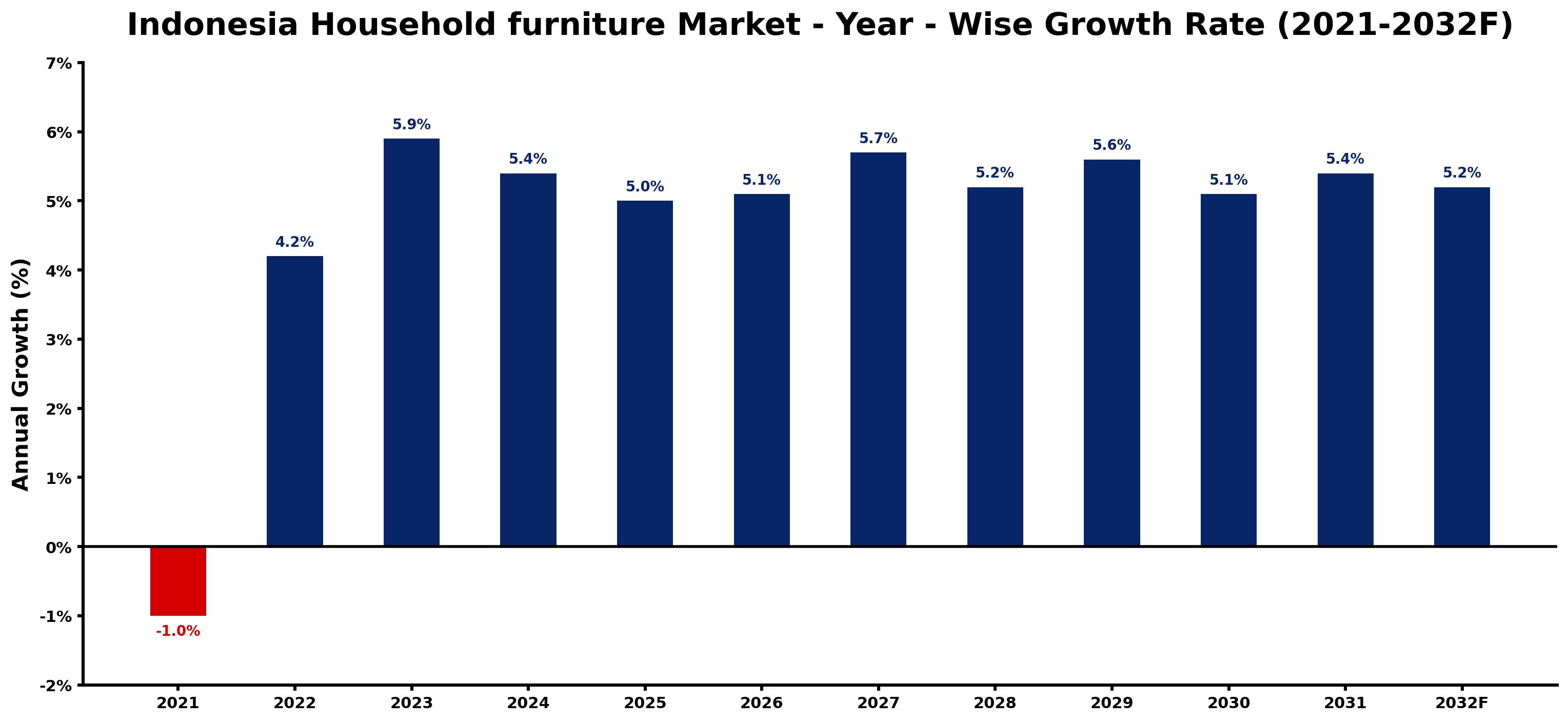
The table below presents the year wise growth rates along with the key drivers influencing the market
| Year | Growth Rate | Major Drivers |
| 2021 | -1.0% | Reduced disposable income from economic challenges led to decreased investments in household furniture purchases. |
| 2022 | 4.2% | Urbanization trends led to more compact living spaces needing functional furniture solutions. |
| 2023 | 5.9% | E-commerce platforms expanded, facilitating easier access to diverse furniture options. |
| 2024 | 5.4% | Sustainability concerns prompted a shift towards eco-friendly furniture materials. |
| 2025 | 5.0% | Rising disposable incomes encouraged consumers to invest in higher-quality home furnishings. |
| 2026 | 5.1% | Local craftsmanship gained popularity, enhancing the appeal of handmade furniture items. |
| 2027 | 5.7% | Increased awareness of interior design spurred demand for aesthetically pleasing furniture. |
| 2028 | 5.2% | Smart technology integration in furniture became a significant selling point for consumers. |
| 2029 | 5.6% | Corporate offices evolving into hybrid spaces fueled home office furniture purchases. |
| 2030 | 5.1% | Millennials increasingly prioritized unique furniture pieces, diversifying market offerings. |
| 2031 | 5.4% | Tourism recovery led to growth in hospitality sector furniture requirements. |
| 2032 | 5.2% | Real estate developments surged, creating new opportunities for the furniture supply chain. |
Note - Market size estimations and growth projections presented in this report are based on 6Wresearch's advanced forecasting approach, validated with industry datasets as of June 2026.
Indonesia Household furniture Market Synopsis
The Indonesia Household furniture Market is projected to reach 5.1% and witness significant growth during the forecast period (2026-2032). This growth trajectory is largely fueled by the rapid expansion of the real estate sector, alongside an increasing number of hospitality outlets such as hotels, offices, and restaurants. As urbanization accelerates, both consumer behavior and demographic shifts are playing pivotal roles in shaping demand dynamics for household furniture across the nation.
Indonesia Household furniture Market Growth Drivers
Several growth drivers are propelling the Indonesia Household furniture Market forward. The following factors are particularly influential:
- The ongoing urbanization trend is resulting in a substantial influx of population to cities, contributing to higher demands for residential and commercial furniture.
- Increasing disposable income levels among Indonesians are enabling households to invest in quality furniture, enhancing aesthetic and functional appeal in living spaces.
- The expansion of the real estate sector is facilitating the construction of new homes and properties, which in turn creates an upward surge in furniture needs.
- The rise in the number of hotels and restaurants directly correlates with greater demand for commercial-grade furniture, thus boosting overall market prospects.
- Growing consumer preferences for innovative and stylish designs are propelling furniture manufacturers to adapt their offerings, aligning with modern aesthetic trends.
Indonesia Household furniture Market Challenges and Restraints
Despite the promising growth forecast, the Indonesia Household furniture Market faces several challenges that could impede progress. Key restraints include:
- Volatility in raw material prices can adversely affect production costs, potentially leading to higher retail prices and affecting consumer purchasing decisions.
- Import restrictions and trade tariffs on certain materials may pose challenges for manufacturers that rely on imported resources for their products.
- Environmental regulations aimed at sustainability can complicate sourcing strategies, pushing manufacturers to innovate in eco-friendly materials and processes.
- The competitive nature of the market may pressure local manufacturers, especially small and medium-sized enterprises, to maintain quality while managing costs.
- Shifts in consumer preferences towards minimalistic designs could affect traditional furniture manufacturers who may be slower to adapt to changing trends.
Indonesia Household furniture Market Trends and Opportunities
The Indonesia Household furniture Market is characterized by several emerging trends and opportunities that stakeholders can leverage for growth:
- Sustainable furniture solutions are gaining traction, with consumers becoming increasingly aware of environmental impacts and seeking eco-conscious alternatives.
- Technological advancements in manufacturing are enabling more efficient production methods, significantly reducing lead times and costs.
- E-commerce platforms for furniture sales are expanding rapidly, presenting new channels for reaching consumers and enhancing purchase convenience.
- Customization options in furniture design are becoming popular, allowing consumers to create personalized pieces that reflect their individual styles.
- The rise in property rentals and co-living spaces is creating demand for versatile and space-saving furniture solutions that cater to urban lifestyles.
Indonesia Household furniture Market Government Investment and Initiatives
The Indonesian government has implemented various initiatives aimed at promoting the growth of the household furniture sector. These initiatives include:
- Investment in infrastructure development, focusing on urban areas, supports the real estate sector, which is crucial for stimulating furniture demand.
- Encouragement of local sourcing through incentives for manufacturers to utilize domestically produced materials, thereby reducing dependency on imports.
- Support for small and medium enterprises in the furniture sector through grants and training programs, aimed at enhancing competitiveness.
- Promotion of environmentally sustainable practices within the industry to align with global sustainability goals and enhance marketability.
- Collaboration with industry stakeholders to streamline regulations and improve the overall business environment for furniture manufacturers.
Indonesia Household furniture Market Latest Developments (May 2025 - June 2026)
In the latest developments for the Indonesia Household furniture Market, several key trends have emerged between May 2025 and June 2026. The industry is experiencing increased investment in technology, particularly in automation and digitization of manufacturing processes, leading to improved efficiency and product quality. Consumer preferences are shifting towards multi-functional and minimalist furniture solutions, prompting many manufacturers to innovate their offerings to meet these demands. Furthermore, sustainability initiatives are being prioritized, with businesses increasingly adopting eco-friendly materials and production methods in response to consumer advocacy for environmentally responsible products. Additionally, e-commerce channels are seeing a surge, as more consumers turn to online shopping for their furniture needs, necessitating a robust digital presence from manufacturers.
Indonesia Household furniture Market - Key Attractiveness of the Report
- 10 Years of Market Numbers
- Historical Data Starting from 2022 to 2025
- Base Year: 2025
- Forecast Data until 2032
- Key Performance Indicators Impacting the Market
- Major Upcoming Developments and Projects
Key Highlights of the Report:
- Indonesia Household furniture Market Outlook
- Market Size of Indonesia Household furniture Market, 2025
- Forecast of Indonesia Household furniture Market, 2032F
- Historical Data and Forecast of Indonesia Household furniture Revenues & Volume for the Period 2022-2032F
- Indonesia Household furniture Market Trend Evolution
- Indonesia Household furniture Market Drivers and Challenges
- Indonesia Household furniture Price Trends
- Indonesia Household furniture Porter's Five Forces
- Indonesia Household furniture Industry Life Cycle
- Historical Data and Forecast of Indonesia Household furniture Market Revenues & Volume By Types for the Period 2022-2032F
- Historical Data and Forecast of Indonesia Household furniture Market Revenues & Volume By Wood Furniture for the Period 2022-2032F
- Historical Data and Forecast of Indonesia Household furniture Market Revenues & Volume By Metal Furniture for the Period 2022-2032F
- Historical Data and Forecast of Indonesia Household furniture Market Revenues & Volume By Plastic Furniture for the Period 2022-2032F
- Historical Data and Forecast of Indonesia Household furniture Market Revenues & Volume By Others for the Period 2022-2032F
- Historical Data and Forecast of Indonesia Household furniture Market Revenues & Volume By Area of Use for the Period 2022-2032F
- Historical Data and Forecast of Indonesia Household furniture Market Revenues & Volume By ?Bedroom Furniture for the Period 2022-2032F
- Historical Data and Forecast of Indonesia Household furniture Market Revenues & Volume By Living Room Furniture for the Period 2022-2032F
- Historical Data and Forecast of Indonesia Household furniture Market Revenues & Volume By Dining Room Furniture for the Period 2022-2032F
- Historical Data and Forecast of Indonesia Household furniture Market Revenues & Volume By Household Furniture for the Period 2022-2032F
- Historical Data and Forecast of Indonesia Household furniture Market Revenues & Volume By Others for the Period 2022-2032F
- Indonesia Household furniture Import Export Trade Statistics
- Market Opportunity Assessment By Types
- Market Opportunity Assessment By Area of Use
- Indonesia Household furniture Top Companies Market Share
- Indonesia Household furniture Competitive Benchmarking By Technical and Operational Parameters
- Indonesia Household furniture Company Profiles
- Indonesia Household furniture Key Strategic Recommendations






































