Indonesia Infrared Imaging Market Size, Share & Growth Rate
The Indonesia Infrared Imaging Market was estimated at USD 192 Million in 2025 and is projected to reach USD 253 Million by 2032, growing at a CAGR of 4.0% from 2026 to 2032. This growth trajectory is driven by increasing applications in security and surveillance, healthcare diagnostics, and industrial automation. As the demand for non-contact temperature measurement rises, the versatility and effectiveness of infrared imaging solutions in various sectors position them favorably for robust market expansion.
Indonesia Infrared Imaging Market Year-wise Growth Rate and Key Drivers
This graph highlights how the Indonesia Infrared Imaging Market has steadily grown over the years, supported by major growth factors.
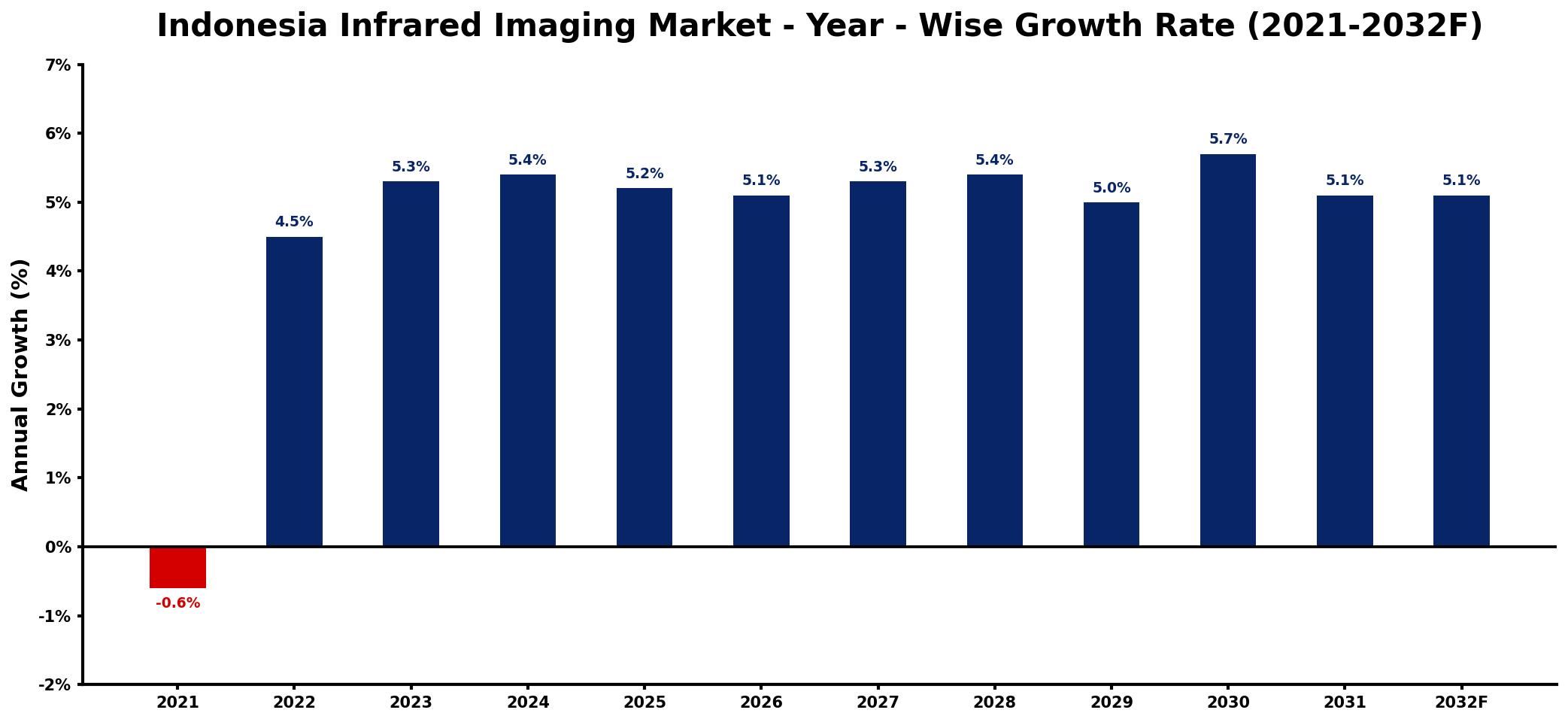
The table below presents the year‑wise growth rates along with the key drivers influencing the market
| Year | Growth Rate | Major Drivers |
| 2021 | -0.6% | decrease in industrial investments |
| 2022 | 4.5% | growth in healthcare applications |
| 2023 | 5.3% | expansion of renewable energy sector |
| 2024 | 5.4% | increased government infrastructure spending |
| 2025 | 5.2% | rising demand for safety protocols |
| 2026 | 5.1% | advancements in technology adoption |
| 2027 | 5.3% | surge in environmental monitoring needs |
| 2028 | 5.4% | growing emerging market penetration |
| 2029 | 5.0% | increased focus on energy efficiency |
| 2030 | 5.7% | strengthening international trade flows |
| 2031 | 5.1% | rising awareness of thermal solutions |
| 2032 | 5.1% | enhanced product quality standards |
Note: Market size estimations and growth projections presented in this report are based on 6Wresearch's proprietary forecasting methodology, utilizing the latest available industry data, government publications, and primary research inputs.
Indonesia Infrared Imaging Market Synopsis
Currently, the Indonesia infrared imaging market is witnessing a surge in adoption across multiple industries. Applications in security, healthcare, and industrial inspections are leading the charge, showcasing the technology's effectiveness in low-light and challenging conditions.
This uptick reflects an increasing recognition of infrared imaging's capability to enhance operational efficiency, detect anomalies, and deliver critical insights in real time. As industries evolve, so does the integration of sophisticated thermal imaging technology into their operations.
Indonesia Infrared Imaging Market Key Takeaways
- The market is characterized by a growing demand in security, healthcare, and industrial automation.
- Technological advancements are enhancing the accuracy and cost-effectiveness of infrared imaging solutions.
- Government initiatives are supporting infrastructure development, leading to increased infrared technology adoption.
- The market is set to overcome temporary setbacks from the COVID-19 pandemic, with renewed focus on thermal imaging applications.
- Investment in R&D is crucial to address affordability and enhance resolution capabilities in infrared devices.
Evaluation of Restraints in Indonesia Infrared Imaging Market
Despite its potential, the Indonesia infrared imaging market faces notable constraints. High initial costs associated with advanced infrared technology limit accessibility, particularly for small to medium-sized enterprises. Furthermore, continual innovation is needed to keep pace with market demands for improved accuracy and resolution. Regulatory hurdles and varying standards can also impede market growth, making it essential for companies to navigate these challenges effectively.
Indonesia Infrared Imaging Market Trends
One prominent trend is the increasing integration of artificial intelligence (AI) with infrared imaging technologies. This combination enhances data analytics, allowing for predictive maintenance and real-time decision-making across sectors. Additionally, the growing focus on safety and health, particularly post-pandemic, has spurred greater investment in infrared solutions for temperature screening in public spaces.
Moreover, the industrial sector is leaning towards automation, leading to a higher demand for infrared imaging in monitoring equipment health and operational efficiency. This trend positions infrared technology as an indispensable tool for modern industrial operations.
Indonesia Infrared Imaging Market Opportunities
The market presents various growth opportunities, especially in sectors such as healthcare and industrial inspection. As healthcare facilities focus on enhancing patient safety through advanced diagnostic tools, infrared imaging plays a crucial role. Moreover, industries looking to adopt smart technologies for predictive maintenance can leverage infrared imaging to optimize operations and reduce downtime. Government initiatives aimed at infrastructure development further enhance the potential for widespread adoption of this technology.
Government Initiatives in the Indonesia Infrared Imaging Market
The Indonesian government is actively promoting technological advancement through initiatives that support health and safety standards, particularly in public health infrastructure. Investments in security and surveillance technology reflect a commitment to enhancing safety in urban environments. Moreover, the governments support for digital transformation across industries provides a conducive environment for the growth of infrared imaging solutions, making them integral to future developments in public safety and industrial efficiency.
Future Insights of the Indonesia Infrared Imaging Market
Looking ahead to 2026-2032, the Indonesia infrared imaging market is poised for substantial growth. The anticipated rise in demand for thermal imaging solutions in the wake of increasing security concerns and health safety measures will likely spur innovation and broaden application scope. As technological advancements make infrared devices more affordable and accessible, adoption rates across various sectors are expected to rise, paving the way for new opportunities and market dynamics.
Indonesia Infrared Imaging Market Latest Developments (2025 - 2026)
In recent months, the Indonesia infrared imaging market has seen significant movement towards the integration of AI-driven analytics with thermal imaging systems. This evolution is enhancing the capabilities of existing solutions, allowing for more precise data collection and analysis. Companies are also emphasizing the importance of regulatory compliance, ensuring that their products meet evolving standards. Additionally, investment in training and education related to infrared technology is gaining traction, fostering a more informed user base.
Indonesia Infrared Imaging Market - Key Attractiveness of the Report
- 10 Years of Market Numbers
- Historical Data Starting from 2022 to 2025
- Base Year: 2025
- Forecast Data until 2032
- Key Performance Indicators Impacting the Market
- Major Upcoming Developments and Projects
Key Highlights of the Report:
- Indonesia Infrared Imaging Market Outlook
- Market Size of Indonesia Infrared Imaging Market, 2025
- Forecast of Indonesia Infrared Imaging Market, 2032
- Historical Data and Forecast of Indonesia Infrared Imaging Revenues & Volume for the Period 2022-2032F
- Indonesia Infrared Imaging Market Trend Evolution
- Indonesia Infrared Imaging Market Drivers and Challenges
- Indonesia Infrared Imaging Price Trends
- Indonesia Infrared Imaging Porter's Five Forces
- Indonesia Infrared Imaging Industry Life Cycle
- Historical Data and Forecast of Indonesia Infrared Imaging Market Revenues & Volume By Technology for the Period 2022-2032F
- Historical Data and Forecast of Indonesia Infrared Imaging Market Revenues & Volume By Cooled Infrared Imaging for the Period 2022-2032F
- Historical Data and Forecast of Indonesia Infrared Imaging Market Revenues & Volume By Uncooled Infrared Imaging for the Period 2022-2032F
- Historical Data and Forecast of Indonesia Infrared Imaging Market Revenues & Volume By Wavelength for the Period 2022-2032F
- Historical Data and Forecast of Indonesia Infrared Imaging Market Revenues & Volume By Near Infrared for the Period 2022-2032F
- Historical Data and Forecast of Indonesia Infrared Imaging Market Revenues & Volume By Shortwave Infrared for the Period 2022-2032F
- Historical Data and Forecast of Indonesia Infrared Imaging Market Revenues & Volume By Mid-wave Infrared for the Period 2022-2032F
- Historical Data and Forecast of Indonesia Infrared Imaging Market Revenues & Volume By Long-wave Infrared for the Period 2022-2032F
- Historical Data and Forecast of Indonesia Infrared Imaging Market Revenues & Volume By Application for the Period 2022-2032F
- Historical Data and Forecast of Indonesia Infrared Imaging Market Revenues & Volume By Security & Surveillance for the Period 2022-2032F
- Historical Data and Forecast of Indonesia Infrared Imaging Market Revenues & Volume By Monitoring & Inspection for the Period 2022-2032F
- Historical Data and Forecast of Indonesia Infrared Imaging Market Revenues & Volume By Detection for the Period 2022-2032F
- Historical Data and Forecast of Indonesia Infrared Imaging Market Revenues & Volume By Vertical for the Period 2022-2032F
- Historical Data and Forecast of Indonesia Infrared Imaging Market Revenues & Volume By Industrial for the Period 2022-2032F
- Historical Data and Forecast of Indonesia Infrared Imaging Market Revenues & Volume By Nonindustrial for the Period 2022-2032F
- Indonesia Infrared Imaging Import Export Trade Statistics
- Market Opportunity Assessment By Technology
- Market Opportunity Assessment By Wavelength
- Market Opportunity Assessment By Application
- Market Opportunity Assessment By Vertical
- Indonesia Infrared Imaging Top Companies Market Share
- Indonesia Infrared Imaging Competitive Benchmarking By Technical and Operational Parameters
- Indonesia Infrared Imaging Company Profiles
- Indonesia Infrared Imaging Key Strategic Recommendations






































