Indonesia Instrumentation Valves and Fittings Market Size, Share & Growth Rate
The Indonesia Instrumentation Valves and Fittings Market was estimated at USD 310 Million in 2025 and is projected to reach USD 409 Million by 2032, growing at a CAGR of 4.0% from 2026 to 2032. This growth trajectory is propelled by the ongoing expansion of critical sectors such as oil and gas, chemicals, and water treatment. As industries increasingly focus on efficiency and precision, the demand for high-quality instrumentation components continues to rise, supporting a robust and dynamic market environment.
Indonesia Instrumentation Valves and Fittings Market Year-wise Growth Rate and Key Drivers
This graph highlights how the Indonesia Instrumentation Valves and Fittings Market has steadily grown over the years, supported by major growth factors.
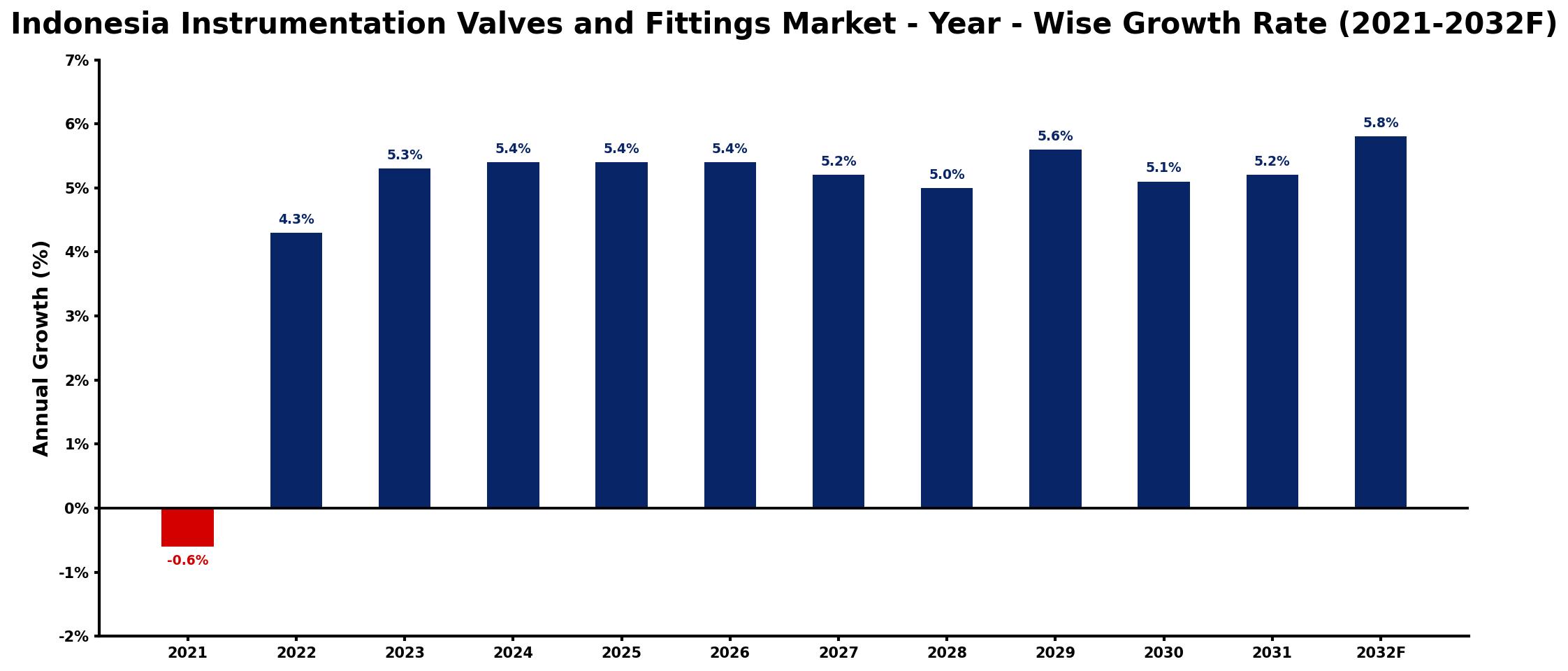
The table below presents the year‑wise growth rates along with the key drivers influencing the market
| Year | Growth Rate | Major Drivers |
| 2021 | -0.6% | slower industrial production activity |
| 2022 | 4.3% | increased infrastructure development projects |
| 2023 | 5.3% | growing energy sector investments |
| 2024 | 5.4% | rising demand from manufacturing sector |
| 2025 | 5.4% | expansion of renewable energy initiatives |
| 2026 | 5.4% | increased automation in industries |
| 2027 | 5.2% | growing focus on sustainability practices |
| 2028 | 5.0% | enhanced technological advancements adoption |
| 2029 | 5.6% | increased foreign direct investments influx |
| 2030 | 5.1% | rising urbanization and population growth |
| 2031 | 5.2% | growing maintenance and repair needs |
| 2032 | 5.8% | increased regulatory compliance requirements |
Note: Market size estimations and growth projections presented in this report are based on 6Wresearch's proprietary forecasting methodology, utilizing the latest available industry data, government publications, and primary research inputs.
Indonesia Instrumentation Valves and Fittings Market Synopsis
The Indonesia Instrumentation Valves and Fittings Market has experienced notable momentum recently, fueled by significant investments in industrial infrastructure. As companies seek to enhance operational efficiency, the importance of precision in controlling fluid flow has never been clearer. This demand is set against a backdrop of an increasingly complex industrial landscape that requires innovative solutions and dependable components.
Looking ahead, the market is poised for steady growth, driven by advancements in technology and a growing emphasis on safety and regulatory compliance. Innovations in materials and design are creating opportunities for enhanced product offerings, further positioning the sector for a competitive edge within the regional marketplace.
Indonesia Instrumentation Valves and Fittings Market Key Takeaways
- The market is forecasted to grow from USD 310 Million in 2025 to USD 409 Million by 2032.
- Key drivers include growth in the oil, gas, and petrochemical industries, alongside advancements in technology.
- Local and international competition influences product variety and pricing strategies within the sector.
- The market is increasingly focused on high-quality products to meet stringent safety and environmental regulations.
- Recent industrial disruptions due to COVID-19 have temporarily impacted demand, yet the market has shown resilience.
Evaluation of Restraints in Indonesia Instrumentation Valves and Fittings Market
Despite its robust growth prospects, the Indonesia Instrumentation Valves and Fittings Market faces notable constraints. Precision and quality demands are paramount in industrial applications, compelling manufacturers to navigate stringent certification processes. Additionally, competition from global suppliers can create pressures on pricing structures and overall market share. The dependency on industrial production rates means fluctuations in manufacturing activities can directly affect demand, making responsiveness a critical factor for stakeholders in this market.
Indonesia Instrumentation Valves and Fittings Market Trends
Several key trends are shaping the Indonesia Instrumentation Valves and Fittings Market. The increased focus on sustainable practices and reducing environmental impact is pushing companies to invest in advanced materials and technologies that minimize leakage and emissions. Moreover, the digital transformation of industrial processes is leading to greater integration of IoT and smart technologies, which require advanced instrumentation solutions. Furthermore, the growing trend towards automation in manufacturing processes underscores the need for reliable control systems, further driving demand for high-quality valves and fittings.
Indonesia Instrumentation Valves and Fittings Market Opportunities
The opportunities in the Indonesia Instrumentation Valves and Fittings Market are extensive. As infrastructure development continues, particularly in the oil and gas sector, there is an urgent need for modern instrumentation solutions that can meet evolving operational demands. Additionally, investments in renewable energy and green technologies present a unique opportunity for innovation in valve and fitting applications. Companies that can offer tailored solutions to meet specific industrial requirements stand to gain significant market share as this sector evolves.
Government Initiatives in the Indonesia Instrumentation Valves and Fittings Market
The Indonesian government has been proactive in promoting industrial growth through various initiatives aimed at enhancing the manufacturing landscape. Policies encouraging foreign investment and technological advancement are fostering an environment conducive to market expansion. Additionally, public spending on infrastructure projects, particularly in energy and utilities, is expected to boost demand for instrumentation valves and fittings significantly. Such government-backed initiatives are critical in laying the groundwork for sustained market growth.
Future Insights of the Indonesia Instrumentation Valves and Fittings Market
Looking towards 2026-2032, the Indonesia Instrumentation Valves and Fittings Market is set to evolve significantly. As industries embrace digital transformation, the incorporation of smart technologies into instrumentation solutions will enhance precision and operational efficiency. Concurrently, the pressure to adhere to stringent safety and environmental standards will encourage innovation in product development. Overall, the market's trajectory will be defined by a combination of technological advancements, increased demand for efficiency, and a commitment to sustainability.
Indonesia Instrumentation Valves and Fittings Market Latest Developments (2025 - 2026)
Recent developments in the Indonesia Instrumentation Valves and Fittings Market reflect a shift towards greater automation and digitalization. Industry stakeholders are increasingly exploring collaborative approaches to enhance product offerings and optimize supply chain efficiencies. Investment in research and development has become a focal point, with many companies announcing plans to innovate their product lines to meet emerging industry demands. Furthermore, strategic partnerships and alliances are being formed, positioning businesses to better navigate the evolving landscape.
Indonesia Instrumentation Valves and Fittings Market - Key Attractiveness of the Report
- 10 Years of Market Numbers
- Historical Data Starting from 2022 to 2025
- Base Year: 2025
- Forecast Data until 2032
- Key Performance Indicators Impacting the Market
- Major Upcoming Developments and Projects
Key Highlights of the Report:
- Indonesia Instrumentation Valves and Fittings Market Outlook
- Market Size of Indonesia Instrumentation Valves and Fittings Market, 2025
- Forecast of Indonesia Instrumentation Valves and Fittings Market, 2032
- Historical Data and Forecast of Indonesia Instrumentation Valves and Fittings Revenues & Volume for the Period 2022-2032F
- Indonesia Instrumentation Valves and Fittings Market Trend Evolution
- Indonesia Instrumentation Valves and Fittings Market Drivers and Challenges
- Indonesia Instrumentation Valves and Fittings Price Trends
- Indonesia Instrumentation Valves and Fittings Porter's Five Forces
- Indonesia Instrumentation Valves and Fittings Industry Life Cycle
- Historical Data and Forecast of Indonesia Instrumentation Valves and Fittings Market Revenues & Volume By Types for the Period 2022-2032F
- Historical Data and Forecast of Indonesia Instrumentation Valves and Fittings Market Revenues & Volume By Tube for the Period 2022-2032F
- Historical Data and Forecast of Indonesia Instrumentation Valves and Fittings Market Revenues & Volume By Pipe for the Period 2022-2032F
- Historical Data and Forecast of Indonesia Instrumentation Valves and Fittings Market Revenues & Volume By Biopharm for the Period 2022-2032F
- Historical Data and Forecast of Indonesia Instrumentation Valves and Fittings Market Revenues & Volume By Hose for the Period 2022-2032F
- Historical Data and Forecast of Indonesia Instrumentation Valves and Fittings Market Revenues & Volume By Weld for the Period 2022-2032F
- Historical Data and Forecast of Indonesia Instrumentation Valves and Fittings Market Revenues & Volume By Others for the Period 2022-2032F
- Historical Data and Forecast of Indonesia Instrumentation Valves and Fittings Market Revenues & Volume By Applications for the Period 2022-2032F
- Historical Data and Forecast of Indonesia Instrumentation Valves and Fittings Market Revenues & Volume By Oil & Gas for the Period 2022-2032F
- Historical Data and Forecast of Indonesia Instrumentation Valves and Fittings Market Revenues & Volume By Marine & Shipbuilding for the Period 2022-2032F
- Historical Data and Forecast of Indonesia Instrumentation Valves and Fittings Market Revenues & Volume By Industrial for the Period 2022-2032F
- Historical Data and Forecast of Indonesia Instrumentation Valves and Fittings Market Revenues & Volume By Others for the Period 2022-2032F
- Historical Data and Forecast of Indonesia Instrumentation Valves and Fittings Market Revenues & Volume By Products for the Period 2022-2032F
- Historical Data and Forecast of Indonesia Instrumentation Valves and Fittings Market Revenues & Volume By Instrumentation Valves for the Period 2022-2032F
- Historical Data and Forecast of Indonesia Instrumentation Valves and Fittings Market Revenues & Volume By Instrumentation Fittings for the Period 2022-2032F
- Indonesia Instrumentation Valves and Fittings Import Export Trade Statistics
- Market Opportunity Assessment By Types
- Market Opportunity Assessment By Applications
- Market Opportunity Assessment By Products
- Indonesia Instrumentation Valves and Fittings Top Companies Market Share
- Indonesia Instrumentation Valves and Fittings Competitive Benchmarking By Technical and Operational Parameters
- Indonesia Instrumentation Valves and Fittings Company Profiles
- Indonesia Instrumentation Valves and Fittings Key Strategic Recommendations






































