Indonesia Non-grape Wine Market Summary
The indonesia non-grape wine market was estimated at USD 416 Million in 2025 and is projected to reach USD 551 Million by 2032, growing at a CAGR of 5.2% from 2026 to 2032.
Indonesia Non-grape Wine Market Year-wise Growth Rate and Key Drivers
This graph highlights how the Indonesia Non-grape Wine Market has steadily grown over the past five years, supported by major growth factors.
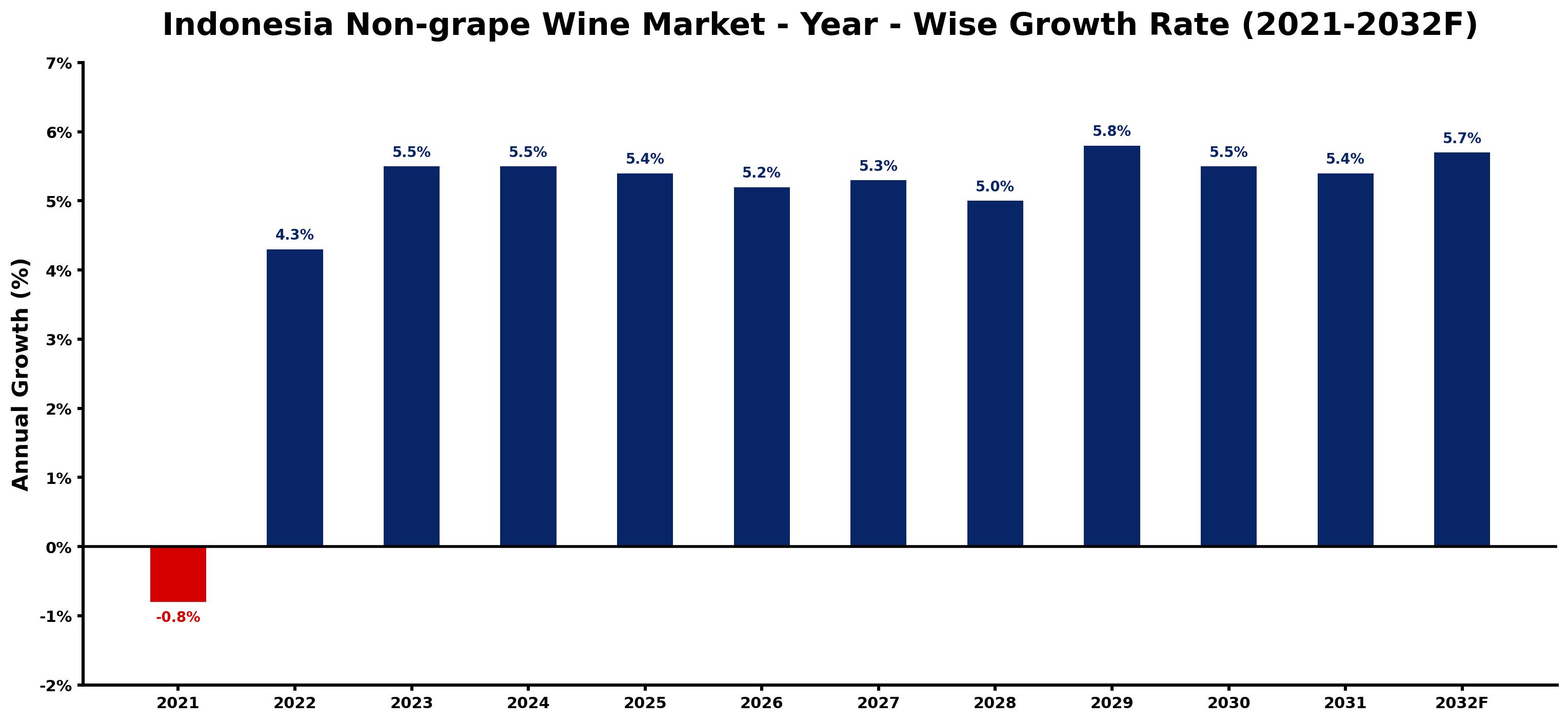
The table below presents the year wise growth rates along with the key drivers influencing the market
| Year | Growth Rate | Major Drivers |
| 2021 | -0.8% | Shifting consumer preferences towards flavored beverages eroded demand for traditional nongrape wine options. |
| 2022 | 4.3% | Local producers experiment with unique ingredients, showcasing Indonesia's diverse agricultural bounty. |
| 2023 | 5.5% | Increased exposure to international wine markets influences Indonesian consumer preferences significantly. |
| 2024 | 5.5% | Emerging online platforms enhance accessibility to non-grape wine products nationwide. |
| 2025 | 5.4% | Cultural events promoting local beverages create heightened awareness and brand loyalty. |
| 2026 | 5.2% | Collaboration between vineyards and tourism sectors boosts market visibility and sales. |
| 2027 | 5.3% | Shifts toward sustainable production attract environmentally-conscious consumers seeking alternatives. |
| 2028 | 5.0% | Innovative marketing campaigns resonate well with younger demographics exploring new experiences. |
| 2029 | 5.8% | Growth in urbanization leads to higher demand for premium and artisanal beverage options. |
| 2030 | 5.5% | Attractiveness of the non-grape wine sector prompts investments from international stakeholders. |
| 2031 | 5.4% | Expansion of local wine festivals helps forge deeper connections among producers and consumers. |
| 2032 | 5.7% | Improved export opportunities position Indonesia as a growing player in Asia's wine market. |
Note - Market size estimations and growth projections presented in this report are based on 6Wresearch's advanced forecasting approach, validated with industry datasets as of June 2026.
Indonesia Non-grape Wine Market Synopsis
The Indonesia Non-grape Wine Market is projected to reach 5.2% and witness significant growth during the forecast period (2026-2032). This dynamic beverage sector is experiencing a surge in demand, driven by shifting consumer preferences and enhanced accessibility. As a result, the market landscape is becoming increasingly competitive, with multiple stakeholders aiming to capture consumer attention and spending.
Indonesia Non-grape Wine Market Growth Drivers
Several factors are propelling the growth of the Indonesia Non-grape Wine Market. The rising disposable incomes among middle-class households have made non-grape wines a more viable option for everyday consumption. Consumers are drawn to these alternatives due to their affordability and the convenience they offer.
- There is a notable shift in consumer preferences towards healthier beverage options, with many opting for drinks that are lower in alcohol content, which include various non-grape wine products.
- Manufacturers are increasingly innovating with new flavors and attractive packaging designs, which not only appeal to consumers visually but also make these products more enticing at competitive price points.
- The tendency to experiment with tastes is heightened by the availability of affordable bottles, prompting consumers to try new flavors without a significant financial commitment.
- Digital marketing initiatives, particularly through social media platforms, have substantially enhanced product visibility, especially among the younger demographic that is keen on exploring novel beverage categories.
- Promotional campaigns emphasizing lifestyle alignments with non-grape wines contribute to their growing acceptance in social settings.
Indonesia Non-grape Wine Market Challenges and Restraints
Despite the promising outlook, the Indonesia Non-grape Wine Market faces several challenges. A primary concern is the inconsistency in product quality stemming from the lack of stringent regulations governing production standards. This situation often leads to consumer apprehension regarding locally produced brands compared to imported variants.
- The scarcity of certain raw materials essential for production poses significant obstacles, impacting manufacturing timelines and overall market supply.
- Intense competition within the sector creates a highly price-sensitive environment, which can erode profit margins and make it difficult for businesses to sustain long-term viability.
- Additionally, many consumers remain unaware of the diverse offerings within the non-grape segment, which stunts market growth as potential customers may default to more familiar products.
- Fluctuating economic conditions can also influence consumer spending habits, making them more cautious about discretionary purchases like non-grape wine.
- Lastly, the ongoing need for financial backing or investment can strain smaller producers, who may lack the required capital to innovate and expand successfully.
Indonesia Non-grape Wine Market Government Investment and Initiatives
The Indonesian government has recognized the significance of the beverage sector, including the non-grape wine segment, as a driver of economic growth. There are ongoing initiatives that focus on boosting local production capabilities and enhancing quality standards.
- Public investment into agricultural sectors to ensure a steady supply of raw materials for non-grape wine production is a priority, fostering a more robust manufacturing environment.
- The government's push for regulatory frameworks aims to establish quality assurance measures that can bolster consumer confidence in domestic products.
- Incentives for local businesses, including grants and subsidies for innovative projects in non-grape wine production, contribute to the growth of startups within this space.
- Moreover, the government is actively promoting the idea of sustainable beverage production, aligning with global trends that favor environmentally responsible practices.
- Collaborations between public and private sectors are encouraged to enhance market accessibility and create distribution networks that could support wider consumer outreach.
Indonesia Non-grape Wine Market Latest Developments (May 2025 - June 2026)
Recent developments in the Indonesia Non-grape Wine Market indicate a vibrant shift towards innovation and market expansion. Industry players have been focusing on diversifying their product ranges, introducing limited editions and seasonal flavors to attract consumer interest.
- Promotional activities have increasingly leveraged e-commerce platforms, recognizing the growing trend of online shopping among consumers, especially post-pandemic.
- Recent collaborations between local producers and international beverage companies have facilitated knowledge transfer, enhancing product quality and marketing strategies.
- Market research indicates a gradual increase in acceptance of non-grape wines in premium dining sectors, showcasing a broader consumer palette.
- Innovative packaging solutions that cater to environmental sustainability are being increasingly adopted, reflecting changing consumer values.
- Overall, a notable increase in product availability in urban areas has further solidified the presence of non-grape wines in the competitive beverage landscape.
Indonesia Non-grape Wine Market - Key Attractiveness of the Report
- 10 Years of Market Numbers
- Historical Data Starting from 2022 to 2025
- Base Year: 2025
- Forecast Data until 2032
- Key Performance Indicators Impacting the Market
- Major Upcoming Developments and Projects
Key Highlights of the Report:
- Indonesia Non-grape Wine Market Outlook
- Market Size of Indonesia Non-grape Wine Market, 2025
- Forecast of Indonesia Non-grape Wine Market, 2032F
- Historical Data and Forecast of Indonesia Non-grape Wine Revenues & Volume for the Period 2022-2032F
- Indonesia Non-grape Wine Market Trend Evolution
- Indonesia Non-grape Wine Market Drivers and Challenges
- Indonesia Non-grape Wine Price Trends
- Indonesia Non-grape Wine Porter's Five Forces
- Indonesia Non-grape Wine Industry Life Cycle
- Historical Data and Forecast of Indonesia Non-grape Wine Market Revenues & Volume By Product Type for the Period 2022-2032F
- Historical Data and Forecast of Indonesia Non-grape Wine Market Revenues & Volume By Fermented Fruit Wine for the Period 2022-2032F
- Historical Data and Forecast of Indonesia Non-grape Wine Market Revenues & Volume By Distilled Fruit Wine for the Period 2022-2032F
- Historical Data and Forecast of Indonesia Non-grape Wine Market Revenues & Volume By Preparation Fruit Wine for the Period 2022-2032F
- Historical Data and Forecast of Indonesia Non-grape Wine Market Revenues & Volume By Sparkling Fruit Wine for the Period 2022-2032F
- Historical Data and Forecast of Indonesia Non-grape Wine Market Revenues & Volume By Application for the Period 2022-2032F
- Historical Data and Forecast of Indonesia Non-grape Wine Market Revenues & Volume By Household for the Period 2022-2032F
- Historical Data and Forecast of Indonesia Non-grape Wine Market Revenues & Volume By Commercial for the Period 2022-2032F
- Indonesia Non-grape Wine Import Export Trade Statistics
- Market Opportunity Assessment By Product Type
- Market Opportunity Assessment By Application
- Indonesia Non-grape Wine Top Companies Market Share
- Indonesia Non-grape Wine Competitive Benchmarking By Technical and Operational Parameters
- Indonesia Non-grape Wine Company Profiles
- Indonesia Non-grape Wine Key Strategic Recommendations






































