Global Nongrape Wine Market Highlights
| Market Size (2025) | USD 47 Billion |
| Forecast Size (2032) | USD 67.14 Billion |
| CAGR | 5.60% |
| Base Year | 2025 |
| Forecast Period | 2026-2032 |
| Largest Region | North America |
| Fastest Growing Region | Asia |
| Largest Segment | Fermented Fruit Wine |
| Fastest Growing Segment | Sparkling Fruit Wine |
| Leading Companies | E & J Gallo Winery, Constellation Brands, Treasury Wine Estates, Barefoot Wine, Mateus |
Global Nongrape Wine Market Size & Growth Rate (2026-2032)
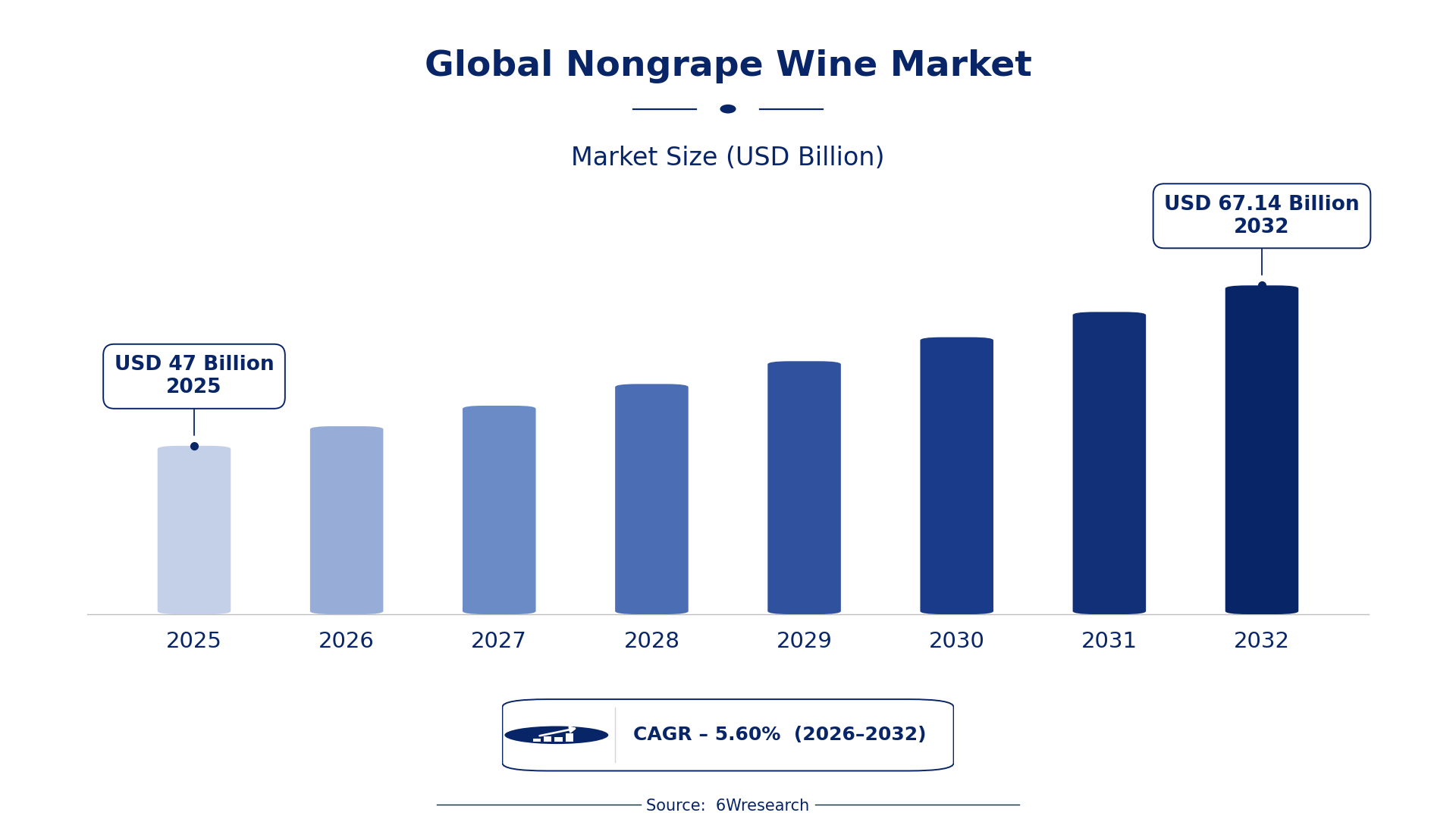
The Global Nongrape Wine Market was estimated at USD 47 Billion in 2025 and is projected to reach USD 67.14 Billion by 2032, growing at a CAGR of 5.60% from 2026 to 2032.
Global Nongrape Wine Market Synopsis
The Global Nongrape Wine Market is undergoing a transformation, largely influenced by changing consumer preferences for unique alcoholic beverages that offer distinct flavors. As people seek alternatives to traditional grape wines, products made from fruits like apples, berries, and honey are seeing increasing market acceptance. This shift is critical for producers aiming to meet the rising demands of health-conscious consumers.
A growing segment of the population, including individuals with dietary restrictions, is driving diversification in wine options. Non-grape wines, often perceived as healthier, also align with trends in sustainable agriculture and organic wine production. These factors position the Global Nongrape Wine Market as a vital player not only in the alcoholic beverage sector but also in broader food and beverage industry dynamics.
Global Nongrape Wine Market Year-wise Growth Rate and Key Drivers
This graph illustrates the annual growth rates of the Global Nongrape Wine Market from 2022 to 2032, highlighting a steady upward trajectory and projected expansion over the forecast period.
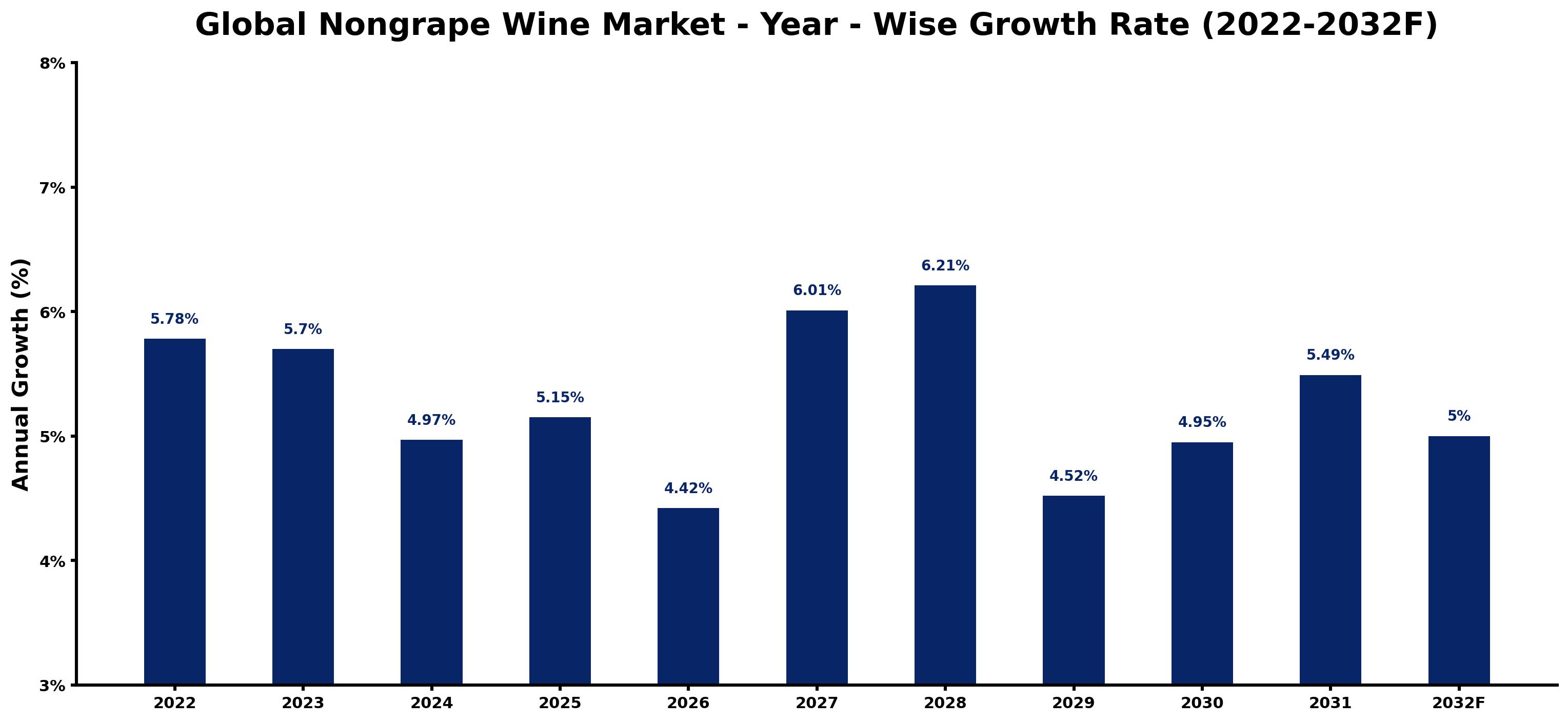
The table below presents the year‑wise growth rates along with the key drivers influencing the market
| Year | Growth Rate (%) | Major Drivers |
| 2022 | 5.78 | Sustainability initiatives in wineries enhance the appeal of nongrape wine options. |
| 2023 | 5.7 | Consumer preferences pivot toward nongrape wines, reflecting evolving taste profiles. |
| 2024 | 4.97 | Investors in the beverage sector are acquiring nongrape wine brands rapidly. |
| 2025 | 5.15 | A shift toward local sourcing of ingredients alters nongrape wine production costs. |
| 2026 | 4.42 | Distributors adapting to new regulations impact the availability of nongrape wine. |
| 2027 | 6.01 | Growing interest in natural ingredients leads to an increase in nongrape wine sales. |
| 2028 | 6.21 | Manufacturers implementing innovative fermentation techniques diversify nongrape wine offerings. |
| 2029 | 4.52 | In the Asian market, supply chain adjustments enhance nongrape wine accessibility. |
| 2030 | 4.95 | Expanding training programs improves workforce skills in nongrape wine production. |
| 2031 | 5.49 | While boutique nongrape wine brands gain traction, larger companies adapt their strategies. |
| 2032 | 5 | Hybrid processing technology enhances the quality of nongrape wine globally. |
Note - Market size estimations and growth projections presented in this report are based on 6Wresearch's proprietary research methodology, combining internal industry data, secondary research, and primary validation, updated periodically to reflect current market conditions. As markets evolve rapidly, figures for certain industries may vary slightly and are intended as informed estimates rather than absolute figures. For the most current market sizing, we recommend validating figures with a 6Wresearch analyst.
Global Nongrape Wine Market Key Takeaways
Below are some of the specific key takeaways from the market, including:
- As of 2025, North America commands approximately 48% share of the Global Nongrape Wine Market.
- The Sparkling Fruit Wine segment is expected to achieve a CAGR of 7.2% from 2026 to 2032.
- Research published in 2023 indicates that consumer interest in vegan and gluten-free alcoholic beverages is accelerating market growth.
- E & J Gallo Winery alone has launched over 10 new non-grape wine products in the last year, capitalizing on changing consumer tastes.
- The regulatory environment is evolving, with more countries recognizing and setting standards for non-grape wines, thereby expanding market opportunities.
Evaluation of Restraints in Global Nongrape Wine Market
Despite the market's potential, several significant challenges remain. One prominent barrier is the perception that non-grape wines are of inferior quality compared to traditional grape-based wines. For instance, a survey indicates that close to 45% of consumers have a preference bias towards grape wines. Additionally, regulatory hurdles, such as complex labeling requirements for non-grape wines, further complicate market entry and expansion for new producers. With these sentiments and obstacles in play, educational efforts and strategic marketing become crucial for overcoming these restraints.
Global Nongrape Wine Market Trends
Currently, the market is witnessing a shift towards innovative product offerings, as companies explore unique ingredients beyond traditional fruits. For example, innovative blends utilizing exotic fruits or floral infusions are becoming increasingly popular. In 2022, Treasury Wine Estates reported a 15% rise in sales volume of its new product line that incorporates such blends, demonstrating the efficacy of innovation in capturing consumer interest.
Another trend is the integration of digital marketing strategies, where producers use social media platforms for targeted advertising. A notable example is Barefoot Wine, which initiated campaigns in 2023 that employed influencer collaborations to promote its non-grape offerings, resulting in a 25% increase in online engagement. As this digital transformation unfolds, it significantly impacts market visibility and consumer engagement.
Global Nongrape Wine Market Opportunities
As consumer preferences evolve, several future revenue opportunities are emerging within the Global Nongrape Wine Market. The health and wellness trend is leading to a heightened interest in low-sugar, organic options, with companies like Mateus exploring this niche by promoting lower-calorie fruit wines. In 2023, they announced plans for a product line aimed explicitly at health-conscious consumers, projecting to contribute an estimated USD 10 million in revenue by 2025.
Additionally, the growing demand for non-alcoholic and low-alcohol variants signifies untapped potential. Various producers are experimenting with such options; for instance, a startup launched an alcohol-free fruit wine in 2023 that gained significant traction, particularly among younger demographics. This collective momentum makes the market ripe for exploration and investment.
Global Nongrape Wine Market by Product Type
Within the Global Nongrape Wine Market, Fermented Fruit Wine currently leads, holding approximately 40% share in 2025. Sparkling Fruit Wine is recognized as the fastest-growing segment, expected to achieve a CAGR of 7.5% from 2026 to 2032. The rising consumer preference for unique, effervescent options contributes significantly to this trend, with innovative production methods enhancing flavor profiles and consumer appeal.
Global Nongrape Wine Market by Application
In terms of application, the Commercial segment dominates, representing about 55% share in 2025, primarily driven by bars and restaurants' increasing interest in diversifying menus. The Household segment is projected to grow at a CAGR of 6.0% from 2026 to 2032, as more consumers experiment with non-grape wines at home for leisure. This trend is supported by ongoing shifts in consumer behavior towards personal consumption, especially as the at-home dining experience continues to evolve.
Global Nongrape Wine Market by Region
North America is currently the largest regional market, comprising approximately 48% share in 2025, largely due to established production facilities and high consumer interest. Conversely, Asia is emerging as the fastest-growing region, with a projected CAGR of 9.0% from 2026 to 2032. This rapid growth is driven by increasing urbanization, rising disposable incomes, and a burgeoning interest in varied beverage options among younger consumers, making it a critical focus for future investments.
Government Initiatives in the Global Nongrape Wine Market
The regulatory environment surrounding the Global Nongrape Wine Market is gradually adapting to accommodate the unique characteristics of non-grape wines. Governments are implementing measures aimed at fostering the growth of this sector, encouraging innovation and ensuring quality standards.
- U.S. Department of Agriculture, Specialty Crop Block Grant Program, 2022 - Aimed at supporting non-grape wine producers through funding for production and marketing efforts.
- European Commission, Regulation on European Wine Quality Schemes, March 2023 - Intended to standardize labeling for non-grape wines in Europe, easing the entry of new products into the market.
- Government of Australia, Wine Equalisation Tax Act, July 2023 - This initiative provides tax incentives for producers of non-grape wines, supporting growth and innovation in regions where these wines are produced.
- Ministry of Agriculture, India, National Agricultural Policy, announced in 2024 - Plans to support the cultivation of diverse fruits used in non-grape wine production, facilitating growth opportunities for local wineries.
Future Insights of the Global Nongrape Wine Market
The trajectory of the Global Nongrape Wine Market is shifting towards a multifaceted landscape fueled by evolving consumer preferences. By 2032, innovations in flavor development and cultivation techniques will likely define the marketplace. For instance, companies such as Treasury Wine Estates are investing significantly in creating hybrid fruit blends. This investment not only aims to appeal to a broader audience but also to meet increasing interest among health-conscious consumers for lower-calorie alcoholic options, suggesting a competitive edge is becoming central to survival.
Global Nongrape Wine Market Latest Developments
Recent developments highlight a vigorous push for innovation and market expansion within the Global Nongrape Wine Market. Companies are actively adapting strategies to capture new consumer segments and respond to market trends.
- E & J Gallo Winery recently expanded its portfolio by incorporating a line of botanical-based wines, aiming to attract wellness-focused consumers. This move is expected to increase its market penetration by early 2024.
- Constellation Brands is set to acquire a startup focused on non-alcoholic fermented beverages in late 2023, reflecting a strategic pivot towards health-conscious drinking alternatives.
- Treasury Wine Estates is launching a new product range in Q1 2024 that utilizes locally sourced fruits to create unique flavor profiles, enhancing its competitive positioning in the market.
- Barefoot Wine has announced plans for a nationwide marketing campaign in mid-2024 to promote its latest line of sparkling fruit wines, targeting younger demographics through digital channels.
Global Nongrape Wine Market Key Players and Industry Positioning
The competitive structure of the Global Nongrape Wine Market is increasingly fragmented, characterized by both established players and emergent startups. This dynamic allows for diverse product offerings and stimulates ongoing innovation throughout the sector.
| Leading Company | Core Strength | Strategic Focus |
|---|---|---|
| E & J Gallo Winery | Robust distribution network | Diversification of product offerings with botanical wines |
| Constellation Brands | Strong market presence in North America | Investment in non-alcoholic segments for health-conscious consumers |
| Treasury Wine Estates | Expertise in premium wine production | New product launches focused on local sourcing |
| Barefoot Wine | Recognized brand with a loyal customer base | Innovative marketing campaigns aimed at younger consumers |
| Mateus | Historical brand reputation in unique wine blends | Emphasis on low-calorie, health-oriented product lines |
As market competition intensifies, these companies are positioning themselves not just through product innovation but also through strategic partnerships and targeted consumer engagement initiatives.
Key Attractiveness of the Report
- 10 Years of Market Numbers
- Historical Data Starting from 2022 to 2025
- Base Year: 2025
- Forecast Data until 2032
- Key Performance Indicators Impacting the Market
- Major Upcoming Developments and Projects
Key Highlights of the Report:
- Global Non-grape Wine Market Outlook
- Market Size of Global Non-grape Wine Market, 2025
- Forecast of Global Non-grape Wine Market, 2032
- Historical Data and Forecast of Global Non-grape Wine Revenues & Volume for the Period 2022-2032
- Global Non-grape Wine Market Trend Evolution
- Global Non-grape Wine Market Drivers and Challenges
- Global Non-grape Wine Price Trends
- Global Non-grape Wine Porter's Five Forces
- Global Non-grape Wine Industry Life Cycle
- Historical Data and Forecast of Global Non-grape Wine Market Revenues & Volume
- Historical Data and Forecast of Global Non-grape Wine Market Revenues & Volume By Product Type for the Period 2022-2032
- Historical Data and Forecast of Global Non-grape Wine Market Revenues & Volume By Fermented Fruit Wine for the Period 2022-2032
- Historical Data and Forecast of Global Non-grape Wine Market Revenues & Volume By Distilled Fruit Wine for the Period 2022-2032
- Historical Data and Forecast of Global Non-grape Wine Market Revenues & Volume By Preparation Fruit Wine for the Period 2022-2032
- Historical Data and Forecast of Global Non-grape Wine Market Revenues & Volume By Sparkling Fruit Wine for the Period 2022-2032
- Historical Data and Forecast of Global Non-grape Wine Market Revenues & Volume By Application for the Period 2022-2032
- Historical Data and Forecast of Global Non-grape Wine Market Revenues & Volume By Household for the Period 2022-2032
- Historical Data and Forecast of Global Non-grape Wine Market Revenues & Volume By Commercial for the Period 2022-2032
- Historical Data and Forecast of North America Non-grape Wine Market Revenues & Volume By Product Type for the Period 2022-2032
- Historical Data and Forecast of North America Non-grape Wine Market Revenues & Volume By Fermented Fruit Wine for the Period 2022-2032
- Historical Data and Forecast of North America Non-grape Wine Market Revenues & Volume By Distilled Fruit Wine for the Period 2022-2032
- Historical Data and Forecast of North America Non-grape Wine Market Revenues & Volume By Preparation Fruit Wine for the Period 2022-2032
- Historical Data and Forecast of North America Non-grape Wine Market Revenues & Volume By Sparkling Fruit Wine for the Period 2022-2032
- Historical Data and Forecast of North America Non-grape Wine Market Revenues & Volume By Application for the Period 2022-2032
- Historical Data and Forecast of North America Non-grape Wine Market Revenues & Volume By Household for the Period 2022-2032
- Historical Data and Forecast of North America Non-grape Wine Market Revenues & Volume By Commercial for the Period 2022-2032
- Historical Data and Forecast of United States of America Non-grape Wine Market Revenues & Volume for the Period 2022-2032
- Historical Data and Forecast of Canada Non-grape Wine Market Revenues & Volume for the Period 2022-2032
- Historical Data and Forecast of Rest of North America Non-grape Wine Market Revenues & Volume for the Period 2022-2032
- Historical Data and Forecast of Latin America (LATAM) Non-grape Wine Market Revenues & Volume By Product Type for the Period 2022-2032
- Historical Data and Forecast of Latin America (LATAM) Non-grape Wine Market Revenues & Volume By Fermented Fruit Wine for the Period 2022-2032
- Historical Data and Forecast of Latin America (LATAM) Non-grape Wine Market Revenues & Volume By Distilled Fruit Wine for the Period 2022-2032
- Historical Data and Forecast of Latin America (LATAM) Non-grape Wine Market Revenues & Volume By Preparation Fruit Wine for the Period 2022-2032
- Historical Data and Forecast of Latin America (LATAM) Non-grape Wine Market Revenues & Volume By Sparkling Fruit Wine for the Period 2022-2032
- Historical Data and Forecast of Latin America (LATAM) Non-grape Wine Market Revenues & Volume By Application for the Period 2022-2032
- Historical Data and Forecast of Latin America (LATAM) Non-grape Wine Market Revenues & Volume By Household for the Period 2022-2032
- Historical Data and Forecast of Latin America (LATAM) Non-grape Wine Market Revenues & Volume By Commercial for the Period 2022-2032
- Historical Data and Forecast of Brazil Non-grape Wine Market Revenues & Volume for the Period 2022-2032
- Historical Data and Forecast of Mexico Non-grape Wine Market Revenues & Volume for the Period 2022-2032
- Historical Data and Forecast of Argentina Non-grape Wine Market Revenues & Volume for the Period 2022-2032
- Historical Data and Forecast of Rest of LATAM Non-grape Wine Market Revenues & Volume for the Period 2022-2032
- Historical Data and Forecast of Asia Non-grape Wine Market Revenues & Volume By Product Type for the Period 2022-2032
- Historical Data and Forecast of Asia Non-grape Wine Market Revenues & Volume By Fermented Fruit Wine for the Period 2022-2032
- Historical Data and Forecast of Asia Non-grape Wine Market Revenues & Volume By Distilled Fruit Wine for the Period 2022-2032
- Historical Data and Forecast of Asia Non-grape Wine Market Revenues & Volume By Preparation Fruit Wine for the Period 2022-2032
- Historical Data and Forecast of Asia Non-grape Wine Market Revenues & Volume By Sparkling Fruit Wine for the Period 2022-2032
- Historical Data and Forecast of Asia Non-grape Wine Market Revenues & Volume By Application for the Period 2022-2032
- Historical Data and Forecast of Asia Non-grape Wine Market Revenues & Volume By Household for the Period 2022-2032
- Historical Data and Forecast of Asia Non-grape Wine Market Revenues & Volume By Commercial for the Period 2022-2032
- Historical Data and Forecast of China Non-grape Wine Market Revenues & Volume for the Period 2022-2032
- Historical Data and Forecast of India Non-grape Wine Market Revenues & Volume for the Period 2022-2032
- Historical Data and Forecast of Japan Non-grape Wine Market Revenues & Volume for the Period 2022-2032
- Historical Data and Forecast of Rest of Asia Non-grape Wine Market Revenues & Volume for the Period 2022-2032
- Historical Data and Forecast of Africa Non-grape Wine Market Revenues & Volume By Product Type for the Period 2022-2032
- Historical Data and Forecast of Africa Non-grape Wine Market Revenues & Volume By Fermented Fruit Wine for the Period 2022-2032
- Historical Data and Forecast of Africa Non-grape Wine Market Revenues & Volume By Distilled Fruit Wine for the Period 2022-2032
- Historical Data and Forecast of Africa Non-grape Wine Market Revenues & Volume By Preparation Fruit Wine for the Period 2022-2032
- Historical Data and Forecast of Africa Non-grape Wine Market Revenues & Volume By Sparkling Fruit Wine for the Period 2022-2032
- Historical Data and Forecast of Africa Non-grape Wine Market Revenues & Volume By Application for the Period 2022-2032
- Historical Data and Forecast of Africa Non-grape Wine Market Revenues & Volume By Household for the Period 2022-2032
- Historical Data and Forecast of Africa Non-grape Wine Market Revenues & Volume By Commercial for the Period 2022-2032
- Historical Data and Forecast of South Africa Non-grape Wine Market Revenues & Volume for the Period 2022-2032
- Historical Data and Forecast of Nigeria Non-grape Wine Market Revenues & Volume for the Period 2022-2032
- Historical Data and Forecast of Egypt Non-grape Wine Market Revenues & Volume for the Period 2022-2032
- Historical Data and Forecast of Rest of Africa Non-grape Wine Market Revenues & Volume for the Period 2022-2032
- Historical Data and Forecast of Europe Non-grape Wine Market Revenues & Volume By Product Type for the Period 2022-2032
- Historical Data and Forecast of Europe Non-grape Wine Market Revenues & Volume By Fermented Fruit Wine for the Period 2022-2032
- Historical Data and Forecast of Europe Non-grape Wine Market Revenues & Volume By Distilled Fruit Wine for the Period 2022-2032
- Historical Data and Forecast of Europe Non-grape Wine Market Revenues & Volume By Preparation Fruit Wine for the Period 2022-2032
- Historical Data and Forecast of Europe Non-grape Wine Market Revenues & Volume By Sparkling Fruit Wine for the Period 2022-2032
- Historical Data and Forecast of Europe Non-grape Wine Market Revenues & Volume By Application for the Period 2022-2032
- Historical Data and Forecast of Europe Non-grape Wine Market Revenues & Volume By Household for the Period 2022-2032
- Historical Data and Forecast of Europe Non-grape Wine Market Revenues & Volume By Commercial for the Period 2022-2032
- Historical Data and Forecast of United Kingdom Non-grape Wine Market Revenues & Volume for the Period 2022-2032
- Historical Data and Forecast of France Non-grape Wine Market Revenues & Volume for the Period 2022-2032
- Historical Data and Forecast of Germany Non-grape Wine Market Revenues & Volume for the Period 2022-2032
- Historical Data and Forecast of Rest of Europe Non-grape Wine Market Revenues & Volume for the Period 2022-2032
- Historical Data and Forecast of Middle East Non-grape Wine Market Revenues & Volume By Product Type for the Period 2022-2032
- Historical Data and Forecast of Middle East Non-grape Wine Market Revenues & Volume By Fermented Fruit Wine for the Period 2022-2032
- Historical Data and Forecast of Middle East Non-grape Wine Market Revenues & Volume By Distilled Fruit Wine for the Period 2022-2032
- Historical Data and Forecast of Middle East Non-grape Wine Market Revenues & Volume By Preparation Fruit Wine for the Period 2022-2032
- Historical Data and Forecast of Middle East Non-grape Wine Market Revenues & Volume By Sparkling Fruit Wine for the Period 2022-2032
- Historical Data and Forecast of Middle East Non-grape Wine Market Revenues & Volume By Application for the Period 2022-2032
- Historical Data and Forecast of Middle East Non-grape Wine Market Revenues & Volume By Household for the Period 2022-2032
- Historical Data and Forecast of Middle East Non-grape Wine Market Revenues & Volume By Commercial for the Period 2022-2032
- Historical Data and Forecast of Saudi Arabia Non-grape Wine Market Revenues & Volume for the Period 2022-2032
- Historical Data and Forecast of UAE Non-grape Wine Market Revenues & Volume for the Period 2022-2032
- Historical Data and Forecast of Turkey Non-grape Wine Market Revenues & Volume for the Period 2022-2032
- Historical Data and Forecast of Rest of Middle East Non-grape Wine Market Revenues & Volume for the Period 2022-2032
- Global Non-grape Wine Market - Key Performance Indicators
- Global Non-grape Wine Market - Import Export Trade Statistics
- Global Non-grape Wine Market - Opportunity Assessment By Countries
- Global Non-grape Wine Market - Opportunity Assessment By Product Type
- Global Non-grape Wine Market - Opportunity Assessment By Application
- Global Non-grape Wine Market - Top Companies Market Share
- Global Non-grape Wine Market - Top Companies Profiles
- Global Non-grape Wine Market - Comparison of Players in Technical and Operating Parameters
- Global Non-grape Wine Market - Strategic Recommendations
Markets Covered
The Global Non-grape Wine Market report provides a detailed analysis of the following market segments:
By Regions and Countries:
- North America
- Europe
- LATAM
- Middle East
- Asia
- Africa
By Product Type:
- Fermented Fruit Wine
- Distilled Fruit Wine
- Preparation Fruit Wine
- Sparkling Fruit Wine
By Application:
- Household
- Commercial






































