Saudi Arabia Non-grape Wine Market Summary
The saudi arabia non-grape wine market was estimated at USD 263 Million in 2025 and is projected to reach USD 336 Million by 2032, growing at a CAGR of 5.0% from 2026 to 2032.
Saudi Arabia Non-grape Wine Market Year-wise Growth Rate and Key Drivers
This graph highlights how the Saudi Arabia Non-grape Wine Market has steadily grown over the past five years, supported by major growth factors.
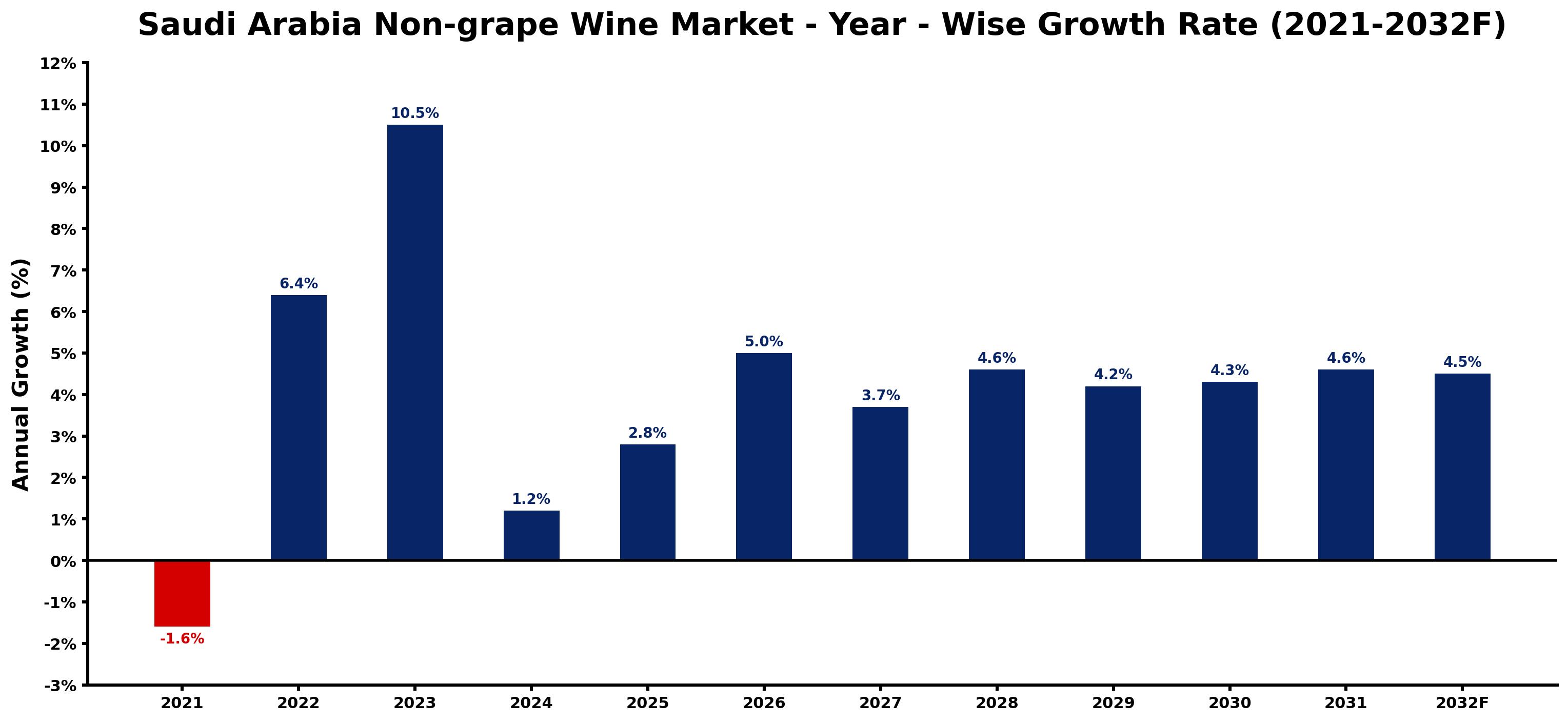
The table below presents the year wise growth rates along with the key drivers influencing the market
| Year | Growth Rate | Major Drivers |
| 2021 | -1.6% | Cultural resistance to nongrape wine offerings hindered consumer acceptance and overall market penetration. |
| 2022 | 6.4% | Local production facilities emerge, catering to unique regional taste preferences. |
| 2023 | 10.5% | Increased tourism boosts interest in non-grape wine options across restaurants. |
| 2024 | 1.2% | Cultural events promote awareness of non-alcoholic wine alternatives among locals. |
| 2025 | 2.8% | Collaborations with international wineries introduce diverse flavors and brands. |
| 2026 | 5.0% | Retail expansion sees boutique wine shops focusing on non-grape selections. |
| 2027 | 3.7% | Sustainability trends encourage organic and locally sourced wine offerings. |
| 2028 | 4.6% | Innovative marketing campaigns engage younger demographics through social media platforms. |
| 2029 | 4.2% | Investment in e-commerce simplifies access to non-grape wine for consumers. |
| 2030 | 4.3% | Regional festivals highlight non-grape wine, celebrating local artisans and producers. |
| 2031 | 4.6% | Changing social attitudes lead to broader acceptance of non-grape wine consumption. |
| 2032 | 4.5% | Distribution networks evolve, ensuring availability across all major cities in Saudi Arabia. |
Note - Market size estimations and growth projections presented in this report are based on 6Wresearch's advanced forecasting approach, validated with industry datasets as of June 2026.
Saudi Arabia Non-grape Wine Market Synopsis
The Saudi Arabia Non-grape Wine Market is projected to reach 5.0% and witness significant growth during the forecast period (2026-2032). This market is anticipated to grow at a compound annual growth rate (CAGR) of approximately 5.4%, driven by an increasing number of health-conscious consumers and rising disposable incomes across the nation. Moreover, heightened awareness around the health benefits associated with moderate alcohol consumption is expected to promote the non-grape wine segment, as consumers seek alternatives that offer lower sugar content and added nutrients.
Saudi Arabia Non-grape Wine Market Growth Drivers
Several factors are contributing to the robust growth of the Saudi Arabia non-grape wine market:
- The increasing health consciousness among consumers is driving a shift towards non-grape wine options, which are viewed as healthier alternatives with lower sugar levels and beneficial nutrients.
- Rising disposable incomes provide consumers with more spending power, enabling them to invest in premium products, including various non-grape wines that often align with health trends.
- The hospitality industry is expanding rapidly, with hotels and restaurants incorporating a diverse range of international beverages into their offerings, thereby increasing the demand for non-grape wines.
- Alcohol awareness campaigns across media platforms have built consumer interest in non-grape wine varieties, leading to increased sales in a traditionally conservative market.
- Evolving lifestyle habits among the population are encouraging a shift in beverage consumption patterns, with many consumers preferring better-quality products over traditional options.
Saudi Arabia Non-grape Wine Market Challenges and Restraints
Despite the favorable growth prospects, the Saudi Arabia non-grape wine market faces several challenges:
- Local producers often struggle to meet the rising demand, constrained by limited production capacities, which hampers their ability to fulfill large orders effectively.
- Regulatory restrictions within the kingdom can pose hurdles for producers in terms of distribution and marketing efforts, impacting overall market accessibility.
- Consumer preferences can be volatile, and the market must continuously adjust to meet changing tastes and demands that can arise from shifts in health trends.
- Competition from alternative beverages, including spirits and soft drinks, may divert consumer interest away from non-grape wines, posing a strategic challenge.
- Economic fluctuations and external factors, such as global market trends, can influence local prices and availability of non-grape wine products.
Saudi Arabia Non-grape Wine Market Impact of COVID-19
The COVID-19 pandemic has profoundly affected various sectors within the Saudi Arabian economy, including the non-grape wine market. The temporary shutdown of restaurants and pubs significantly hindered sales and distribution channels. Furthermore, travel restrictions imposed during the pandemic led to a decline in exports, adversely affecting revenue streams. However, as consumer awareness of the health benefits associated with non-grape wines grows, it is anticipated that domestic consumption will rebound, potentially compensating for previous losses incurred during the pandemic.
Saudi Arabia Non-grape Wine Market Government Investment and Initiatives
The Saudi government has been implementing various initiatives aimed at enhancing the hospitality and beverage sectors within the kingdom, which indirectly influences the non-grape wine market. Public spending on infrastructure, tourism, and hospitality projects is designed to elevate the overall consumer experience, fostering an environment where international beverage options, including non-grape wines, naturally fit into the expanding scene. The government's focus on diversifying the economy through Vision 2030 includes promoting local production capabilities, which can lead to greater support for non-grape wine producers. Additionally, any incentives or support schemes introduced for the hospitality sector can further stimulate demand for diverse beverage offerings in restaurants and hotels.
Saudi Arabia Non-grape Wine Market Latest Developments (May 2025 - June 2026)
Recent developments in the Saudi Arabia non-grape wine market from May 2025 to June 2026 have highlighted a growing trend towards healthier beverage options, reflecting changing consumer preferences. Government initiatives to support local production may lead to an increase in the variety of non-grape wines available to consumers. Additionally, establishments in the hospitality sector are progressively expanding their menus to include a wider range of international beverages, including non-grape options, thereby fostering market growth. Consumer engagement has also increased through targeted marketing campaigns that focus on the health benefits of non-grape wines, contributing to an overall rise in domestic consumption. This positive trajectory positions the market favorably for sustained growth in the coming years.
Saudi Arabia Non-grape Wine Market - Key Attractiveness of the Report
- 10 Years of Market Numbers
- Historical Data Starting from 2022 to 2025
- Base Year: 2025
- Forecast Data until 2032
- Key Performance Indicators Impacting the Market
- Major Upcoming Developments and Projects
Key Highlights of the Report:
- Saudi Arabia Non-grape Wine Market Outlook
- Market Size of Saudi Arabia Non-grape Wine Market, 2025
- Forecast of Saudi Arabia Non-grape Wine Market, 2032
- Historical Data and Forecast of Saudi Arabia Non-grape Wine Revenues & Volume for the Period 2022-2032F
- Saudi Arabia Non-grape Wine Market Trend Evolution
- Saudi Arabia Non-grape Wine Market Drivers and Challenges
- Saudi Arabia Non-grape Wine Price Trends
- Saudi Arabia Non-grape Wine Porter's Five Forces
- Saudi Arabia Non-grape Wine Industry Life Cycle
- Historical Data and Forecast of Saudi Arabia Non-grape Wine Market Revenues & Volume By Product Type for the Period 2022-2032F
- Historical Data and Forecast of Saudi Arabia Non-grape Wine Market Revenues & Volume By Fermented Fruit Wine for the Period 2022-2032F
- Historical Data and Forecast of Saudi Arabia Non-grape Wine Market Revenues & Volume By Distilled Fruit Wine for the Period 2022-2032F
- Historical Data and Forecast of Saudi Arabia Non-grape Wine Market Revenues & Volume By Preparation Fruit Wine for the Period 2022-2032F
- Historical Data and Forecast of Saudi Arabia Non-grape Wine Market Revenues & Volume By Sparkling Fruit Wine for the Period 2022-2032F
- Historical Data and Forecast of Saudi Arabia Non-grape Wine Market Revenues & Volume By Application for the Period 2022-2032F
- Historical Data and Forecast of Saudi Arabia Non-grape Wine Market Revenues & Volume By Household for the Period 2022-2032F
- Historical Data and Forecast of Saudi Arabia Non-grape Wine Market Revenues & Volume By Commercial for the Period 2022-2032F
- Saudi Arabia Non-grape Wine Import Export Trade Statistics
- Market Opportunity Assessment By Product Type
- Market Opportunity Assessment By Application
- Saudi Arabia Non-grape Wine Top Companies Market Share
- Saudi Arabia Non-grape Wine Competitive Benchmarking By Technical and Operational Parameters
- Saudi Arabia Non-grape Wine Company Profiles
- Saudi Arabia Non-grape Wine Key Strategic Recommendations






































