Indonesia Typewriter Market Size, Share & Growth Rate
The Indonesia Typewriter Market was estimated at USD 461 Million in 2025 and is projected to reach USD 612 Million by 2032, growing at a CAGR of 4.1% from 2026 to 2032. This modest growth can be attributed to a resurgence of interest among niche consumer segments, particularly among younger individuals seeking economical alternatives to digital devices. Furthermore, the cultural nostalgia associated with typewriters offers a unique market dynamic, allowing enthusiasts to explore vintage models while also integrating modern electric typewriters into their daily routines.
Indonesia Typewriter Market Year-wise Growth Rate and Key Drivers
This graph highlights how the Indonesia Typewriter Market has steadily grown over the years, supported by major growth factors.
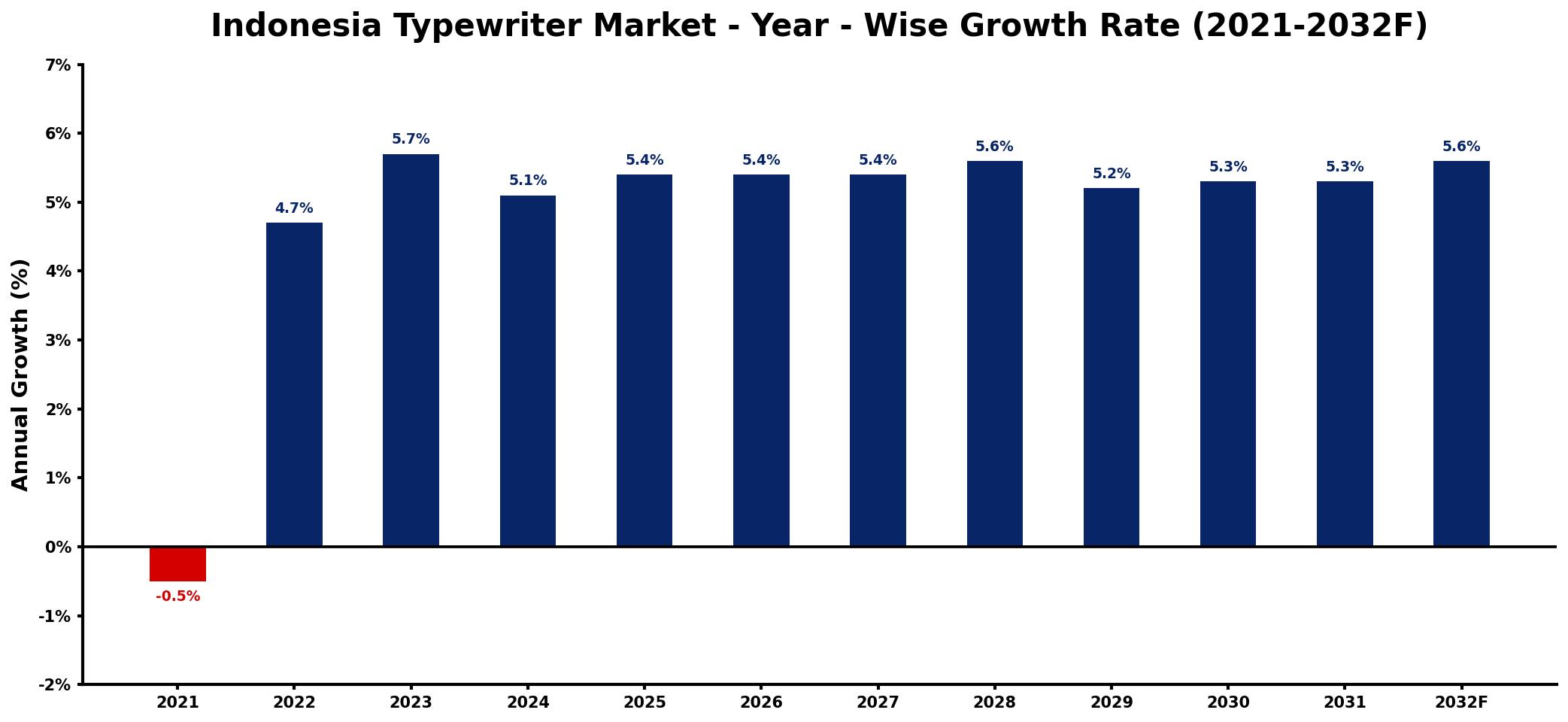
The table below presents the year‑wise growth rates along with the key drivers influencing the market
| Year | Growth Rate | Major Drivers |
| 2021 | -0.5% | Shift towards digital communication tools |
| 2022 | 4.7% | Growing interest in vintage aesthetics |
| 2023 | 5.7% | Increased demand for retro products |
| 2024 | 5.1% | Expansion of niche market segments |
| 2025 | 5.4% | Rise in artisanal craftsmanship appreciation |
| 2026 | 5.4% | Surge in creative writing communities |
| 2027 | 5.4% | Growth in educational institution supplies |
| 2028 | 5.6% | Increased popularity of DIY projects |
| 2029 | 5.2% | increased overall sector activity |
| 2030 | 5.3% | Investment in alternative writing tools |
| 2031 | 5.3% | improved processing technologies adoption |
| 2032 | 5.6% | Emergence of themed writing workshops |
Note: Market size estimations and growth projections presented in this report are based on 6Wresearch's proprietary forecasting methodology, utilizing the latest available industry data, government publications, and primary research inputs.
Indonesia Typewriter Market Synopsis
In Indonesia, the typewriter market reflects a fascinating interplay between tradition and modernity. Last year, approximately 49 thousand units were sold, with a noticeable uptick in interest due to the cost-effectiveness of electric typewriters, especially when compared to more expensive computing options. This trend is particularly pronounced among younger consumers, who are increasingly gravitating towards typewriting for its unique tactile experience.
Despite the overall decline in typewriter usage in favor of digital solutions, specific sectors continue to rely on these devices. Certain government and legal documents still favor typewriters for official documentation, while vintage enthusiasts celebrate the nostalgia associated with these machines, ensuring that the market retains a dedicated, albeit niche, customer base.
Indonesia Typewriter Market Key Takeaways
- The market is projected to grow at a CAGR of 4.1% from 2026 to 2032, reaching USD 612 Million by 2032.
- A noticeable rise in popularity of electric typewriters has emerged, especially among younger consumers.
- Niche markets focusing on official documentation and vintage typewriting communities remain relevant.
- Local brands are thriving by catering to small businesses and individual users seeking affordable typing solutions.
- While digital technology poses challenges, a unique blend of nostalgia and practicality drives typewriter demand.
Evaluation of Restraints in Indonesia Typewriter Market
The primary restraint on the Indonesia Typewriter Market is the overarching shift toward digital technology, which continues to dominate in terms of convenience and functionality. As younger generations grow up in a digital-first world, the appeal of traditional typewriters becomes more specialized. Companies must recalibrate their strategies to tap into the pockets of demand that still exist, focusing on marketing efforts that highlight the unique benefits of typewriting, particularly in educational and artistic contexts. Furthermore, logistical challenges in sourcing parts for manufacturing can hinder production capabilities, limiting the supply of typewriters to interested consumers.
Indonesia Typewriter Market Trends
Currently, the Indonesia Typewriter Market is experiencing a blend of vintage appreciation and modern utility. The rise of DIY culture and artisanal craftsmanship has also inspired a renewed interest in typewriters, with more individuals looking to incorporate them into creative projects. Additionally, online platforms and social media have facilitated communities of typewriter enthusiasts who share insights and creative uses for these machines, driving demand further.
Indonesia Typewriter Market Opportunities
There are genuine opportunities for investment in the Indonesia Typewriter Market, particularly in enhancing product lines that cater to specific interests, such as specialized electric models aimed at writers and educators. Marketing strategies focusing on the historical and cultural significance of typewriters can also open doors to educational institutions and cultural organizations. Furthermore, innovations in manufacturing processes that reduce costs while maintaining quality could lead to broader accessibility for smaller businesses and individual consumers.
Government Initiatives in the Indonesia Typewriter Market
While not a significant focus, government initiatives aimed at promoting small businesses and local craftsmanship can indirectly benefit the typewriter market. Public funding programs encouraging the preservation of traditional skills may enhance the visibility and appeal of typewriting as an art form, prompting increased interest from younger generations. Furthermore, policies that support local manufacturing could aid in the supply chain sustainability of typewriter production.
Future Insights of the Indonesia Typewriter Market
Looking ahead to the period between 2026 and 2032, the Indonesia Typewriter Market is likely to maintain its niche status, yet exhibit steady growth as interest in retro products continues to evolve. With increasing digital fatigue, typewriters may be seen as a refreshing alternative for individuals seeking a break from screens. This market will likely see sustained demand from vintage communities, educational applications, and small businesses that appreciate the unique advantages offered by typewriters.
Indonesia Typewriter Market Latest Developments (2025 - 2026)
Recent developments in the Indonesia Typewriter Market have seen an increase in workshops and community events dedicated to typewriting, fostering a sense of collective nostalgia among participants. Additionally, several local manufacturers have begun to invest in eco-friendly production methods, appealing to environmentally conscious consumers. The rise of e-commerce has also enabled easier access to both new and refurbished typewriters, bridging the gap for enthusiasts across the archipelago.
Indonesia Typewriter Market - Key Attractiveness of the Report
- 10 Years of Market Numbers
- Historical Data Starting from 2022 to 2025
- Base Year: 2025
- Forecast Data until 2032
- Key Performance Indicators Impacting the Market
- Major Upcoming Developments and Projects
Key Highlights of the Report:
- Indonesia Typewriter Market Outlook
- Market Size of Indonesia Typewriter Market, 2025
- Forecast of Indonesia Typewriter Market, 2032
- Historical Data and Forecast of Indonesia Typewriter Revenues & Volume for the Period 2022-2032F
- Indonesia Typewriter Market Trend Evolution
- Indonesia Typewriter Market Drivers and Challenges
- Indonesia Typewriter Price Trends
- Indonesia Typewriter Porter's Five Forces
- Indonesia Typewriter Industry Life Cycle
- Historical Data and Forecast of Indonesia Typewriter Market Revenues & Volume By Type for the Period 2022-2032F
- Historical Data and Forecast of Indonesia Typewriter Market Revenues & Volume By Standard Typewriter for the Period 2022-2032F
- Historical Data and Forecast of Indonesia Typewriter Market Revenues & Volume By Portable Typewriter for the Period 2022-2032F
- Historical Data and Forecast of Indonesia Typewriter Market Revenues & Volume By Noiseless Typewriter for the Period 2022-2032F
- Historical Data and Forecast of Indonesia Typewriter Market Revenues & Volume By Electric Typewriter for the Period 2022-2032F
- Historical Data and Forecast of Indonesia Typewriter Market Revenues & Volume By Variable Typewriter for the Period 2022-2032F
- Historical Data and Forecast of Indonesia Typewriter Market Revenues & Volume By Automatic Typewriter for the Period 2022-2032F
- Historical Data and Forecast of Indonesia Typewriter Market Revenues & Volume By Electronic Typewriter for the Period 2022-2032F
- Historical Data and Forecast of Indonesia Standard Typewriter Typewriter Market Revenues & Volume By Typewriter with Additional Attachments for the Period 2022-2032F
- Historical Data and Forecast of Indonesia Typewriter Market Revenues & Volume By Application for the Period 2022-2032F
- Historical Data and Forecast of Indonesia Typewriter Market Revenues & Volume By Commerical for the Period 2022-2032F
- Historical Data and Forecast of Indonesia Typewriter Market Revenues & Volume By Industrial for the Period 2022-2032F
- Historical Data and Forecast of Indonesia Typewriter Market Revenues & Volume By Others for the Period 2022-2032F
- Indonesia Typewriter Import Export Trade Statistics
- Market Opportunity Assessment By Type
- Market Opportunity Assessment By Application
- Indonesia Typewriter Top Companies Market Share
- Indonesia Typewriter Competitive Benchmarking By Technical and Operational Parameters
- Indonesia Typewriter Company Profiles
- Indonesia Typewriter Key Strategic Recommendations






































