Iran Cybersecurity Market Growth Rate
According to 6Wresearch internal databases and industry insights, the Iran Cybersecurity Market is projected to grow at a compound annual growth rate (CAGR) of 9.86% during the forecast period 2026–2032.
Iran Cybersecurity Market Year-wise Growth Rate and Key Drivers (2022–2032)
This graph illustrates the annual growth rates of the Iran Cybersecurity Market from 2022 to 2032, highlighting a steady upward trajectory and projected market expansion over the forecast period.
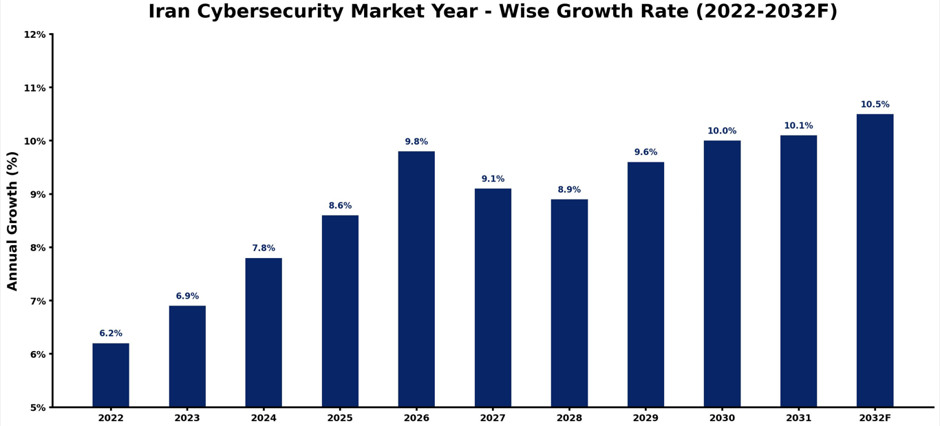
The following table summarizes the historical and forecasted growth rates of the Iran Cybersecurity Market, along with the rationale behind each year’s performance.
| Year | Estimated Growth (%) | Market Rationale |
| 2022 | 6.2% | Early-stage cybersecurity adoption across enterprises and government systems |
| 2023 | 6.9% | Rising cyber fraud incidents and increased awareness of digital threats |
| 2024 | 7.8% | Expansion of national IT infrastructure and secure communication systems |
| 2025 | 8.6% | Growing deployment of enterprise security tools in BFSI and telecom sectors |
| 2026 | 9.8% | Strong regulatory push for data protection and cyber resilience frameworks |
| 2027 | 9.1% | Increased adoption of cloud security and identity management systems |
| 2028 | 8.9% | Expansion of AI-based threat detection and SOC modernization |
| 2029 | 9.6% | Temporary stabilization due to cybersecurity standardization efforts |
| 2030 | 10% | Rise in critical infrastructure protection investments |
| 2031 | 10.1% | Growth in zero-trust security architecture adoption |
| 2032 | 10.5% | Mature cybersecurity ecosystem with integrated national defense systems |
Topics Covered in the Iran Cybersecurity Market Report
The Iran Cybersecurity Market report covers the market by security type, deployment, and end-user. The report provides a detailed analysis of evolving cyber threats, enterprise security adoption, government regulations, and digital infrastructure protection trends shaping market growth.
Iran Cybersecurity Market Highlights
| Report Name | Iran Cybersecurity Market |
| Forecast period | 2026–2032 |
| CAGR | 9.86% |
| Growing Sector | Government & Defense and BFSI Cyber Protection |
Iran Cybersecurity Market Synopsis
Iran Cybersecurity Market is witnessing steady expansion due to rapid digitalization across government, banking, and industrial sectors. The increasing number of cyberattacks, ransomware attacks, and data breaches are compelling organizations to adopt advanced cybersecurity solutions like network security, identity and access management, data security, and cloud security frameworks. Additionally, increasing investments in national cyber defense infrastructure, secure communication systems, and threat intelligence capabilities are further fueling the market growth. Also, awareness of cyber risks and regulatory attention are fueling wider adoption of cybersecurity in Iran.
Evaluation of Growth Drivers in Iran Cybersecurity Market (2026–2032)
Below are some major drivers and their influence on the market dynamics:
| Drivers | Primary Segment Affected | Why It Matters (Evidence) |
| Rising cyberattacks and ransomware incidents | BFSI & Government | Increases demand for advanced threat detection and prevention systems |
| Digital transformation across enterprises | IT & Telecom | Expands attack surface requiring stronger cybersecurity frameworks |
| Government cybersecurity regulations | Public Sector | Mandates compliance-driven security adoption |
| Cloud migration across industries | Enterprises | Drives demand for cloud security and identity management |
| Critical infrastructure digitization | Energy & Defense | Requires high-level infrastructure protection systems |
The Iran Cybersecurity Market is expected to grow at a CAGR of 9.86% during the forecast period (2026-2032). The market growth is driven by rising cyber threats, growing enterprise digitalization, and the increasing focus of the government on national cyber defense strategies. The rapid adoption of cloud computing, AI-based threat detection, and secure identity management solutions is further bolstering the cybersecurity deployment across industries.
Evaluation of Restraints in Iran Cybersecurity Market
Below are some major restraints and their influence on the market dynamics:
| Restraints | Primary Segment Affected | What This Means (Evidence) |
| Limited cybersecurity expertise | Enterprises | Shortage of skilled professionals slows implementation |
| High deployment and maintenance costs | SMEs | Restricts adoption of advanced security systems |
| Legacy IT infrastructure | Government & Enterprises | Difficult integration with modern cybersecurity tools |
| Regulatory complexity | IT & BFSI | Compliance challenges across evolving cyber laws |
| Limited access to global cybersecurity tools | Enterprises | Reduces availability of advanced solutions |
Iran Cybersecurity Market Challenges
The Iran Cybersecurity Industry faces challenges due to shortage of skilled cybersecurity professionals and limited access to advanced global security technologies. Many organizations continue relying on legacy IT infrastructure, which hinders deployment of modern security frameworks. The cost of implementation is high, and technology constraints due to the sanctions and changing regulatory requirements further hinder the adoption among SMEs and mid-sized enterprises.
Iran Cybersecurity Market Trends
Key trends influencing the growth of the Iran Cybersecurity Market include:
- AI-Driven Threat Detection: Organizations are increasingly using AI and machine learning to detect cyber threats in real time and improve response speed and accuracy.
- Zero Trust Architecture Adoption: Enterprises are shifting to zero trust models that continuously verify users, devices, and access, strengthening overall security posture.
- Cloud & Endpoint Security Growth: Rising digitalization is driving demand for cloud security, endpoint protection, and encrypted communication to secure distributed IT environments.
Investment Opportunities in the Iran Cybersecurity Market
Some of the profitable investments in the Iran Cybersecurity industry include the following:
- Advanced Threat Intelligence & SOC Platforms: Developing Security Operations Center (SOC) and threat intelligence systems offers a strong opportunity to enable real-time monitoring, detection and rapid response to cyber threats across enterprises and government networks.
- Identity & Access Management (IAM): Growing demand for secure authentication, multi-factor verification, and privileged access management solutions to strengthen control over sensitive systems and prevent unauthorized access.
- Cloud Security & Encryption Services: Rising cloud adoption is driving investment potential in cloud security frameworks, encryption technologies, and secure migration services to protect data and ensure regulatory compliance.
- Critical Infrastructure Cybersecurity: Increasing need to secure energy, telecom, and government systems is creating opportunities in industrial cybersecurity, SCADA protection, and national-level cyber defense solutions.
Leading Players in Iran Cybersecurity Market
Below is a list of key players operating in the Iran Cybersecurity Market:
1. ArvanCloud Security Division
| Company Name | ArvanCloud Security Division |
|---|---|
| Established Year | 2014 |
| Headquarters | Tehran, Iran |
| Official Website | Click Here |
ArvanCloud Security Division offers cloud security infrastructure, DDoS protection, CDN security, and secure content delivery solutions for enterprises transitioning to cloud environments.
2. Fanap Infrastructure Security
| Company Name | Fanap Infrastructure Security |
|---|---|
| Established Year | 2003 |
| Headquarters | Tehran, Iran |
| Official Website | - |
Fanap Infrastructure Security delivers integrated cybersecurity systems for banking networks, payment platforms, and national digital infrastructure projects with a focus on secure financial ecosystems.
3. Afranet
| Company Name | Afranet |
|---|---|
| Established Year | 1997 |
| Headquarters | Tehran, Iran |
| Official Website | Click Here |
Afranet is a public joint-stock internet and data transmission company providing secure hosting, enterprise connectivity, and foundational network security services.
4. Pars Online
| Company Name | Pars Online |
|---|---|
| Established Year | 1999 |
| Headquarters | Tehran, Iran |
| Official Website | - |
Pars Online is a leading internet service provider offering secure broadband services, corporate network protection, and data communication security solutions.
Government Initiatives being implemented in the Iran Cybersecurity Market
The government of Iran is strengthening its cybersecurity framework by investing in digital defense infrastructure, secure communication systems, and critical infrastructure protection. New policies focus on enhancing data privacy, cyber resilience, and threat intelligence sharing across government agencies. Efforts are also being made to enhance domestic cybersecurity capabilities and reduce reliance on foreign technologies.
One key initiative is the development of the National Information Network (NIN), which aims to establish a domestically controlled digital infrastructure while improving protection for national online services and data. These initiatives are driving stronger national cyber defense readiness and supporting the Iran cybersecurity market growth.
Future Insights of the Iran Cybersecurity Market
The Iran Cybersecurity Market is expected to witness strong growth through 2032, driven by rising cyber threats, growing cloud adoption, and increasing digital government initiatives, supported by a population of around 89 million with internet penetration exceeding 70%.
The deployment of AI-based security solutions, zero-trust architecture, and automated threat detection capabilities will significantly enhance enterprise defense capabilities, as cyberattack volumes continue to rise globally and regionally each year. In addition, rising investments in national cyber defense infrastructure and secure communication systems will enhance market resilience and promote greater cybersecurity adoption across the government, BFSI, and enterprise sectors.
Market Segmentation Analysis
This report presents a detailed analysis of the market segments along with their leading categories.
By Security Type – Network Security Dominates, Cloud Security Expands Rapidly
According to Bhawna Singh, Assistant Manager, 6Wresearch, Network Security secured a dominant 28.40% share of the Iran cybersecurity market in 2025. The high reliance on secure enterprise networks and the need to protect critical national digital infrastructure against increasingly sophisticated cyber threats are the driving forces behind this leading position. However, cloud security is expected to grow at a strong CAGR of 12.90% in the forecast period of 2026–2032, driven by rapid digital transformation of enterprises and escalating demand for scalable and cost-effective security frameworks to support hybrid and distributed IT environments.
By Deployment – On-Premise Leads, Cloud Deployment Grows Strongly
On-Premise deployment secured a dominant 52.10% share of the market in 2025, driven by strong adoption among government institutions, defense organizations, and large enterprises prioritizing full control over sensitive data and critical infrastructure within internal IT environments. On the other hand, the Cloud Deployment is projected to witness a CAGR of 11.80% between 2026-2032 owing to rapid enterprise cloud adoption and increasing inclination towards cost-efficient cybersecurity solutions across industries.
By End-User – Government & Defense Dominates, BFSI Grows Steadily
Government & Defense segment secured a dominant 31.20% share of the Iran Cybersecurity market value in 2025, fueled by escalating national security concerns, increased investment in safeguarding critical infrastructure, and the increasing need to protect government networks against advanced cyber threats and state-sponsored attacks. Simultaneously, the BFSI segment is projected to expand at a steady CAGR of 10.90% during 2026-2032 owing to the rapid adoption of digital banking and the rising implementation of sophisticated cybersecurity frameworks to protect online transactions and customer data ecosystems.
Note: Market size estimations and growth projections presented in this report are based on 6Wresearch's proprietary forecasting methodology, utilizing the latest available industry data, government publications, and primary research inputs.
Key Attractiveness of the Report
- 10 Years of Market Numbers
- Historical Data Starting from 2022 to 2025
- Base Year: 2025
- Forecast Data until 2032
- Key Performance Indicators Impacting the Market
- Major Upcoming Developments and Projects
Key Highlights of the Report:
- Iran Cybersecurity Market Outlook
- Market Size of Iran Cybersecurity Market, 2025
- Forecast of Iran Cybersecurity Market, 2032
- Historical Data and Forecast of Iran Cybersecurity Revenues & Volume for the Period 2022-2032
- Iran Cybersecurity Market Trend Evolution
- Iran Cybersecurity Market Drivers and Challenges
- Iran Cybersecurity Price Trends
- Iran Cybersecurity Porter's Five Forces
- Iran Cybersecurity Industry Life Cycle
- Historical Data and Forecast of Iran Cybersecurity Market Revenues & Volume By Security Type for the Period 2022-2032
- Historical Data and Forecast of Iran Cybersecurity Market Revenues & Volume By Cloud Security for the Period 2022-2032
- Historical Data and Forecast of Iran Cybersecurity Market Revenues & Volume By Data Security for the Period 2022-2032
- Historical Data and Forecast of Iran Cybersecurity Market Revenues & Volume By Identity Access Management for the Period 2022-2032
- Historical Data and Forecast of Iran Cybersecurity Market Revenues & Volume By Network Security for the Period 2022-2032
- Historical Data and Forecast of Iran Cybersecurity Market Revenues & Volume By Consumer Security for the Period 2022-2032
- Historical Data and Forecast of Iran Cybersecurity Market Revenues & Volume By Infrastructure Protection for the Period 2022-2032
- Historical Data and Forecast of Iran Cybersecurity Market Revenues & Volume By Others for the Period 2022-2032
- Historical Data and Forecast of Iran Cybersecurity Market Revenues & Volume By Deployment for the Period 2022-2032
- Historical Data and Forecast of Iran Cybersecurity Market Revenues & Volume By Cloud for the Period 2022-2032
- Historical Data and Forecast of Iran Cybersecurity Market Revenues & Volume By On-Premise for the Period 2022-2032
- Historical Data and Forecast of Iran Cybersecurity Market Revenues & Volume By End-User for the Period 2022-2032
- Historical Data and Forecast of Iran Cybersecurity Market Revenues & Volume By BFSI for the Period 2022-2032
- Historical Data and Forecast of Iran Cybersecurity Market Revenues & Volume By Healthcare for the Period 2022-2032
- Historical Data and Forecast of Iran Cybersecurity Market Revenues & Volume By Manufacturing for the Period 2022-2032
- Historical Data and Forecast of Iran Cybersecurity Market Revenues & Volume By Government and Defense for the Period 2022-2032
- Historical Data and Forecast of Iran Cybersecurity Market Revenues & Volume By IT and Telecommunication for the Period 2022-2032
- Historical Data and Forecast of Iran Cybersecurity Market Revenues & Volume By Others for the Period 2022-2032
- Iran Cybersecurity Import Export Trade Statistics
- Market Opportunity Assessment By Security Type
- Market Opportunity Assessment By Deployment
- Market Opportunity Assessment By End-User
- Iran Cybersecurity Top Companies Market Share
- Iran Cybersecurity Competitive Benchmarking By Technical and Operational Parameters
- Iran Cybersecurity Company Profiles
- Iran Cybersecurity Key Strategic Recommendations
Market Covered
The report offers an extensive study of the following market segments:
By Security Type
- Cloud Security
- Data Security
- Identity Access Management
- Network Security
- Consumer Security
- Infrastructure Protection
- Others
By Deployment
- Cloud
- On-Premise
By End User
- BFSI
- Healthcare
- Manufacturing
- Government & Defense
- IT & Telecommunication
- Others






































